


Overview
Levels of Diversity and India's Position
Genetic, species, ecosystem and functional diversity, and why India ranks among the world's mega-diverse nations.
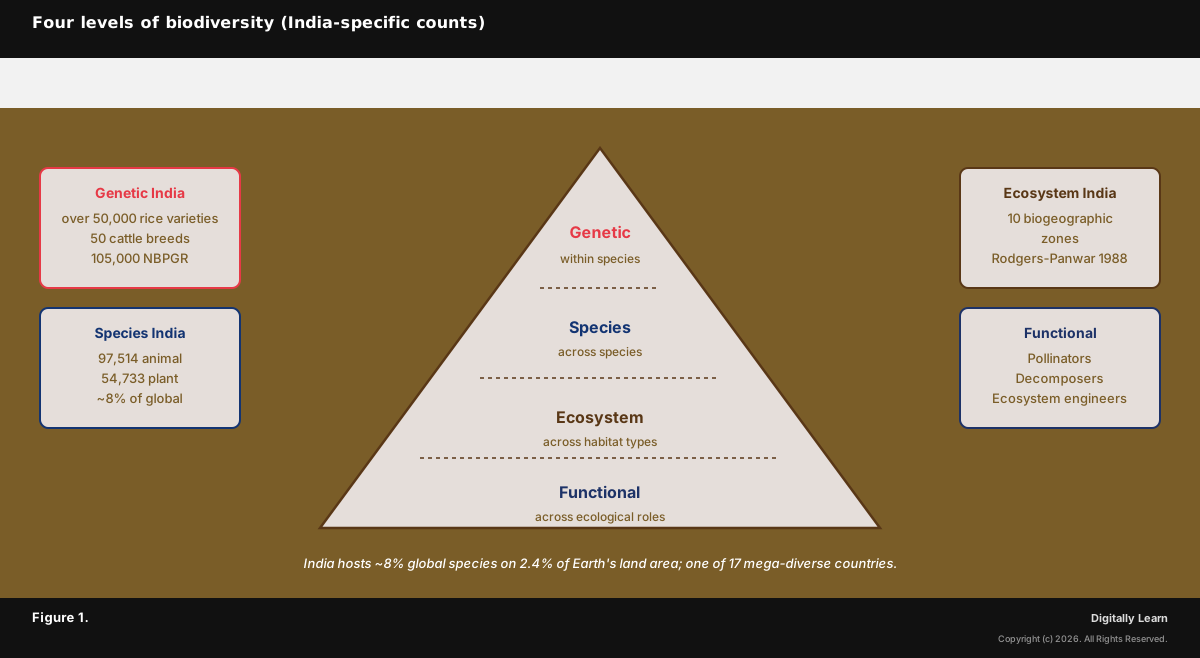
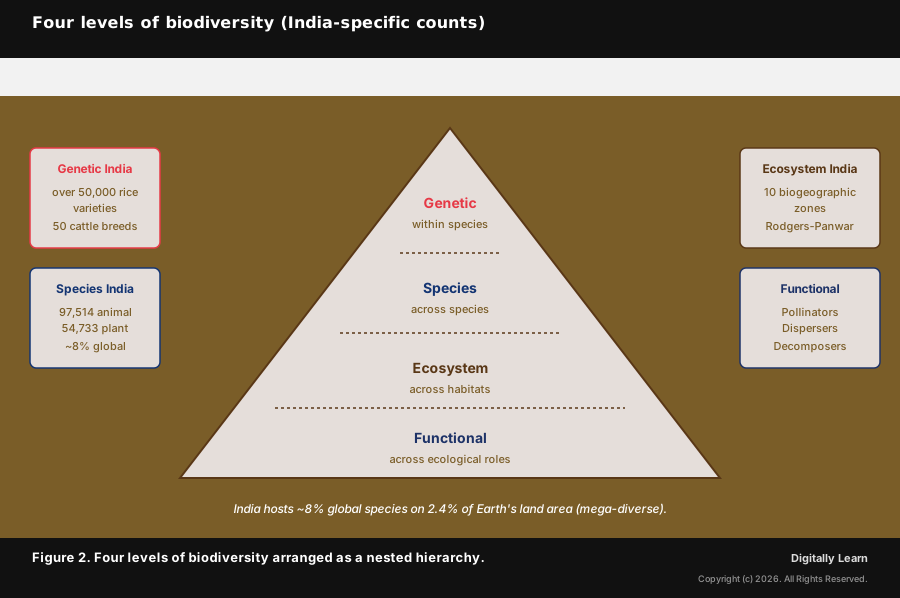
Biodiversity is the variety of life on Earth at all levels of biological organisation. The Convention on Biological Diversity (CBD), adopted at the Rio Earth Summit in 1992, defines biodiversity as variability among living organisms from all sources including terrestrial, marine, and other aquatic ecosystems and the ecological complexes of which they are part. The concept spans four interlocked levels: genetic diversity (variation within a species), species diversity (variation across species), ecosystem diversity (variation across habitat types), and functional diversity (variation in ecological roles). India is one of the 17 mega-diverse countries recognised by Conservation International and hosts approximately 8 per cent of global species on 2.4 per cent of the Earth's land area.
Background and Historical Context
Biodiversity underwrites every ecosystem service that the Indian economy and society depend on: agricultural productivity, water security, pollination, climate regulation, and the cultural-spiritual fabric of tribal and rural communities. Approximately 275 million Indians directly depend on forest biodiversity for fuelwood, fodder, and minor forest produce; another 600 million rely indirectly through ecosystem services. UPSC Prelims questions on biodiversity foundations have appeared in 2008, 2010, 2014, 2017, 2019, 2021, 2022, 2023, and 2025. UPSC GS-III Mains repeatedly anchors on biodiversity conservation policy and the Biological Diversity Act 2002 framework.
What is the significance of mastering biodiversity fundamentals? The four-level framework explains why conservation cannot focus on charismatic megafauna alone. Each level requires its own protection mechanism: in-situ conservation through Protected Areas preserves ecosystem diversity; ex-situ conservation through gene banks preserves genetic diversity; community institutions sustain functional diversity through traditional knowledge stewardship.
The Biological Diversity Act 2002 operationalises the CBD framework in India through a three-tier institutional structure: the National Biodiversity Authority (NBA) at the central level, State Biodiversity Boards (SBB) at state level, and Biodiversity Management Committees (BMC) at panchayat or municipality level. The Nagoya Protocol on access and benefit-sharing, ratified by India in 2014, gives BMCs the statutory mandate to determine access conditions and collect benefit-sharing fees on biological resources. The Kunming-Montreal Global Biodiversity Framework adopted at CBD COP-15 in December 2022 sets the 30-by-30 target (protecting 30 per cent of land and sea by 2030) that frames India's conservation policy through this decade.
Introduction: The Convention on Biological Diversity Framework
CBD 1992 definition and the four-level framework
The Convention on Biological Diversity (CBD), adopted at the Rio Earth Summit in June 1992 and ratified by 196 parties (including India in 1994), is the principal international legal instrument governing biodiversity. It defines biodiversity as variability among living organisms from all sources, including terrestrial, marine, and other aquatic ecosystems.
The definition encompasses three explicit dimensions (genetic, species, ecosystem) and one implicit dimension (functional) that has gained recognition since the 1990s.
The Convention pursues three objectives:
- (i) Conservation of biological diversity.
- (ii) Sustainable use of its components.
- (iii) Fair and equitable sharing of benefits arising from genetic resources.
India operationalises these objectives through the Biological Diversity Act 2002 and the National Biodiversity Action Plan (NBAP) updated in 2014 and currently under revision to align with the 2022 Kunming-Montreal Global Biodiversity Framework
Four Levels of Biodiversity: Genetic, Species, Ecosystem, Functional
Genetic diversity: variation within a species
Genetic diversity is the variation in genes within a single species. It is measured by allele-frequency variation, by heterozygosity, and by the number of distinct cultivars or breeds in domesticated species. It determines a species' capacity to adapt; low genetic diversity raises extinction risk under climate stress or disease.
Species diversity: variation across species
Species diversity is the variation across species in a defined area. It has two measurable dimensions: species richness (the count of distinct species) and species evenness (the relative abundance distribution across species). A site with 100 species of which 99 are rare and 1 is dominant has high richness but low evenness; a site with 20 species in roughly equal abundance has lower richness but higher evenness.
Ecosystem diversity: variation across habitat types
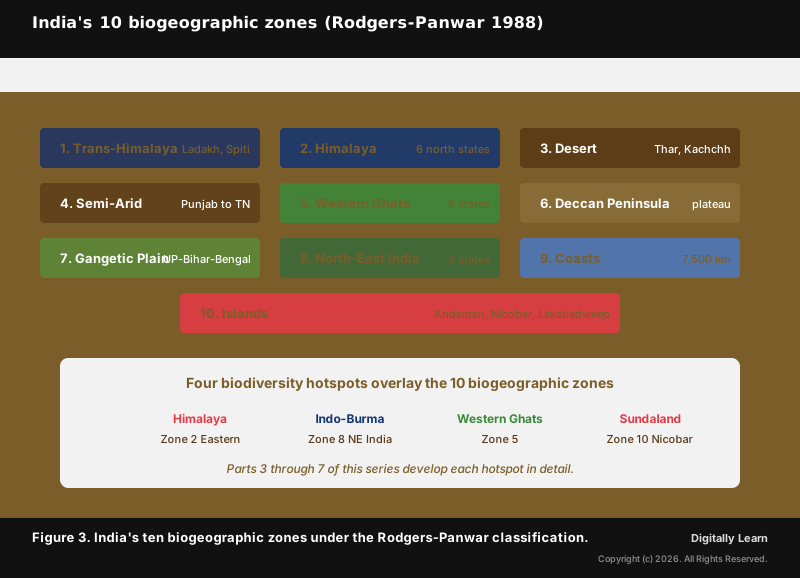
Ecosystem diversity is the variation across habitat types and biological communities. India's ecosystem diversity is exceptional because the country spans tropical to alpine climates, sea-level to high-Himalayan elevations, and arid to hyper-humid rainfall regimes. The Wildlife Institute of India recognises 10 biogeographic zones following the Rodgers-Panwar (1988) classification: Trans-Himalaya, Himalaya, Desert, Semi-Arid, Western Ghats, Deccan Peninsula, Gangetic Plain, North-East India, Coasts, and Islands.
- Trans-Himalaya zone: Ladakh and Spiti; cold-desert ecosystems; snow leopard habitat.
- Himalayan zone: 6 North-Indian states; alpine to sub-tropical forest gradient.
- Desert zone: Thar and Kachchh; xeric ecosystems; great Indian bustard habitat.
- Western Ghats zone: 6 Peninsular states; UNESCO World Heritage 2012.
- North-East India zone: 8 States; Indo-Burma biodiversity hotspot.
- Coasts and Islands zone: Mangroves, coral reefs, Andaman-Nicobar endemics.
Functional diversity: variation in ecological roles
Functional diversity is the variation in ecological roles or functional traits across organisms in a community. Two communities may share identical species richness yet differ sharply if one holds multiple pollinators, decomposers and predators while the other has redundant roles. It is the dimension most directly linked to ecosystem-service delivery and resilience.
Biogeographical Concepts: Endemic, Keystone, Flagship, Indicator Species
Endemic, keystone, flagship, indicator species: definitions and Indian examples
An endemic species is one found nowhere else outside its native geographical region. Endemism is the strongest signal of biogeographic distinctness; losing an endemic species means global extinction, not local extirpation. The Western Ghats alone hosts roughly 325 endemic vertebrate species, with further endemic concentrations in the Eastern Himalayas and the Andaman and Nicobar Islands.
A keystone species is one whose ecological role disproportionately exceeds its abundance; removing a keystone species triggers cascade effects across the ecosystem. The tiger (Panthera tigris) is the canonical Indian keystone species: as apex predator it regulates herbivore populations across protected areas; loss of tigers leads to herbivore irruption, vegetation collapse, and downstream cascade. The fig (Ficus) genus is a keystone plant: it fruits asynchronously through the dry season and sustains over 1,200 frugivore species during food-scarce periods.
- Endemic species: Restricted to native geographical region; loss equals global extinction. Western Ghats hosts ~325 endemic vertebrates.
- Keystone species: Ecological role exceeds abundance; removal triggers cascade. Tiger (apex predator), Fig (frugivore-sustaining plant).
- Flagship species: Anchors conservation campaigns through charisma. Bengal tiger, Asian elephant, Indian rhinoceros.
- Indicator species: Presence or trend signals environmental conditions. Amphibians (water quality), lichens (air quality).
- Umbrella species: Protection extends to many co-occurring species. Tiger protection in tiger reserves preserves entire ecosystem.
- Ecotone: Transition zone between two ecological communities; often higher species richness than either adjacent zone (edge effect).
Species Richness and Species Evenness: The Two Components of Diversity
Why both components matter: the diversity-index decomposition
Species richness counts the number of distinct species in a defined area; species evenness measures the relative abundance distribution across those species. A community with 100 species of which 99 are individually rare and 1 dominates 90 per cent of the abundance has high richness but low evenness; functionally it behaves like a low-diversity community because the dominant species drives ecological outcomes.
The Shannon-Wiener diversity index (H' = -sum(p_i * ln(p_i))) combines richness and evenness into a single number; the Simpson's index emphasises evenness more strongly. Both indices are used in operational biodiversity assessments under the Forest Survey of India's vegetation surveys and the Wildlife Institute of India's population monitoring.
Indian Biodiversity Variation: Mega-Diverse Country with Four Hotspots
India's mega-diverse status and the four biodiversity hotspots
India is one of 17 mega-diverse countries identified by Conservation International. The classification requires a country to host at least 5,000 endemic plant species and marine ecosystems within its borders. India qualifies on both counts, with substantial marine biodiversity along its long coastline and the Andaman and Nicobar Islands.
India hosts four of the world's 36 biodiversity hotspots (Conservation International, current count revised from the original 25 of Norman Myers 1988). The four Indian hotspots are the Himalaya (Eastern Himalaya as the global-designation portion), the Indo-Burma (north-east India), the Western Ghats and Sri Lanka, and the Sundaland (Nicobar Islands as the Indian portion). Parts 3 through 7 of this Biodiversity series develop each hotspot in detail.
| Country | Biogeographic feature | Endemic plant species |
|---|---|---|
| Brazil | Amazon basin and Cerrado and Atlantic Forest | Approximately 16,000 |
| Colombia | Andes and Amazon and Pacific coast | Approximately 10,000 |
| China | Hengduan and Yunnan and Tibetan Plateau | Approximately 12,000 |
| Indonesia | Sundaland and Wallacea and Papua | Approximately 15,500 |
Biological Diversity Act 2002 and the Three-Tier Institutional Framework
Three-tier structure: NBA and SBB and BMC
The Biological Diversity Act 2002 operationalises the Convention on Biological Diversity in India through a three-tier statutory architecture. The National Biodiversity Authority (NBA), constituted at Chennai in 2003, regulates access to biological resources by foreign nationals and Indian commercial users; it administers benefit-sharing under the Nagoya Protocol. The State Biodiversity Boards (SBB) at state level regulate access by Indian individuals and bodies.
The Biodiversity Management Committees (BMC) at panchayat and municipality level maintain the local-level People's Biodiversity Register and have the statutory mandate to collect benefit-sharing fees.
Prelims 2023 tested the BMCs' Nagoya Protocol role and their access-and-benefit-sharing functions. Both statements in that question are correct: BMCs are statutorily key to Nagoya Protocol implementation in India, AND BMCs have the power to determine access and benefit-sharing including fee collection on biological-resource access within their jurisdiction. The Biological Diversity (Amendment) Act 2023 exempts AYUSH practitioners and registered Indian users from prior NBA approval; the amendment is constitutionally challenged on grounds of weakening community-level benefit-sharing.
- NBA at Chennai: Constituted 2003; regulates foreign and Indian commercial access; administers Nagoya Protocol implementation.
- State Biodiversity Boards (SBB): 29 SBBs across states; regulate Indian individual and body access to biological resources.
- BMCs at panchayat level: Over 270,000 BMCs constituted nationally; maintain People’s Biodiversity Register; collect benefit-sharing fees.
- Nagoya Protocol: Ratified by India 2014; mandates fair and equitable benefit-sharing on use of biological resources and associated traditional knowledge.
- Biological Diversity (Amendment) Act 2023: Exempts AYUSH and registered Indian users from prior NBA approval; constitutionally challenged.
Previous Year UPSC-CSE Questions
Previous Year UPSC-CSE Questions By the end you will be able to draft model answers for the following UPSC questions. Each question carries a collapsible framework showing how to approach it in the exam.
- UPSC Prelims 2023 General StudiesConsider the following statements:
- In India, the Biodiversity Management Committees are key to the realization of the objectives of the Nagoya Protocol.
- The Biodiversity Management Committees have important functions in determining access and benefit sharing, including the power to levy collection fees on the access of biological resources within its jurisdiction.
Which of the statements given above is/are correct?
How to approach this Prelims question
Approach: Two-statement evaluation testing knowledge of the Biological Diversity Act 2002 institutional architecture and the Nagoya Protocol implementation framework. Each statement is independent; each must be evaluated against the statutory text.
Trap to watch: Aspirants may incorrectly assume BMCs are advisory-only because of their grassroots level. The trap is that the 2002 Act and 2014 ABS Regulations explicitly empower BMCs to determine access and collect fees; this is a statutory power, not advisory.
Key facts to recall:
- Biological Diversity Act 2002: three-tier structure NBA and SBB and BMC.
- Nagoya Protocol: ratified by India 2014; access-and-benefit-sharing mandate.
- BMCs under Section 41: prepare People's Biodiversity Register and determine access and collect fees.
- NBA at Chennai: regulates foreign and Indian commercial access.
Answer signal: Both 1 and 2
- UPSC Prelims 2021 General StudiesConsider the following statements:
- Moringa (drumstick tree) is a leguminous evergreen tree.
- Tamarind tree is endemic to South Asia.
- In India, most of the tamarind is collected as minor forest produce.
- India exports tamarind and seeds of moringa.
- Seeds of moringa and tamarind can be used in the production of biofuels.
Which of the statements given above are correct?
How to approach this Prelims question
Approach: Five-statement evaluation testing botanical family, native range, economic-use, export status, and biofuel potential for two minor-forest-produce species. Each statement is independent; species-specific botanical knowledge is required.
Trap to watch: Aspirants may assume Tamarind is South-Asian endemic because of its strong cultural association with Indian cuisine. The trap is that Tamarind is native to tropical Africa and was introduced to South Asia in prehistoric times; centuries of cultivation create the false impression of endemism.
Key facts to recall:
- Moringa oleifera: family Moringaceae, deciduous, native to India and Africa; not leguminous.
- Tamarindus indica: native to tropical Africa, introduced to South Asia; not endemic.
- Minor forest produce: tamarind collected from deciduous forests of central and southern India.
Answer signal: 3, 4 and 5
- UPSC Mains 2018 GS-IIIHow does biodiversity vary in India? How is the Biological Diversity Act, 2002 helpful in conservation of flora and fauna?
How to structure the answer in the exam
Introduction: Open by stating that India is one of 17 mega-diverse countries with approximately 8 per cent of global species on 2.4 per cent of Earth's land area. Biodiversity varies at four levels and across ten biogeographic zones, anchored by four global hotspots. The Biological Diversity Act 2002 operationalises the CBD framework in India.
Body (sub-themes to develop):
- Variation by level: genetic (over 50,000 rice varieties, 50 cattle breeds, 105,000 NBPGR plant accessions); species (97,514 animal and 54,733 plant species documented); ecosystem (10 biogeographic zones per Rodgers-Panwar 1988); functional (pollinator, decomposer, seed-disperser, soil-engineer roles).
- Four biodiversity hotspots: Himalaya, Indo-Burma, Western Ghats and Sri Lanka, Sundaland (Nicobar component). Each hotspot meets Conservation International criteria of at least 1,500 endemic plant species and at least 70 per cent habitat loss.
- Biological Diversity Act 2002 mechanism: three-tier architecture (NBA Chennai and State Biodiversity Boards and over 270,000 BMCs at panchayat level). Regulates access to biological resources by foreign and Indian commercial users; mandates fair and equitable benefit-sharing.
Conclusion: Conclude by noting that Indian biodiversity's exceptional variation (mega-diverse country status, four hotspots, ten biogeographic zones) requires the comprehensive multi-level governance that the Biological Diversity Act 2002 provides. The three-tier architecture combined with the People's Biodiversity Register and the Nagoya Protocol's access-and-benefit-sharing framework forms the institutional backbone. The 2023 Amendment debate and the Kunming-Montreal alignment are the contemporary policy frontier.
Sources and Further Reading
- NCERT Class 11 India: Physical Environment, Chapter 5 – Natural Vegetation
- Convention on Biological Diversity – Official text (Wikipedia)
- National Biodiversity Authority of India (Wikipedia)
- Ministry of Environment, Forest and Climate Change – Biodiversity (Wikipedia)
- Wikipedia – Biodiversity
- Wikipedia – Megadiverse countries
- Wikipedia – Biological Diversity Act 2002
- Conservation International – Biodiversity Hotspots (Wikipedia)
- CBD COP-15 Kunming-Montreal Global Biodiversity Framework (Wikipedia)
- Nagoya Protocol on Access and Benefit-sharing (Wikipedia)
- Wikipedia – Convention on Biological Diversity
Disclaimer
This article is prepared by the Digitally Learn editorial team for UPSC preparation. Definitions, institutional facts, and figures draw on the Convention on Biological Diversity, the Biological Diversity Act 2002, NCERT, and authoritative ecological sources. Aspirants should cross-check evolving policy details, such as amendment and framework status, against the latest official notifications.