


Overview
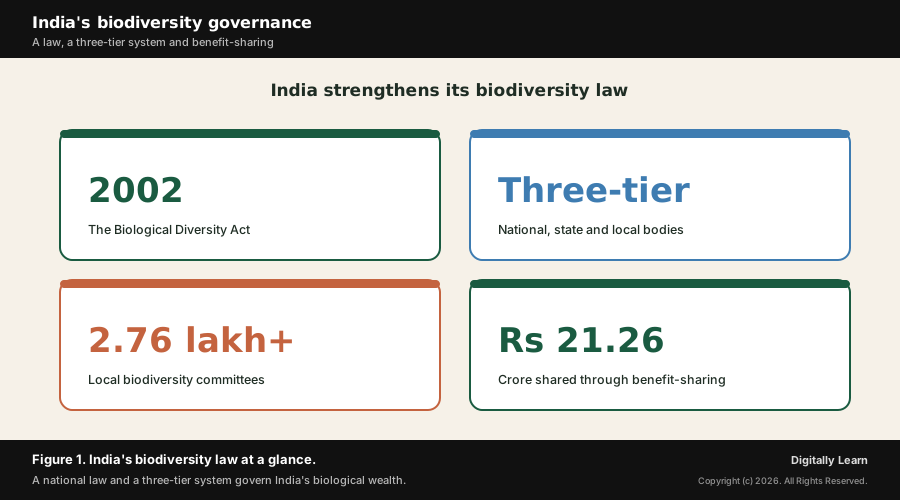
India has been strengthening the Biological Diversity Act, 2002, its main law for conserving the country's biological wealth and ensuring that the benefits of using it are shared fairly. The law was amended in 2023 and is implemented through a three-tier system of the National Biodiversity Authority, State Biodiversity Boards and local Biodiversity Management Committees. It gives effect to India's commitments under the global Convention on Biological Diversity and the Nagoya Protocol on access and benefit sharing.
India Strengthens Its Biodiversity Law
A law, a three-tier system and benefit-sharing
India has been strengthening the working of the Biological Diversity Act, 2002, the law that governs access to the country's plants, animals, microbes and the traditional knowledge linked to them. The aim is conservation, sustainable use and the fair sharing of benefits.
The law was amended in 2023, and new rules and regulations have since been put in place to make access and benefit-sharing work more smoothly. Through these, users who profit from India's biological resources are expected to share a part of the gains.
This sharing is beginning to show results. The National Biodiversity Authority, the apex body under the law, has channelled benefit-sharing payments to communities, a sign that the system is moving from rules on paper to real transfers.
Why a Biodiversity Law Matters
Guarding a megadiverse country's wealth
Why it matters is that India is one of the world's megadiverse countries, holding a large share of the planet's species and a deep store of traditional knowledge about plants and medicine. This wealth is valuable and can be exploited.
Without rules, outsiders could use India's biological resources or knowledge for profit while giving nothing back, a problem often called biopiracy. A strong law ensures that access is regulated and that local communities share in the benefits.
What the Strengthened Framework Signifies
From regulation to real benefit-sharing
What is the significance of this framework lies in turning a regulatory idea into practice. The law has long required access to be approved and benefits to be shared, but doing so at scale, fairly and without choking research, is the hard part.
Recent reforms aimed to ease the process for legitimate users while keeping safeguards, and the flow of benefit-sharing payments to communities shows the system working. The challenge is to balance conservation, community rights and the needs of research and industry.
The Biological Diversity Act and Its Three-Tier Structure
India's biodiversity law at a glance
The table sets out the key features of the law and what each one means. Together they show a layered system, reaching from a national authority down to committees in villages and towns.
| Feature | Detail |
|---|---|
| The law | The Biological Diversity Act, 2002, amended in 2023 |
| Aim | Conservation, sustainable use and the fair sharing of benefits |
| National body | The National Biodiversity Authority |
| State bodies | State Biodiversity Boards |
| Local bodies | Biodiversity Management Committees, which keep local registers |
| Global basis | The Convention on Biological Diversity and the Nagoya Protocol |
Read together, the rows show how the law connects a global commitment to action at the local level, where biodiversity is actually used and conserved.
The National, State and Local Bodies
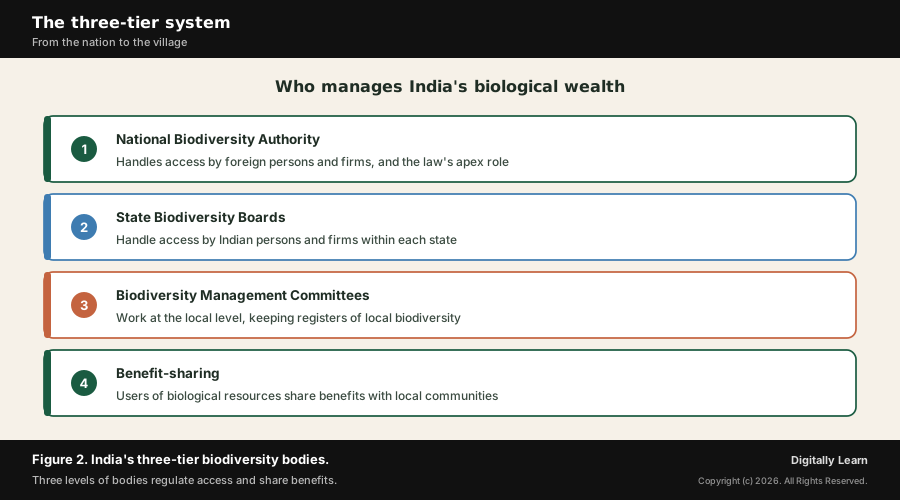
The law works through three levels. The National Biodiversity Authority handles access sought by foreign persons and companies and oversees the system; the State Biodiversity Boards handle access by Indian persons and firms within each state.
At the base are the Biodiversity Management Committees, set up by local bodies in villages, towns and cities. They prepare People's Biodiversity Registers, which record local plants, animals and knowledge, and they have a say in access and in collecting benefit-sharing fees.
What to Watch in India's Biodiversity Governance
Three things to track from here
The strengthened framework points to three developments worth following, since a law works only if its bodies function on the ground.
- (a) Benefit-sharing. Whether more of the gains from using biological resources actually reach the communities that conserve them.
- (b) The committees. Whether the local Biodiversity Management Committees are active and keep useful registers.
- (c) The balance. Whether the rules protect resources without blocking honest scientific research.
The real test is whether the law conserves biodiversity and rewards the communities that protect it, while still allowing responsible scientific research and use.
Access and Benefit Sharing and the Global Framework
From the global treaty to traditional knowledge
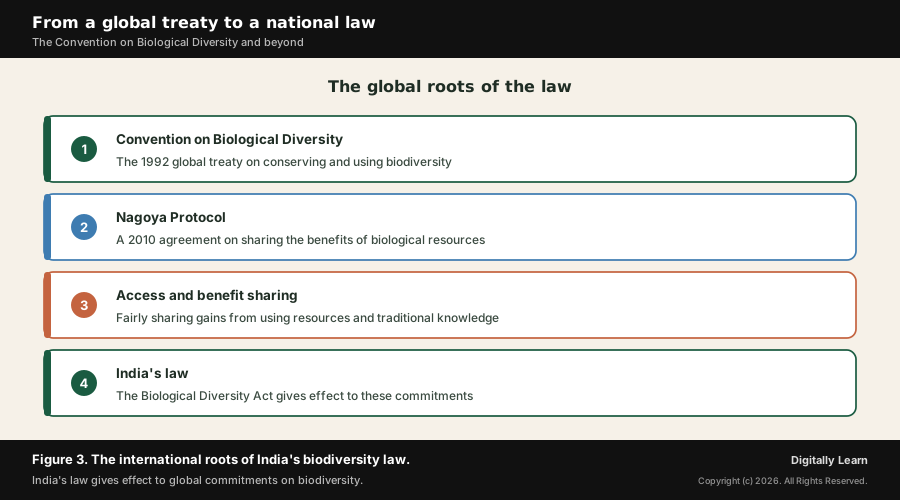
Contemporary linkages tie India's law to the global framework for biodiversity. It gives effect to the Convention on Biological Diversity, the 1992 treaty agreed at the Earth Summit, whose three goals are conservation, sustainable use and the fair sharing of benefits.
A key part of that framework is the Nagoya Protocol of 2010, which sets rules for access to biological resources and for sharing the benefits that flow from using them, including the traditional knowledge of communities.
India's law puts this into action. Anyone seeking a patent or other right based on Indian biological resources must first register with the National Biodiversity Authority, a check that helps guard the country's resources and knowledge against biopiracy.
This connects to India's wider effort to protect traditional knowledge, including databases that record traditional remedies so that they cannot be wrongly patented abroad, and to its updated national plan for biodiversity under the global goals.
UPSC Relevance and Exam Focus
Where this fits in the UPSC-CSE syllabus
This topic maps to General Studies Paper III: conservation, environment and biodiversity, with links to international environmental agreements and the protection of traditional knowledge.
For Prelims, hold the high-yield facts: the Biological Diversity Act, 2002, its three-tier bodies, the role of Biodiversity Management Committees, and the meaning of access and benefit sharing under the Nagoya Protocol.
For Mains, two framings recur: how the Biological Diversity Act helps conserve flora and fauna, and how India protects its traditional knowledge from being wrongly patented.
Recurring linked concepts an aspirant should keep in working memory:
- National Biodiversity Authority: the apex body under the Biological Diversity Act.
- Biodiversity Management Committees: local bodies that keep People’s Biodiversity Registers.
- Access and benefit sharing: fairly sharing the gains from using biological resources.
- Nagoya Protocol: the 2010 agreement on access and benefit sharing under the Convention on Biological Diversity.
A common Prelims trap is to forget the local tier; Biodiversity Management Committees, not just the national authority, are central to access and benefit sharing.
A common Mains trap is to treat the law as only about conservation. It is equally about sharing benefits with communities and guarding against biopiracy.
Previous Year UPSC-CSE Questions By the end you will be able to draft model answers for the following UPSC questions. Each question carries a collapsible framework showing how to approach it in the exam.
- UPSC Mains 2018 GS-IIIHow does biodiversity vary in India? How is the Biological Diversity Act, 2002 helpful in conservation of flora and fauna?
How to structure the answer in the exam
Introduction: Open with India as a megadiverse country with varied biodiversity.
Body (sub-themes to develop):
- Variation: hotspots, ecosystems and species richness across regions.
- The Act: regulates access, requires benefit-sharing, guards traditional knowledge.
- The three-tier system: NBA, State Boards and local committees.
- Limits: weak local committees, enforcement and balancing research.
Conclusion: Conclude that the Act, if well implemented, conserves biodiversity and rewards communities.
- UPSC Mains 2019 GS-IIIHow is the Government of India protecting traditional knowledge of medicine from patenting by pharmaceutical companies?
How to structure the answer in the exam
Introduction: Open with the risk of biopiracy of India's traditional medical knowledge.
Body (sub-themes to develop):
- Law: registration with the NBA before patents on Indian biological resources.
- Databases: traditional-knowledge records to block wrongful patents abroad.
- Benefit-sharing: ensuring communities gain from their knowledge.
- Global links: the Convention on Biological Diversity and the Nagoya Protocol.
Conclusion: Conclude that legal and database tools together protect India's traditional knowledge.
- UPSC Prelims 2023 GS-IConsider the following statements:
- In India, the Biodiversity Management Committees are key to the realization of the objectives of the Nagoya Protocol.
- The Biodiversity Management Committees have important functions in determining access and benefit sharing, including the power to levy collection fees on the access of biological resources within its jurisdiction.
Which of the statements given above is/are correct?
How to approach this Prelims question
Approach: Recall the functions of the local Biodiversity Management Committees.
Trap to watch: Do not dismiss the local tier; the committees are central to access and benefit sharing.
Key facts to recall:
- Biodiversity Management Committees are key to realising the Nagoya Protocol's objectives at the local level.
- They help determine access and benefit sharing and can levy collection fees, so both statements are correct.
Answer signal: Both functions are real, so the answer is Both 1 and 2.
Sources and Further Reading
- Press Information Bureau: National Biodiversity Authority realises Rs 21.26 crore through the Access and Benefit Sharing mechanism
- Press Information Bureau: Regulatory reforms under the Biological Diversity (Amendment) Act, 2023
- National Biodiversity Authority
- Press Information Bureau: India submits its first National Report on the Nagoya Protocol
Editorial Disclaimer
This briefing is for UPSC preparation. Verify the provisions and figures against the official government and National Biodiversity Authority sources before relying on them.

