


Overview
India's cheetah reintroduction at Kuno
Project Cheetah is India's programme to restore the cheetah, which was declared extinct in the country in 1952. Cheetah reintroduction in India began at Kuno National Park in Madhya Pradesh on 17 September 2022, with African cheetahs from Namibia, South Africa and Botswana taking the place of the lost Asiatic cheetah. The National Tiger Conservation Authority runs the project, and India had 55 cheetahs at the end of September 2026.
Project Cheetah: India's Cheetah Reintroduction at Kuno
Founder Cheetahs from Namibia, South Africa and Botswana
On the launch day the Prime Minister released the first eight cheetahs, from Namibia, into enclosures at Kuno. The Ministry of Environment, Forest and Climate Change runs the project through the National Tiger Conservation Authority (NTCA). Bringing founders from southern Africa made it the world's first intercontinental translocation of a large carnivore.
| Batch | Cheetahs | Arrived | Arrangement |
|---|---|---|---|
| Namibia | 8 (5 females, 3 males) | 17 September 2022 | Memorandum of understanding, July 2022 |
| South Africa | 12 (5 females, 7 males) | February 2023 | Memorandum of understanding, January 2023 |
| Botswana | 9 (6 females, 3 males) | February 2026 | Gift made during the President's visit to Botswana, November 2025 |
Indian Air Force C‑17 Globemasters flew the first two batches more than 7,900 km. The agreement with South Africa is reviewed every five years and covers training and technology transfer as well as translocation. Drawing founders from several genetically diverse southern African populations strengthens the small founding group.
Cheetah Population in India in 2026: Births, Deaths and Dispersal
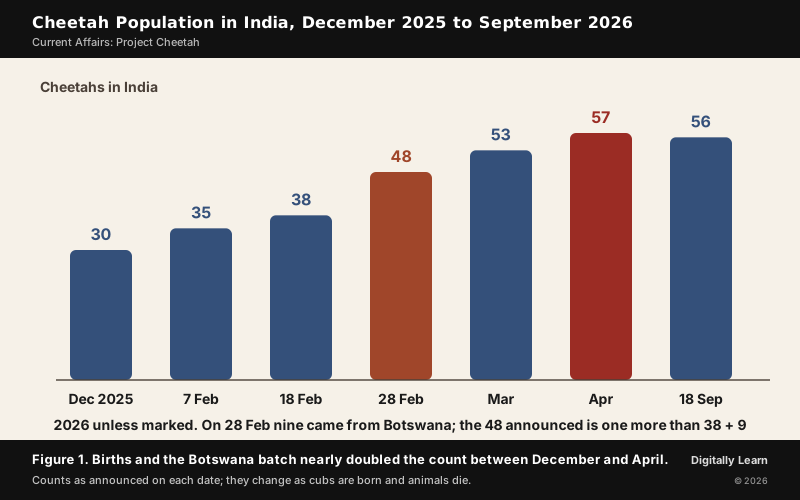
Breeding is the clearest sign that the project is working. In December 2025 India had 30 cheetahs: 11 founders and 19 born in India. A month earlier Mukhi, the first cub born on Indian soil, had given birth to five cubs, the first second-generation litter. Through 2026 the Environment Ministry announced a new count after each birth, death or arrival:
- February 2026: Aasha had five cubs and Gamini three, and on 28 February nine cheetahs from Botswana were released at Kuno. The count announced then was 48, of whom 28 were born in India. That is one India-born cheetah more than the earlier announcements add up to (38 before the release, 27 of them born in India), and the announcements do not explain the difference.
- March 2026: Jwala, a Namibian founder, had five cubs, the tenth litter on Indian soil, and the count rose to 53, of whom 33 were born in India.
- April 2026: An India-born daughter of Gamini had four cubs in the open forest, the first births outside the enclosures, and the count reached 57.
- May 2026: Those four cubs were found dead on 12 May, probably killed by a leopard.
- September 2026: The project turned four on 17 September, and a new litter announced the next day took the count to 56. On 21 September the Namibian male Gaurav died, which left 55 cheetahs in India, 51 of them at Kuno.
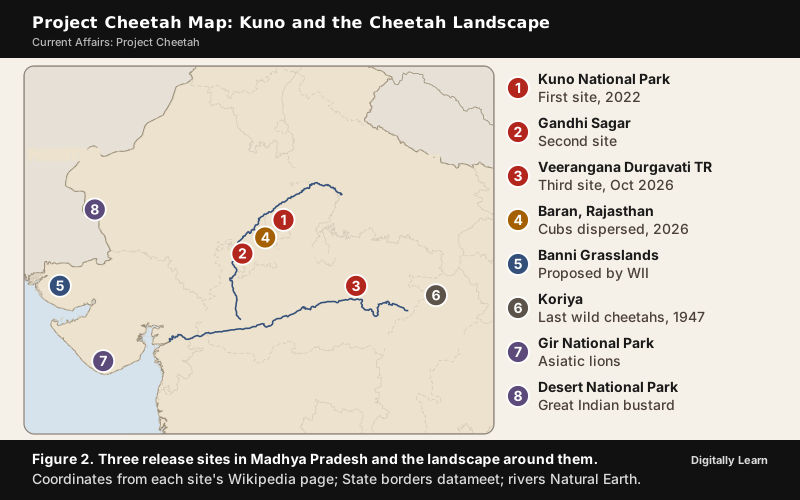
Young cheetahs have also begun to roam. In early 2026 two India-born cheetahs, KP2 and KP3, walked 60 to 70 km from Kuno into Baran district in Rajasthan. The NTCA called this natural territorial behaviour that the action plan anticipates; the animals are radio-collared and tracked round the clock by a joint team of the two States.
Why India Lost the Asiatic Cheetah and Turned to Africa
Asiatic Cheetah Extinction in India in 1952
The Asiatic cheetah once ranged from Punjab to Tirunelveli and from Gujarat and Rajasthan to Bengal, in scrub, dry grassland and savanna. The last confirmed wild cheetahs were three animals shot in 1947 in the sal forests of Koriya, now in Chhattisgarh, and in 1952 the cheetah was declared extinct in India.
- Why it vanished: Hunting, poaching and the use of cheetahs for coursing, together with habitat loss to farming, the decline of prey and the species' low rate of reproduction.
- Today: Cheetahs have vanished from 91 per cent of their former global range; about 50 Asiatic cheetahs survive, all in Iran.
- Status: The cheetah species is Vulnerable on the Red List of the International Union for Conservation of Nature (IUCN) and is listed in Appendix I of the Convention on International Trade in Endangered Species of Wild Fauna and Flora (CITES).
Requests to Iran for Asiatic cheetahs, first made in the 1970s, failed, and the plan to source them from Iran was dropped in 2010. India therefore turned to the African cheetah, a different subspecies of the same species, which can fill the empty ecological role.
Today the cheetah is not naturally found in India; the animals at Kuno came from Africa. Many other animals are native. The black-necked crane breeds in Ladakh, the snow leopard lives high in the Himalaya, and the Indian giant flying squirrel is native to India's forests.
The two bodies behind the cheetah's status work differently. The IUCN, which compiles the Red List, is not an organ of the United Nations, although it holds observer status there, and it runs field projects around the world. CITES is legally binding on its Parties but does not take the place of national laws, so each country passes its own legislation to apply it.
Kuno National Park, the Lion Plan and the Supreme Court
Kuno National Park covers 748.76 sq km in Madhya Pradesh and became a national park in 2018. In the 1990s it was chosen for the Asiatic Lion Reintroduction Project, meant to give India a second lion population away from Gir; between 1998 and 2003 about 1,650 people from 24 villages, mostly Saharia tribal people, were resettled outside it. In April 2013 the Supreme Court ordered Gujarat to send some Gir lions to Kuno, but Gujarat has not carried out the order, and the prepared park later went to the cheetah.
The lion that Kuno was prepared for and the cheetah that came instead are different kinds of cat. The cheetah belongs to the Felinae, the subfamily of cats that can purr but cannot roar, whereas the lion and the leopard, which also lives at Kuno, belong to the Pantherinae, the roaring cats. Lions have no fixed breeding season, and male leopards, like male lions, mark their territory with scent.
The search for a cheetah site ran beside the lion plan and passed through the Supreme Court:
- 2009: A workshop at Gajnar in Rajasthan, in September, began the search for a cheetah site; Kuno, Nauradehi and Shahgarh were among the places studied.
- 2012: The Supreme Court halted the plan, treating it as an introduction rather than a reintroduction.
- January 2020: The Court reversed itself and allowed a small number of African cheetahs on a trial basis, which opened the way for Kuno.
How Cheetah Reintroduction Works: Soft Release, Tracking and Expansion
Soft Release, GPS Tracking and the Metapopulation Goal
A cheetah flown in from Africa is not set free at once. It goes through a soft release, moving in stages from a quarantine enclosure to a larger fenced acclimatisation camp, called a boma, and only then into the open park, following soft-release protocols used worldwide.
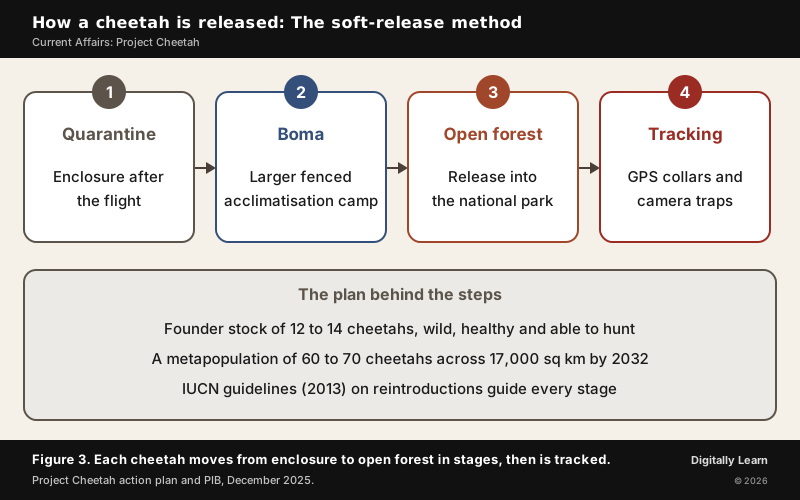
Monitoring follows the IUCN guidelines of 2013 on reintroductions. GPS collars, camera traps and 734 to 816 km of line transects track the cheetahs and their prey. The collars show how widely they range. The female Gamini and her four sub-adult cubs used about 6,160 sq km, and the male coalition Agni and Vayu about 1,819 sq km.
A single park cannot hold a lasting population, so the plan links several. A metapopulation is a set of separate groups of one species, connected by animals that move or are moved between them.
- Goal: 60 to 70 cheetahs across 17,000 sq km of the Kuno and Gandhi Sagar landscape by 2032, starting from Kuno National Park and a 3,200 sq km landscape around it.
- Gandhi Sagar Wildlife Sanctuary: 368 sq km, with 2,500 sq km of potential habitat about 300 km from Kuno, in Mandsaur and Neemuch districts; three adult cheetahs lived there in February 2026.
- Veerangana Durgavati Tiger Reserve: On 7 October 2026 two cheetahs, Vyom and Neera, were released in this reserve in Sagar district, the third cheetah site; it was declared a tiger reserve in 2023.
- Banni Grasslands: The Wildlife Institute of India has identified this reserve in Kutch, Gujarat, as a possible reintroduction site.
The numbers behind the plan are modest. With about 5 per cent net growth a year, the population is expected to fill its carrying capacity in about 15 years. The first phase cost ₹39 crore, met within the centrally sponsored Project Tiger scheme.
Communities, Grasslands and Big Cat Diplomacy
Cheetah Mitras, Grasslands and the International Big Cat Alliance
The project depends on the people who live around Kuno. Over 450 Cheetah Mitras in 80 villages act as its local ambassadors, and it has created about 380 direct jobs, including 80 cheetah trackers and 200 patrol workers. Local communities receive a 5 per cent share of eco-tourism revenue.
The ecological case is about grasslands. The cheetah is used as a flagship and umbrella species, a well-known animal that draws attention and money, and whose protected habitat shelters many other species of the neglected grassland and semi-arid ecosystems, such as the great Indian bustard of the Thar desert.
Critics see symbolism in this. They argue that African cheetahs kept in enclosures, like tigers flown between reserves, put single species ahead of landscapes, while many grassland birds decline unnoticed.
Project Cheetah sits inside India's wider big-cat diplomacy. The Prime Minister launched the International Big Cat Alliance (IBCA) on 9 April 2023, at the event marking 50 years of Project Tiger, for the seven big cats, which are the tiger, lion, leopard, snow leopard, cheetah, jaguar and puma.
- Base and money: It is headquartered in India, with ₹150 crore of budgetary support for five years, up to 2027‑28.
- Members: In May 2026 it had 24 member countries and three observers; Saudi Arabia had confirmed its membership, while China was not expected to join.
- First summit: Planned for New Delhi from 1 to 3 June 2026, alongside the fourth India-Africa Forum Summit, it was postponed in May 2026 because of the Ebola outbreak in parts of Africa; new dates were to be announced after consultations.
Biodiversity of India and the Biological Diversity Act, 2002
How India's Biodiversity Varies and the Biological Diversity Act
India is one of the 17 megadiverse countries and holds four of the world's 36 biodiversity hotspots, namely the Western Ghats, the Himalaya, the Indo-Burma region and the Nicobar Islands. Its ecosystems run from high Himalayan cold desert to evergreen forest, desert, coasts and mangroves.
India is divided into 10 biogeographic zones, namely the Trans-Himalaya, the Himalaya, the desert, the semi-arid zone, the Western Ghats, the Deccan plateau, the Gangetic plain, the North-East, the coasts and the islands. The cheetah belongs to the semi-arid grasslands and scrub, which have drawn far less protection than forests.
Biodiversity hotspots are regions with very high species richness and a high degree of endemism, species found nowhere else. Conservation that protects a whole ecosystem, as when the entire forest is saved to save the tiger, is in situ (on site) conservation; national parks, sanctuaries and biosphere reserves are its legal tools. Ex situ (off site) conservation, as in zoos and seed banks, is used when a species faces a very high risk of extinction in the wild. Project Cheetah returns a species to its habitat, so it is in situ conservation.
The Biological Diversity Act, 2002, provides for the conservation of biological diversity, the sustainable use of its components and the fair and equitable sharing of benefits from biological resources and knowledge. It works through three tiers of bodies. The National Biodiversity Authority, set up at Chennai in 2003, acts at the national level, State Biodiversity Boards in the States, and Biodiversity Management Committees in local bodies.
Parliament amended the Act in 2023 to promote research on medicinal plants, encourage plant-based medicines, benefit local people who use forest produce and simplify compliance for domestic companies.
Previous Year UPSC‑CSE Questions
Each Prelims question is explained option by option, and each Mains question comes with an answer outline.
- UPSC Prelims 2024Consider the following statements:
- Lions do not have a particular breeding season.
- Unlike most other big cats, cheetahs do not roar.
- Unlike male lions, male leopards do not proclaim their territory by scent marking.
Which of the statements given above are correct?
How to approach this Prelims question
Approach: Test each statement against what is known of the three cats.
- Step 1: Statement 1: Lions do not mate at a specific time of year, so it is correct.
- Step 2: Statement 2: The cheetah belongs to the Felinae, which can purr but cannot roar, so it is correct.
- Step 3: Statement 3: Male leopards do mark their territory with scent, so it is wrong.
Trap to watch: Statement 3 is a negative claim. Leopards, like lions, scent-mark, so a student who remembers only the lion's marking may accept it.
Why each option is right or wrong:
- (a) 1 and 2 only: Correct. Lions breed at any time of year, and cheetahs cannot roar.
- (b) 2 and 3 only: Wrong. Statement 3 is false, because male leopards scent-mark, and statement 1 is true.
- (c) 1 and 3 only: Wrong. Statement 3 is false, and statement 2 is true.
- (d) 1, 2 and 3: Wrong. Male leopards do scent-mark their territory.
Answer: (a) 1 and 2 only. Lions have no fixed breeding season and cheetahs cannot roar, while male leopards do mark their territory with scent.
- UPSC Prelims 2017Recently there was a proposal to translocate some of the lions from their natural habitat in Gujarat to which one of the following sites?
How to approach this Prelims question
Approach: Recall where the second home for the Asiatic lion was planned.
- Step 1: Kuno Palpur in Madhya Pradesh was prepared from the 1990s for Gir's lions, and the Supreme Court ordered the move in 2013.
- Step 2: The other three parks lie in other States and were never part of the lion plan.
Trap to watch: Kuno, prepared for lions, now holds cheetahs, but the question asks about the lion plan.
Why each option is right or wrong:
- (a) Corbett National Park: Wrong. Corbett lies in Uttarakhand and was never proposed as a home for Gir's lions.
- (b) Kuno Palpur Wildlife Sanctuary: Correct. It was prepared for Gir's lions from the 1990s.
- (c) Mudumalai Wildlife Sanctuary: Wrong. Mudumalai lies in the Nilgiris of Tamil Nadu and was not part of the lion plan.
- (d) Sariska National Park: Wrong. Sariska, in Rajasthan, is a tiger reserve and was not proposed for Gir's lions.
Answer: (b) Kuno Palpur Wildlife Sanctuary. Kuno Palpur in Madhya Pradesh was prepared as the second home for Gir's lions.
- UPSC Prelims 2015With reference to the International Union for Conservation of Nature and Natural Resources (IUCN) and the Convention on International Trade in Endangered Species of Wild Fauna and Flora (CITES), which of the following statements is/are correct?
- IUCN is an organ of the United Nations and CITES is an international agreement between governments.
- IUCN runs thousands of field projects around the world to better manage natural environments.
- CITES is legally binding on the States that have joined it, but this Convention does not take the place of national laws.
Select the correct answer using the code given below.
How to approach this Prelims question
Approach: Separate what each body is from what it does.
- Step 1: Statement 1: The IUCN is not an organ of the UN, though it has observer status, so it is wrong.
- Step 2: Statement 2: The IUCN runs field projects, so it is correct.
- Step 3: Statement 3: CITES is legally binding but does not take the place of national laws, so it is correct.
Trap to watch: Observer status at the UN does not make the IUCN a UN organ.
Why each option is right or wrong:
- (a) 1 only: Wrong. Statement 1 is false, because the IUCN is not a UN organ.
- (b) 2 and 3 only: Correct. The IUCN runs field projects, and CITES binds its Parties without replacing their laws.
- (c) 1 and 3 only: Wrong. Statement 1 is false, and statement 2 is true.
- (d) 1, 2 and 3: Wrong. Statement 1 is false.
Answer: (b) 2 and 3 only. The IUCN runs field projects and CITES binds its Parties, but the IUCN is not an organ of the United Nations.
- UPSC Prelims 2012Consider the following :
- Black-necked crane
- Cheetah
- Flying squirrel
- Snow leopard
Which of the above are naturally found in India?
How to approach this Prelims question
Approach: Check whether each animal lives in India in the wild today.
- Step 1: Black-necked crane: It breeds in Ladakh; native.
- Step 2: Cheetah: It has been extinct in India since 1952, and those at Kuno were brought from Africa; not native.
- Step 3: Flying squirrel: The Indian giant flying squirrel is native.
- Step 4: Snow leopard: It lives in the Himalaya; native.
Trap to watch: The Kuno cheetahs are introduced from Africa, so the cheetah is still not naturally found in India.
Why each option is right or wrong:
- (a) 1, 2 and 3 only: Wrong. The cheetah is not naturally found in India, and the snow leopard is.
- (b) 1, 3 and 4 only: Correct. The crane, the flying squirrel and the snow leopard are native; the cheetah is not.
- (c) 2 and 4 only: Wrong. It includes the cheetah and leaves out the crane and the flying squirrel.
- (d) 1, 2, 3 and 4: Wrong. The cheetah has been extinct in India since 1952.
Answer: (b) 1, 3 and 4 only. The black-necked crane, the flying squirrel and the snow leopard are native, while the cheetah has been extinct in India since 1952.
- UPSC Mains 2018 GS‑IIIHow does biodiversity vary in India? How is the Biological Diversity Act, 2002 helpful in conservation of flora and fauna?
Answer outline
The outline sets out what the question asks, the main arguments, relevant examples and the direction of the conclusion; it is not a full model answer.
Introduction: India is one of 17 megadiverse countries and holds four of the world's 36 biodiversity hotspots.
Body (sub-themes to develop):
- Variation: Ten biogeographic zones from the Trans-Himalaya to the islands; the Western Ghats, Himalaya, Indo-Burma and Nicobar hotspots; grasslands and semi-arid scrub long neglected.
- The Act's aims: Conservation, sustainable use and fair and equitable sharing of benefits from biological resources and knowledge.
- Institutions: The National Biodiversity Authority (Chennai, 2003), State Biodiversity Boards and local Biodiversity Management Committees; the 2023 amendment on medicinal plants and simpler compliance.
- Example: Project Cheetah restores a lost predator and uses it as a flagship for grasslands; IUCN and CITES frame its status.
Conclusion: Law, institutions and habitat-level programmes together conserve India's varied biodiversity, but its grasslands still need the attention its forests have received.
Sources
- Press Information Bureau: Roaring Revival, The Return of the Cheetah, 12 December 2025
- All India Radio: Kuno National Park receives nine cheetahs from Botswana, 28 February 2026
- All India Radio: Parliament passes Biological Diversity (Amendment) Bill 2023, 1 August 2023
- NCERT: Biology (Class XII), Chapter 13, Biodiversity and Conservation
- NCERT: Contemporary India II (Class X), Chapter 2, Forest and Wildlife Resources
- Wikipedia: Cheetah reintroduction in India
- Wikipedia: Cheetah
- Wikipedia: Felinae
- Wikipedia: Pantherinae
- Wikipedia: Lion
- Wikipedia: Leopard
- Wikipedia: Kuno National Park
- Wikipedia: Veerangana Durgavati Tiger Reserve
- Wikipedia: Banni Grasslands Reserve
- Wikipedia: Desert National Park
- Wikipedia: Black-necked crane
- Wikipedia: Indian giant flying squirrel
- Wikipedia: Snow leopard
- Wikipedia: International Union for Conservation of Nature
- Wikipedia: CITES
- Wikipedia: Biological Diversity Act, 2002
- Wikipedia: Biodiversity of India
- Wikipedia: Biogeographic classification of India
- The Hindu: The cheetah and its lost range (5 February 2026)
- The Hindu: Five cubs born to the Namibian cheetah Aasha at Kuno (8 February 2026)
- The Hindu: South African cheetah gives birth to three cubs in Kuno (19 February 2026)
- The Hindu: Nine Botswana cheetahs released into Kuno park (1 March 2026)
- The Hindu: Cheetahs in Baran showing natural territorial behaviour, says NTCA (9 March 2026)
- The Hindu: India's cheetah population hits 53 with new litter at Kuno (10 March 2026)
- The Hindu: Indian-born cheetah gives birth to four cubs at Kuno (12 April 2026)
- The Hindu: The International Big Cat Alliance and its members (7 May 2026)
- The Hindu: Saudi Arabia joins the International Big Cat Alliance ahead of its summit (12 May 2026)
- The Hindu: Four cheetah cubs found dead at Kuno (13 May 2026)
- The Hindu: India-Africa Forum Summit and Big Cat Alliance summit postponed (22 May 2026)
- The Hindu: Indian-born cheetah gives birth to four cubs at Kuno (19 September 2026)
- The Hindu: 10-year-old Namibian cheetah dies in Kuno National Park (22 September 2026)
- The Hindu: Editorial on conservation policy and symbolism (6 October 2026)
- The Hindu: Two cheetahs released in Veerangana Durgavati Tiger Reserve (8 October 2026)
- UPSC: Previous year question papers of the Civil Services Examination
Editorial Disclaimer
This article draws on the Press Information Bureau, All India Radio, The Hindu, NCERT and Wikipedia, each listed under Sources.
See more of our UPSC articles in Google Search
Add to Preferred Sources

