


Overview
Meaning, criteria, the 36 hotspots and India's four

Biodiversity hotspots are regions that are both unusually rich in species found nowhere else and badly threatened by people. To qualify, a region must hold at least 1,500 endemic species of vascular plants and must have lost at least 70 per cent of its original vegetation. There are 36 biodiversity hotspots in the world, and the biodiversity hotspots in India are four: the Himalaya, Indo-Burma, the Western Ghats and Sri Lanka, and Sundaland, whose Indian part is the Nicobar Islands.
Biodiversity Hotspots: Meaning, Definition and Origin of the Concept
What Are Biodiversity Hotspots?
Biodiversity hotspots are biogeographic regions with very high levels of species richness and a high degree of endemism, which are also threatened by human activity. An endemic species is one confined to a region and found nowhere else, so its loss there is a loss to the world.
The idea answers a practical problem. The number of species waiting to be saved from extinction far exceeds the money and people available for conservation. Hotspots tell conservationists where the same effort protects the most species that exist nowhere else. All the hotspots together cover a tiny share of the land, yet strict protection of them could cut the ongoing mass extinctions by almost 30 per cent.
- Species richness: A very large number of species in the region.
- Endemic species: A large share of those species found only there.
- Threat: Rapid loss of the natural habitat that holds them.
Norman Myers and the History of the Hotspot Concept
The concept came from Norman Myers (1934 to 2019), a British environmentalist, who wrote about it in two articles in The Environmentalist in 1988 and 1990. He first identified ten hotspots. In 2000 the idea was revised, with others, into a book on the Earth's biologically richest and most endangered ecoregions and a paper in the journal Nature, which proposed that hotspots should be the focus of preservation to cut the rate of mass extinction.
- 1988: Myers identifies the first ten hotspots, and returns to the idea in 1990.
- 2000: The revised concept, with fixed criteria; Conservation International now designates the hotspots.
- 25, then 34: Initially 25 hotspots were identified; nine more were added later.
- 36 today: The current list, the 36th being the North American Coastal Plain.
Biodiversity Hotspot Criteria: Endemic Plants and Habitat Loss
Criteria for a Biodiversity Hotspot: 1,500 Endemic Plants and 70 Per Cent Loss
To qualify as a biodiversity hotspot, a region must meet two strict criteria. Both must hold: a region rich in endemic plants but still intact is not a hotspot, and nor is a damaged region with few endemics.
- Plant endemism: At least 1,500 species of vascular plants found nowhere else, more than 0.5 per cent of the world’s total.
- Habitat loss: The loss of at least 70 per cent of its primary vegetation, so that 30 per cent or less of the original habitat remains.
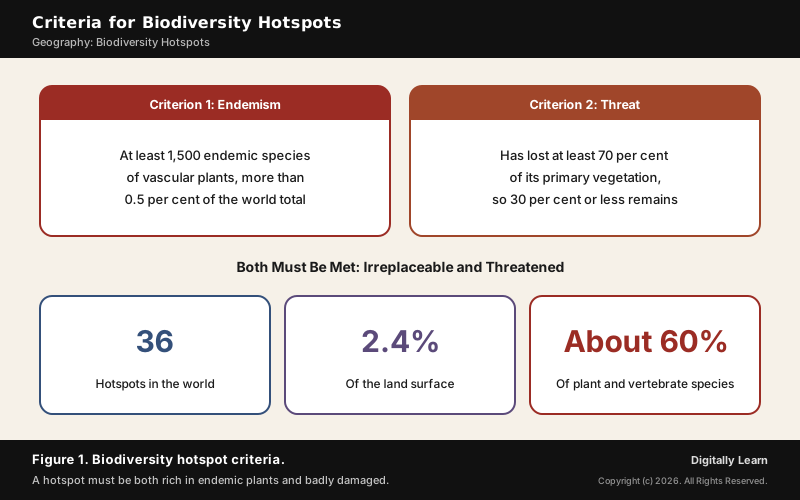
The two criteria work together: the first shows that a region is irreplaceable, and the second that it is disappearing. Hotspots are, by definition, regions of accelerated habitat loss.
Species Richness of Hotspots: 2.4 Per Cent of Land, 60 Per Cent of Species
The importance of biodiversity hotspots lies in how much life they pack into how little land. The 36 hotspots hold their ecosystems on just 2.4 per cent of the planet's surface, yet support nearly 60 per cent of the world's plant, bird, mammal, reptile and amphibian species, with a high share of them endemic.
- Once much larger: The current 36 used to cover more than 15.7 per cent of all land, but have lost around 85 per cent of their area.
- Extremes: Some hotspots hold up to 15,000 endemic plant species, and some have lost up to 95 per cent of their natural habitat.
- Little protection: Only a small share of the land within hotspots is protected.
- Funding: The Critical Ecosystem Partnership Fund, founded in 2000, gives grants to civil society groups; it has funded work in 25 hotspots across 105 countries and territories.
The hotspot approach has critics. It does not count the cost of conserving each place, and it does not consider phylogenetic diversity, the spread of evolutionary lineages among species. Other priority maps therefore sit beside it.
| Priority scheme | What it marks |
|---|---|
| Global 200 Ecoregions (WWF) | Priority ecoregions from terrestrial, freshwater and marine habitat types; every hotspot contains at least one |
| Endemic Bird Areas (BirdLife) | 218 areas, each with two or more bird species found nowhere else |
| Important Bird and Biodiversity Areas (BirdLife) | About 13,000 sites important for birds |
| Alliance for Zero Extinction | 595 sites holding the most threatened endemic species |
Biodiversity Hotspots in the World: The 36 Hotspots by Region
How Many Biodiversity Hotspots Are There in the World?
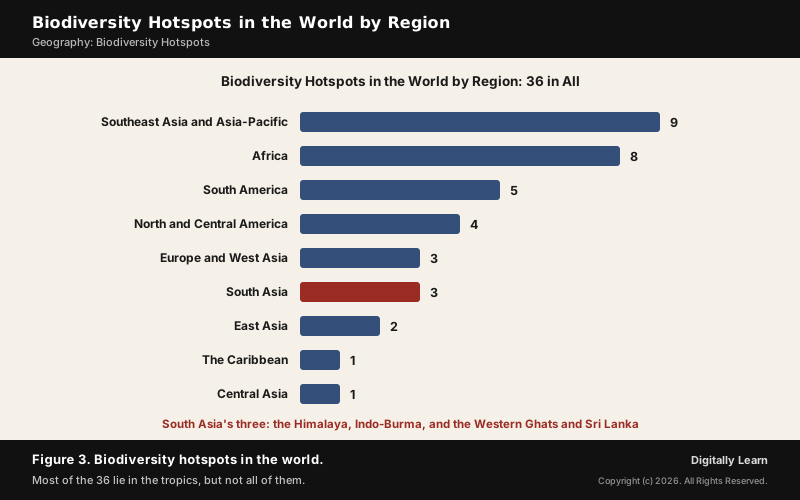
There are 36 biodiversity hotspots in the world. Most lie in the tropics, where most biodiversity is found, but the list also includes temperate regions with Mediterranean-type climates, mountain ranges and oceanic islands.
| Region | Biodiversity hotspots |
|---|---|
| North and Central America | California Floristic Province, Madrean pine-oak woodlands, Mesoamerica, North American Coastal Plain |
| The Caribbean | Caribbean Islands |
| South America | Atlantic Forest, Cerrado, Chilean Winter Rainfall-Valdivian Forests, Tumbes-Choco-Magdalena, Tropical Andes |
| Europe and West Asia | Mediterranean Basin, Caucasus, Irano-Anatolian |
| Africa | Cape Floristic Region, Coastal Forests of Eastern Africa, Eastern Afromontane, Guinean Forests of West Africa, Horn of Africa, Madagascar and the Indian Ocean Islands, Maputaland-Pondoland-Albany, Succulent Karoo |
| Central Asia | Mountains of Central Asia |
| South Asia | Himalaya, Indo-Burma, Western Ghats and Sri Lanka |
| Southeast Asia and Asia-Pacific | East Melanesian Islands, New Caledonia, New Zealand, Philippines, Polynesia-Micronesia, Eastern Australian temperate forests, Southwest Australia, Sundaland, Wallacea |
| East Asia | Japan, Mountains of Southwest China |
Africa and Southeast Asia with the Pacific hold 17 of the 36 between them. South Asia has three, all shared with India, and India's fourth, Sundaland, is counted under Southeast Asia because most of it lies in Malaysia and Indonesia. Several hotspots are whole island groups, such as Madagascar, the Philippines and New Zealand, where long isolation has produced species found nowhere else.
Tropical and Temperate Hotspots: Where Hotspots Are Found
Hotspots are not found only in the tropics. The Mediterranean Basin, the California Floristic Province, the Cape Floristic Region at the south-west tip of South Africa, central Chile and Southwest Australia all have Mediterranean-type climates, with their own shrub vegetation: maquis, chaparral, fynbos, matorral and mallee. Mountain systems such as the Caucasus, the Mountains of Central Asia and the Himalaya are hotspots too.
- Tropical forests: The Tropical Andes, Mesoamerica, the Atlantic Forest, the Guinean Forests of West Africa, Indo-Burma and Sundaland.
- Islands: Madagascar, the Philippines, New Caledonia, New Zealand, the Caribbean and Japan, where isolation has produced species found nowhere else.
- High-risk hotspots: The Caribbean Islands, the Tropical Andes, the Philippines, Mesoamerica and Sundaland are losing forest fast enough to lose most of their plant and vertebrate species.
Biodiversity Hotspots in India: Himalaya, Indo-Burma, Western Ghats, Sundaland
How Many Biodiversity Hotspots Are in India?
There are four biodiversity hotspots in India: the Himalaya, Indo-Burma, the Western Ghats and Sri Lanka, and Sundaland. None lies wholly within India. Each is shared with neighbouring countries, and in the case of Sundaland only the Nicobar Islands fall inside India's borders. India's plants are concentrated in three centres of floristic diversity, the Himalaya, the Western Ghats and the Andaman and Nicobar Islands, and these are the parts of India that the four hotspots cover.

| Hotspot | Part in India | Shared with |
|---|---|---|
| Himalaya | Himalayan states and the hills of north Bengal | Nepal, Bhutan, China, Myanmar |
| Indo-Burma | North-east south of the Brahmaputra; Andaman Islands | Myanmar, Thailand, Indo-China, south China |
| Western Ghats and Sri Lanka | The Sahyadri, from Gujarat to Kanyakumari | Sri Lanka |
| Sundaland | Nicobar Islands | Malaysia, Indonesia (Sumatra, Java, Borneo) |
Himalaya Biodiversity Hotspot: The Indian Himalaya
The Himalaya hotspot runs along the mountain chain through India, Nepal, Bhutan, Tibet and on to Yunnan and northern Myanmar in the east. In India it covers the Himalayan states from Jammu and Kashmir to Arunachal Pradesh. The monsoon of June to September waters the eastern Himalaya.
- Altitude layers: Forests change from tropical in the foothills to alpine meadows, so many habitats sit one above another within a short distance.
- Himalayan animals: The snow leopard at the top of the food chain, the endemic bharal or Himalayan blue sheep, the Himalayan tahr, the takin, the Himalayan serow and the endangered Himalayan musk deer.
- Birds and plants: Of 979 bird species recorded in the Himalayan region, four Endemic Bird Areas have been marked for priority conservation, and 32 to 40 per cent of vascular plants in India’s mountain ecosystems are endemic.
Its detailed treatment, species by species, is in the Himalayan biodiversity hotspot.
Indo-Burma Biodiversity Hotspot: North-East India and the Andamans
The Indo-Burma hotspot covers 2,373,000 square kilometres of tropical Asia east of the Ganga-Brahmaputra lowlands. It begins in eastern Bangladesh, runs across north-eastern India south of the Brahmaputra, and takes in nearly all of Myanmar, parts of Yunnan, Laos, Cambodia, Vietnam, most of Thailand and a small part of Peninsular Malaysia. Offshore it includes Hainan and India's Andaman Islands.
- Redefined: It once included the Himalayan chain and foothills in Nepal, Bhutan and India, but has been narrowed to the Indo-Chinese region; the Himalaya is now a separate hotspot.
- Ecosystems: 33 terrestrial ecoregions, from wet and dry evergreen, deciduous and montane forests to mangroves and forests on limestone.
- Southern edge: On the Thai-Malay Peninsula it gives way to Sundaland along the Kangar-Pattani Line.
- Birds and turtles: Almost 1,300 bird species, and many endemic freshwater turtles, most of them threatened by over-harvesting and habitat loss.
Indo-Burma is among the most threatened hotspots on Earth. It was one of the first places where people took up farming, often clearing land with fire. Teak, rubber and oil palm plantations have replaced large areas of lowland forest, while tea, coffee and other crops press on the hill forests; logging, mining, dams and the conversion of mangroves to shrimp ponds add to the loss.
The North-east's part of this hotspot, and its species, are taken up in the Indo-Burma biodiversity hotspot.
Western Ghats and Sri Lanka Biodiversity Hotspot
The Western Ghats, or Sahyadri, run about 1,600 km along the west coast of India, over 160,000 square kilometres, through Gujarat, Maharashtra, Goa, Karnataka, Kerala and Tamil Nadu to Kanyakumari. With Sri Lanka they form one hotspot. They hold nearly 30 per cent of all the plant and animal species found in India, most of them endemic, and at least 325 globally threatened species.
- Flowering plants: 7,402 species of flowering plants have been recorded; 1,273 are confined to the Western Ghats alone, and 56 per cent of the 645 tree species are endemic.
- Mammals and birds: The lion-tailed macaque, the Nilgiri langur and the endemic Nilgiri tahr, which recovered to about 3,122 animals in 2015; at least 19 endemic birds.
- Reptiles, frogs and fish: More than 50 per cent of species are endemic in these groups, and several frog genera are found nowhere else.
- World Heritage: Declared a UNESCO World Heritage Site in 2012, as 39 sites in seven clusters.
Sundaland Hotspot and the Nicobar Islands
Sundaland is the hotspot of the Malay Peninsula and the great islands of Sumatra, Java and Borneo, bounded on the west and south by the deep Sunda Trench and on the east by the Wallace Line. India's only share of it is the Nicobar Islands, which is why the hotspot is listed as Sundaland, Indonesia and the Nicobar Islands of India.
When sea levels were lower in the last glacial period, all of Sundaland was part of the Asian mainland, which is why its islands carry Asian mammals such as elephants, apes, tigers, tapirs and rhinoceroses. Its remaining lowland forests are known for giant dipterocarp trees and orangutans.
Borneo, Java and Sumatra have served as refuges for plants and animals through repeated glacial periods, and Sundaland has been an evolutionary centre of biodiversity since the early Miocene. It is also among the hotspots losing forest fastest. The Nicobars and their species are covered in the Sundaland hotspot.
India as a Megadiverse Country and the Biological Diversity Act
Threats to Biodiversity Hotspots in India and In Situ Conservation
India's hotspots are under pressure from the same forces that made them hotspots. In the Indian Himalayan Region, development and poverty are changing land use and causing habitat loss and fragmentation. In the Western Ghats, selective logging, conversion to farms and cash-crop plantations, and river valley projects drove the decline of biodiversity in the past.
- Newer pressures: Mass tourism, unsustainable land use and heavy subsistence dependence on forests are now the major challenges in the mountain hotspots.
- North-east: Plantations, logging, mining and dams across the Indo-Burma region, as described above.
- Invasive alien species: Controlling them is one of India’s national biodiversity goals, backed by quarantine rules on imported plant material.
The main answer is in situ protection: keeping species in their natural habitat so that the whole ecosystem is protected. India legally protects its richest regions as biosphere reserves, national parks and wildlife sanctuaries, and cultural traditions add sacred groves: in the Khasi and Jaintia Hills of Meghalaya, in the Western Ghats of Karnataka and Maharashtra, and elsewhere. In Meghalaya the sacred groves are the last refuges for many rare and threatened plants.
Megadiverse Countries: Why India Is One of 17
Megadiverse countries are the nations that hold the majority of Earth's species. Conservation International identified 17 in 1998, all at least partly tropical or subtropical. A megadiverse country must have at least 5,000 endemic plant species and must border marine ecosystems.
India qualifies easily. It occupies only 2.4 per cent of the world's land but holds nearly 8 per cent of the world's flora and 7.5 per cent of its fauna; 28 per cent of its plants and over 30 per cent of its animals are endemic. Over 91,200 animal and 45,500 plant species have been documented across its ten biogeographic regions.
- Endemic vertebrates: India ranks tenth in the world in endemic birds (69 species), fifth in endemic reptiles (156) and seventh in endemic amphibians (110).
- How biodiversity varies: Richness and endemism peak in the hotspots, the mountain ecosystems of the Himalaya and the Western Ghats; arid and semi-arid regions cover 38.8 per cent of India and the cold Trans-Himalayan desert 5.62 per cent, with their own specialised life.
Biological Diversity Act, 2002: NBA, State Boards and BMCs
The Biological Diversity Act, 2002 is India's law for conserving biodiversity, using it sustainably and sharing fairly the benefits from biological resources and traditional knowledge. It was enacted to meet India's obligations under the Convention on Biological Diversity, and was amended in 2023.
- National Biodiversity Authority (NBA): A statutory body set up under Section 8, at Chennai, which regulates access to biological resources and associated knowledge and the sharing of benefits.
- State Biodiversity Boards: Constituted in 28 States and 8 Union Territories; Indian citizens and companies seek their permission, while foreigners need the NBA’s.
- Biodiversity Management Committees (BMCs): Set up by local bodies; 2,76,653 BMCs have prepared 2,72,648 People’s Biodiversity Registers recording local species and knowledge.
- Biodiversity Heritage Sites: Unique, fragile ecosystems that State Governments notify under Section 37.
The 2023 amendment moved patent-related approvals to a registration system: anyone seeking an intellectual property right based on Indian biological resources must first obtain a certificate of registration from the NBA. The NBA received 1,077 such applications and issued 885 certificates between April 2025 and March 2026. Wider conservation policy is covered in biodiversity conservation in India.
Kunming-Montreal Framework, 30 by 30 and India's NBSAP
The Kunming-Montreal Global Biodiversity Framework, adopted at COP 15 of the Convention on Biological Diversity on 19 December 2022, carries four goals for 2050 and 23 targets for 2030. Its Target 3, the 30 by 30 target, asks governments to protect 30 per cent of the Earth's land and water by 2030, with new protected areas guided towards places rich in endemic life, which is exactly what hotspots mark.
India released its updated National Biodiversity Strategy and Action Plan (NBSAP), aligned with the framework, at COP 16 in Cali on 30 October 2024. It aims to halt and reverse biodiversity loss by 2030, with a vision of living in harmony with nature by 2050, through ecosystem restoration, species recovery and community-driven conservation. It is implemented through the three-tier structure of the NBA, State Boards and BMCs.
Previous Year UPSC-CSE Questions
Previous Year UPSC-CSE Questions By the end you will be able to draft model answers for the following UPSC questions. Each question carries a collapsible framework showing how to approach it in the exam.
- UPSC Mains 2018 GS-IIIHow does biodiversity vary in India? How is the Biological Diversity Act, 2002 helpful in conservation of flora and fauna?
Answer outline: how to structure the answer
What the question asks, the main arguments, relevant examples and the direction of the conclusion. This is not a full model answer.
Introduction: Open with India as one of 17 megadiverse countries: 2.4 per cent of the land, nearly 8 per cent of flora and 7.5 per cent of fauna, with parts of four hotspots.
Body (sub-themes to develop):
- Variation: four hotspots (Himalaya, Indo-Burma, Western Ghats, Nicobars), ten biogeographic regions, high endemism in amphibians and reptiles, arid and cold desert life.
- Act: enacted to meet CBD obligations; NBA (Section 8), State Biodiversity Boards, BMCs with People's Biodiversity Registers.
- Access and benefit sharing: NBA permission for foreigners, State Boards for Indians; registration before patents on Indian bioresources since the 2023 amendment.
- Biodiversity Heritage Sites under Section 37.
Conclusion: Conclude that the Act's local tier, the BMCs and their registers, is what turns national law into protection of the hotspots on the ground, now aligned with the 30 by 30 target.
- UPSC Prelims 2010 Prelims-GSConsider the following statements :
- Biodiversity hotspots are located only in tropical regions.
- India has four biodiversity hotspots i.e., Eastern Himalayas, Western Himalayas, Western Ghats and Andaman and Nicobar Islands.
Which of the statements given above is/are correct ?
How to approach this Prelims question
Approach: Test statement 1 against the temperate hotspots and statement 2 against the list of India's four.
Trap to watch: India's four are Himalaya, Indo-Burma, Western Ghats-Sri Lanka and Sundaland, not a split of the Himalaya.
Key facts to recall:
- (a) 1 only: wrong. Statement 1 is false: the Mediterranean Basin, California and Cape hotspots are not tropical.
- (b) 2 only: wrong. Statement 2 is false: India's four are the Himalaya, Indo-Burma, the Western Ghats-Sri Lanka and Sundaland; the Nicobars are in Sundaland and the Andamans in Indo-Burma.
- (c) Both 1 and 2: wrong, since both statements are false.
- (d) Neither 1 nor 2: right. Hotspots occur outside the tropics too, and the statement's list of India's four is wrong.
Answer signal: Neither statement is correct, option (d).
- UPSC Prelims 2011 Prelims-GSThree of the following criteria have contributed to the recognition of Western Ghats-Sri Lanka and Indo-Burma regions as hotspots of biodiversity:
- Species richness
- Vegetation density
- Endemism
- Ethno-botanical importance
- Threat perception
- Adaptation of flora and fauna to warm and humid conditions
Which three of the above are correct criteria in this context?
How to approach this Prelims question
Approach: Keep only what the hotspot definition uses: richness, endemism, threat.
Trap to watch: Vegetation density and warm, humid conditions sound plausible but are not criteria.
Key facts to recall:
- (a) 1, 2 and 6: wrong. Vegetation density and adaptation to warm, humid conditions are not hotspot criteria.
- (b) 2, 4 and 6: wrong. None of these three is a criterion.
- (c) 1, 3 and 5: right. A hotspot needs species richness, endemism (at least 1,500 endemic vascular plants) and threat (70 per cent of the primary vegetation lost).
- (d) 3, 4 and 6: wrong. Ethno-botanical importance and adaptation to climate are not criteria.
Answer signal: 1, 3 and 5, option (c).
- UPSC Prelims 2015 Prelims-GSWith reference to an organization known as ‘BirdLife International’, which of the following statements is/are correct?
- It is a Global Partnership of Conservation Organizations.
- The concept of ‘biodiversity hotspots’ originated from this organization.
- It identifies the sites known/referred to as ‘Important Bird and Biodiversity Areas’.
Select the correct answer using the code given below.
How to approach this Prelims question
Approach: Separate what BirdLife is and does from where the hotspot idea came from.
Trap to watch: Statement 2 credits BirdLife with the hotspot concept; it was Myers.
Key facts to recall:
- (a) 1 only: wrong. It leaves out statement 3, though BirdLife identifies Important Bird and Biodiversity Areas.
- (b) 2 and 3 only: wrong. Statement 2 is false: the hotspot concept came from Norman Myers, not from BirdLife.
- (c) 1 and 3 only: right. BirdLife is a global partnership of conservation organisations and it identifies Important Bird and Biodiversity Areas.
- (d) 1, 2 and 3: wrong, since statement 2 is false.
Answer signal: 1 and 3 only, option (c).
- UPSC Prelims 2009 Prelims-GSConsider the following regions:
- Eastern Himalayas
- Eastern Mediterranean region
- North-western Australia
Which of the above is/are Biodiversity Hotspot(s)?
How to approach this Prelims question
Approach: Check each region against the list of 36.
Trap to watch: Southwest Australia is a hotspot; north-western Australia is not.
Key facts to recall:
- (a) 1 only: wrong. It leaves out the eastern Mediterranean, which lies in the Mediterranean Basin hotspot.
- (b) 1 and 2 only: right. The Eastern Himalayas lie in the Himalaya hotspot and the eastern Mediterranean in the Mediterranean Basin hotspot.
- (c) 2 and 3 only: wrong. North-western Australia is not a hotspot; Australia's are Southwest Australia and the eastern temperate forests.
- (d) 1, 2 and 3: wrong, since north-western Australia is not a hotspot.
Answer signal: 1 and 2 only, option (b).
- UPSC Prelims 1996 Prelims-GSWhich one of the following regions of India is now regarded as an 'ecological hot spot'?
How to approach this Prelims question
Approach: Recall which Indian ranges are hotspots.
Trap to watch: The Eastern Ghats are not a hotspot.
Key facts to recall:
- (a) Western Himalayas: not the key's answer. UPSC's key gives the Western Ghats.
- (b) Eastern Himalayas: also defensible. The Eastern Himalaya lies in the Himalaya hotspot, as Prelims 2009 itself accepted, so this option is correct by the current hotspot map, though UPSC's key gives (c).
- (c) Western Ghats: right by UPSC's key. They form the Western Ghats and Sri Lanka hotspot and have been a UNESCO World Heritage Site since 2012.
- (d) Eastern Ghats: wrong. The Eastern Ghats are not part of any of India's four hotspots.
Answer signal: Western Ghats, option (c), by UPSC's key. Answer in doubt: the Eastern Himalayas (b) also lie in a hotspot, so (b) is correct by the current hotspot map.
Sources
- NCERT: Biology (Class XII), Biodiversity and Conservation
- PIB (MoEFCC): India at the IUCN World Conservation Congress, Abu Dhabi
- PIB (MoEFCC): Biological Diversity Act, 2002 (Rajya Sabha reply)
- PIB (MoEFCC): NBA support to State Biodiversity Boards, 2025-26
- PIB (MoEFCC): Biological Diversity (Amendment) Act, 2023 and IPR filings
- PIB (MoEFCC): India releases updated NBSAP at CBD COP 16
- Botanical Survey of India: Plant discoveries and the flora of India
- MoEFCC: India's Fourth National Report to the Convention on Biological Diversity
- Wikipedia: Biodiversity hotspot
- Wikipedia: Norman Myers
- Wikipedia: Megadiverse countries
- Wikipedia: Biodiversity of India
- Wikipedia: Critical Ecosystem Partnership Fund
- Wikipedia: Kunming-Montreal Global Biodiversity Framework
- Wikipedia: Western Ghats
- Wikipedia: Indo-Burma
- Wikipedia: Sundaland
- Wikipedia: Himalayas
- Wikipedia: Eastern Himalayas
- Wikipedia: Biological Diversity Act, 2002
- Wikipedia: BirdLife International
- Wikipedia: Biodiversity Heritage Site
- Wikipedia: Mediterranean climate
- Wikipedia: Climate of India
- UPSC: Civil Services Examination question papers
Disclaimer
This article draws on the NCERT textbooks, the Press Information Bureau, the Convention on Biological Diversity and the other sources listed on this page. Hotspot areas on the map are shaded by district and are generalised.