


Overview
Two expert panels, one unresolved Eco-Sensitive Area question, and a decade of lapsed notifications.
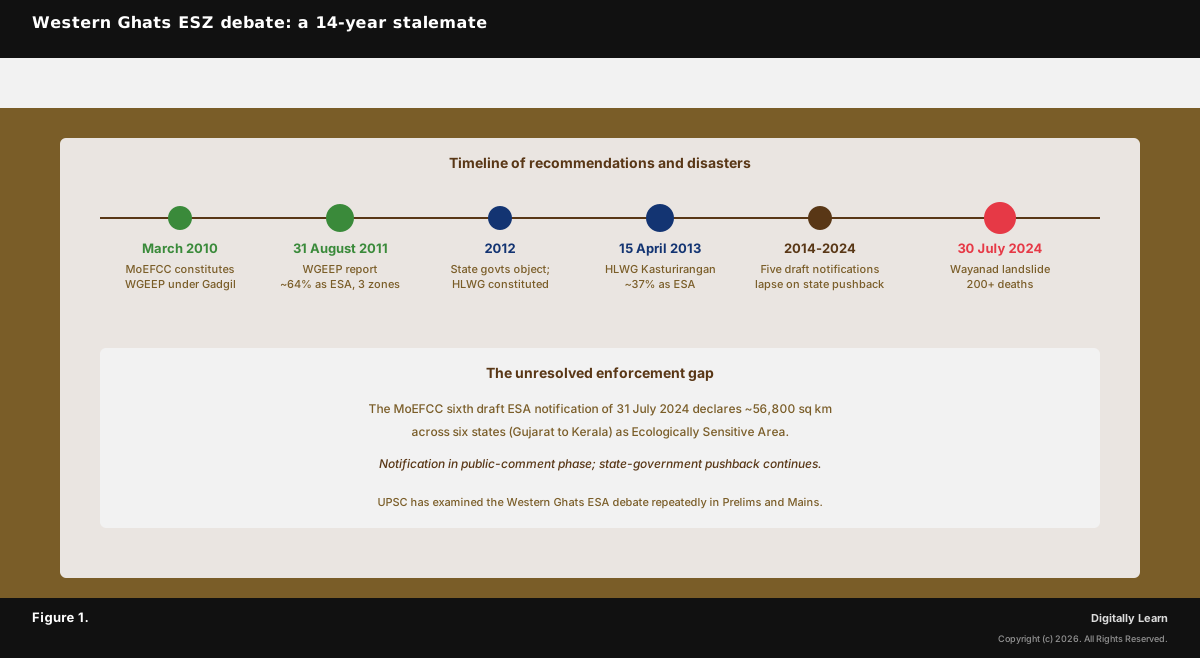
The Gadgil-Kasturirangan debate is the unresolved policy contest over Eco-Sensitive Zone protection across the Western Ghats. The Western Ghats Ecology Expert Panel (WGEEP), chaired by ecologist Madhav Gadgil, submitted its report on 31 August 2011, recommending that approximately 64 per cent of the Western Ghats be designated an Ecologically Sensitive Area in three regulatory zones. The High Level Working Group (HLWG), chaired by K. Kasturirangan, submitted its report on 15 April 2013 and revised the ESA extent down to approximately 37 per cent, distinguishing cultural landscape from natural landscape. State governments across the six Ghats states have resisted both reports, and MoEFCC draft ESA notifications have lapsed repeatedly. The unresolved enforcement gap was sharply illustrated by the Wayanad landslide of 30 July 2024, which killed more than 200 people and reopened the policy debate.
Background and Historical Context
The Western Ghats sustain the headwaters of the Krishna, Godavari, and Cauvery river systems for the entire peninsular Indian water economy, regulate the south-west monsoon mechanics, and host roughly 1,273 plant species endemic to the range along with India's third-highest amphibian endemism. Anthropogenic threats including hill-slope quarrying, hydropower expansion, plantation agriculture, mining, ribbon urbanisation, and tourism pressure have generated cumulative habitat fragmentation that the existing protected-area network alone cannot offset. UPSC has examined this debate repeatedly in Prelims; GS-III Mains questions concentrate on EIA, biodiversity-conservation legislation, carrying capacity, and the policy tension between development pressure and ecological integrity.
What is the significance of the Gadgil-Kasturirangan debate? The debate frames three structurally distinct questions. The science-policy boundary: WGEEP proposed regulatory zoning grounded in ecology while HLWG accepted the political constraint that already-modified cultural landscapes could not be reclassified backward, generating a fundamental disagreement on baseline. The federal politics of conservation: Western Ghats land lies in six state jurisdictions, each with separate political economies linking quarry operators, plantation lobbies, tourism interests, and small farmers, all of whom resist external regulation; central MoEFCC notifications have therefore failed to win state-government endorsement. The role of disasters as policy triggers: the Kerala floods of 2018 and the catastrophic Wayanad landslide of 30 July 2024 each forced political attention back to the Ghats without producing durable notification.
The MoEFCC issued its sixth draft ESA notification on 31 July 2024, the day after the Wayanad landslide, declaring approximately 56,800 square kilometres across six states, Gujarat, Maharashtra, Goa, Karnataka, Tamil Nadu, and Kerala, as Ecologically Sensitive Area. The draft is open for public comment and has drawn the standard state-government pushback. National Green Tribunal directions in cases such as Saving Mollem (Goa) and Athirappilly hydropower (Kerala) have increasingly intervened where state and central environmental clearance is contested. The Forest (Conservation) Amendment Act 2023 exempted infrastructure projects within 100 kilometres of international borders from forest clearance, a provision that does not directly affect the Western Ghats but signals the legislative drift away from blanket conservation strictures.
The Anthropogenic Threat Landscape Across the Western Ghats
Six pressure categories driving habitat loss
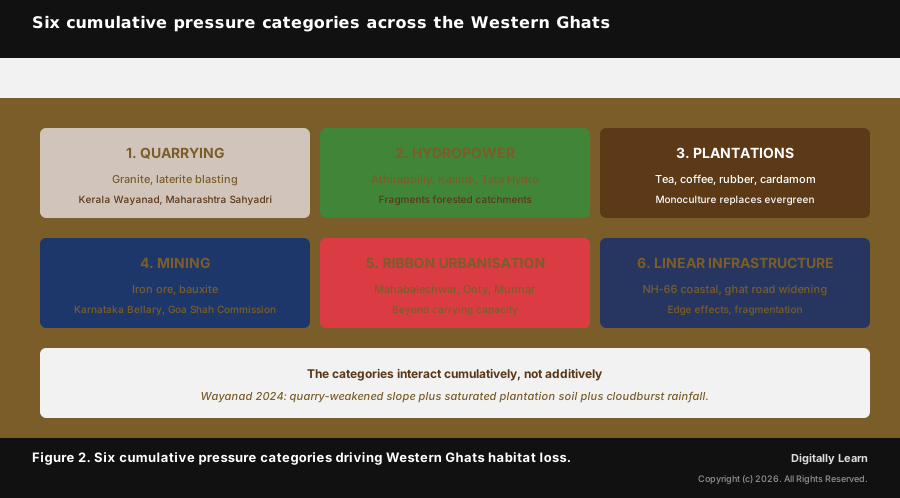
The Western Ghats face anthropogenic pressures that cumulate rather than offset. Six pressure categories drive habitat loss across the chain. Hill-slope quarrying for granite and laterite destabilises slopes through blasting and altered drainage; hill stations such as Mahabaleshwar and Ooty have seen quarry-driven sub-soil change in adjacent ridgelines.
Hydropower expansion, particularly under Maharashtra and Karnataka power policies, fragments forested catchments; the Athirappilly project in Kerala has been litigated for two decades. Plantation agriculture, principally tea, coffee, rubber, cardamom, and increasingly oil palm, has converted millions of hectares of evergreen forest to monoculture since the colonial era.
- Quarrying for granite and laterite: Slope destabilisation through blasting, altered drainage, debris loading; widespread in Kerala Wayanad, Karnataka Malenadu, Maharashtra Sahyadri.
- Hydropower expansion: Athirappilly, Kalindi, Tata Hydro projects fragment catchments; tunnel discharge alters sediment regimes downstream.
- Plantation agriculture: Tea, coffee, rubber, cardamom, oil palm; monocultures replace evergreen canopy across millions of hectares.
- Mining for iron ore and bauxite: Karnataka Bellary belt and Goa illegal mining cases (Shah Commission) caused decades of slope and stream damage.
- Ribbon urbanisation: Hill stations Mahabaleshwar, Ooty, Munnar, Madikeri have grown beyond carrying capacity with unregulated tourism infrastructure.
- Linear infrastructure: Highways NH-66 along the coast, ghat-section road widening for tourism, railway tunnels generate edge effects.
The Gadgil Committee (WGEEP) 2011 Report
Sixty-four per cent ESA recommendation and three regulatory zones
The Western Ghats Ecology Expert Panel was constituted by the MoEFCC in 2010 under the chairpersonship of Madhav Gadgil, ecologist and former chairperson of the Centre for Ecological Sciences, IISc Bangalore. The panel was asked to demarcate ecologically sensitive areas, recommend conservation measures, and review developmental project applications.
WGEEP submitted its report on 31 August 2011. The headline recommendation was that approximately 64 per cent of the Western Ghats be designated as Ecologically Sensitive Area. The ESA was further divided into three graded zones with progressively less stringent regulatory restrictions.
- ESZ-1 (Ecologically Sensitive Zone 1): Most stringent protection; no new mining, hydropower above 25 megawatts, polluting industry, or large-scale wind energy permitted; existing operations to be phased out.
- ESZ-2 (Ecologically Sensitive Zone 2): Moderate restrictions; existing developmental activities permitted with strict scrutiny; new large projects discouraged.
- ESZ-3 (Ecologically Sensitive Zone 3): Light restrictions; sustainable development with community participation; agroforestry and traditional livelihoods supported.
WGEEP additionally proposed the constitution of a Western Ghats Ecology Authority as a statutory body under the Environment (Protection) Act 1986 to coordinate the implementation. The report was grounded in the precautionary principle and treated the entire Western Ghats as one biogeographic unit. State governments objected that the recommendations were ecology-led without sufficient consultation on existing land use, generating the political pushback that prompted the constitution of the Kasturirangan working group.
The Kasturirangan Committee (HLWG) 2013 Report
Cultural versus natural landscape distinction and the 37 per cent ESA
The MoEFCC constituted the High Level Working Group on the Western Ghats in 2012 to revisit the WGEEP recommendations in light of state-government objections. The HLWG was chaired by K. Kasturirangan, space scientist and former chairperson of ISRO, and submitted its report on 15 April 2013.
The headline revision was to distinguish the land area into cultural landscape, meaning areas with significant settlement, plantations, agricultural fields, and built infrastructure, and natural landscape, meaning relatively undisturbed forest, scrub, and grassland. The HLWG recommended that the ESA designation cover only the natural landscape, totalling approximately 37 per cent of the Western Ghats or roughly 60,000 square kilometres.
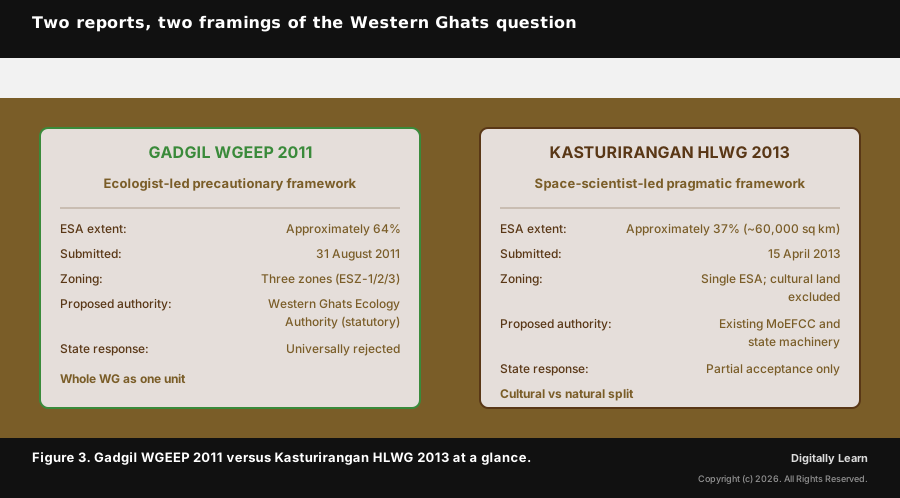
| Parameter | Gadgil WGEEP 2011 | Kasturirangan HLWG 2013 |
|---|---|---|
| Chairperson | Madhav Gadgil (ecologist) | K. Kasturirangan (space scientist) |
| Submission date | 31 August 2011 | 15 April 2013 |
| ESA extent | ~64% of Western Ghats | ~37% of Western Ghats |
| Approximate area | Not specified in WGEEP report | Approximately 60,000 sq km |
| Zoning | Three graded zones (ESZ-1, ESZ-2, ESZ-3) | Single ESA; cultural landscape excluded |
| Baseline philosophy | Precautionary; entire WG as biogeographic unit | Pragmatic; protect undisturbed natural landscape only |
| Proposed authority | Western Ghats Ecology Authority (statutory) | Existing MoEFCC and state machinery |
| State acceptance | Universally rejected | Partial acceptance; pushback from Kerala and Karnataka |
| Critic reaction | Gadgil endorsed; environmentalists supported | Gadgil critical; called HLWG approach insufficient |
State-Level Pushback: The Politics of Conservation
Kerala, Karnataka, Maharashtra, Goa, Tamil Nadu, and Gujarat responses
Both WGEEP and HLWG recommendations have faced sustained state-government resistance across the six Western Ghats states. The resistance reflects three structural drivers. Plantation lobbies in Kerala and Karnataka represent substantial economic interests organised through industry associations. Quarrying and small-scale mining provide local employment and rent extraction integral to district-level political economies in Goa, Maharashtra, and Karnataka. The federal politics of conservation create veto points: state legislatures, district administrations, and panchayats each can stall MoEFCC notification implementation.
- Kerala: Strong pushback against HLWG draft notification 2014; concerns about hill-slope plantations, settler livelihoods, and church-affiliated estates; periodic landslide events (2018 floods, 2024 Wayanad) reopen debate.
- Karnataka: Malenadu region pushback from coffee, areca-nut, and rubber estates; opposition to ESZ implementation around Kudremukh and Sahyadri tiger reserves.
- Maharashtra: Mining, hydropower, and tourism interests in Sahyadri; assembly resolutions opposing strict ESZ enforcement.
- Goa: Mining lobby resistance after the Shah Commission; ongoing NGT litigation over iron-ore mining and Saving Mollem National Park.
- Tamil Nadu: Tea and coffee estate interests in the Nilgiri-Anaimalai belt; concerns about ESZ overlap with existing tiger reserves.
- Gujarat: Smallest Western Ghats footprint (Dangs district); relatively limited pushback compared to southern states.
The Wayanad Landslide of 30 July 2024
More than 200 deaths and the policy debate it reopened
On 30 July 2024 in the early hours, a series of catastrophic landslides struck the villages of Punjirimattom, Mundakkai, Chooralmala, and Vellarimala in the Meppadi panchayat of Vythiri taluk, Wayanad district, Kerala. A second slide followed soon after the first.
The disaster killed more than 200 people, with scores more reported missing. The slides followed cloudburst rainfall of more than 370 millimetres in a 24-hour window over already-saturated hill slopes, mobilising debris and soil at a velocity that overwhelmed the downstream settlements. Wayanad lies within an area that the Gadgil WGEEP report had classified as ESZ-1, the most stringent zone, yet it carried no operative ESZ notification at the time of the disaster.
- Hill-slope quarrying: Post-event assessments documented active quarries close to the slide initiation zones, pointing to slope destabilisation upstream of the affected villages.
- Lapsed ESZ notification: A decade of draft circulation never reached implementation; Kerala had repeatedly objected to expanding the ESA classification over Wayanad.
- Climate overlay: Short-duration extreme rainfall over the Western Ghats has grown more frequent, raising the failure risk of modified slopes.
The Wayanad disaster reopened the policy debate on whether ecology-led zoning could have reduced the toll. Critics noted that the slide initiation zone fell within terrain the Gadgil panel had marked for the strictest protection, while supporters of the state position argued that settlement and livelihood patterns made retrospective zoning impractical.
The central response was procedural rather than structural. The MoEFCC issued its sixth draft ESA notification on 31 July 2024, the day after the disaster, declaring approximately 56,800 square kilometres across six states as Ecologically Sensitive Area, and reopened the same public-comment cycle that earlier drafts had failed to clear.
The Way Forward: NGT, Draft Notifications, and the Hotspot Integrity Imperative
Cumulative-impact assessment, state buy-in, climate adaptation
The way forward on Western Ghats conservation policy requires four institutional moves. The sixth draft ESA notification of 31 July 2024 must be finalised through genuine multi-state consultation rather than ad hoc state-by-state exclusions, replacing the cycle of lapsed drafts with a settled boundary. Cumulative-impact assessment, currently absent from project-by-project Environmental Impact Assessment, is needed to capture the aggregate effect of many small projects on a single catchment.
The National Green Tribunal has grown more active on Western Ghats disputes; sustained engagement on Saving Mollem (Goa) and Athirappilly hydropower (Kerala) provides a judicial backstop where executive action stalls. Finally, climate-adaptive land-use planning for hill stations and ridge settlements must replace the present pattern of post-disaster reconstruction without zoning change.
Previous Year UPSC-CSE Questions
Previous Year UPSC-CSE Questions By the end you will be able to draft model answers for the following UPSC questions. Each question carries a collapsible framework showing how to approach it in the exam.
- UPSC Prelims 2016 General Studies'Gadgil Committee Report' and 'Kasturirangan Committee Report', sometimes seen in the news, are related to
How to approach this Prelims question
Approach: Single-fact recall on the topical scope of two named expert-panel reports.
Trap to watch: Aspirants familiar with other Indian environmental policy debates may pick Ganga Action Plan or river linking. The trap is that both committee names point unambiguously to Western Ghats protection.
Key facts to recall:
- Gadgil Committee: WGEEP 2011; recommended ~64% Western Ghats as ESA; three regulatory zones.
- Kasturirangan Committee: HLWG 2013; revised to ~37% ESA; cultural vs natural landscape distinction.
- Connection: Both reports address Western Ghats Eco-Sensitive Zone designation.
- Status: MoEFCC draft notifications have lapsed repeatedly; sixth draft issued 31 July 2024.
Answer signal: protection of Western Ghats
- UPSC Prelims 2014 General StudiesWith reference to 'Eco-Sensitive Zones', which of the following statements is/are correct?
- Eco-Sensitive Zones are the areas that are declared under the Wildlife (Protection) Act, 1972.
- The purpose of the declaration of Eco-Sensitive Zones is to prohibit all kinds of human activities in those zones except agriculture.
Select the correct answer using the code given below.
How to approach this Prelims question
Approach: Two-statement evaluation testing knowledge of the legal basis for and purpose of Eco-Sensitive Zones.
Trap to watch: Aspirants may assume ESZ is declared under WLPA 1972 because it surrounds protected areas. The trap is that ESZ is an EPA 1986 instrument, not a WLPA 1972 instrument.
Key facts to recall:
- Legal basis of ESZ: Environment (Protection) Act 1986, NOT Wildlife (Protection) Act 1972.
- Function of ESZ: Shock absorber or transition area around protected areas.
- What is prohibited: Commercial mining, large industries, polluting industries, major hydropower.
- What is permitted: Agriculture, fishing, traditional livelihoods, regulated tourism, sustainable use.
Answer signal: Neither 1 nor 2
- UPSC Mains 2019 GS-IIIDefine the concept of carrying capacity of an ecosystem as relevant to an environment. Explain how understanding this concept is vital while planning for sustainable development of a region.
How to structure the answer in the exam
Introduction: Open by defining carrying capacity precisely: the maximum population size or cumulative anthropogenic load an ecosystem can sustain indefinitely given prevailing resources. The concept frames sustainable development by quantifying when ecosystem use crosses from renewable into degradative.
Body (sub-themes to develop):
- Conceptual foundation: Carrying capacity links biotic productivity, abiotic inputs (water, soil, climate), and assimilative capacity for waste; it is the operational definition of sustainability.
- Regional land-use zoning: Western Ghats Gadgil 64 per cent and Kasturirangan 37 per cent ESA recommendations are both carrying-capacity exercises at biome scale.
- Tourism management: Mahabaleshwar, Ooty, Munnar exceed peak-season carrying capacity for water, waste, and ridgeline vegetation; need permit systems and rotation.
- Water-resource allocation: Cauvery basin disputes (Karnataka, Tamil Nadu, Kerala) reflect over-allocation beyond hydrological carrying capacity in drought years.
- Waste-assimilation capacity: River pollution standards (BOD, COD) operationalise stream carrying capacity for organic load.
- Disaster-risk reduction: Wayanad 30 July 2024 landslide demonstrates that quarried and deforested slopes have a sharply lower carrying capacity for cloudburst rainfall.
Conclusion: Conclude by noting that carrying capacity is not a fixed scientific number but a contested management threshold; sustainable development planning requires institutional capacity to monitor, contest, and enforce carrying-capacity-based limits. The Western Ghats ESZ debate is a textbook case where carrying-capacity science (Gadgil 2011) has yet to translate into binding policy after fourteen years.
Sources and Further Reading
- Wikipedia – Western Ghats Ecology Expert Panel
- Wikipedia – K. Kasturirangan
- Wikipedia – 2024 Wayanad landslides
- Wikipedia – Western Ghats
- Wikipedia – Eco-Sensitive Zone
- Wikipedia – National Green Tribunal
- Wikipedia – Madhav Gadgil
- Wikipedia – 2018 Kerala floods
- Wikipedia – Forest (Conservation) Act, 1980
- Wikipedia – Ministry of Environment, Forest and Climate Change
Disclaimer
This article is an explainer for UPSC preparation and is not a substitute for primary documents. Figures on Ecologically Sensitive Area extent, panel recommendations, and disaster tolls should be cross-checked against the MoEFCC notifications, the WGEEP and HLWG reports, and official assessments. Readers should verify any figure against the source before citing it in an answer.