


Overview
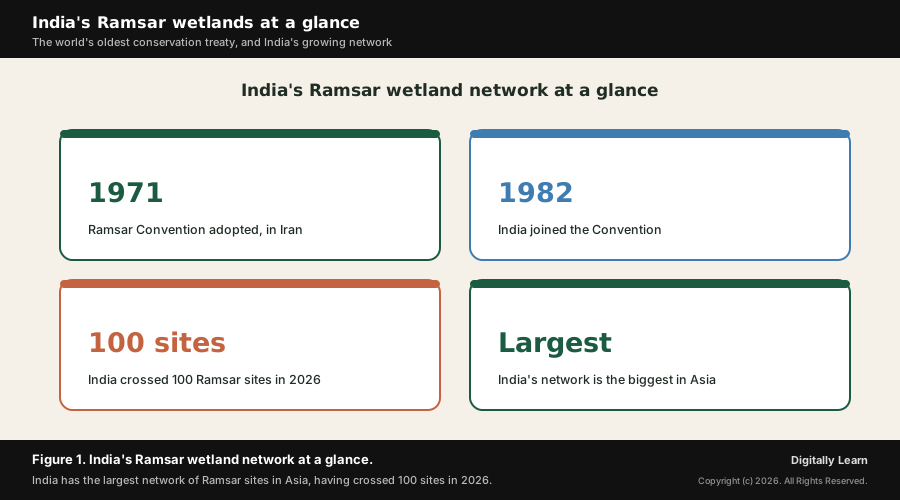
The Ramsar Convention on Wetlands is an intergovernmental treaty adopted in the city of Ramsar in Iran in 1971, the oldest of the modern global environmental agreements. It provides the framework for national action and international cooperation to conserve and make wise use of wetlands and their resources. A wetland listed under the Convention is called a Ramsar site, or a Wetland of International Importance. India became a party to the Convention in 1982 and designated its first two sites, Chilika Lake in Odisha and Keoladeo National Park in Rajasthan, in 1981. India today holds the largest network of Ramsar sites in Asia, having crossed one hundred sites in 2026.
The Ramsar Convention and India's Network of Wetland Sites
What the Ramsar Convention is and what a Ramsar site means
A wetland is land where water is the main force shaping the soil and the life it supports, including marshes, lakes, rivers, mangroves, lagoons and even coral reefs and shallow coasts. The global framework for protecting such places is the Ramsar Convention on Wetlands, an intergovernmental treaty adopted in the Iranian city of Ramsar in 1971 and named after it.
The Convention is the oldest of the modern global environmental agreements, predating most of the better-known treaties on climate and biodiversity. Its purpose is to provide the framework for national action and international cooperation for the conservation of wetlands and for their wise use, recognising that wetlands cross borders and that migratory species depend on them.
A wetland that a country places on the Convention's list is called a Ramsar site, formally a Wetland of International Importance. Listing is a pledge that the country will manage the site to keep its ecological character intact, and it brings the wetland into a worldwide network of protected places watched by the international community.
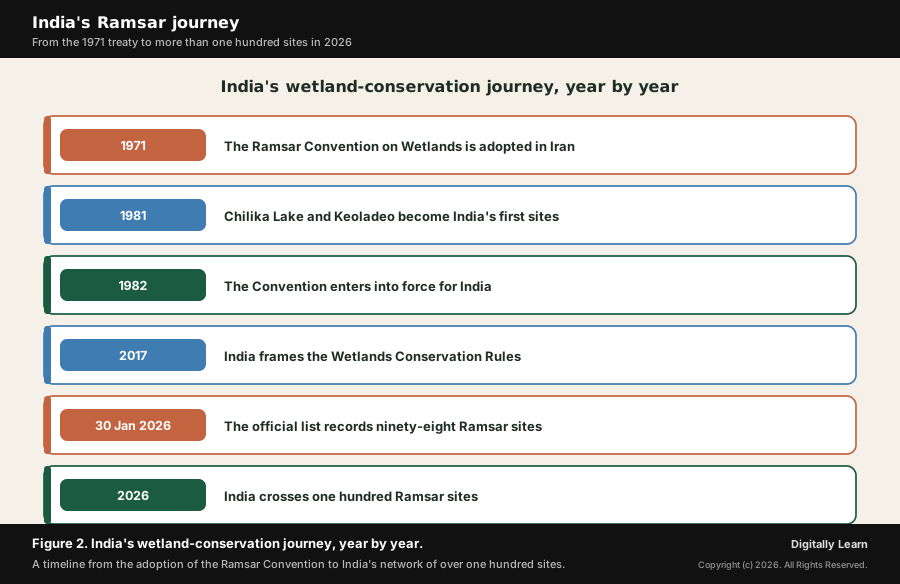
India became a Contracting Party to the Convention in 1982, when the treaty entered into force for the country. India had already named its first two wetlands, Chilika Lake in Odisha and Keoladeo National Park in Rajasthan, in 1981. The figure below sets out India's network at a glance.
Why Ramsar Sites Are in the News: India Crosses One Hundred
From ninety-eight to a hundredth designated site in 2026
Why it matters now is that India's network of Ramsar sites has grown rapidly and crossed a landmark. The official list of the Ministry of Environment, Forest and Climate Change dated 30 January 2026 recorded ninety-eight Ramsar sites, after two fresh additions, the Patna Bird Sanctuary in Uttar Pradesh and Chhari-Dhand in Gujarat, were announced ahead of World Wetlands Day.
Soon after, India designated its hundredth Ramsar site, the Jai Prakash Narayan Bird Sanctuary, also called Surha Tal, in Ballia district of Uttar Pradesh. Reaching one hundred sites makes India's the largest Ramsar network in Asia, a sharp rise from twenty-six sites about a decade earlier, which is why the milestone has drawn wide attention.
Because new wetlands are being designated frequently, the exact number changes through the year, so it is always read with its date. As of the most recent count in 2026, India holds over one hundred Ramsar sites, together covering more than one and a third million hectares of wetland.
Understanding the Significance of India's Ramsar Sites
Why protecting these wetlands matters for India
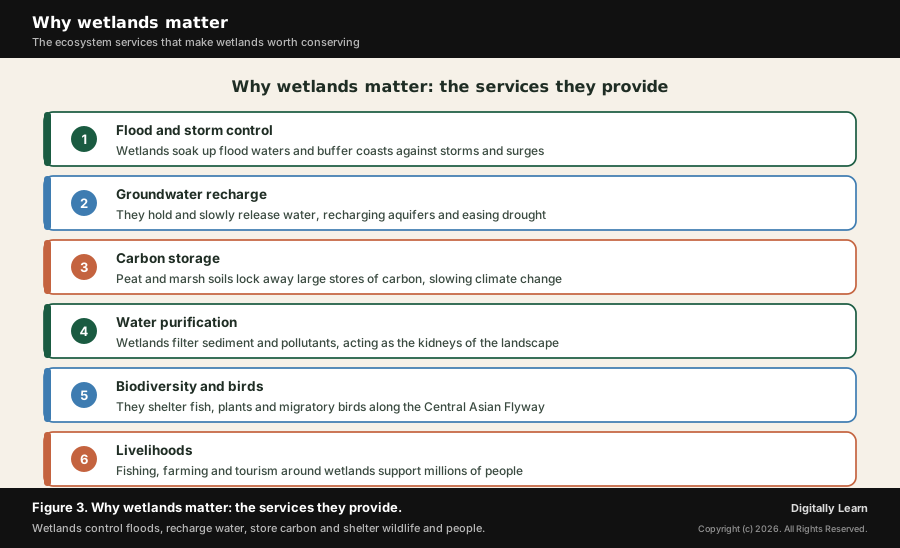
What is the significance of India's Ramsar sites lies first in what wetlands do for the country. They store and slowly release water, so they buffer both floods and droughts, recharge the groundwater on which farming depends, and trap sediment and pollutants, which is why wetlands are often called the kidneys of the landscape.
The deeper value is ecological and economic together. India's wetlands shelter fish, plants and vast flocks of migratory birds, and they support the fishing, farming and tourism that millions of people live on. By listing its most important wetlands as Ramsar sites, India commits to keeping these ecosystem services intact and signals that wetlands, long treated as wasteland to be drained, deserve protection alongside forests and wildlife.
The International Union for Conservation of Nature makes the same point at a global scale, noting that wetlands deliver valuable ecosystem services such as water purification and filtration, water storage and storm buffering, and calling for their protection, restoration and wise use. This is why the international community treats wetlands not as spare land but as working infrastructure that quietly does the job of cleaning water and absorbing floods.
How the Ramsar System Works: Wise Use, the Criteria and the Montreux Record
The wise-use principle at the heart of the Convention
The idea that holds the Convention together is wise use. Rather than fencing wetlands off, the Convention asks that they be used sustainably, so that people continue to fish, farm and draw water while the wetland keeps working as an ecosystem. Wise use is defined as the maintenance of a wetland's ecological character, achieved through ecosystem approaches, within the context of sustainable development.
This is a balance, not a ban. A wetland's ecological character is the combination of its water, soil, plants, animals and the services it provides, and wise use means managing human activity so that this character is not lost. The principle applies to every wetland in a country, not only to its listed Ramsar sites, which is why it shapes national wetland policy as a whole.
The nine criteria for a Wetland of International Importance
A wetland qualifies as a Ramsar site if it meets at least one of nine criteria agreed by the parties to the Convention. The criteria fall into two broad groups: one rewards wetlands that are rare or representative examples of a wetland type, and the other rewards wetlands that are important for conserving biological diversity.
| Group of criteria | What the wetland must show | Example |
|---|---|---|
| Representative or rare types | A rare, unusual or good representative example of a natural wetland type for its region | An intact mangrove or a high-altitude lake |
| Importance for biodiversity | Support for vulnerable or endangered species, or for large numbers of waterbirds, fish or other wildlife | A site holding more than twenty thousand waterbirds, or one percent of a species' population |
Reading the two groups together explains why such different places, from a tiny montane lake to a vast coastal mangrove, can all be Ramsar sites: a wetland can qualify either because of the type of habitat it represents or because of the wildlife it sustains, and many qualify on both counts.
The Montreux Record for wetlands under threat
The Convention also keeps a watch-list for sites in trouble, the Montreux Record. A Ramsar site is placed on this record when its ecological character has changed, is changing, or is likely to change as a result of human interference such as pollution, drainage or development. It is a flag for international attention and help, not a punishment.
Two Indian sites have been on the Montreux Record: Keoladeo National Park in Rajasthan, where a loss of water supply once damaged the wetland, and Loktak Lake in Manipur, affected by a dam and by the spread of floating vegetation. A common exam point is that being on the Montreux Record signals an adverse change in ecological character, nothing more elaborate. The timeline below traces India's wider Ramsar journey.
India's Wetlands and How They Vary: Flagship Sites and the Flyway
The many kinds of Indian wetland
India's wetlands are remarkably varied, because the country's geography is varied. They range from the high-altitude lakes of the Himalaya and Ladakh, through the rivers, floodplains, tanks and reservoirs of the plains, to the lagoons, mangroves, mudflats and coral reefs of the long coastline, so a single label covers very different ecosystems.
This variety is usually sorted into inland and coastal wetlands. Inland wetlands include natural lakes, rivers, marshes and ox-bow lakes as well as human-made tanks and reservoirs; coastal wetlands include estuaries, lagoons, backwaters, salt marshes, mangroves and reefs. Many of India's most crowded and most productive landscapes are built around such wetlands, which is part of why their conservation is difficult and important.
The full spread of these wetlands has been mapped from space. The National Wetland Inventory and Assessment, carried out by the Space Applications Centre of the Indian Space Research Organisation, used satellite imagery to record the country's wetlands at a scale of one to fifty thousand and to sort them into inland and coastal types. This national inventory is the baseline against which the loss and condition of India's wetlands are tracked.
Chilika, Keoladeo, the Sundarbans and Loktak
A few flagship sites show the range. Chilika Lake in Odisha, one of India's first two Ramsar sites, is the country's largest coastal lagoon, famous for its winter flocks of migratory birds and for the Irrawaddy dolphins that live in it. Keoladeo National Park at Bharatpur in Rajasthan, the other first site, is a man-made wetland that became one of the finest waterbird habitats in the region, though it has also been listed on the Montreux Record.
Two more sites mark the extremes. The Sundarban Wetland in West Bengal, part of the world's largest mangrove forest and home to the tiger, is India's single largest Ramsar site by area. Loktak Lake in Manipur, the largest freshwater lake in the north-east, is famous for its floating islands of vegetation called phumdis and, like Keoladeo, sits on the Montreux Record. Together these sites show how differently a Ramsar wetland can look from one part of India to another.
| Ramsar site | State | What makes it notable |
|---|---|---|
| Chilika Lake | Odisha | India's largest coastal lagoon; among the first two Ramsar sites; Irrawaddy dolphins and migratory birds |
| Keoladeo National Park | Rajasthan | A man-made waterbird wetland; among the first two sites; on the Montreux Record |
| Sundarban Wetland | West Bengal | Part of the world's largest mangrove forest; India's single largest Ramsar site by area |
| Loktak Lake | Manipur | The largest freshwater lake of the north-east; floating phumdi islands; on the Montreux Record |
Read together, the rows make the point that India's Ramsar sites are not a single kind of place: a coastal lagoon, a man-made bird wetland, a mangrove forest and a floating-island lake all sit under the same international label, which is exactly why a national framework is needed to manage them.
Wetlands and the Central Asian Flyway
Many of India's wetlands matter far beyond the country, because they lie on the Central Asian Flyway, one of the great routes along which migratory birds travel each year between their breeding grounds in the north and their wintering grounds in the south. India is a crucial wintering and staging area on this flyway.
Ramsar sites such as Chilika, Keoladeo and the wetlands of the plains are the resting and feeding stations that these long-distance travellers depend on. Protecting them is therefore an international duty as much as a national one, since the loss of a single key wetland can break a chain that stretches across many countries, which is part of why the Convention stresses cooperation between states.
The science behind this protection is led from within the government. The Wildlife Institute of India, the autonomous research body of the Ministry of Environment, Forest and Climate Change, assesses and monitors waterbird populations and aquatic habitats, and its work fed into the National Wildlife Action Plan that gives special emphasis to the recovery of aquatic ecosystems. Such monitoring is what turns a flyway map into hard knowledge of which wetlands the birds actually need.
India's Wetland-Conservation Architecture: Rules, Programmes and Threats
The Wetlands Rules, the NPCA and Amrit Dharohar
Beyond the international Convention, India conserves its wetlands through its own law and programmes. The central instrument is the Wetlands (Conservation and Management) Rules, 2017, framed under the country's environment-protection law, which prohibit damaging activities in notified wetlands and require each state to set up a Wetlands Authority to identify, notify and manage them.
Funding and technical support come through the National Plan for Conservation of Aquatic Ecosystems, a centrally sponsored scheme that helps states conserve both wetlands and lakes through survey, management plans and restoration work. More recently the Amrit Dharohar initiative, launched in 2023, promotes the conservation and wise use of Ramsar sites by encouraging local communities, eco-tourism and livelihoods around them, so that protection and people go together.
These instruments work alongside the wider conservation framework, including the protection given to wetlands that fall inside national parks and sanctuaries, such as Keoladeo and the Sundarbans. The point is that wetland conservation in India rests on a layered architecture of an international treaty, central rules, a funding scheme and a community initiative, each playing a distinct part.
Who manages wetlands: the institutional architecture
The institutional picture runs from the centre to the wetland itself. At the apex, the Ministry of Environment, Forest and Climate Change is the nodal ministry; it designates Ramsar sites, frames the rules and runs the national scheme. It is advised on the science and on management by bodies and expert groups that prepare guidelines for healthy wetlands.
Below the centre, each state or union territory sets up a State Wetlands Authority under the 2017 Rules to identify and notify wetlands, approve their management plans and regulate activities around them. At the ground level, the day-to-day care of a wetland often falls to the state forest or environment department and to local bodies and communities, especially where a Ramsar site lies inside a sanctuary.
This tiered arrangement, of the centre, the state authority and the local manager, is how India tries to turn a listing on paper into real protection on the water.
The threats wetlands face and why they keep shrinking
For all this architecture, India's wetlands remain under heavy pressure. The biggest threat is outright loss, as wetlands are drained or filled for farming, housing and industry, especially around fast-growing cities, where lakes and marshes are steadily built over. What survives is often degraded rather than destroyed.
- (a) Pollution. Untreated sewage, industrial effluent and farm runoff carry nutrients and toxins into wetlands, choking them with weeds and killing aquatic life.
- (b) Encroachment and reclamation. Wetlands are filled in for construction and agriculture, shrinking their area and cutting their ability to absorb floods.
- (c) Invasive species. Fast-spreading plants such as water hyacinth blanket the water surface, starving the wetland of light and oxygen.
- (d) Altered water flow. Dams, embankments and diversions change how much water reaches a wetland and when, damaging its ecological character.
Read together, these threats explain why simply listing a wetland is not enough: a Ramsar site can still decline, as Keoladeo and Loktak did, unless the rules are enforced, the water is kept clean and flowing, and the people who live around the wetland are given a stake in keeping it healthy. The figure below sets out why wetlands are worth this effort.
Ramsar Sites in Context: Climate, Global Goals and Indian Conservation
Where wetland conservation connects to wider debates
Contemporary linkages tie India's Ramsar sites to several larger stories. The first is climate change. Wetlands, and peatlands in particular, store great quantities of carbon, so draining them releases it, while healthy wetlands buffer the floods, droughts and storm surges that a warming climate makes worse, which makes wetland conservation a quiet but powerful form of climate action.
The second is the framework of global goals. Conserving wetlands feeds directly into the Sustainable Development Goals on clean water, life on land and life below water, and into the international targets for halting the loss of biodiversity, so India's growing Ramsar network is part of how it meets commitments it has made to the world.
The third is the place of wetlands within India's own conservation effort, which has long centred on forests and on flagship animals such as the tiger. The rapid growth of the Ramsar list, and initiatives such as Amrit Dharohar, mark an attempt to give wetlands and the species that depend on them, from the Irrawaddy dolphin to wintering cranes, a share of the same attention and resources.
Finally, the network connects to the everyday business of governance and livelihoods. Because most Indian wetlands are used by people for water, fishing and farming, their conservation cannot be separated from how cities plan, how rivers are managed and how rural communities earn a living, which is precisely the balance the wise-use principle is meant to strike.
UPSC Relevance and Exam Focus
Where this fits in the UPSC-CSE syllabus
This topic maps to General Studies Paper III: conservation, environment and biodiversity, with links to environmental treaties, the protection of ecosystems, and India's conservation laws and institutions.
For Prelims, hold the high-yield facts: the Ramsar Convention was adopted in 1971 and is the oldest such treaty; India joined in 1982; Chilika and Keoladeo were the first sites; the Montreux Record flags an adverse change in ecological character, with Keoladeo and Loktak the Indian sites once on it; the Sundarbans is India's largest Ramsar site; and India has the largest Ramsar network in Asia.
For Mains, the recurring framing is what a wetland is, how the Ramsar concept of wise use guides its conservation, and how India protects its wetlands through law and programmes, illustrated with Indian Ramsar sites. The 2018 question asking for the meaning of a wetland, the wise-use concept and two Indian examples is answered in full by this article.
Recurring linked concepts an aspirant should keep in working memory:
- Wise use: Maintaining a wetland’s ecological character through sustainable use, the core principle of the Ramsar Convention.
- Montreux Record: The Convention’s watch-list of Ramsar sites whose ecological character has changed or is likely to change.
- Ecosystem services: The benefits wetlands provide, such as flood control, groundwater recharge, carbon storage and habitat.
- Central Asian Flyway: The migratory-bird route for which India’s wetlands are vital wintering and staging grounds.
A common Prelims trap is to over-read the Montreux Record, for instance to assume it requires a buffer law or rests on cultural practice. It means only that a site's ecological character has changed, is changing or is likely to change through human interference.
A common Mains trap is to treat wise use as locking wetlands away from people. It means the opposite: managing human use so that the wetland keeps its ecological character, which is why community livelihoods sit at the centre of the answer.
Previous Year UPSC-CSE Questions By the end you will be able to draft model answers for the following UPSC questions. Each question carries a collapsible framework showing how to approach it in the exam.
- UPSC Mains 2018 GS-IIIWhat is wetland? Explain the Ramsar concept of 'wise use' in the context of wetland conservation. Cite two examples of Ramsar sites from India.
How to structure the answer in the exam
Body (sub-themes to develop):
- A wetland is an area where water, permanent or seasonal, shapes the ecosystem; it includes inland wetlands such as lakes, rivers and marshes and coastal wetlands such as estuaries, lagoons and mangroves.
- The Ramsar concept of wise use is the maintenance of a wetland's ecological character, achieved through ecosystem approaches, within the context of sustainable development, so that human use continues without degrading the wetland.
- Wise use balances conservation with the livelihoods of people who fish, farm and draw water from wetlands, and it applies to all wetlands, not only listed Ramsar sites.
- Chilika Lake in Odisha, India's largest coastal lagoon and among its first two Ramsar sites, illustrates wise use through regulated fishing and tourism alongside conservation of migratory birds and Irrawaddy dolphins.
- Keoladeo National Park in Rajasthan, the other first site, shows both the value and the fragility of a wetland, having been placed on the Montreux Record after its water supply was disrupted.
Sources and Further Reading
- Ramsar Convention: About the Convention on Wetlands
- Ramsar Convention: The Ramsar Sites Criteria
- Ramsar Convention: India country profile
- Ministry of Environment, Forest and Climate Change: Ramsar Sites of India (as on 30.01.2026)
- Press Information Bureau: Two new wetlands added to India's Ramsar List ahead of World Wetlands Day 2026
- Press Information Bureau: Jai Prakash Narayan Bird Sanctuary, India's 100th Ramsar site
- IUCN: Safeguarding the world's wetlands (ecosystem services and the wise use of wetlands)
- Wildlife Institute of India: National Wildlife Action Plan 2017-2031 (recovery of aquatic ecosystems)
- Space Applications Centre, ISRO: National Wetland Inventory and Assessment (NWIA) Atlas of India
- Wikipedia: List of Ramsar sites in India
- Wikipedia: Ramsar Convention
- Wikipedia: Chilika Lake
- Wikipedia: Keoladeo National Park
Editorial Disclaimer
This briefing is for UPSC preparation. Verify the figures and site details against the official Ramsar Convention, MoEFCC and PIB sources before relying on them.


