


Overview
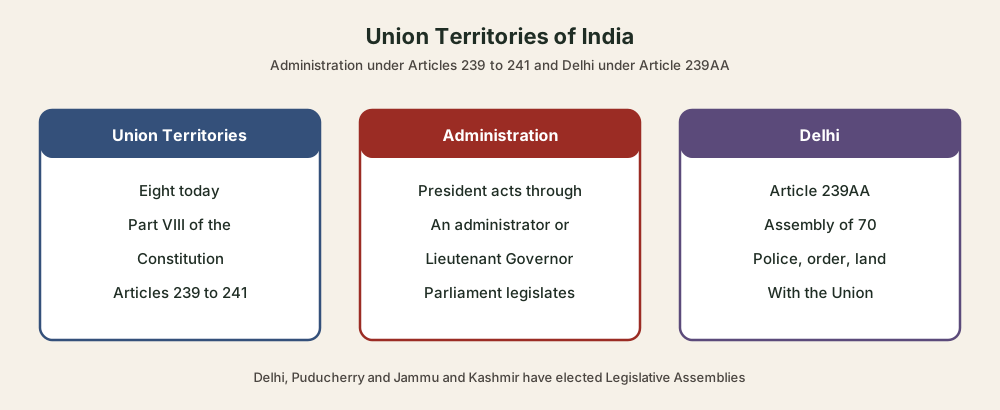
The union territories of India are eight regions governed directly by the Union rather than by a State government. The President administers each through an administrator under Articles 239 to 241; Delhi, Puducherry and Jammu and Kashmir also have elected Assemblies, and Delhi has special provisions under Article 239AA.
Union Territories of India: Meaning, List and Origins
Union Territory Meaning and Constitutional Basis: Article 1 and Part VIII
A Union Territory is a region governed directly by the Union Government, unlike a State, which has a government of its own. Article 1 says the territory of India comprises the territories of the States, the Union territories specified in the First Schedule and any territory that may be acquired. Part VIII of the Constitution, Articles 239 to 241, deals with how they are run, and Article 366(30) adds that the term covers any territory within India that the First Schedule does not name.
The territories were kept under the Union for different reasons, and the reason often explains how each is run today:
- Political and administrative reasons: Delhi and Chandigarh.
- Cultural distinctiveness: Puducherry, Dadra and Nagar Haveli, and Daman and Diu.
- Strategic importance: The Andaman and Nicobar Islands and Lakshadweep.
- Care of backward and tribal people: Mizoram, Manipur, Tripura and Arunachal Pradesh, which later became States.
Union Territories of India With Capital and High Court
The 8 union territories of India differ in size, status and set-up. Three have an elected Legislative Assembly and a Chief Minister; five are run by an administrator alone. Ladakh is the largest by area, and Lakshadweep is the smallest. Chandigarh also serves as the shared capital of two States, Punjab and Haryana.
| Union Territory | Capital | High Court |
|---|---|---|
| Andaman and Nicobar Islands | Sri Vijaya Puram (Port Blair) | Calcutta |
| Chandigarh | Chandigarh | Punjab and Haryana |
| Dadra and Nagar Haveli and Daman and Diu | Daman | Bombay |
| Delhi (Assembly) | New Delhi | Delhi |
| Jammu and Kashmir (Assembly) | Srinagar and Jammu | Jammu and Kashmir and Ladakh |
| Ladakh | Leh and Kargil (divisional headquarters) | Jammu and Kashmir and Ladakh |
| Lakshadweep | Kavaratti | Kerala |
| Puducherry (Assembly) | Puducherry | Madras |
Union Territories of India Map: Where the Eight Lie
The map of the Union Territories shows why most of them are small. Delhi and Chandigarh are city territories in the north, and Chandigarh sits between Punjab and Haryana, the two States whose capital it is. Only Jammu and Kashmir and Ladakh are large mountain regions, carved out of a State in 2019.
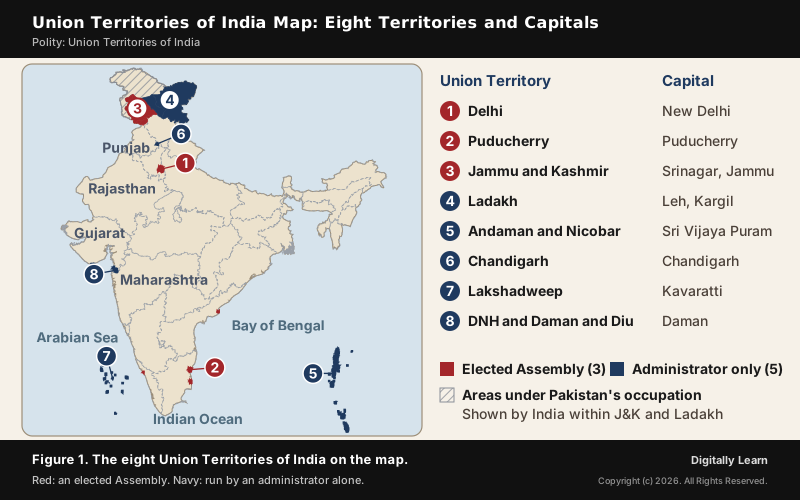
- Gujarat and Maharashtra: Dadra is a small enclave within Gujarat and Nagar Haveli lies between Gujarat and Maharashtra; Daman is an enclave on the southeast coast of Gujarat, and Diu is an island off its south-central coast.
- Arabian Sea: The Lakshadweep islands lie about 220 to 440 kilometres off the Malabar Coast, with about 32.62 square kilometres of land, and only ten of them are inhabited.
- Bay of Bengal: The Andaman and Nicobar Islands lie between the Bay of Bengal and the Andaman Sea, close to the Strait of Malacca, one of the major maritime routes, which is why their location helps India watch the shipping in the region.
- Tamil Nadu, Andhra Pradesh and Kerala: Puducherry is spread over four districts in three States, with Puducherry and Karaikal in Tamil Nadu, Yanam enclosed by Andhra Pradesh and Mahe by Kerala.
The two island groups therefore lie in the seas on either side of the peninsula, which is why they were kept under the Union for strategic reasons.
How Many Union Territories Are There in India: Changes From 1956 to 2020
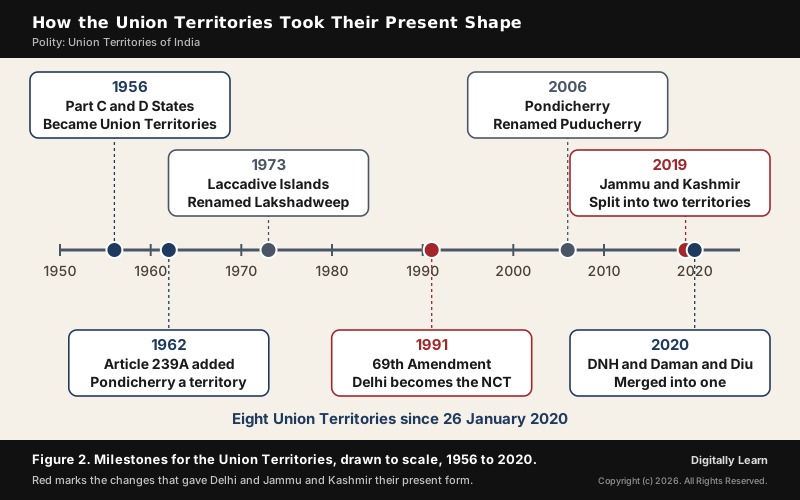
India has eight Union Territories today, but the number has changed often as territories became States, were merged or were newly created. Some of these areas were first made scheduled districts in 1874 under British rule and later became chief commissioners' provinces. The Constitution adopted in 1949 placed them among the Part C States, each run by a chief commissioner, and one Part D State, the Andaman and Nicobar Islands. In 1956 the 7th Constitutional Amendment and the States Reorganisation Act turned them into Union Territories; the politics of that reorganisation is told in the history of federalism and Centre-State relations.
- Acquired territories: Goa, Daman and Diu, and Dadra and Nagar Haveli came from the Portuguese; Puducherry from the French.
- Upgraded to statehood: Himachal Pradesh, Manipur, Tripura, Mizoram, Arunachal Pradesh and Goa were once Union Territories.
- Renamed: Lakshadweep was the Laccadive, Minicoy and Amindivi Islands until 1973; Pondicherry became Puducherry in 2006.
- 31 October 2019: The Jammu and Kashmir Reorganisation Act reconstituted the State into two Union Territories, Jammu and Kashmir and Ladakh.
- 26 January 2020: Dadra and Nagar Haveli and Daman and Diu were merged into one Union Territory.
Older books therefore speak of seven Union Territories, the count before the 2019 Act. For the three months between the two changes India had nine, and the merger of January 2020 brought the number to eight.
Administration of Union Territories Under Articles 239 to 241
Administrator and Lieutenant Governor Under Article 239
Under Article 239, every Union Territory is administered by the President, acting through an administrator whom the President appoints with a designation the President chooses: Lieutenant Governor, Chief Commissioner or Administrator. All Union Territories belong to one category, yet there is no uniformity in how they are run.
- Lieutenant Governor: Delhi, Puducherry, the Andaman and Nicobar Islands, Jammu and Kashmir, and Ladakh.
- Administrator: Chandigarh, Lakshadweep, and Dadra and Nagar Haveli and Daman and Diu.
An administrator is an agent of the President, not a head of State like a Governor of a State. The President may also make the Governor of a State the administrator of an adjoining Union Territory, and the Governor then acts independently of the State's Council of Ministers. That is how Chandigarh is run: the Governor of Punjab has been its administrator since 1984, and Gulab Chand Kataria has held the post since 27 July 2024. Lakshadweep, by contrast, has an administrator of its own at Kavaratti, who also acts as the territory's Inspector General of Police.
- Ministry of Home Affairs: The nodal ministry for Union Territory legislation, finance and budget, services and the appointment of Lieutenant Governors and Administrators.
- Home Minister’s Advisory Committee: The forum for Union Territories without a legislature, chaired by the Union Home Minister, with the administrator, the local Member of Parliament and members of local elected bodies.
- Zonal Councils: Union Territories sit in them with the States; Delhi, Chandigarh, Jammu and Kashmir and Ladakh are in the Northern Zonal Council. The councils are explained in the article on the Sarkaria Commission.
- Local bodies: Ladakh has no legislature, but its Leh and Kargil districts each elect an Autonomous Hill Development Council with some control over local policy and development funds.
Article 240 Regulations, Article 239B Ordinances and Article 241 High Courts
The other Articles in Part VIII adjust this basic model. Each answers a practical question: who makes the laws, who issues urgent orders and which court hears the cases.
| Article | What it provides |
|---|---|
| 239A | Parliament may by law create a legislature, a Council of Ministers, or both, for Puducherry (added by the 14th Amendment, 1962); the 2019 Act applied it to Jammu and Kashmir. Such a law is not an amendment under Article 368 |
| 239B | The administrator may issue an ordinance when the legislature is not in session, only on the President's instructions and never while it is dissolved; it lapses six weeks after the legislature reassembles |
| 240 | The President may make regulations for the Andaman and Nicobar Islands, Lakshadweep, Dadra and Nagar Haveli and Daman and Diu, and Puducherry (only when its legislature is dissolved or suspended); section 58 of the 2019 Act extends this to Ladakh |
| 241 | Parliament may constitute a High Court for a Union Territory, or extend the jurisdiction of a State's High Court to it |
A regulation under Article 240 has the same force as an Act of Parliament and can repeal or amend any Act of Parliament that applies to that territory, so for the island territories and Ladakh the President is in effect the law-maker. Chandigarh is not on the Article 240 list; its laws come from Parliament. Parliament itself can make laws on any subject of the three Lists, the State List included, for any Union Territory under Article 246(4), as explained in the article on the Seventh Schedule. This power continues even where a Union Territory has its own legislature; Puducherry and Jammu and Kashmir are covered in the article on Article 239A.
Courts follow the same logic. Delhi has had a High Court of its own since 1966, Jammu and Kashmir and Ladakh share one, and the rest fall under a neighbouring State's High Court, as Table 1 shows: the Andaman and Nicobar Islands under Calcutta, Lakshadweep under Kerala, Puducherry under Madras. The wider structure of the courts is explained in the article on High Courts.
Difference Between Union Territory and State
The difference between a Union Territory and a State lies in who holds power. A State shares power with the Centre under the Constitution; a Union Territory is under the direct control of the Centre, and any powers it has are largely granted by Parliament's laws.
| Point | State | Union Territory |
|---|---|---|
| Relationship with the Centre | Federal | Unitary |
| Executive head | Governor, a constitutional head | Administrator or Lieutenant Governor, an agent of the President |
| Set-up | Uniform | No uniformity |
| State List subjects | Parliament legislates only in special circumstances | Parliament can legislate on any subject |
| Rajya Sabha seats | Every State | Only Delhi (3), Puducherry (1) and Jammu and Kashmir (4) |
The Rajya Sabha row is a favourite of examiners. The Fourth Schedule allots seats to Delhi, Puducherry and Jammu and Kashmir, and Article 80(5) leaves the manner of choosing those members to Parliament's law; the Union Territories without a legislature have no Rajya Sabha seat. The article on federal features explains why this unequal pattern still fits a federal system.
Union Territories in Parliament, Presidential Election and Finance
Union Territories take part in national institutions in limited ways. Parliament, which under Article 79 consists of the President and the two Houses, legislates for them, and Article 81 allows not more than twenty members of the Lok Sabha to represent them, chosen as Parliament provides by law; Dadra and Nagar Haveli and Daman and Diu, for example, sends two.
For the President's election, the Explanation to Article 54, added by the 70th Amendment of 1992, counts the National Capital Territory of Delhi and Puducherry as States. The elected members of their Assemblies therefore belong to the electoral college, alongside the elected members of Parliament and of the State Assemblies.
Money follows the same pattern. The Constitution does not say how tax revenue is to be shared with Union Territories, as it does for States, and the Union decides their funds. When Jammu and Kashmir became two Union Territories, the Fifteenth Finance Commission made an adjustment of about 1 per cent and kept the share at 41 per cent for the remaining twenty-eight States; the article on the Finance Commission explains the scheme. Union Territories without a legislature levy UT-GST in place of State GST.
Delhi as the National Capital Territory Under Article 239AA
Delhi Assembly History: Part C State to the 69th Amendment
Delhi first got a Legislative Assembly on 17 March 1952, as a Part C State under the Government of Part C States Act, 1951; the Assembly had 48 members. On the States Reorganisation Commission's advice, Delhi ceased to be a Part C State from 1 November 1956 and came under the direct administration of the President.
In 1966 the Delhi Administration Act created a Metropolitan Council of 56 elected and 5 nominated members. It had no legislative powers and only an advisory role, so demands for a full Assembly continued. On 24 December 1987 the Union appointed a committee, first called the Sarkaria Committee and later the Balakrishnan Committee, which reported on 14 December 1989.
The committee advised that Delhi should remain a Union Territory but have a Legislative Assembly, and that the arrangement should be written into the Constitution to give the capital a special status. Parliament passed the 69th Constitutional Amendment Act, 1991, inserting Articles 239AA and 239AB, in force from 1 February 1992. The new Assembly first sat on 14 December 1993.
Is Delhi a Union Territory: National Capital Territory of Delhi Under Article 239AA
Yes. Delhi is a Union Territory, renamed by Article 239AA the National Capital Territory of Delhi, with its administrator designated the Lieutenant Governor. It is the only Union Territory whose Assembly is written into the Constitution itself, which is why it cannot be abolished by an ordinary law. Its main provisions follow.
- Assembly: 70 members, all directly elected; 12 seats are reserved for Scheduled Castes.
- Law-making: Any State List or Concurrent List subject, except public order, police and land (State List entries 1, 2 and 18).
- Parliament prevails: Where an Assembly law conflicts with a law of Parliament, Parliament’s law prevails, unless the Assembly law was reserved for the President and received assent.
- Council of Ministers: Not more than 10 per cent of the Assembly, so seven ministers including the Chief Minister, collectively responsible to the Assembly.
- Appointments: The President appoints the Chief Minister, and the other ministers on the Chief Minister’s advice; they hold office during the President’s pleasure.
- Differences: If the Lieutenant Governor and the ministers disagree on any matter, the Lieutenant Governor refers it to the President and acts on the decision, and may take immediate action meanwhile if the matter is urgent.
- Election Commission: It conducts the Assembly’s elections as it does for a State, because Articles 324 to 327 and 329 apply, and a result can be challenged only by an election petition.
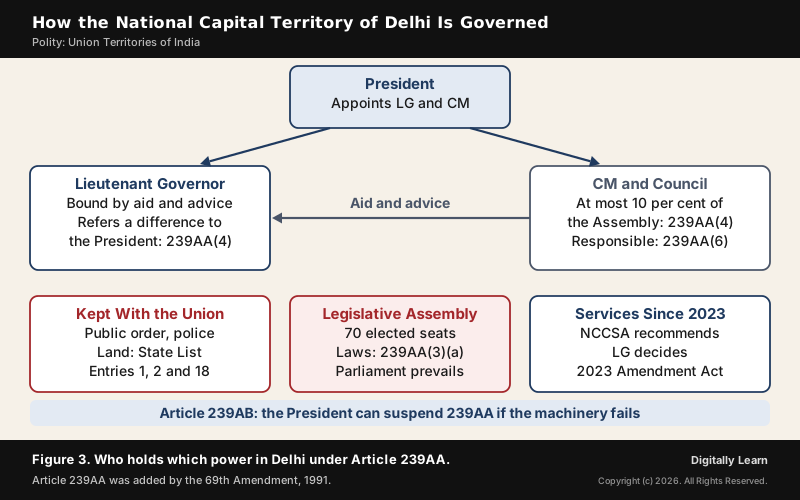
Article 239AB lets the President suspend Article 239AA if the administration cannot be carried on under it, on the Lieutenant Governor's report or otherwise. The President can then take over the territory's administration, much as Article 356 does for a State. The 106th Amendment of 2023 also reserves seats for women in the Assembly, from a date yet to be notified.
Lieutenant Governor of Delhi and the Elected Government
The proviso that lets the Lieutenant Governor of Delhi refer 'any matter' to the President led to years of conflict with the elected government. A notification of 2015 also kept services, the control of officers under State List entry 41, with the Lieutenant Governor.
A Constitution Bench ruled on 4 July 2018. The Lieutenant Governor is bound by the aid and advice of the Council of Ministers on matters within the Assembly's powers. The words 'any matter' cannot be read as 'every matter', so a reference to the President is for rare circumstances, such as national interest and finance. Delhi is sui generis, a class of its own, unlike the other Union Territories and yet not a State.
The dispute over services went back to the Court. On 11 May 2023 a five-judge Bench held that Delhi has legislative and executive power over services, except those related to public order, police and land, and that the Lieutenant Governor is bound by the elected government's decisions on them. Civil servants, it said, are part of a triple chain of command, in which officers answer to ministers, ministers to the legislature, and the legislature to the voters.
Parliament then reversed the result. An ordinance of 19 May 2023 was replaced by the Government of National Capital Territory of Delhi (Amendment) Act, 2023, which became law on 11 August 2023. It created the National Capital Civil Services Authority: the Chief Minister chairs it, with the Chief Secretary and the Principal Home Secretary; it decides by vote, but the Lieutenant Governor has the final decision. An amendment passed in 2021 had already provided that 'Government' in the Assembly's laws means the Lieutenant Governor.
Delhi Police, Municipal Bodies and the Full Statehood Debate
Several arms of government in Delhi lie outside the elected government's hands. Delhi Police, headed by the Police Commissioner, reports to the Ministry of Home Affairs, like the police of other Union Territories. The Municipal Corporation of Delhi, split into three bodies in 2012, was reunified on 22 May 2022, while the Delhi Cantonment Board is governed directly by the Ministry of Defence.
Delhi is also the centre of the National Capital Region, an interstate regional planning area created in 1985 that takes in satellite cities such as Ghaziabad, Faridabad, Gurgaon and Noida.
The demand for full statehood turns on the same tension. The Union argued in 2023 that, as the national capital, Delhi needs Union control over services, without which the Union could not discharge its national and international responsibilities. The Court, relying on its 2018 reasoning, replied that a representative government would be futile if the government that enjoys the people's confidence could not carry out policies within its legislative power. The Balakrishnan Committee had earlier advised that Delhi remain a Union Territory.
Previous Year UPSC-CSE Questions
Previous Year UPSC-CSE Questions By the end you will be able to draft model answers for the following UPSC questions. Each question carries a collapsible framework showing how to approach it in the exam.
- UPSC Mains 2018 GS-IIWhether the Supreme Court Judgement (July 2018) can settle the political tussle between the Lt. Governor and elected government of Delhi? Examine.
Answer outline: how to structure the answer
What the question asks, the main arguments, relevant examples and the direction of the conclusion. This is not a full model answer.
Introduction: The July 2018 Constitution Bench judgment defined the Lieutenant Governor's role under Article 239AA and called Delhi sui generis.
Body (sub-themes to develop):
- What it settled: aid and advice binding on matters within the Assembly's powers; 'any matter' is not 'every matter'; references to the President only in rare cases such as national interest and finance.
- What it left open: control of services, kept with the Lieutenant Governor by the 2015 notification and decided only in May 2023 by a five-judge Bench, which gave it to the elected government except for public order, police and land.
- What followed: the May 2023 ordinance and the August 2023 Act created the National Capital Civil Services Authority with the Lieutenant Governor having the final decision, so the tussle moved from the courts to the statute book.
Conclusion: Conclude that the judgment settled the principle but not the tussle, which depends on conventions and restraint between the two offices as much as on litigation.
- UPSC Mains 2016 GS-IIDiscuss the essentials of the 69th Constitutional Amendment Act and anomalies, if any, that have led to recent reported conflicts between the elected representatives and the institution of the Lieutenant Governor in the administration of Delhi. Do you think that this will give rise to a new trend in the functioning of the Indian federal politics?
Answer outline: how to structure the answer
What the question asks, the main arguments, relevant examples and the direction of the conclusion. This is not a full model answer.
Introduction: The 69th Amendment (1991), on the Balakrishnan Committee's advice, made Delhi the National Capital Territory with an Assembly and a Council of Ministers under Article 239AA.
Body (sub-themes to develop):
- Essentials: an Assembly of 70; State and Concurrent List powers except public order, police and land; a Council of not more than 10 per cent; Parliament's law prevails; Article 239AB for a breakdown.
- Anomalies: the proviso letting the Lieutenant Governor refer 'any matter' to the President; services kept with the Lieutenant Governor by the 2015 notification; police and land with the Union.
- New trend: the clash of an elected government with a Union-appointed head, which the courts later resolved by calling Delhi sui generis and making aid and advice binding; weigh whether it is a passing dispute or a pattern of asymmetric federalism in which the Union keeps the levers over a capital.
Conclusion: Conclude that a capital needs a special arrangement, and that it becomes a lasting trend only if clear lines between the offices and mutual restraint are missing.
- UPSC Prelims 2001 Prelims-GSMatch List I (Amendments to the Constitution) with List II (Contents), where List II reads A) Establishment of State-level Rent Tribunals Act, 1991, B) No reservations for Scheduled Castes in Panchayats in Arunachal Pradesh, C) Constitution of Panchayats in Villages or at other local levels, D) Accepting the recommendations of the Tenth Finance Commission, E) According the status of National Capital Territory to Delhi:
- I. The Constitution (Sixty-ninth Amendment) Act, 1991
- II. The Constitution (Seventy-fifth Amendment) Act, 1994
- III. The Constitution (Eightieth Amendment) Act, 2000
- IV. The Constitution (Eighty-third Amendment) Act, 2000
Select the correct answer using the codes given below the Lists:
How to approach this Prelims question
Approach: Step 1: fix the pair the article teaches: the 69th Amendment (1991) made Delhi the National Capital Territory, so I-E. Step 2: only options (a) and (c) begin I-E. Step 3: they differ on III and IV. The 80th Amendment (2000) rewrote Article 270 on the sharing of taxes, which followed the Tenth Finance Commission, so III-D; the 83rd Amendment (2000) inserted the Arunachal Pradesh exception on reservation for Scheduled Castes in panchayats, so IV-B. Step 4: that is option (a).
Trap to watch: Options (a) and (c) both begin I-E, II-A, so knowing only the Delhi pair is not enough; III and IV decide it.
Key facts to recall:
- (a) I-E, II-A, III-D, IV-B: right. 69th: Delhi; 75th: rent tribunals (Article 323B); 80th: the Tenth Finance Commission's tax-sharing scheme; 83rd: Arunachal Pradesh panchayats.
- (b) I-A, II-E, III-C, IV-D: wrong. It gives Delhi's status to the 75th Amendment, but it came from the 69th in 1991.
- (c) I-E, II-A, III-C, IV-D: wrong. Panchayats were created by the 73rd Amendment, not the 80th, and the 83rd did not deal with the Finance Commission.
- (d) I-A, II-E, III-D, IV-B: wrong. It swaps the 69th and 75th Amendments; the 69th created the National Capital Territory.
Answer signal: I-E, II-A, III-D, IV-B: option (a), the official answer, because the 69th Amendment gave Delhi its National Capital Territory status.
- UPSC Prelims 2009 Prelims-GSConsider the following statements :
- The Governor of Punjab is concurrently the Administrator of Chandigarh.
- The Governor of Kerala is concurrently the Administrator of Lakshadweep.
Which of the above statements is/are correct ?
How to approach this Prelims question
Approach: Step 1: statement 1: under Article 239 the President can make a neighbouring State's Governor the administrator, and the Governor of Punjab has administered Chandigarh since 1984; correct. Step 2: statement 2: Lakshadweep falls under the Kerala High Court, but its administrator is a separate appointee based at Kavaratti, not Kerala's Governor; incorrect. Step 3: only statement 1, option (a).
Trap to watch: Lakshadweep's link with Kerala through the High Court makes the second statement look plausible.
Key facts to recall:
- (a) 1 only: right. Punjab's Governor is Chandigarh's administrator; Lakshadweep's is not Kerala's Governor.
- (b) 2 only: wrong. Statement 2 is the incorrect one, and statement 1 is correct.
- (c) Both 1 and 2: wrong. Lakshadweep has its own administrator.
- (d) Neither 1 nor 2: wrong. Statement 1 is correct.
Answer signal: 1 only: option (a), the official answer, because only Chandigarh is run by a neighbouring State's Governor.
- UPSC Prelims 2003 Prelims-GSWhich one of the following High Courts has the territorial jurisdiction over Andaman and Nicobar Islands?
How to approach this Prelims question
Approach: Step 1: Article 241 lets Parliament extend a State's High Court to a Union Territory. Step 2: the Andaman and Nicobar Islands come under the Calcutta High Court, as Table 1 shows. Step 3: the other courts serve Union Territories or States elsewhere.
Trap to watch: The islands lie closer on the map to Chennai and the Andhra and Odisha coasts, which tempts a guess by distance.
Key facts to recall:
- (a) Andhra Pradesh: wrong. That High Court serves its own State, not the islands.
- (b) Calcutta: right. The Calcutta High Court's jurisdiction covers the Andaman and Nicobar Islands.
- (c) Madras: wrong. The Madras High Court covers Puducherry among the Union Territories.
- (d) Orissa: wrong. It serves Odisha alone.
Answer signal: Calcutta: option (b), the official answer.
- UPSC Prelims 2012 Prelims-GSConsider the following statements :
- Union Territories are not represented in the Rajya Sabha.
- It is within the purview of the Chief Election Commissioner to adjudicate the election disputes.
- According to the Constitution of India, the Parliament consists of the Lok Sabha and the Rajya Sabha only.
Which of the statements given above is/are correct?
How to approach this Prelims question
Approach: Step 1: statement 1: the Fourth Schedule gives Rajya Sabha seats to Delhi (3), Puducherry (1) and Jammu and Kashmir (4); incorrect. Step 2: statement 2: an election can be questioned only by an election petition decided by the courts, not by the Chief Election Commissioner; incorrect. Step 3: statement 3: under Article 79 Parliament consists of the President and the two Houses; incorrect. Step 4: none is correct, option (d).
Trap to watch: Statement 1 sounds right because five of the eight Union Territories have no seat.
Key facts to recall:
- (a) 1 only: wrong. Union Territories with legislatures do have Rajya Sabha seats.
- (b) 2 and 3: wrong. Election disputes go to the courts by election petition, and Parliament includes the President.
- (c) 1 and 3: wrong. Both statements are incorrect.
- (d) None: right. All three statements are incorrect.
Answer signal: None: option (d), the official answer, because each statement contradicts the Constitution.
Sources and Further Reading
- Legislative Department, Ministry of Law and Justice: The Constitution of India
- Supreme Court of India: Government of NCT of Delhi v. Union of India, Constitution Bench, 11 May 2023
- Legislative Assembly Secretariat, NCT of Delhi: About Delhi Assembly (origin and growth)
- Legislative Assembly Secretariat, NCT of Delhi: Delhi Metropolitan Council
- NCERT: Indian Constitution at Work, Class 11, Chapter 7, Federalism
- Inter-State Council Secretariat: Zonal Councils, Genesis
- Finance Commission of India: Report of the Fifteenth Finance Commission, Volume I
- Wikipedia: Union territory
- Wikipedia: Government of Delhi
- Wikipedia: Lieutenant Governor of Delhi
- Wikipedia: Government of National Capital Territory of Delhi (Amendment) Act, 2023
- Wikipedia: Dadra and Nagar Haveli and Daman and Diu
- Wikipedia: Ladakh
- Wikipedia: Jammu and Kashmir (union territory)
- Wikipedia: Andaman and Nicobar Islands
- Wikipedia: Lakshadweep
- Wikipedia: Delhi
- Wikipedia: Jammu and Kashmir Reorganisation Act, 2019
- Wikipedia: Chandigarh
- The Jammu and Kashmir Reorganisation Act, 2019 (Act 34 of 2019), gazette text
- Wikipedia: 2025 Delhi Legislative Assembly election
- Wikipedia: Taranjit Singh Sandhu
- The Hindu (Delhi): Delhi L-G launches drive to revive over 100 water bodies, 17 May 2026
- Wikipedia: Puducherry (union territory)
Editorial Disclaimer
This article explains the Union Territories from the Constitution's text, the Supreme Court's judgment, the Delhi Assembly's records and the other sources listed.


