


Overview
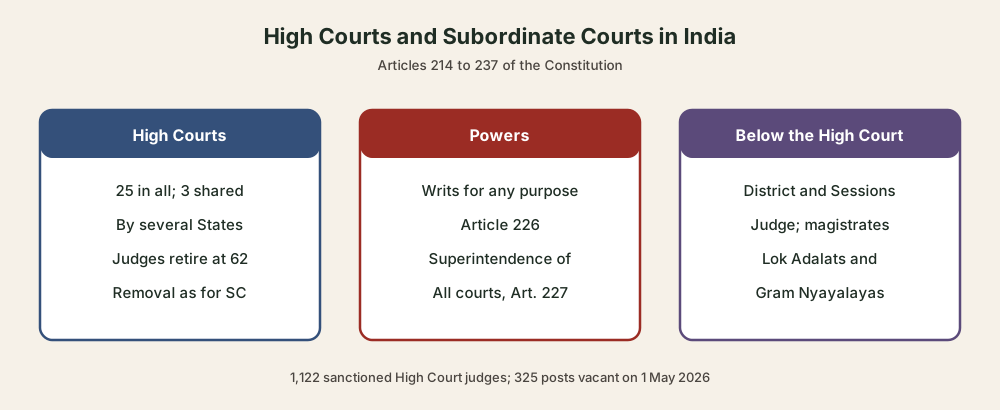
The High Courts in India head the judiciary of each State under Articles 214 to 231. There are 25 of them, three shared by more than one State. Their judges are appointed on the collegium's recommendation, retire at 62, issue writs for any legal right under Article 226, supervise every court and tribunal in their territory under Article 227, and control the district courts below them.
High Courts in India: Number, Origin and Territorial Jurisdiction
How Many High Courts in India: 25 Courts Under Articles 214 to 231
In India's single integrated judicial system, the High Court stands below the Supreme Court and above the subordinate courts, and it heads the judicial administration of a State. Articles 214 to 231 in Part VI deal with its organisation, independence, jurisdiction and powers. Article 214 says there shall be a High Court for each State, and Article 216 gives each one a Chief Justice and such other judges as the President appoints, so the Constitution fixes no number.
- How many: There are 25 High Courts, with a combined sanctioned strength of 1,122 judges on 1 May 2026.
- The oldest: The High Courts of Calcutta, Bombay and Madras were set up in 1862, and Calcutta, which came into existence on 14 May 1862, is the oldest. Allahabad followed in 1866.
- After 1950: The High Court of each province became the High Court of the corresponding State.
The number of High Courts in India has grown as States were created and separated. In 2013, for example, Manipur, Meghalaya and Tripura received High Courts of their own, and the Department of Justice's current list includes separate High Courts for Andhra Pradesh and Telangana.
Common High Courts and Union Territories (Articles 230 and 231)
The Seventh Amendment of 1956 let Parliament set up a common High Court for two or more States, or for two or more States and a Union Territory, now Article 231. Article 230 lets Parliament extend a High Court's jurisdiction to a Union Territory or exclude it. Three High Courts serve more than one State today, and several State High Courts also cover Union Territories.
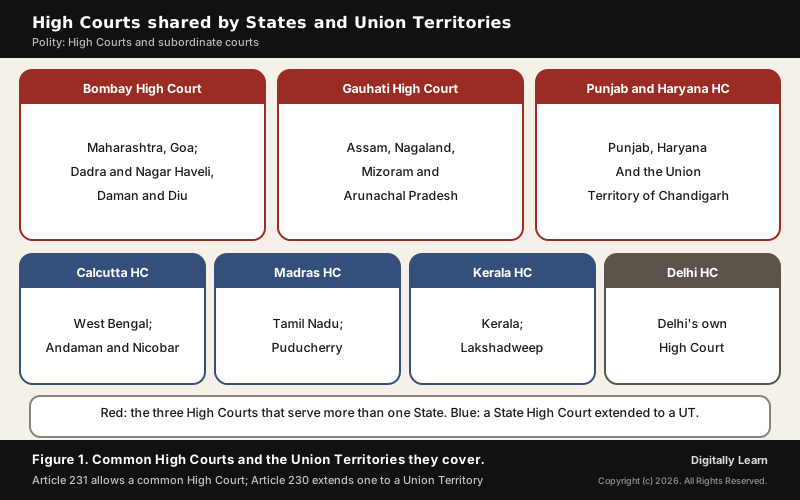
Delhi has had a High Court of its own since 1966, and the High Court of Jammu and Kashmir and Ladakh now serves those two Union Territories. So Article 214's promise of a High Court for each State does not mean that every State has one inside its territory.
Judges of the High Court: Appointment, Tenure, Transfer and Removal
Appointment and Qualifications of High Court Judges (Article 217)
Every High Court judge is appointed by the President by warrant under Article 217, after consultation with the Chief Justice of India, the Governor of the State and, for judges other than the Chief Justice, the Chief Justice of that High Court. For a common High Court, the Governors of all the States concerned are consulted.
In practice the collegium governs the choice. The Second Judges Case (1993) held that no appointment can be made unless it conforms to the opinion of the Chief Justice of India, and the Third Judges Case (1998) required him to consult the two senior-most judges of the Supreme Court. Under the Memorandum of Procedure, the proposal starts with the High Court's Chief Justice and two senior-most puisne judges; the State Government's views are taken; and only names the Supreme Court collegium recommends are appointed. The collegium system for the Supreme Court works the same way.
- Must be a citizen of India.
- Must have held a judicial office in India for at least ten years, or been an advocate of a High Court for at least ten years.
- Unlike the Supreme Court, there is no route for a distinguished jurist, and no minimum age is prescribed.
Retirement at 62, Transfer and Removal of High Court Judges
A High Court judge holds office until the age of 62, raised from 60 by the Fifteenth Amendment of 1963; a Supreme Court judge serves until 65. A question about a High Court judge's age is decided by the President after consulting the Chief Justice of India. A judge may resign by writing to the President, and the office falls vacant on appointment to the Supreme Court or on transfer to another High Court.
Under Article 222 the President may transfer a judge from one High Court to another after consulting the Chief Justice of India. The Court held in 1977 that transfers are an exceptional measure in the public interest, not a punishment, and in the Third Judges Case that the Chief Justice of India must consult the collegium and the Chief Justices of both High Courts involved.
A High Court judge is removed in exactly the same way as a Supreme Court judge: an order of the President after an address by each House of Parliament passed by a special majority, on the grounds of proved misbehaviour or incapacity, under the Judges (Inquiry) Act, 1968. No High Court judge has been removed so far.
Additional, Acting and Retired Judges and Practice After Retirement
- Additional judges (Article 224): Appointed by the President for up to two years when business increases temporarily or arrears build up.
- Acting judges: Appointed when a permanent judge other than the Chief Justice is absent or acting as Chief Justice; neither additional nor acting judges may serve beyond 62.
- Acting Chief Justice: Appointed by the President when the office is vacant or the Chief Justice is absent or unable to act.
- Retired judges (Article 224A): May be asked to sit again, with the previous consent of the President and of the person concerned.
After retirement, Article 220 bars a permanent High Court judge from pleading or acting in any court or before any authority in India except the Supreme Court and the other High Courts. A retired Supreme Court judge faces a total bar; a retired High Court judge may still practise in those two kinds of court.
Salaries, Independence and Vacancies in the High Courts
High Court judges' salaries, allowances and the court's administrative expenses are charged on the Consolidated Fund of the State, so the State legislature cannot vote on them, though it may discuss them. Their pensions are charged on the Consolidated Fund of India. Their service conditions cannot be varied to their disadvantage after appointment, except in a financial emergency, and Article 229 lets the Chief Justice appoint the court's own staff.
| Point | Supreme Court judge | High Court judge |
|---|---|---|
| Appointment | Article 124(2), collegium of the CJI and four senior-most judges | Article 217, collegium of the CJI and two senior-most judges |
| Qualification | 5 years as a High Court judge, 10 years as an advocate, or a distinguished jurist | 10 years in judicial office or as an advocate |
| Retirement | 65 | 62 |
| Oath | Before the President | Before the Governor |
| Salary charged on | Consolidated Fund of India | Consolidated Fund of the State |
| After retirement | May not plead in any court in India | May plead in the Supreme Court and other High Courts |
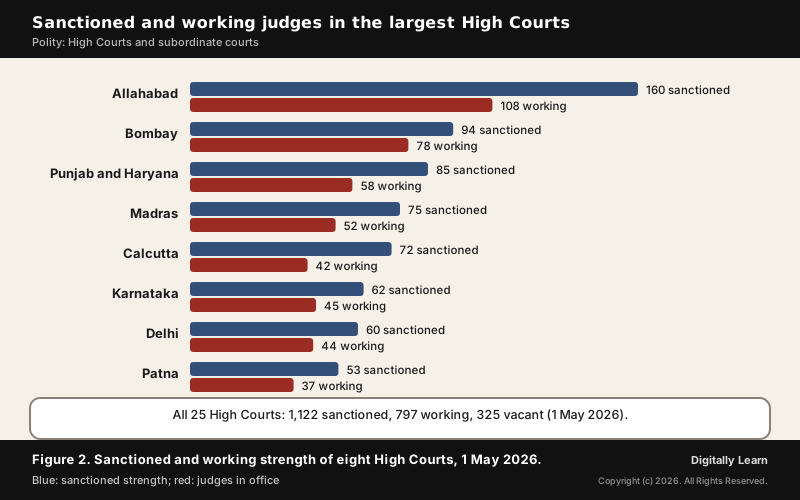
Vacancies are a lasting problem. On 1 May 2026, against a sanctioned strength of 1,122, 797 judges were working and 325 posts were vacant. Allahabad, with the largest sanctioned strength of 160 judges, had 108 in office. The Memorandum of Procedure asks High Courts to recommend names at least six months before a vacancy, a time limit the Law Ministry says is rarely observed.
Jurisdiction and Powers of the High Courts
Original and Writ Jurisdiction Under Article 226
A High Court's original jurisdiction covers matters such as admiralty, wills, marriage, divorce, company law and contempt of court; disputes over the election of members of Parliament and State legislatures; revenue matters; and cases transferred from lower courts that raise a question of constitutional interpretation. The High Courts of Calcutta, Bombay, Madras and Delhi also have original civil jurisdiction in cases of higher value.
Every High Court has power under Article 226 to issue writs, including habeas corpus, mandamus, prohibition, quo warranto and certiorari, "for the enforcement of any of the rights conferred by Part III and for any other purpose". The Supreme Court's writ power under Article 32 is limited to Fundamental Rights, so a High Court's is wider in purpose, though its territorial reach is its own area or wherever the cause of action arises. The two are concurrent: a person may approach either court.
Appellate and Supervisory Jurisdiction (Article 227)
A High Court is primarily a court of appeal for the subordinate courts in its territory, in both civil and criminal matters, and its appellate jurisdiction is wider than its original jurisdiction.
- Civil: First appeals from district courts on law and fact; second appeals on questions of law only; intra-court appeals from a single judge to a division bench in some High Courts.
- Criminal: Appeals from sessions courts where the sentence exceeds seven years’ imprisonment. A death sentence passed by a sessions court must be confirmed by the High Court before it can be carried out, whether or not there is an appeal.
- Tribunals: Appeals from administrative and other tribunals lie to a division bench of the High Court.
Every High Court has superintendence under Article 227 over all courts and tribunals in its territory, except military courts. It covers administrative and judicial superintendence and can be used on the court's own motion, but it is an extraordinary power, used sparingly for excess of jurisdiction, gross violation of natural justice, error of law or manifest injustice.
Court of Record, Review and Judicial Review by High Courts
Under Article 215 every High Court is a court of record, with power to punish for contempt of itself. As a court of record it can also review and correct its own judgments, though no specific power of review is conferred on it by the Constitution; the Supreme Court's power of review, by contrast, is express in Article 137.
High Courts also exercise judicial review over Central and State laws and executive orders, on the strength of Articles 13 and 226. The 42nd Amendment tried to stop them from ruling on the validity of Central laws by inserting Article 226A, but the 43rd Amendment omitted it with effect from 13 April 1978.
High Courts and Tribunals: Articles 323A, 323B and the Chandra Kumar Case
The original Constitution had no provision on tribunals. The 42nd Amendment of 1976 added Part XIV-A: Article 323A lets Parliament set up administrative tribunals for disputes on recruitment and service conditions of public servants, and Article 323B lets Parliament and the State legislatures set up tribunals for taxation, foreign exchange, industrial and labour matters, land reforms, urban property ceilings, elections, foodstuffs and rent.
Under Article 323A, Parliament passed the Administrative Tribunals Act, 1985, and the Central Administrative Tribunal was set up the same year. Appeals from it originally lay only to the Supreme Court. In L. Chandra Kumar v. Union of India (1997) the Court struck down the provisions of both articles that excluded the High Courts and the Supreme Court, holding judicial review to be part of the basic structure.
Since Chandra Kumar, appeals against an order of the Central Administrative Tribunal lie first to a division bench of the High Court, and the writ jurisdiction of the High Courts and the Supreme Court cannot be ousted even by a constitutional amendment. Tribunals therefore supplement the High Courts rather than replace them.
Subordinate Courts Under Articles 233 to 237
Appointment of District Judges and the State Judicial Service
The subordinate courts are the courts below the High Court at the district level and below. Under Article 233, district judges are appointed, posted and promoted by the Governor in consultation with the High Court. A person not already in the service of the Union or a State is eligible only if he or she has been an advocate or pleader for at least seven years and is recommended by the High Court.
- Other judicial posts (Article 234): Filled by the Governor after consulting the State Public Service Commission and the High Court.
- Control (Article 235): Posting, promotion and leave of judicial officers below the district judge are vested in the High Court.
- Meaning of district judge (Article 236): Includes a judge of a city civil court, additional and assistant district judges, the chief judge of a small cause court, the chief presidency magistrate and sessions judges.
Structure of Civil and Criminal Courts in a District
The structure below the High Court is laid down by each State, so names differ slightly, but there are broadly three tiers. The District and Sessions Judge heads the district with original and appellate jurisdiction: called the district judge in civil cases and the sessions judge in criminal cases. A sessions judge can impose any sentence, including death, subject to the High Court's confirmation.
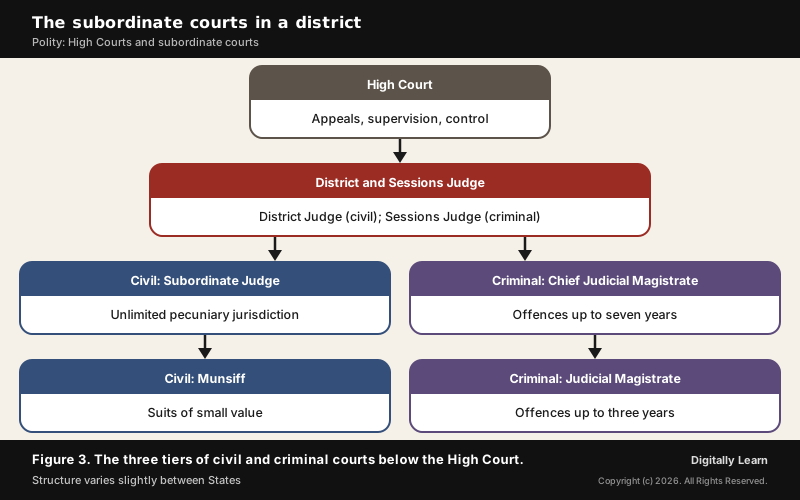
Below the district judge sit the Subordinate Judge on the civil side, with unlimited pecuniary jurisdiction, and the Chief Judicial Magistrate on the criminal side, for offences punishable up to seven years. At the lowest level are the Munsiff and the Judicial Magistrate, who tries offences punishable up to three years. Metropolitan cities have city civil courts and metropolitan magistrates, and some States have small causes courts and panchayat courts for petty cases.
Alongside the regular courts, Lok Adalats under the Legal Services Authorities Act, 1987 settle pending and pre-litigation disputes by agreement, and Gram Nyayalayas under the 2008 Act bring a mobile court of a first-class magistrate to the intermediate panchayat level.
Previous Year UPSC-CSE Questions
Previous Year UPSC-CSE Questions By the end you will be able to draft model answers for the following UPSC questions. Each question carries a collapsible framework showing how to approach it in the exam.
- UPSC Mains 2018 GS-IIHow far do you agree with the view that tribunals curtail the jurisdiction of ordinary courts? In view of the above, discuss the constitutional validity and competency of the tribunals in India.
Answer outline: how to structure the answer
What the question asks, the main arguments, relevant examples and the direction of the conclusion. This is not a full model answer.
Introduction: The 42nd Amendment added Articles 323A and 323B to create tribunals for specialised disputes.
Body (sub-themes to develop):
- Curtailment: service and other disputes moved out of civil courts and High Courts; original bar on High Court appeals.
- Validity: Chandra Kumar 1997 struck down the exclusion; judicial review is basic structure; appeals to High Court division benches.
- Competency: expertise and speed against independence and appointment concerns.
Conclusion: Conclude that tribunals supplement rather than supplant the High Courts.
- UPSC Mains 2019 GS-II“The Central Administrative Tribunal which was established for redressal of grievances and complaints by or against central government employees, nowadays is exercising its powers as an independent judicial authority.” Explain.
Answer outline: how to structure the answer
What the question asks, the main arguments, relevant examples and the direction of the conclusion. This is not a full model answer.
Introduction: The Central Administrative Tribunal was set up in 1985 under Article 323A for service disputes of Central employees.
Body (sub-themes to develop):
- Purpose: speedy, inexpensive justice in service matters.
- Independence: members with judicial and administrative backgrounds; natural justice rather than civil procedure.
- Limits: appeals now lie to High Court division benches after Chandra Kumar.
Conclusion: Conclude that the CAT is an independent adjudicator within, not outside, the judicial system.
- UPSC Prelims 2008 Prelims-GSHow many High Courts in India have jurisdiction over more than one State (Union Territories not included)?
How to approach this Prelims question
Approach: Count the High Courts whose jurisdiction covers more than one State, leaving out Union Territories: Bombay (Maharashtra and Goa), Gauhati (Assam, Nagaland, Mizoram and Arunachal Pradesh) and Punjab and Haryana. That makes three.
Trap to watch: Counting Union Territories raises the number.
Key facts to recall:
- (a) 2: wrong. Three High Courts serve more than one State.
- (b) 3: right. Bombay, Gauhati, and Punjab and Haryana.
- (c) 4: wrong. Only three serve more than one State once Union Territories are left out.
- (d) 5: wrong. Only three serve more than one State.
Answer signal: Option (b): three High Courts.
- UPSC Prelims 2003 Prelims-GSWhich one of the following High Courts has the territorial jurisdiction over Andaman and Nicobar Islands?
How to approach this Prelims question
Approach: Recall the common jurisdictions. The Calcutta High Court covers West Bengal and the Andaman and Nicobar Islands.
Trap to watch: Madras covers Puducherry, not the islands.
Key facts to recall:
- (a) Andhra Pradesh: wrong. Its High Court does not cover the islands.
- (b) Calcutta: right. It covers the Andaman and Nicobar Islands.
- (c) Madras: wrong. It covers Tamil Nadu and Puducherry.
- (d) Orissa: wrong. Its High Court does not cover the islands.
Answer signal: Option (b): the Calcutta High Court.
- UPSC Prelims 2006 Prelims-GSConsider the following Assertion (A) and Reason (R):
- Assertion (A): In India, every State has a High Court in its territory.
- Reason (R): The Constitution of India provides for a High Court in each State.
How to approach this Prelims question
Approach: Article 214 provides for a High Court for each State, so the Reason is true. But Article 231 lets two or more States share a common High Court, so not every State has one in its territory, and the Assertion is false.
Trap to watch: The reason is a true statement of Article 214.
Key facts to recall:
- (a) Both true, R explains A: wrong. The Assertion is false.
- (b) Both true, R does not explain A: wrong. The Assertion is false.
- (c) A true, R false: wrong. The Reason is true and the Assertion false.
- (d) A false, R true: right. Common High Courts mean not every State has its own.
Answer signal: Option (d): the Assertion is false and the Reason true.
- UPSC Prelims 2005 Prelims-GSConsider the following statements :
- There are 25 High Courts in India
- Punjab, Haryana and the Union Territory of Chandigarh have a common High Court.
- National Capital Territory of Delhi has a High Court of its own.
Which of the statements given above is/are correct?
How to approach this Prelims question
Approach: Take each statement as it stood in 2005. There were not 25 High Courts then, so statement 1 was false; Punjab, Haryana and Chandigarh share a High Court (2), and Delhi has its own (3).
Trap to watch: Today's count of 25 makes statement 1 look right.
Key facts to recall:
- (a) 2 and 3: right. Both statements were correct; statement 1 was false at the time.
- (b) 1 and 2: wrong. Statement 1 was false in 2005.
- (c) 1, 2 and 3: wrong. Statement 1 was false in 2005.
- (d) 3 only: wrong. Statement 2 is also correct.
Answer signal: Option (a): statements 2 and 3.
- UPSC Prelims 2006 Prelims-GSConsider the following statements:
- A person who has held office as a permanent Judge of a High Court cannot plead or act in any court or before any authority in India except the Supreme Court.
- A person is not qualified for appointment as a Judge of a High Court in India unless he has for at least five years held a judicial office in the territory of India.
Which of the statements given above is/are correct?
How to approach this Prelims question
Approach: Article 220 bars a retired permanent High Court judge only from practising in that High Court; he may plead in the Supreme Court and in other High Courts, so statement 1 is wrong. Appointment needs ten years of judicial office, not five, so statement 2 is wrong.
Trap to watch: Both statements are nearly right.
Key facts to recall:
- (a) 1 only: wrong. Practice in other High Courts is also allowed.
- (b) 2 only: wrong. The requirement is ten years, not five.
- (c) Both 1 and 2: wrong. Both statements are wrong.
- (d) Neither 1 nor 2: right. Both statements misstate the Constitution.
Answer signal: Option (d): neither statement is correct.
- UPSC Prelims 2007 Prelims-GSConsider the following statements:
- The mode of removal of a Judge of a High Court in India is the same as that of removal of a Judge of the Supreme Court.
- After retirement from office, a permanent Judge of a High Court cannot plead or act in any court or before any authority in India.
Which of the statements given above is/are correct?
How to approach this Prelims question
Approach: A High Court judge is removed in the same way as a Supreme Court judge, so statement 1 is correct. Article 220 allows a retired judge to plead in the Supreme Court and in other High Courts, so statement 2 is wrong.
Trap to watch: Statement 2 copies the Supreme Court rule.
Key facts to recall:
- (a) 1 only: right. Removal works as for a Supreme Court judge.
- (b) 2 only: wrong. Retired judges may plead in other courts.
- (c) Both 1 and 2: wrong. Statement 2 is wrong.
- (d) Neither 1 nor 2: wrong. Statement 1 is correct.
Answer signal: Option (a): only statement 1 is correct.
- UPSC Prelims 2002 Prelims-GSThe salaries and allowances of the Judges of the High Court are charged on the
How to approach this Prelims question
Approach: Salaries of High Court judges are charged on the Consolidated Fund of the State; their pensions are charged on the Consolidated Fund of India.
Trap to watch: Supreme Court salaries go to the Consolidated Fund of India.
Key facts to recall:
- (a) Consolidated Fund of India: wrong. That fund carries their pensions, not their salaries.
- (b) Consolidated Fund of the State: right. Their salaries and allowances are charged on it.
- (c) Contingency Fund of India: wrong. It meets unforeseen expenditure, not salaries.
- (d) Contingency Fund of the State: wrong. It meets unforeseen expenditure, not salaries.
Answer signal: Option (b): the Consolidated Fund of the State.
- UPSC Prelims 2019 Prelims-GSWith reference to the Constitution of India, consider the following statements:
- No High Court shall have the jurisdiction to declare any Central law to be constitutionally invalid.
- An amendment to the Constitution of India cannot be called in question by the Supreme Court of India.
Which of the statements given above is/are correct?
How to approach this Prelims question
Approach: Article 226A, which barred High Courts from declaring Central laws invalid, was omitted by the 43rd Amendment, so statement 1 is wrong. Constitutional amendments can be reviewed against the basic structure, so statement 2 is wrong.
Trap to watch: Article 226A did exist between 1977 and 1978.
Key facts to recall:
- (a) 1 only: wrong. Article 226A was omitted.
- (b) 2 only: wrong. Amendments are reviewable.
- (c) Both 1 and 2: wrong. Both statements are wrong.
- (d) Neither 1 nor 2: right. High Courts can review Central laws and amendments can be reviewed.
Answer signal: Option (d): neither statement is correct.
- UPSC Prelims 2004 Prelims-GSConsider the following statements:
- The highest criminal court of the district is the Court of District and Sessions Judge.
- District Judge are appointed by the Governor in consultation with the High Courts.
- A person to be eligible for appointment as a District Judge should be an advocate or a pleader of seven years' standing or more, or a member of a judicial service of the State.
- When the Sessions Judge awards death sentence, it must be confirmed by the High Court before it is carried out.
Which of these statements given above are correct?
How to approach this Prelims question
Approach: Check each statement. The District and Sessions Judge is the highest criminal court of the district (1); district judges are appointed by the Governor in consultation with the High Court under Article 233 (2); seven years' practice or judicial service qualifies (3); and a death sentence needs the High Court's confirmation (4). All four are correct.
Trap to watch: Statement 4 sounds procedural rather than constitutional.
Key facts to recall:
- (a) 1 and 2: wrong. Statements 3 and 4 are also correct.
- (b) 2, 3 and 4: wrong. Statement 1 is also correct.
- (c) 1 and 3: wrong. Statements 2 and 4 are also correct.
- (d) 1, 2, 3 and 4: right. All four statements are correct.
Answer signal: Option (d): all four statements are correct.
- UPSC Prelims 1996 Prelims-GSAccording to the Constitution of India, the term ‘district judge’ shall not include
How to approach this Prelims question
Approach: Article 236(a) lists who is included in 'district judge': judges of city civil courts, additional, joint and assistant district judges, chief judges of small cause courts, chief presidency magistrates and sessions judges. A tribunal judge is not in the list.
Trap to watch: Chief presidency magistrate sounds executive but is included.
Key facts to recall:
- (a) Chief presidency magistrate: wrong. The post is included.
- (b) Sessions judge: wrong. The post is included.
- (c) Tribunal judge: right. It is not part of the definition.
- (d) Chief judge of a small cause court: wrong. The post is included.
Answer signal: Option (c): a tribunal judge is not a district judge.
Sources and Further Reading
- Legislative Department, Ministry of Law and Justice: The Constitution of India
- Department of Justice: Sanctioned strength, working strength and vacancies of judges, as on 1 May 2026
- Lok Sabha: Unstarred Question 2144, Collegium recommendation on judicial appointments (31 July 2026)
- Supreme Court of India: Constitution (the judicial system)
- NCERT: Indian Constitution at Work, Class 11, Chapter 6, Judiciary
- Press Information Bureau: Gram Nyayalayas Act to come into force from 2 October 2009
- Wikipedia: High courts of India
- Wikipedia: District courts of India
- Wikipedia: Lok Adalat
Editorial Disclaimer
This article explains the High Courts and subordinate courts from the text of the Constitution, official data of the Department of Justice and the other sources listed. It is not legal advice.


