


Overview
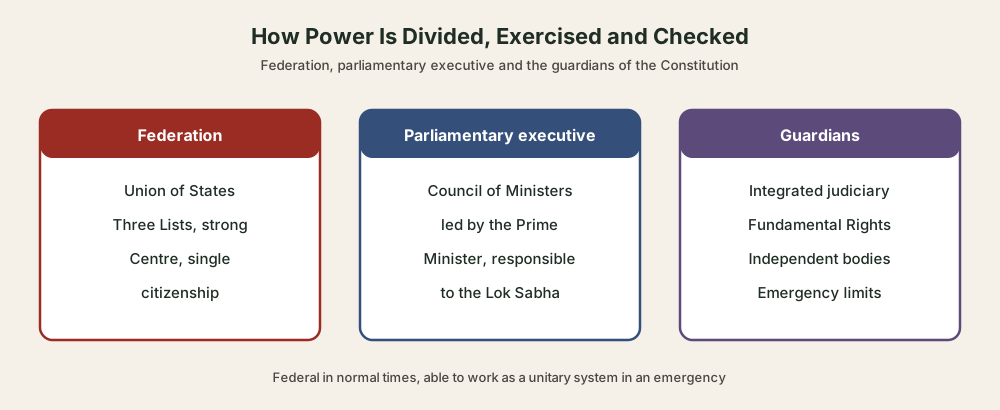
The federal features of the Indian Constitution divide power between the Union and the States through three Lists while keeping a strong Centre and a single citizenship. They work with a parliamentary system, in which the Council of Ministers answers to the Lok Sabha, and are checked by an integrated judiciary, Fundamental Rights and independent bodies.
Federal Features of the Indian Constitution: An Overview
Federal and Parliamentary Design of the Constitution
The federal features of the Indian Constitution divide power between the Union and the States while keeping a strong Centre, and they work alongside a parliamentary system in which the executive answers to the legislature. An integrated judiciary, enforceable rights and independent constitutional bodies hold both in check.
These features matter because they settle who governs, how the government is held to account and who decides disputes between governments. They explain much of the day-to-day working of the Constitution, from President's rule in a State to a no-confidence motion in the Lok Sabha.
The significance of this design lies in three choices that recur throughout the Constitution:
- Form of government: A parliamentary executive, collectively responsible to the House of the People.
- Form of the federation: A Union of States with a strong Centre, able to work as a unitary system in an emergency.
- Guardians: An integrated, independent judiciary, enforceable Fundamental Rights and constitutional bodies with security of tenure.
Ambedkar's Answers: Responsibility First and a Flexible Federation
Ambedkar gave the Constituent Assembly two answers on 4 November 1948. For the executive, the draft preferred responsibility to stability and chose the British parliamentary model over the American presidential one; for the federation, it created a dual polity that could work as a federal system in normal times and as a unitary one in war.
The sources of these features, their amendment and the basic structure that protects them are explained in Salient Features of the Indian Constitution: Sources, Amendment and Basic Structure. The framers' reasons are told in Salient Features of the Indian Constitution: Why They Were Chosen.
Federal System With a Unitary Bias
Federal Features: Dual Polity, Division of Powers and Independent Courts
Article 1 declares that India, that is Bharat, shall be a Union of States, and the Constitution does not use the word federation. Ambedkar nonetheless called it federal because it establishes a dual polity: the Union at the Centre and the States at the periphery, each sovereign in the field assigned to it.
Legislative power is divided by Article 246 among the Union, State and Concurrent Lists of the Seventh Schedule, and Article 248 gives Parliament the residuary power over matters in no List. Because any invasion of one field by the other is a breach of the Constitution, disputes go to an independent judiciary, which Ambedkar called the legalism inherent in federalism.
Unitary Features: Strong Centre, Single Citizenship and Emergency Powers
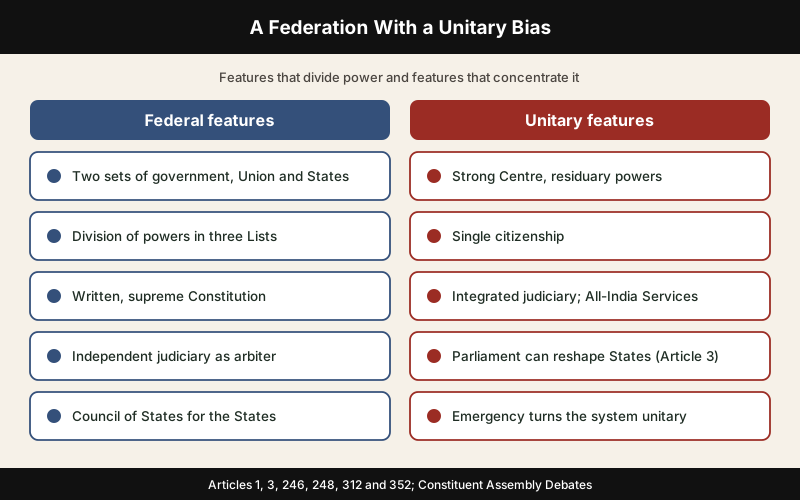
Alongside the federal features, the Constitution gives the Union powers that concentrate authority. The main ones are listed below and summarised in the table and figure that follow:
- Parliament can form new States and alter the area, boundaries or name of any State by law under Article 3, after only seeking the views of the State legislature.
- Residuary powers lie with Parliament under Article 248, and under Article 249 Parliament can legislate on a State subject if the Council of States so resolves by a two-thirds majority.
- There is a single citizenship, a single integrated judiciary and All-India Services under Article 312, common to the Union and the States.
- Governors are appointed by the Centre and may reserve State Bills for the President’s assent.
- Emergency provisions can turn the federal polity into a highly centralised one, and Article 356 allows President’s rule in a State.
| Federal features | Unitary features |
|---|---|
| Two sets of government, Union and States (dual polity) | Strong Centre with residuary powers (Article 248) |
| Division of powers in three Lists (Article 246) | Single citizenship |
| Written Constitution binding both levels | Integrated judiciary and All-India Services (Article 312) |
| Independent judiciary to settle disputes | Parliament can reshape States (Article 3) |
| States represented in the Council of States | Emergency provisions (Articles 352 and 356) |
None of these powers abolishes the States. They sit beside a federal division of powers, which is why the Constitution is described as a federation with a unitary bias rather than as a unitary State: the States keep their own Lists, Legislatures and governments in normal times.
Why the Framers Chose a Strong Centre
The framers wanted a federal constitution that would accommodate the country's diversities, but also a strong Centre to stem disintegration. More than 500 princely states had to be integrated, and poverty, illiteracy and inequality were seen as problems needing central planning and coordination.
T. T. Krishnamachari told the Assembly on 25 November 1949 that the drift in all constitutions had been towards the centre. Ambedkar added that the Constitution could be both unitary and federal according to the requirements of time and circumstances: federal in normal times, but able to work as a unitary system in war.
The Indian federation was not formed by an agreement among States. Ambedkar described it as not a league of States, and because Parliament can reorganise States under Article 3, the Union is described as one of States rather than a compact between them, a point the linked question on federalism tests.
Indian and American Federations Compared
Ambedkar measured the Indian federation against the United States. The resemblance lay in the dual polity; the differences, he argued, were more fundamental than the similarities, as the table shows:
| Feature | United States | India |
|---|---|---|
| Citizenship | Dual: citizenship of the Union and of the State | Single citizenship for the whole country |
| State constitutions | Each State frames its own constitution | One frame for the Union and the States |
| Judiciary | Federal and State judiciaries separate | One integrated judiciary |
| Civil services | Federal and State services | State services plus All-India Services for strategic posts |
| Flexibility | Cannot change into a unitary form | Can work as a unitary system in war |
The comparison explains the Indian design. Uniformity was sought through three means Ambedkar named: a single judiciary, uniformity in fundamental civil and criminal laws through the Concurrent List, and a common All-India service to man strategic posts.
Cooperative Federalism: Zonal Councils, the Inter-State Council and the GST Council
Beside the division of powers, the Constitution and later laws created forums where the Union and the States work together. Under Article 263, the President may establish an inter-State Council to inquire into and advise upon disputes between States and to discuss subjects of common interest.
Part III of the States Reorganisation Act, 1956 created the Zonal Councils as part of the scheme for reorganising the States; section 15 of that Act provides for a Zonal Council for each of the five zones of the country.
The newest forum is fiscal. The GST Council, created under Article 279A by the 101st Amendment, consists of the Union Finance Minister as Chairperson, the Union Minister of State in charge of Revenue or Finance, and a minister nominated by each State; it first met on 22 and 23 September 2016.
The Council recommends to the Union and the States on the goods and services to be taxed or exempted, model GST laws, rates and special provisions for certain States. Its own account describes it as a joint forum of the Centre and the States, a working form of cooperative federalism.
Parliamentary Form of Government
Features of the Parliamentary System: Nominal Head and Responsible Ministers
Under Article 74(1), there is a Council of Ministers with the Prime Minister at its head to aid and advise the President, who shall act in accordance with that advice. Ambedkar compared the President to the King under the English Constitution: head of the State but not of the Executive.
The system rests on a few provisions that keep the executive answerable to the legislature:
- Collective responsibility: The Council of Ministers is collectively responsible to the House of the People under Article 75(3).
- Ministers from Parliament: A Minister who is not a member of either House for six consecutive months ceases to be a Minister under Article 75(5).
- Nominal and real executive: The President is the constitutional head, while the Prime Minister and the Council of Ministers exercise effective power.
- Dissolution: The President may dissolve the House of the People under Article 85(2).
A Minister who disagrees with a Cabinet decision must either accept it or resign, which is what collective responsibility means in practice. The Council of Ministers cannot exist without the Prime Minister, whose death or resignation ends it.
Responsibility Over Stability: Why the Framers Rejected the Presidential System
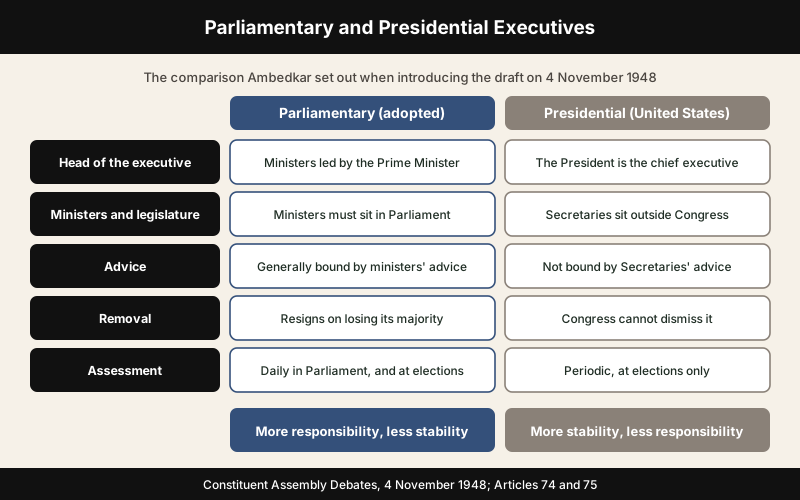
Ambedkar explained that a democratic executive must be both stable and responsible, and no system ensures both equally. The American and Swiss systems give more stability but less responsibility; the British system gives more responsibility but less stability, because a parliamentary government must resign once it loses its majority.
Responsibility in a parliamentary system is also assessed more often. Members of Parliament assess the executive daily through Questions, Resolutions, No-confidence motions, Adjournment motions and Debates on Addresses, while voters assess it periodically. The draft, Ambedkar concluded, preferred more responsibility to more stability.
| Point of comparison | Parliamentary (adopted) | Presidential (United States) |
|---|---|---|
| Head of the executive | Council of Ministers led by the Prime Minister; President a constitutional head | The President is the chief executive |
| Relation to the legislature | Ministers must be members of Parliament | Executive separate from Congress |
| Advice | President generally bound by ministerial advice | President not bound by Secretaries' advice |
| Removal | Government falls when it loses a majority | Congress cannot dismiss the executive |
| Assessment of responsibility | Daily, in Parliament, and periodic, at elections | Periodic, at elections |
How the Indian System Differs From the British Model
The parliamentary system came from Britain, but it operates within a written Constitution that courts enforce. A law inconsistent with the Fundamental Rights is void to the extent of the inconsistency under Article 13, and judicial review is among the features attributed to the United States rather than to Britain.
The head of State is also elected rather than hereditary, since India is a republic whose President is chosen by an electoral college under Article 54, as explained in Preamble to the Indian Constitution. Parliamentary government in India is therefore limited government.
Balancing Parliamentary Sovereignty and Judicial Supremacy
Judicial Review Under Articles 13, 32 and 226
The Supreme Court or a High Court can examine the constitutionality of any law and declare it unconstitutional and inapplicable if it is inconsistent with the Constitution. This power of judicial review is often described as the most important power of the Supreme Court.
The power rests on specific articles. Article 13(2) forbids laws that take away or abridge Fundamental Rights, Article 32 guarantees the right to move the Supreme Court for their enforcement, and Article 226 empowers every High Court to issue writs throughout its territory.
Both courts issue writs in the nature of habeas corpus, mandamus, prohibition, quo warranto and certiorari. The High Courts' power is wider in one respect: Article 226 allows writs for the enforcement of the Fundamental Rights and for any other purpose, whereas Article 32 is confined to the rights in Part III.
The Balance Struck by the Kesavananda Ruling
The balance between Parliament and the courts was settled in Kesavananda Bharati. The ruling allows Parliament to amend any and all parts of the Constitution, but it sets a limit: no amendment can violate the basic structure, and the judiciary is the final authority on what that structure is.
Neither institution is therefore supreme on its own. Parliament has the constituent power under Article 368 and the courts can strike down laws and amendments, but each works within the Constitution, so the system balances the two rather than making either supreme.
Integrated and Independent Judiciary
One Judicial System for Union and State Laws
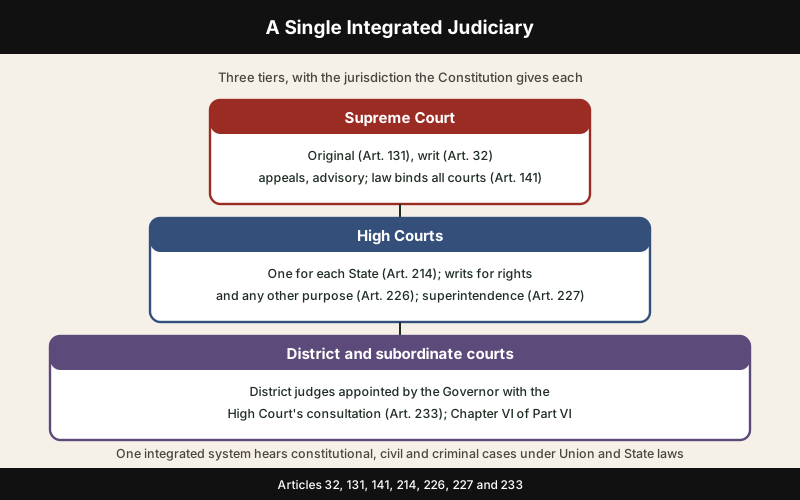
The Constitution provides for a single integrated judicial system. Unlike some other federal countries, India has no separate State courts; the structure is pyramidal, with the Supreme Court at the top, High Courts below it, and district and subordinate courts at the lowest level.
Ambedkar contrasted this with the United States, where federal and State judiciaries are separate. In India the High Courts and the Supreme Court form one judiciary for constitutional, civil and criminal law, a design he said only Canada closely parallels. Under Article 141, the law declared by the Supreme Court binds all courts.
Safeguards of Judicial Independence
Independence is secured through several measures. The legislature is not involved in appointing judges, and a judge of the Supreme Court can be removed only by an order of the President after an address by each House supported by a majority of its total membership and two-thirds of those present and voting.
The design balances the branches: the executive plays a crucial role in appointments, while the legislature holds the power of removal. Only one case of removal of a Supreme Court judge has come before Parliament, and the motion failed because it lacked a majority of the total strength of the House.
Jurisdictions of the Supreme Court: Original, Writ, Appellate and Advisory
The Supreme Court's work falls under several jurisdictions. Under Article 131 it has original jurisdiction, to the exclusion of any other court, in disputes between the Government of India and one or more States, or between States, which makes it the umpire of the federation.
It hears appeals from the High Courts, which must usually certify that a case involves a serious question of law or of the Constitution, and it can grant special leave to appeal under Article 136 from any court or tribunal except those under laws relating to the Armed Forces. Under Article 137 it may review its own judgments.
Its advisory jurisdiction lets the President refer any matter of public importance, or one that involves interpreting the Constitution, for its advice. Neither side is obliged: the Court may decline to advise and the President may decline to follow the advice, but a reference lets the government obtain a legal opinion before acting.
Fundamental Rights, Directive Principles and Fundamental Duties
Justiciable Fundamental Rights in Part III
Part III guarantees Fundamental Rights that bind the State and can be enforced in court. The right to move the Supreme Court for their enforcement is itself guaranteed by Article 32, and any law abridging them is void to the extent of the conflict under Article 13.
The official text groups the rights under six headings:
- Right to Equality: Articles 14 to 18.
- Right to Freedom: Articles 19 to 22.
- Right against Exploitation: Articles 23 and 24.
- Right to Freedom of Religion: Articles 25 to 28.
- Cultural and Educational Rights: Articles 29 and 30.
- Right to Constitutional Remedies: Article 32.
The idea of a judicially enforceable charter of rights is attributed to the United States. The rights are not absolute: many carry reasonable restrictions, and under Article 359 the enforcement of some can be suspended during an emergency.
Directive Principles in Part IV: Instructions to the State
The Directive Principles in Part IV are not enforceable by any court, but under Article 37 they are fundamental in the governance of the country and the State has a duty to apply them in making laws. The idea is attributed to the Constitution of Ireland.
Ambedkar explained them with a colonial comparison. They are like the Instrument of Instructions issued to the Governor-General and Governors under the 1935 Act, he said; the only difference is that they are instructions to the legislature and the executive. The full treatment is in Directive Principles of State Policy.
Fundamental Duties in Part IVA
The Fundamental Duties in Article 51A were added by the 42nd Amendment of 1976, which also made wide changes to other parts of the Constitution. They include duties to abide by the Constitution and respect its ideals and institutions, the National Flag and the National Anthem.
Published accounts attribute the idea to the Constitution of the Soviet Union. Unlike the Fundamental Rights, the duties are addressed to citizens rather than to the State, as explained in Fundamental Duties.
Clause (k), added by the 86th Amendment with effect from 1 April 2010, asks every parent or guardian to provide opportunities for education to a child between six and fourteen years, bringing the duties to eleven.
Secular State, Universal Adult Franchise and Single Citizenship
Secularism: Equal Freedom of Conscience and Religion
Under Article 25(1), all persons are equally entitled to freedom of conscience and the right freely to profess, practise and propagate religion, subject to public order, morality and health. The State maintains no religion of its own and treats persons of all faiths equally.
The word secular was added to the Preamble only in 1976, but the principle ran through the original text. The Supreme Court upheld the addition in 2024, and the Indian meaning of secularism is explained in Preamble to the Indian Constitution.
Universal Adult Franchise Under Article 326
Elections to the House of the People and to the State Legislative Assemblies are held on the basis of adult suffrage under Article 326, open to every citizen not less than eighteen years of age who is not otherwise disqualified.
In the Constituent Assembly, universal suffrage was the one provision passed without virtually any debate. It was a sharp break with the Government of India Act, 1935, whose electorate of about 35 million rested on property and other qualifications.
The voting age itself has changed once. The 61st Amendment, in force from 28 March 1989, substituted eighteen years for twenty-one in Article 326, extending the vote to a new generation of citizens.
Single Citizenship in a Dual Polity
India combines a dual polity with a single citizenship. Ambedkar contrasted this with the United States, where a citizen holds both national and State citizenship and States may favour their own citizens in voting, employment and public professions.
Under the Constitution there is only one citizenship for the whole country, and there is no State citizenship; every Indian has the same rights of citizenship, whichever State he or she lives in. The rules are explained in Citizenship in India.
Independent Bodies, Emergency Provisions and Three-Tier Government
Independent Constitutional Bodies: Election Commission, CAG and Finance Commission
The Constitution itself creates bodies that oversee elections, audit, recruitment and fiscal transfers, rather than leaving them to ordinary law. Their key features are set out in the table:
| Body | Article | Key feature |
|---|---|---|
| Election Commission | 324 | Superintendence, direction and control of elections to Parliament, State Legislatures, and the offices of President and Vice-President |
| Comptroller and Auditor-General | 148 | Removable only in like manner and on the like grounds as a Supreme Court judge |
| Public Service Commissions | 315 | A commission for the Union and one for each State |
| Finance Commission | 280 | Constituted every fifth year or earlier; a Chairman and four other members |
Security of tenure is the common thread. The Comptroller and Auditor-General, for example, can be removed only in the same manner and on the same grounds as a judge of the Supreme Court, which shields the office from the government it audits.
Emergency Provisions: Articles 352, 356 and 360
The Constitution provides for three kinds of emergency. Under Article 352, the President may proclaim a national emergency if the security of India is threatened by war, external aggression or armed rebellion; Article 356 covers the failure of constitutional machinery in a State; Article 360 covers threats to financial stability or credit.
During a national emergency Parliament may legislate on State subjects under Article 250, and under Article 359 the President may suspend the right to move courts for enforcing certain Fundamental Rights. These powers are what allow the federal system, in Ambedkar's words, to work as though it were unitary.
Three-Tier Government: Panchayats and Municipalities
Since 1993 the Constitution has provided for a third tier of government. Part IX, inserted by the 73rd Amendment, requires Panchayats at the village, intermediate and district levels, although a State with a population not exceeding twenty lakhs may omit the intermediate level.
Part IXA, inserted by the 74th Amendment with effect from 1 June 1993, provides for Nagar Panchayats, Municipal Councils and Municipal Corporations, and the Twelfth Schedule lists the functions States may assign to municipalities. The change added a tier that the 1948 draft had left out when it adopted the individual rather than the village as its unit.
Federal and Parliamentary Features in Practice Since 1950
Anti-Defection Law, Ministry Size Cap and the GST Council
Amendments have changed how the design works, and three changes are observable outcomes of how the federal and parliamentary features have been used:
- Party discipline: The Tenth Schedule, added by the 52nd Amendment in force from 1 March 1985, provides for disqualification on the ground of defection.
- Size of ministries: The 91st Amendment, in force from 1 January 2004, capped the Council of Ministers at fifteen per cent of the total membership of the House of the People (Article 75(1A)).
- Fiscal cooperation: The 101st Amendment created the GST Council in 2016 as a joint forum of the Centre and the States.
These changes keep the features in current debate. A matching fifteen per cent cap applies to State ministries, and the GST Council deliberates on a tax that, under Article 246A, both Parliament and the State Legislatures have power to make laws about.
UPSC Relevance and Previous-Year Questions
Where These Features Fit in the UPSC-CSE Syllabus
This topic belongs to General Studies Paper II, under the features of the Constitution, federal structure, the executive and the judiciary, and to the polity section of the preliminary examination. The linked questions from that examination test precise points:
- What makes the system parliamentary: Responsibility of the Council of Ministers to the Lok Sabha.
- What distinguishes Indian federalism, and what it is not: An agreement among the units.
- Why an independent judiciary is essential to a federation, and how India differs from Britain.
- The colonial precedent for the Directive Principles.
The linked question from the main examination asks whether federalism under the Constitution leans towards a strong Centre. The sections on federal and unitary features, and on cooperative federalism, supply both sides of that answer.
Previous Year UPSC-CSE Questions
Previous Year UPSC-CSE Questions By the end you will be able to draft model answers for the following UPSC questions. Each question carries a collapsible framework showing how to approach it in the exam.
- UPSC Prelims 2021 GS-IWhich one of the following in Indian polity is an essential feature that indicates that it is federal in character?
How to approach this Prelims question
Approach: Ask which feature a federation cannot work without.
Trap to watch: Enforceable rights and elected representatives exist in unitary democracies too.
Key facts to recall:
- Division of powers creates disputes between governments.
- Such disputes are justiciable.
- An independent judiciary is the arbiter.
Answer signal: An independent judiciary is the essential federal safeguard, so option (a) is the answer.
- UPSC Prelims 2020 GS-IA Parliamentary System of Government is one in which
How to approach this Prelims question
Approach: Identify the defining link: the executive depends on the confidence of the legislature.
Trap to watch: Election by the people describes democracy in general, not the parliamentary form in particular.
Key facts to recall:
- Article 75(3): collective responsibility to the House of the People.
- Government falls when it loses its majority.
- Presidential executives cannot be dismissed by the legislature.
Answer signal: Responsibility to and removal by Parliament defines the system, so option (b) is the answer.
- UPSC Prelims 2017 GS-IWhich one of the following is not a feature of Indian federalism?
How to approach this Prelims question
Approach: Test each option against Article 1 and Article 3.
Trap to watch: Unequal representation in the Rajya Sabha is a real feature; the false option is the idea of a compact among States.
Key facts to recall:
- Article 1: a Union of States.
- Article 3: Parliament can alter States by law.
- Article 246: three Lists.
Answer signal: Indian federalism did not arise from an agreement among units, so option (d) is the answer.
- UPSC Prelims 2015 GS-IThere is a Parliamentary System of Government in India because the
How to approach this Prelims question
Approach: Choose the option that describes the executive's dependence on the legislature.
Trap to watch: Direct election and the amending power are true facts but do not make a system parliamentary.
Key facts to recall:
- Article 75(3).
- Article 74(1): President acts on ministerial advice.
- Ministers must be members of Parliament (Article 75(5)).
Answer signal: Responsibility of the Council of Ministers to the Lok Sabha is the defining feature, so option (d) is the answer.
- UPSC Prelims 2013 GS-IIn the context of India, which of the following principles is/are implied institutionally in the parliamentary government?
- Members of the Cabinet are Members of the Parliament.
- Ministers hold the office till they enjoy confidence in the Parliament.
- Cabinet is headed by the Head of the State.
Select the correct answer using the codes given below.
How to approach this Prelims question
Approach: Separate the head of State, who is nominal, from the head of the government.
Trap to watch: Statement 3 describes a presidential system; in India the Prime Minister heads the Council of Ministers under Article 74(1).
Key facts to recall:
- Article 75(5): Minister must become a member within six months.
- Article 75(3): collective responsibility.
- Article 74(1): Prime Minister at the head of the Council.
Answer signal: Statements 1 and 2 are correct and 3 is not, so option (a) is the answer.
- UPSC Prelims 2010 GSThe “Instrument of Instructions” contained in the Government of India Act 1935 have been incorporated in the Constitution of India in the year 1950 as
How to approach this Prelims question
Approach: Link instructions that guide the use of power to the non-justiciable principles that guide the State.
Trap to watch: Executive power and conduct of business are procedural provisions, not instructions on policy.
Key facts to recall:
- Ambedkar, 4 November 1948.
- Article 37: not enforceable, but fundamental in governance.
- Idea of Directive Principles attributed to Ireland.
Answer signal: The Instrument of Instructions became the Directive Principles, so option (b) is the answer.
- UPSC Prelims 1998 GSThe Indian parliamentary system is different from the British parliamentary system in that India has
How to approach this Prelims question
Approach: Eliminate features the two systems share.
Trap to watch: A nominal and real executive, collective responsibility and bicameralism are common to both systems.
Key facts to recall:
- Article 13: laws inconsistent with Fundamental Rights are void.
- Judicial review attributed to the United States.
- Parliamentary government attributed to the United Kingdom.
Answer signal: Judicial review is the distinguishing feature, so option (d) is the answer.
- UPSC Mains 2014 GS-IIThough the federal principle is dominant in our Constitution and that principle is one of its basic features, but it is equally true that federalism under the Indian Constitution leans in favour of a strong Centre, a feature that militates against the concept of strong federalism. Discuss.
How to structure the answer in the exam
Introduction: Article 1 makes India a Union of States, and Ambedkar described the Constitution as a dual polity that can be both unitary and federal according to circumstances.
Body (sub-themes to develop):
- Federal core: dual polity, three Lists under Article 246, written Constitution, independent judiciary.
- Strong Centre: residuary powers (Article 248), Article 249, Article 3, All-India Services (Article 312), Governors, Article 356.
- Unitary in emergencies: Articles 250, 352 and 359.
- Reasons: integration of over 500 princely states, unity, planned development; the drift towards the centre noted in 1949.
- Checks: ratification by half the States for federal provisions, judicial review, and cooperative forums such as the Inter-State Council under Article 263 and the GST Council.
Conclusion: Indian federalism is best read as a flexible federation: federal in normal times, with central powers that are designed for national needs and are subject to constitutional and judicial limits.
Sources and Further Reading
- Legislative Department, Ministry of Law and Justice: The Constitution of India
- Lok Sabha Secretariat: Constituent Assembly Debates, Official Report, Volume VII (4 November 1948)
- Lok Sabha Secretariat: Constituent Assembly Debates, Official Report, Volume XI (25 November 1949)
- Goods and Services Tax Council: GST Council
- Inter-State Council Secretariat, Ministry of Home Affairs: Zonal Councils, Genesis
- NCERT: Indian Constitution at Work, Class 11, Chapter 1, Constitution: Why and How?
- NCERT: Indian Constitution at Work, Class 11, Chapter 4, Executive
- NCERT: Indian Constitution at Work, Class 11, Chapter 6, Judiciary
- NCERT: Indian Constitution at Work, Class 11, Chapter 7, Federalism
- NCERT: Indian Constitution at Work, Class 11, Chapter 9, Constitution as a Living Document
- Supreme Court of India: Dr Balram Singh v Union of India, order of 25 November 2024 (2024 INSC 893)
- Wikipedia: Constitution of India
- Wikipedia: Government of India Act 1935
Editorial Disclaimer
This article is for UPSC preparation and explains the federal, parliamentary and judicial features of the Constitution. Amendments and court rulings can change these provisions, so the current official text governs any question of law.


