


Overview
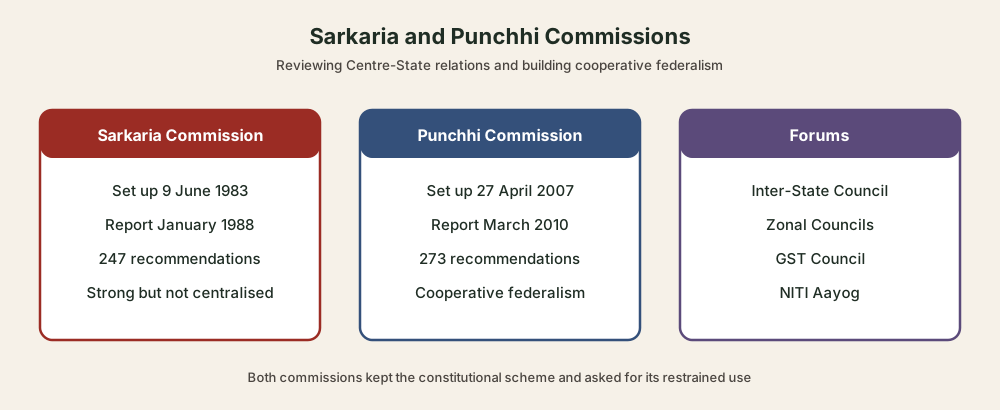
The Sarkaria Commission (1983-88) and the Punchhi Commission (2007-10) were the two national commissions that reviewed Centre-State relations. Both kept the constitutional scheme but asked for restraint in the use of central powers, a working Inter-State Council and closer consultation, the idea now called cooperative federalism.
Commissions on Centre State Relations: Why They Were Set Up
Tension Areas in Centre-State Relations Since 1967
Until 1967, Centre-State relations were largely smooth because one party ruled at the Centre and in most States. In the 1967 elections the Congress lost power in nine States, and non-Congress governments began to oppose growing centralisation and demand more powers and resources. The legislative, administrative and financial scheme itself is explained in the article on the Seventh Schedule.
- Governor’s office: The mode of appointment and dismissal, and a partisan role.
- Emergency powers: President’s Rule imposed for partisan interests, and Central forces deployed in States.
- State Bills and the State List: Reservation of State Bills for the President and encroachment on the State List.
- Money and planning: Discrimination in financial allocations and the Planning Commission’s role in approving State projects.
- All India Services: Their management and control.
These issues run through the reports of every later commission. Because they are political as much as legal, demands for autonomy have to be resolved through negotiation rather than only in court.
Rajamannar Committee and the Demand for State Autonomy
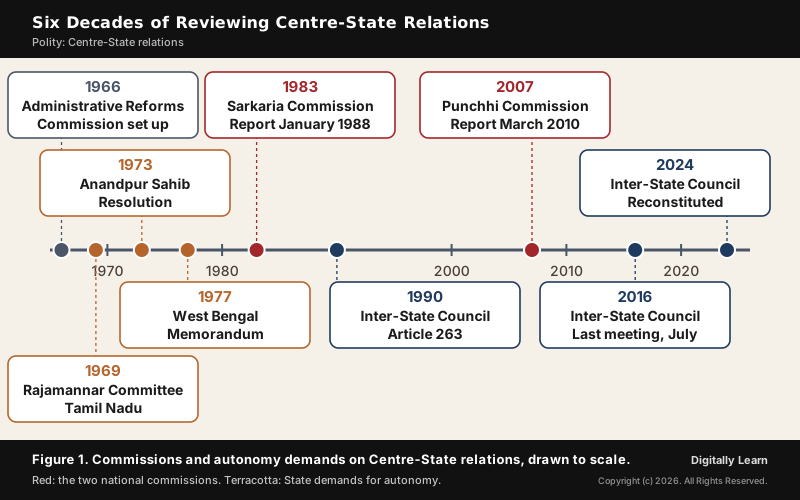
The first review came from the Union: the Administrative Reforms Commission of 1966, through a study team under M. C. Setalvad, reported in 1969 with 22 recommendations, including an Inter-State Council under Article 263. No action followed. The States then made their own proposals.
| Proposal | Year | Main demands |
|---|---|---|
| Rajamannar Committee (Tamil Nadu) | 1969, report 1971 | An Inter-State Council at once; a permanent Finance Commission; Planning Commission replaced by a statutory body; Articles 356, 357 and 365 omitted; residuary powers to the States; All India Services abolished |
| Anandpur Sahib Resolution (Akali Dal) | 1973 | Centre limited to defence, foreign affairs, communications and currency; all residuary powers to the States |
| West Bengal Memorandum | 1977 | 'Union' replaced by 'federal'; Articles 356, 357 and 360 repealed; 75 per cent of Central revenue to the States; Rajya Sabha equal to Lok Sabha |
The Rajamannar Committee, a three-member body appointed by Tamil Nadu under Dr P. V. Rajamannar, traced centralisation to special constitutional powers of the Centre, one-party rule, the States' fiscal dependence and Central planning. The Union ignored its recommendations and did not accept the West Bengal demands either.
Sarkaria Commission (1983-88)
Sarkaria Commission: Composition, Terms and Approach
The Sarkaria Commission was constituted by the Ministry of Home Affairs on 9 June 1983 under Justice R. S. Sarkaria, a retired Supreme Court judge, with B. Sivaraman and Dr S. R. Sen as members. It was to examine the working of the arrangements between the Union and the States in all spheres, with due regard to the Constitution's framework for unity and integrity. It was first given one year, but its term was extended four times.
Its report, running to 1,600 pages, was submitted in January 1988 with 247 recommendations in 19 chapters. The Commission did not favour structural change: it found the constitutional scheme basically sound and asked for changes in how power is used. A strong Centre was essential for unity, but not the same as centralisation, which it said leads to "blood pressure at the centre and anemia at the periphery".
Sarkaria Commission Recommendations on Centre-State Relations
- Inter-Governmental Council: A permanent Inter-State Council under Article 263, to be called the Inter-Governmental Council, with a permanent secretariat modelled on the Cabinet Secretariat.
- Article 356: To be used very sparingly, in extreme cases, as a last resort.
- Governors: The Chief Minister to be consulted on appointments; a five-year term not to be disturbed except for compelling reasons; no dismissal of a ministry that commands a majority.
- Legislation: The Centre to consult States before legislating on a Concurrent List subject; reasons to be given when the President withholds assent to a State Bill; residuary powers other than taxation to the Concurrent List.
- Other bodies: Zonal Councils revived; the National Development Council renamed the National Economic and Development Council; more All India Services.
Other recommendations dealt with money, security and language. The Centre could deploy its armed forces without a State's consent, though consulting the State was desirable; the net proceeds of corporation tax could be made shareable; a surcharge on income tax should be only for a specific purpose and a limited period; and the three-language formula should be implemented in its true spirit.
Much of the report was acted on. The Inter-State Council set up in 1990 spent its early meetings on the report, agreeing in 1996 on 179 recommendations examined by its sub-committee. By December 2011 the Union had implemented 180 of the 247.
Punchhi Commission (2007-10)
Punchhi Commission: Composition and Terms of Reference
The second Commission on Centre-State Relations was constituted on 27 April 2007 under Justice Madan Mohan Punchhi, a former Chief Justice of India, to examine new issues since the Sarkaria Commission two decades earlier. Its members were Dhirendra Singh, Vinod Kumar Duggal and Dr N. R. Madhava Menon, with Vijay Shanker as Member Secretary.
- Scope: Legislative and administrative relations, the role of Governors, emergency provisions, financial relations, planning, Panchayati Raj and the sharing of resources, including inter-State river water.
- New questions: The Centre’s role in prolonged communal or caste violence, mega projects such as river linking, a Central agency for crimes with inter-State ramifications, and a law under Article 355 for deploying Central forces.
It presented a seven-volume report on 30 March 2010 with 273 recommendations, counted differently in some books. It drew on the Sarkaria report, the report of the National Commission to Review the Working of the Constitution and the Second Administrative Reforms Commission, but differed from Sarkaria in several areas. Its central conclusion was that cooperative federalism would be the key to India's unity, integrity and development.
Punchhi Commission Recommendations (2010)
- Governor’s tenure and removal: Chosen by the Sarkaria criteria; a fixed five-year tenure with removal not at the Centre’s will; removal by a procedure like the President’s impeachment; no longer Chancellors of universities.
- Assent to Bills: Governors to decide within six months, and the President also within six months on a reserved Bill.
- Emergencies: Article 356 limited to a real failure of constitutional machinery, with the Bommai guidelines written into the Constitution; a framework for a “localised emergency” under Article 355.
- Concurrent List: Broad agreement with States before legislating; restraint in asserting parliamentary supremacy over State subjects.
- Institutions: A stronger Inter-State Council meeting at least thrice a year; Zonal Councils meeting at least twice a year.
On the Governor's discretion, the Commission held that Article 163 gives no general power to act against the Council of Ministers; the area of discretion is limited and must be exercised with reason and good faith. It laid down guidelines for a hung Assembly and for the Governor's other difficult choices.
- Forming a government: Invite the party or combination with the widest support, treating a pre-poll alliance as one party. In a hung Assembly the order of preference, first set out by Sarkaria, is a pre-poll alliance, then the single largest party with the support of others, then a post-poll coalition with all partners in the government, and last a post-poll alliance with some partners supporting from outside.
- Dismissing a Chief Minister: Insist on a floor test within a time limit.
- Prosecution of a minister: The Governor may sanction it against the Cabinet’s advice if the Cabinet’s decision appears biased in the face of overwhelming material.
Sarkaria Commission vs Punchhi Commission: Key Differences
The two commissions agreed on the basics and differed in method. Sarkaria asked mainly for restraint: consult the States before legislating, keep the Governor's office above party politics and use Article 356 only as a last resort. Punchhi, two decades later, wanted firmer rules: a fixed tenure and an impeachment-like removal for Governors, six-month limits on assent to Bills and a framework for a localised emergency under Article 355.
| Point | Sarkaria Commission | Punchhi Commission |
|---|---|---|
| Constituted | 9 June 1983 | 27 April 2007 |
| Report | January 1988, 247 recommendations | 30 March 2010, 273 recommendations |
| Approach | Scheme sound; change the way power is used | Cooperative federalism as the key |
| Governors | Consult the Chief Minister; stable five-year term | Fixed tenure; removal like impeachment; no Chancellor role |
| Inter-State Council | Permanent council under Article 263 | Stronger, meeting thrice a year, with follow-up powers |
Cooperative Federalism and Its Institutions
Cooperative Federalism and Competitive Federalism in Practice
The Constitution never uses the word federation. Article 1 calls India a Union of States, which implies that the federation is not the result of an agreement among the States and that no State may secede. Nor are the States equal in the Rajya Sabha, where seats are allotted to them on the basis of population. Scholars have described the result as quasi-federal (K. C. Wheare), bargaining federalism (Morris Jones) and co-operative federalism (Granville Austin).
In cooperative federalism the Union and the States work as partners through shared forums, and competitive federalism means the Centre and the States, and the States among themselves, competing in the joint pursuit of national development. NITI Aayog, which replaced the Planning Commission in 2015, was meant to foster both, moving from a top-down to a bottom-up approach with a Governing Council of Chief Ministers.
Zonal Councils and the North Eastern Council
The Zonal Councils were created by Part III of the States Reorganisation Act, 1956, one for each of five zones. Each is an advisory body that may discuss any matter of common interest to its States, or to the Union and those States, including economic and social planning, border disputes, linguistic minorities and inter-State transport. The Union Home Minister chairs them, with the zone's Chief Ministers as members.
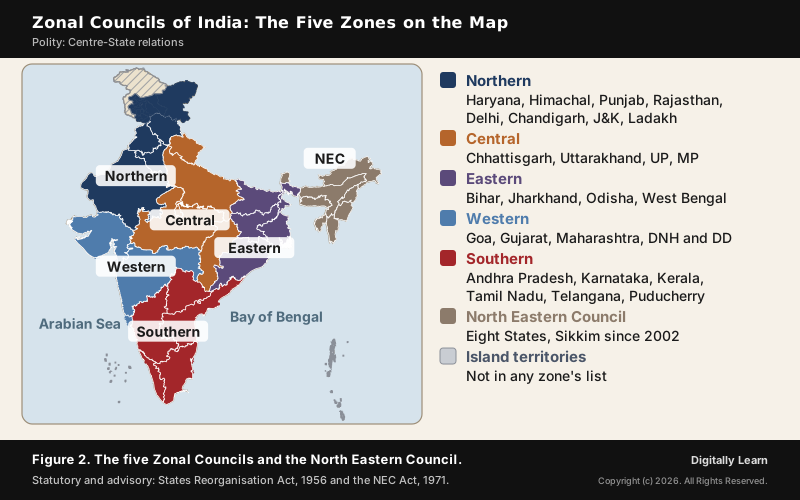
The north-eastern States are outside the Zonal Councils. Their common problems are handled by the North Eastern Council, set up under an Act of Parliament in 1971, with Sikkim added in 2002. It is chaired by the Union Home Minister and includes the Governors and Chief Ministers of the eight States.
Inter-State Council, GST Council and NITI Aayog as Forums
Cooperative federalism depends on forums where governments meet. Each has a different legal basis and a different weight.
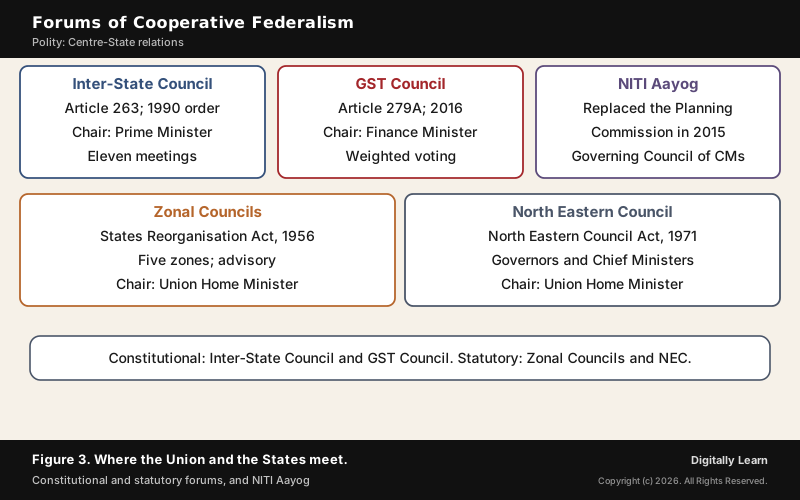
- Inter-State Council: Constitutional under Article 263 but recommendatory; eleven meetings since 1990, the last in 2016. Explained in the article on administrative relations.
- GST Council: Constitutional under Article 279A; decisions by weighted vote needing both the Union and the States.
- NITI Aayog: Replaced the Planning Commission in 2015; its Governing Council brings together the Chief Ministers, and Regional Councils address issues shared by groups of States.
- Zonal Councils and NEC: Statutory and advisory; the Punchhi Commission asked for Zonal Councils to meet at least twice a year.
The older planning bodies show the contrast. The Planning Commission of March 1950 and the National Development Council of August 1952 were created by executive resolution, neither constitutional nor statutory, yet the grants made on the Planning Commission's advice formed the larger part of Central grants to the States. The Rajamannar Committee wanted it replaced by a statutory body; the Sarkaria Commission found its division of work with the Finance Commission reasonable.
Trust Deficit in Centre-State Relations and the Way Forward
Recent years have seen both deeper cooperation and sharper disputes. On the cooperative side, GST pooled the taxing powers of the Union and the States from 2017 through the GST Council, and the Fourteenth Finance Commission raised the States' share of Union taxes to 42 per cent. The finances are explained in the article on the Finance Commission.
- Pressure points: Withdrawals of general consent to the CBI by several States, delays in assent to State Bills, and the role of Governors.
- Assent to Bills in court: The Governor, appointed by the President under Article 155, has four choices on a State Bill under Article 200: assent, withhold assent, return it for reconsideration unless it is a Money Bill, or reserve it for the President. The Article sets no time limit. In April 2025 a two-judge Bench, in State of Tamil Nadu v. Governor of Tamil Nadu, set timelines for the Governor and the President and treated pending Bills as assented to. On a presidential reference, the Constitution Bench answered in November 2025 that courts should not prescribe such timelines and that deemed assent by the Court takes over the role of another constitutional authority. It found the Punchhi Commission’s reading of the Governor’s discretion consistent with the Constitution, as the Court had in Nabam Rebia (2016).
- Institutional gaps: The Inter-State Council has not met since 2016, though it was reconstituted in November 2024.
- The way forward: The Punchhi Commission’s advice to settle governance issues through political and administrative processes rather than long litigation, with the Inter-State Council as the main forum.
Previous Year UPSC-CSE Questions
Previous Year UPSC-CSE Questions By the end you will be able to draft model answers for the following UPSC questions. Each question carries a collapsible framework showing how to approach it in the exam.
- UPSC Mains 2024 GS-IIWhat changes has the Union Government recently introduced in the domain of Centre-State relations? Suggest measures to be adopted to build the trust between the Centre and the States and for strengthening federalism.
Answer outline: how to structure the answer
What the question asks, the main arguments, relevant examples and the direction of the conclusion. This is not a full model answer.
Introduction: Centre-State relations have been reshaped by pooled taxation, higher devolution and new forums, but disputes have sharpened.
Body (sub-themes to develop):
- Changes: GST and the GST Council; the 14th Finance Commission's 42 per cent; NITI Aayog replacing the Planning Commission.
- Friction: Governors and assent to Bills, CBI consent, Article 356 history.
- Measures: Punchhi Commission proposals on Governors, time limits on assent, a stronger Inter-State Council, Zonal Councils meeting twice a year.
Conclusion: Conclude that trust depends on regular, institutional consultation rather than ad hoc bargaining.
- UPSC Mains 2015 GS-IIThe concept of cooperative federalism has been increasingly emphasized in recent years. Highlight the drawbacks in the existing structure and the extent to which cooperative federalism would answer the shortcomings.
Answer outline: how to structure the answer
What the question asks, the main arguments, relevant examples and the direction of the conclusion. This is not a full model answer.
Introduction: Cooperative federalism means the Union and the States working as partners through shared forums.
Body (sub-themes to develop):
- Drawbacks: Governors, Article 356, fiscal dependence, a dormant Inter-State Council.
- Answers: GST Council's joint decisions, NITI Aayog's Governing Council, Zonal Councils.
- Limits: forums are advisory except the GST Council; trust deficit persists.
Conclusion: Conclude that cooperative federalism works where institutions give both sides a real voice.
- UPSC Mains 2014 GS-IIThough the federal principle is dominant in our Constitution and that principle is one of its basic features, but it is equally true that federalism under the Indian Constitution leans in favour of a strong Centre, a feature that militates against the concept of strong federalism. Discuss.
Answer outline: how to structure the answer
What the question asks, the main arguments, relevant examples and the direction of the conclusion. This is not a full model answer.
Introduction: Federalism is part of the basic structure, yet the Constitution leans towards a strong Centre.
Body (sub-themes to develop):
- Tilt: Union of States, emergency powers, Union List predominance, All India Services.
- Sarkaria: scheme sound; strong Centre is not centralisation; 'blood pressure at the centre and anemia at the periphery'.
- Balance: consultation on Concurrent List, Inter-State Council, restraint on Article 356.
Conclusion: Conclude that a strong Centre and strong States are compatible when power is used with restraint.
- UPSC Mains 2026 GS-IIDiscuss the position of the Governor in the federal polity of India. What is the nature of his power while giving assent to a bill passed by the State Legislature? Is he bound by the aid and advice of his Council of Ministers in all his functions?
Answer outline: how to structure the answer
What the question asks, the main arguments, relevant examples and the direction of the conclusion. This is not a full model answer.
Introduction: The Governor is the constitutional head of the State and also the link between the State and the Union.
Body (sub-themes to develop):
- Position: appointed by the President; nominal head bound in general by ministerial advice; the commissions' concern that Governors act as agents of the Centre.
- Assent: the options under Article 200, reservation for the President, the April 2025 timelines and the November 2025 opinion that courts should not prescribe timelines or deem assent.
- Aid and advice: Article 163 gives no general discretion; Punchhi's limited area of discretion, exercised with reason and good faith, upheld in Nabam Rebia and in 2025.
Conclusion: Conclude that the office works when its discretion is narrow, reasoned and exercised in good faith, as both commissions urged.
- UPSC Prelims 2025 Prelims-GSWith reference to India, consider the following:
- I. The Inter-State Council
- II. The National Security Council
- III. Zonal Councils
How many of the above were established as per the provisions of the Constitution of India?
How to approach this Prelims question
Approach: Take each council and ask where it comes from. I, the Inter-State Council: Article 263 provides for it, and the 1990 presidential order was made under that Article, so it counts. II, the National Security Council: the executive set it up in November 1998 and no Article provides for it, so it does not count. III, the Zonal Councils: statutory, created by Part III of the States Reorganisation Act, 1956, so they do not count. One council counts.
Trap to watch: The Inter-State Council was set up by a presidential order in 1990, which can make it look executive; the order was made under Article 263.
Key facts to recall:
- (a) Only one: right. Only the Inter-State Council rests on the Constitution, under Article 263.
- (b) Only two: wrong. The National Security Council was set up by the executive and the Zonal Councils by a statute.
- (c) All the three: wrong. Two of the three have no constitutional basis.
- (d) None: wrong. Article 263 provides for the Inter-State Council, though the President set it up by order in 1990.
Answer signal: Option (a), only one: the Inter-State Council is the one council provided for by the Constitution.
- UPSC Prelims 2017 Prelims-GSWhich one of the following is not a feature of Indian federalism?
How to approach this Prelims question
Approach: Test each option against the Constitution. India has an independent judiciary, a division of powers in the Seventh Schedule and Rajya Sabha seats allotted by population, all features of its federation. Article 1 calls India a Union of States: the federation was not formed by the States agreeing to join, and no State may leave it. So the statement about an agreement is the one that does not fit.
Trap to watch: Unequal representation in the Rajya Sabha may look unfederal, but it is how India's federation is built.
Key facts to recall:
- (a) Independent judiciary: wrong as the answer. It is a feature; courts settle disputes between the Union and the States.
- (b) Powers clearly divided: wrong as the answer. The Seventh Schedule divides powers through three lists.
- (c) Unequal representation in the Rajya Sabha: wrong as the answer. Seats are allotted to the States by population, and this is a feature of the Indian model.
- (d) Result of an agreement among the units: right. Article 1 makes India a Union of States, not a federation formed by agreement.
Answer signal: Option (d): India's federation is not the result of an agreement among the States.
Sources and Further Reading
- Inter-State Council Secretariat: Sarkaria Commission
- Inter-State Council Secretariat: Punchhi Commission
- Inter-State Council Secretariat: Inter-State Council, Meetings
- Inter-State Council Secretariat: Inter-State Council, Composition
- Inter-State Council Secretariat: Zonal Councils, Genesis
- Inter-State Council Secretariat: Zonal Councils, Composition
- Inter-State Council Secretariat: Report of the Commission on Centre-State Relations (Punchhi), Volume II, March 2010
- North Eastern Council: Composition of NEC
- North Eastern Council: About NEC
- GST Council: The GST Council
- Legislative Department, Ministry of Law and Justice: The Constitution of India
- NCERT: Indian Constitution at Work, Class 11, Chapter 7, Federalism
- Supreme Court of India: Opinion on the presidential reference under Article 143, 20 November 2025
- Wikipedia: NITI Aayog
- Wikipedia: Anandpur Sahib Resolution
- Wikipedia: National Security Council (India)
- The Hindu (Delhi): Governor's role in govt. formation, 11 May 2026
Editorial Disclaimer
This article explains the commissions on Centre-State relations from the Inter-State Council Secretariat's records, the commissions' reports and the other sources listed.


