


Overview
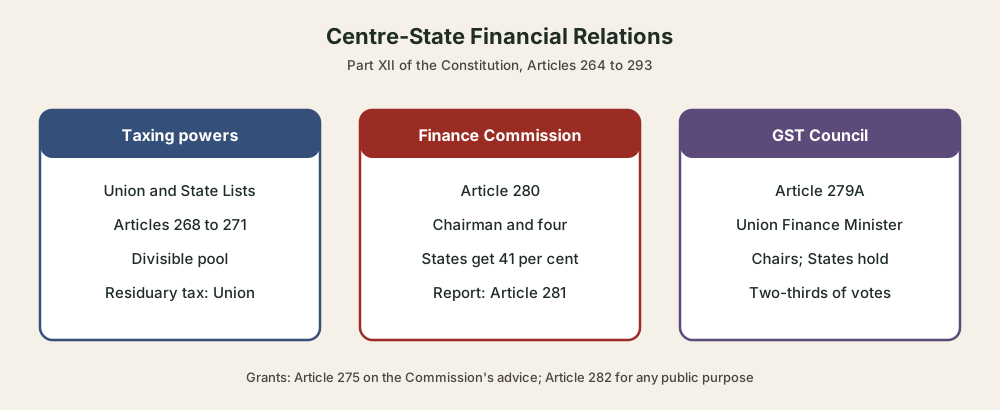
The Finance Commission is the constitutional body that recommends how Union taxes are shared with the States and on what principles grants are made. Set up every five years under Article 280, it sits at the centre of Centre-State financial relations, alongside the rules on tax distribution in Articles 268 to 271, grants under Articles 275 and 282, borrowing limits and the GST Council.
Financial Relations Between Centre and State: Taxing Powers
Allocation of Taxing Powers Between the Union and the States
Taxing powers follow the Seventh Schedule: Parliament levies the taxes in the Union List and State Legislatures those in the State List, as explained in the article on the Seventh Schedule. Any tax not mentioned in the State or Concurrent Lists falls to Parliament under its residuary power, Article 248 and Entry 97 of the Union List. Under Article 265, no tax can be levied or collected except by authority of law.
The Constitution also separates the power to levy and collect a tax from the right to its proceeds. Income tax, for example, is levied and collected by the Union, but its proceeds are shared with the States. This matters because economic and financial powers are centralised with the Union: the States have immense responsibilities but very meagre revenue sources of their own.
- Professions tax (Article 276): A State may tax professions, trades, callings and employments, but the total payable by any one person cannot exceed Rs 2,500 a year.
- Goods and services tax (Article 246A): Since 2016 Parliament and every State Legislature can both legislate on GST; inter-State supplies are for Parliament alone.
- Presidential recommendation (Article 274): A Bill that imposes or varies a tax in which States are interested can be introduced in Parliament only on the President’s recommendation.
- Union property (Article 285): Property of the Union is exempt from all taxes imposed by a State or by any authority within it, unless Parliament provides otherwise.
- State property (Article 289): The property and income of a State are exempt from Union taxation, subject to exceptions Parliament may make by law.
Distribution of Tax Revenues Under Articles 268 to 271
Part XII sorts Union taxes by who levies, who collects and who keeps the money. At one end are taxes whose proceeds go wholly to the States; at the other are surcharges kept wholly by the Union. In between lies the divisible pool, which the Finance Commission shares out.
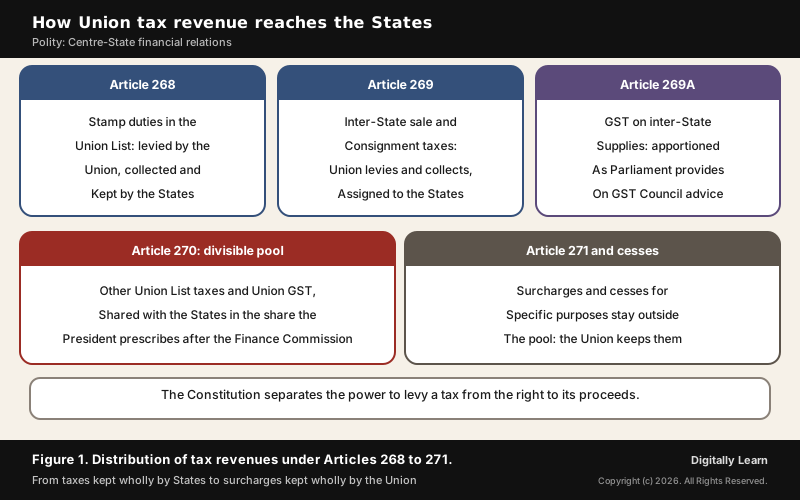
- Article 268: Stamp duties mentioned in the Union List are levied by the Union but collected by the States, and the proceeds do not enter the Consolidated Fund of India; they are assigned to the State.
- Article 269: Taxes on the sale or consignment of goods in inter-State trade are levied and collected by the Union but assigned to the States.
- Article 269A: GST on inter-State supplies is levied and collected by the Union and apportioned between the Union and the States as Parliament provides on the GST Council’s recommendation.
- Article 270: All other Union List taxes, and the Union’s GST, are shared between the Union and the States in the share the President prescribes after considering the Finance Commission’s recommendations.
- Article 271: Parliament may add a surcharge to taxes under Articles 269 and 270, except GST, and the whole surcharge goes to the Union.
The 80th Amendment of 2000 created today's divisible pool, bringing all Union taxes into sharing with effect from 1 April 1996 on the Tenth Finance Commission's advice, which had proposed that 29 per cent of the income from certain Central taxes and duties go to the States, a scheme the Inter-State Council had discussed in 1997. The net proceeds of each tax, the proceeds minus the cost of collection, are certified by the Comptroller and Auditor-General, whose certificate is final.
Cesses and Surcharges Outside the Divisible Pool
Article 270 excludes two things from sharing: surcharges under Article 271 and any cess levied for a specific purpose. Cesses are statutory levies earmarked for particular uses, so the Union keeps them in full.
The exclusion has grown in importance. The Fifteenth Finance Commission noted that cesses and surcharges had grown to about 15 per cent of the Union's gross revenues, reducing the divisible pool from which States draw their share; the Fourteenth had already called their growing share problematic. The introduction of GST in 2017-18 merged a number of cesses and surcharges into it.
Grants-in-Aid and Borrowing
Grants-in-Aid: Article 275 Statutory Grants and Article 282
Besides tax shares, the Union transfers money through grants-in-aid. Under Article 275, the sums Parliament provides are charged on the Consolidated Fund of India each year as grants to the States it finds in need of assistance, and different sums may be fixed for different States.
| Point | Article 275 grants | Article 282 grants |
|---|---|---|
| Nature | Statutory: to States in need of assistance | Discretionary: for any public purpose |
| Who advises | The Finance Commission recommends the principles | No constitutional adviser |
| Special uses | Welfare of Scheduled Tribes and administration of Scheduled Areas | Any purpose, even outside the giver's legislative competence |
| Charged on | Consolidated Fund of India | The giver's own revenues |
Under Article 282, the Union or a State may make grants for any public purpose, even one outside its law-making power. In the planning era the Union made these grants on the Planning Commission's advice, and they formed the larger part of Central grants, which pushed the Finance Commission into the background.
Borrowing Powers of the Union and the States: Articles 292 and 293
- Union (Article 292): It may borrow on the security of the Consolidated Fund of India within limits Parliament fixes by law, and give guarantees.
- States (Article 293(1)): A State may borrow only within India, on the security of its Consolidated Fund, within limits its Legislature fixes.
- Union loans (Article 293(2)): The Union may lend to States or guarantee their loans, and such loans are charged on the Consolidated Fund of India.
- Consent (Article 293(3) and (4)): A State that still owes the Union any part of a loan cannot raise a new loan without the Union’s consent, which may carry conditions.
For any State that still owes the Union money, Article 293(3) gives the Union a real lever over its borrowing. The Fifteenth Finance Commission commissioned a study of the legal basis for the conditions the Union may attach to that consent.
Finance Commission of India Under Article 280
Finance Commission Chairman, Members and Qualifications
Under Article 280, the President constitutes a Finance Commission every fifth year, or earlier if needed, consisting of a Chairman and four other members. The first was set up in 1951, and Parliament fixed the qualifications in the Finance Commission (Miscellaneous Provisions) Act, 1951.
- Chairman: A person with experience in public affairs.
- Who can be a member: Persons who are, or are qualified to be, High Court judges; or have special knowledge of government finance and accounts; or wide experience of financial matters and administration; or special knowledge of economics.
- Powers of a civil court: The powers of a civil court to summon witnesses and require documents and public records.
- Sixteenth Commission: Constituted on 31 December 2023 with Arvind Panagariya as Chairman; it submitted its report on 17 November 2025 for 2026-27 to 2030-31.
Functions of the Finance Commission and Article 281
Article 280(3) lists what the Commission recommends to the President. It works as a quasi-judicial body and is the balancing wheel of fiscal federalism.
- Tax sharing: The distribution of the net proceeds of shareable taxes between the Union and the States (vertical), and among the States (horizontal).
- Grants: The principles that should govern grants-in-aid to the States out of the Consolidated Fund of India.
- Local bodies: Measures to augment a State’s Consolidated Fund to supplement the resources of Panchayats and Municipalities, based on the State Finance Commission’s recommendations; clauses added by the 73rd and 74th Amendments.
- Any other matter: Referred by the President in the interests of sound finance.
- State Finance Commissions: Under Article 243I, each Governor constitutes a State Finance Commission every fifth year to review the finances of the Panchayats and recommend how State taxes are shared with them; its report feeds the Union Commission’s local body recommendations.
Under Article 281, the President lays every recommendation before each House of Parliament with an explanatory memorandum on the action taken. The government decides which recommendations to accept; the memorandum on the Sixteenth Commission, laid in February 2026, records that it accepted the tax-sharing ones.
Vertical Devolution: The States' Share of Union Taxes
The States' share of the divisible pool has risen sharply in the last two awards. The Thirteenth Finance Commission (2010-15) set it at 32 per cent. The Fourteenth (2015-20), chaired by Y. V. Reddy, raised it to 42 per cent, holding that formula-based tax devolution should be the primary route of transfers to States.
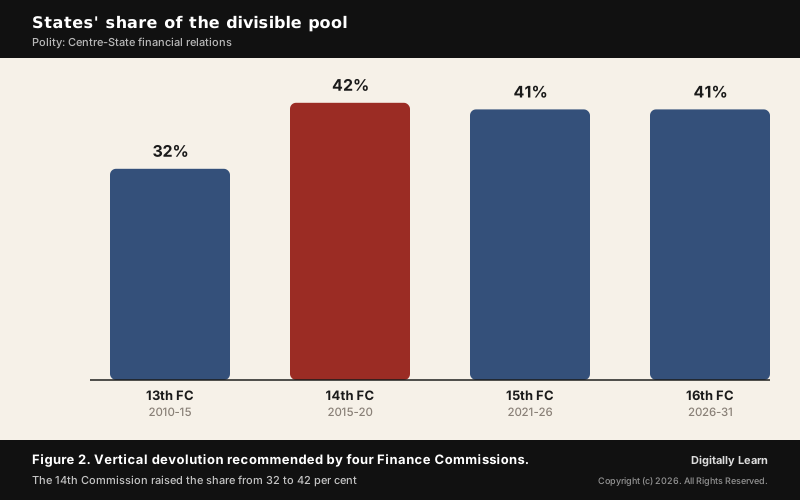
The Fifteenth (2021-26), chaired by N. K. Singh, kept the share at 41 per cent, the only change being an adjustment of about 1 per cent for Jammu and Kashmir becoming a Union Territory. The Sixteenth (2026-31) retained 41 per cent and asked the Union to disclose each year the net proceeds certified by the CAG.
Horizontal Devolution: Criteria and Weights
Horizontal devolution divides the States' share among them. The Fifteenth Commission used six criteria, balancing need, equity and performance, and used 2011 population data as its terms of reference required.
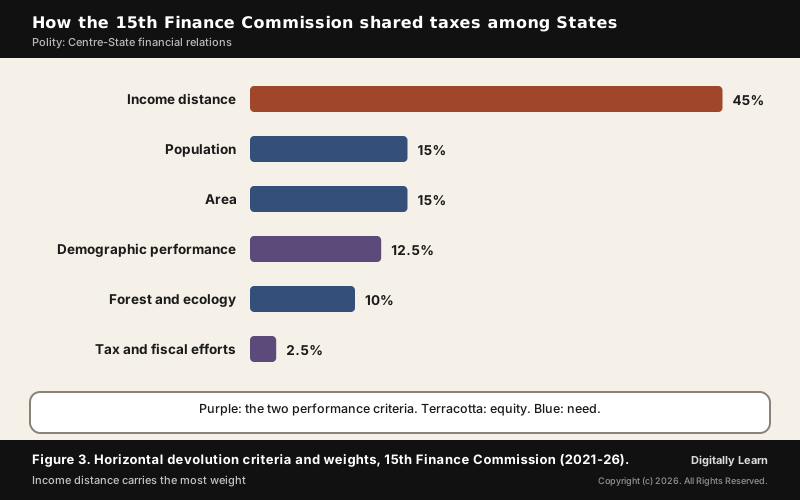
- Equity: Income distance, 45 per cent, gives poorer States more.
- Need criteria: Population and area, 15 per cent each, and forest and ecology, 10 per cent.
- Performance: Demographic performance, 12.5 per cent, and tax and fiscal efforts, 2.5 per cent; tax effort had been used by the Tenth to Twelfth Commissions and was brought back.
- Sixteenth Commission’s formula: Uses population, demographic performance, area, forest, per capita income distance and a new criterion, each State’s contribution to GDP.
Grants Recommended by the Fifteenth and Sixteenth Finance Commissions
- Revenue deficit grants (15th): Rs 2,94,514 crore to seventeen States over 2021-26.
- Education (15th): Rs 4,800 crore from 2022-23 to 2025-26 to incentivise States to enhance educational outcomes.
- Agriculture (15th): Rs 45,000 crore as performance-based incentives for all States for agricultural reforms.
- Health (15th): Rs 1,06,606 crore in all for the health sector, including State-specific health grants of Rs 4,800 crore.
- Sixteenth Commission’s grants: No revenue deficit grants and no sector-specific or State-specific grants; local body grants of Rs 7,91,493 crore for 2026-31, split 60:40 between rural and urban bodies.
The Sixteenth Commission tied local body grants to conditions. A State must have duly constituted local bodies, publish their provisional and audited accounts online, and constitute its State Finance Commission every five years. The grants are split 80:20 into basic and performance components, and half the basic grant is tied to sanitation, solid waste management or water management.
The contrast shows two approaches. The Fifteenth Commission used many targeted grants to reward reforms; the Sixteenth relied on tax devolution and local body grants, observing that States have significant scope to raise revenue and rationalise spending. The award is analysed in the current affairs article on the Sixteenth Finance Commission.
GST Council and the Changing Fiscal Federalism
GST Council Under Article 279A: Composition and Voting
The 101st Amendment Act, 2016 gave Parliament and the State Legislatures simultaneous power over GST and created the GST Council under Article 279A. Article 279A came into force on 12 September 2016, and the Council first met on 22 and 23 September 2016.
- GST Council members: The Union Finance Minister as Chairperson, the Union Minister of State for Revenue or Finance, and the Finance or Taxation Minister, or another nominated Minister, of each State; the State members choose a Vice-Chairperson.
- Quorum: One-half of the total members.
- Voting: The Union’s vote carries one-third of the weight and all the States together two-thirds; a decision needs three-fourths of the weighted votes of members present and voting.
- Recommendations: Taxes to be subsumed, exemptions, model laws, place of supply, threshold limits, rates and special rates during disasters, and the date for bringing petroleum crude, diesel, petrol, natural gas and aviation turbine fuel under GST.
- Disputes: Article 279A(11) requires the Council to set up a mechanism to settle disputes arising from its recommendations.
The voting rule means neither side can act alone: the Union cannot carry a decision without most States, and the States cannot outvote the Union. In practice the Council works by consensus. Its composition, functions and the Supreme Court's ruling on its recommendations are explained in the article on the GST Council, and recent rate changes in the current affairs article on the GST reform.
Evolving Fiscal Federalism: From Planning to GST
For decades, discretionary Article 282 grants on the Planning Commission's advice, a body neither constitutional nor statutory, outweighed the Finance Commission's transfers. In 2015 the NITI Aayog replaced the Planning Commission, and the Fourteenth Finance Commission made formula-based tax devolution the main channel of transfers.
- Shift to formula: The States’ share rose from 32 to 42 per cent, giving them more untied money.
- Pooled tax power: GST merged Union and State taxes, with rates decided jointly in the GST Council.
- Pressure points: Cesses and surcharges outside the divisible pool, and the Union’s consent over State borrowing under Article 293(3).
- Transparency: The Sixteenth Commission’s call for yearly disclosure of CAG-certified net proceeds.
Previous Year UPSC-CSE Questions
Previous Year UPSC-CSE Questions By the end you will be able to draft model answers for the following UPSC questions. Each question carries a collapsible framework showing how to approach it in the exam.
- UPSC Mains 2018 GS-IIHow is the Finance Commission of India constituted? What do you know about the terms of reference of the recently constituted Finance Commission? Discuss.
Answer outline: how to structure the answer
What the question asks, the main arguments, relevant examples and the direction of the conclusion. This is not a full model answer.
Introduction: The Finance Commission is a constitutional body set up by the President every five years under Article 280.
Body (sub-themes to develop):
- Constitution: a Chairman and four members; qualifications under the Finance Commission (Miscellaneous Provisions) Act, 1951.
- Functions under Article 280(3): vertical and horizontal sharing, principles of grants, local body resources.
- Terms of reference of a recent Commission: 2011 population data, performance incentives, fiscal consolidation.
- States' concerns: demographic performance weight to protect States that controlled population.
Conclusion: Conclude that the terms of reference shape the balance between equity and efficiency.
- UPSC Mains 2021 GS-IIHow have the recommendations of the 14th Finance Commission of India enabled the States to improve their fiscal position?
Answer outline: how to structure the answer
What the question asks, the main arguments, relevant examples and the direction of the conclusion. This is not a full model answer.
Introduction: The Fourteenth Finance Commission (2015-20) raised the States' share of the divisible pool from 32 to 42 per cent.
Body (sub-themes to develop):
- Untied funds: formula-based devolution as the primary route of transfers.
- Greater autonomy in spending as a share of transfers moved from grants to tax devolution.
- Limits: cesses and surcharges outside the pool, and reduced Central scheme funding.
Conclusion: Conclude that the award strengthened fiscal autonomy more than fiscal capacity.
- UPSC Mains 2025 GS-IIExamine the evolving pattern of Centre-State financial relations in the context of planned development in India. How far have the recent reforms impacted the fiscal federalism in India?
Answer outline: how to structure the answer
What the question asks, the main arguments, relevant examples and the direction of the conclusion. This is not a full model answer.
Introduction: Centre-State financial relations have moved from plan-based discretionary grants to formula devolution and pooled tax sovereignty.
Body (sub-themes to develop):
- Planning era: Article 282 grants on the Planning Commission's advice outweighed Finance Commission transfers.
- 2015: NITI Aayog replaces the Planning Commission; the 14th Finance Commission raises the share to 42 per cent.
- GST and the GST Council: shared decisions with weighted voting.
- Concerns: cesses and surcharges, borrowing consent under Article 293(3), end of revenue deficit grants.
Conclusion: Conclude that cooperation has deepened in form, while the States' fiscal space depends on the size of the divisible pool.
- UPSC Prelims 2000 Prelims-GSThe primary function of the Finance Commission in India is to
How to approach this Prelims question
Approach: Recall the Commission's first duty under Article 280(3)(a): to recommend how the net proceeds of taxes are distributed between the Union and the States. Budgets, general financial advice and allocations to ministries are other bodies' work.
Trap to watch: Budget preparation belongs to the Finance Ministry.
Key facts to recall:
- (a) Distribute revenue between the Centre and the States: right. That is its duty under Article 280(3)(a).
- (b) Prepare the Annual Budget: wrong. The Union Finance Ministry prepares the budget.
- (c) Advise the President on financial matters: wrong. Its remit is the specific matters listed in Article 280(3).
- (d) Allocate funds to ministries: wrong. Allocation to ministries is part of each government's budget.
Answer signal: Option (a): its primary function is the distribution of revenue between the Union and the States.
- UPSC Prelims 2002 Prelims-GSWhich one of the following authorities recommends the principles governing grants-in-aid of the revenues to the states out of the Consolidated Fund of India?
How to approach this Prelims question
Approach: Article 280(3)(b) asks the Finance Commission to recommend the principles that govern grants-in-aid of the revenues of the States out of the Consolidated Fund of India.
Trap to watch: The Inter-State Council sounds plausible.
Key facts to recall:
- (a) Finance Commission: right. Article 280(3)(b) gives it this task.
- (b) Inter-State Council: wrong. It is a forum for consultation under Article 263, not for grants.
- (c) Union Ministry of Finance: wrong. It acts on the principles; it does not recommend them under the Constitution.
- (d) Public Accounts Committee: wrong. It examines spent accounts in Parliament.
Answer signal: Option (a): the Finance Commission recommends the principles of grants-in-aid.
- UPSC Prelims 2003 Prelims-GSConsider the following statements: In India, stamp duties on financial transactions are
- Levied and collected by the State Government
- Appropriated by the Union Government.
Which of these statements is/are correct?
How to approach this Prelims question
Approach: Stamp duties on financial transactions fall under Article 268: the Union levies them, and the States collect and keep them. Statement 1 is wrong because the State does not levy them, and statement 2 is wrong because the Union does not appropriate them.
Trap to watch: States collecting the duty makes statement 1 look right.
Key facts to recall:
- (a) Only 1: wrong. The Union, not the State, levies these duties.
- (b) Only 2: wrong. The States, not the Union, keep the proceeds.
- (c) Both 1 and 2: wrong. Both statements are wrong.
- (d) Neither 1 nor 2: right. Under Article 268 the Union levies and the States collect and keep them.
Answer signal: Option (d): neither statement describes Article 268.
- UPSC Prelims 2003 Prelims-GSConsider the following statements: The function(s) of the Finance Commission is/are
- To allow the withdrawal of money out of the Consolidated Fund of India.
- To allocate between the States the shares of proceeds of taxes.
- To consider applications for grants-in-aid from States.
- To supervise and report on whether the Union and State governments are levying taxes in accordance with the budgetary provisions.
Which of these statements is/are correct?
How to approach this Prelims question
Approach: List what Article 280(3) actually asks of the Commission: allocating the States' shares of tax proceeds among them and recommending grants-in-aid. Withdrawals from the Consolidated Fund need a law of Parliament, and supervising tax levies is not its role.
Trap to watch: Withdrawal from the Consolidated Fund is Parliament's control.
Key facts to recall:
- (a) Only 1: wrong. The Commission does not allow withdrawals from the Consolidated Fund.
- (b) 2 and 3: right. Allocating tax shares among States and considering grants-in-aid are its functions.
- (c) 3 and 4: wrong. Supervising tax levies is not its function.
- (d) 1, 2 and 4: wrong. Statements 1 and 4 are not its functions.
Answer signal: Option (b): its functions are statements 2 and 3.
- UPSC Prelims 2010 Prelims-GSWho of the following shall cause every recommendation made by the Finance Commission to be laid before each House of Parliament?
How to approach this Prelims question
Approach: Article 281 settles it: the President causes every recommendation of the Finance Commission to be laid before each House of Parliament, with an explanatory memorandum on the action taken.
Trap to watch: The Finance Minister presents the budget, not this report.
Key facts to recall:
- (a) The President of India: right. Article 281 places this duty on the President.
- (b) The Speaker of the Lok Sabha: wrong. The Speaker does not lay the report.
- (c) The Prime Minister: wrong. The Constitution names the President.
- (d) The Union Finance Minister: wrong. The Constitution names the President.
Answer signal: Option (a): the President lays the recommendations before Parliament.
- UPSC Prelims 2015 Prelims-GSWith reference to the Fourteenth Finance Commission, which of the following statements is/are correct?
- It has increased the share of States in the central divisible pool from 32 percent to 42 percent.
- It has made recommendations concerning sector-specific grants.
Select the correct answer using the code given below.
How to approach this Prelims question
Approach: Check each claim against the Fourteenth Commission's report. It raised the States' share of the divisible pool from 32 to 42 per cent, so statement 1 is correct. It did not recommend sector-specific grants; it left them to be identified through an expanded Inter-State Council, so statement 2 is wrong.
Trap to watch: Sector-specific grants were discussed but not recommended.
Key facts to recall:
- (a) 1 only: right. The share rose from 32 to 42 per cent.
- (b) 2 only: wrong. It made no recommendations on sector-specific grants.
- (c) Both 1 and 2: wrong. Statement 2 is wrong.
- (d) Neither 1 nor 2: wrong. Statement 1 is correct.
Answer signal: Option (a): only statement 1 is correct.
- UPSC Prelims 2023 Prelims-GSConsider the following:
- Demographic performance
- Forest and ecology
- Governance reforms
- Stable government
- Tax and fiscal efforts
For the horizontal tax devolution, the Fifteenth Finance Commission used how many of the above as criteria other than population area and income distance?
How to approach this Prelims question
Approach: Recall the Fifteenth Commission's formula. Besides population, area and income distance, it used demographic performance, forest and ecology, and tax and fiscal efforts. Governance reforms and stable government were not criteria, so three of the five count.
Trap to watch: Governance reforms sound like a performance criterion.
Key facts to recall:
- (a) Only two: wrong. Three of the five items were criteria.
- (b) Only three: right. Demographic performance, forest and ecology, and tax and fiscal efforts.
- (c) Only four: wrong. Governance reforms and stable government were not criteria.
- (d) All five: wrong. Two items were not criteria.
Answer signal: Option (b): three of the five items were criteria.
- UPSC Prelims 2025 Prelims-GSWhich of the following statements with regard to recommendations of the 15th Finance Commission of India are correct?
- I. It has recommended grants of ₹ 4,800 crores from the year 2022-23 to the year 2025-26 for incentivizing States to enhance educational outcomes.
- II. 45% of the net proceeds of Union taxes are to be shared with States.
- III. ₹ 45,000 crores are to be kept as performance-based incentive for all States for carrying out agricultural reforms.
- IV. It reintroduced tax effort criteria to reward fiscal performance.
Select the correct answer using the code given below.
How to approach this Prelims question
Approach: Take each statement in turn. The education grant of Rs 4,800 crore (I), the Rs 45,000 crore incentive for agricultural reforms (III) and the return of tax effort as a criterion (IV) are correct. The States' share was set at 41 per cent, not 45, so statement II is wrong.
Trap to watch: The 45 per cent figure mirrors the 45 per cent weight of income distance.
Key facts to recall:
- (a) I, II and III: wrong. Statement II is wrong; the share is 41 per cent.
- (b) I, II and IV: wrong. Statement II is wrong.
- (c) I, III and IV: right. These three describe the Fifteenth Commission's recommendations.
- (d) II, III and IV: wrong. Statement II is wrong and statement I is left out.
Answer signal: Option (c): statements I, III and IV are correct.
Sources and Further Reading
- Legislative Department, Ministry of Law and Justice: The Constitution of India
- Finance Commission: The Finance Commission (Miscellaneous Provisions) Act, 1951
- Finance Commission: Composition of the Sixteenth Finance Commission
- Fifteenth Finance Commission: Report for 2021-26, Volume I, Main Report
- Finance Commission: Fifteenth Finance Commission, reports and studies
- Ministry of Finance: Explanatory Memorandum on the Recommendations of the Sixteenth Finance Commission, February 2026
- GST Council: The GST Council
- Inter-State Council Secretariat: Inter-State Council, Meetings
- NCERT: Indian Constitution at Work, Class 11, Chapter 7, Federalism
- Wikipedia: Finance Commission
- Wikipedia: Thirteenth Finance Commission
- Wikipedia: Fourteenth Finance Commission
- Wikipedia: Fifteenth Finance Commission
- Wikipedia: NITI Aayog
Editorial Disclaimer
This article explains Part XII of the Constitution and the Finance Commission from the Constitution, the Commissions' own reports and the other sources listed.


