


Overview
Article 239A lets Parliament create a legislature and a Council of Ministers for a Union Territory by ordinary law. Puducherry has had an Assembly under it since 1963 and Jammu and Kashmir since 2019, after Article 370 ceased to apply and the State was reorganised; Ladakh, carved out at the same time, has none.
Article 239A: How a Union Territory Gets a Legislature
Article 239A Explained: Legislature and Council of Ministers by Ordinary Law
A Union Territory is run by the Union. Under Article 239 the President administers each one through an administrator whom the President appoints and whose title the President chooses, which is why some territories have a Lieutenant Governor and others an Administrator. Article 239A adds a second layer: Parliament may, by law, create for the territory a legislature, wholly elected or partly nominated and partly elected, a Council of Ministers, or both.
The Article was inserted by the Fourteenth Amendment, which came into effect on 28 December 1962. As first written, it covered six Union Territories: Himachal Pradesh, Manipur, Tripura, Goa, Daman and Diu, and Pondicherry. Most of them later became States, and since the Goa, Daman and Diu Reorganisation Act of 1987 the Article names Puducherry alone. The same amendment made Pondicherry the ninth Union Territory and gave it one seat in the Rajya Sabha.
Clause (2) of the Article is what gives it its flexibility. A law made under it is not treated as an amendment of the Constitution for the purposes of Article 368, even where it changes how the Constitution applies, so Parliament can create, enlarge or reshape a territory's legislature by a simple majority. In 2019 Parliament used exactly this route for Jammu and Kashmir.
Union Territories With Legislative Assembly: Delhi, Puducherry and Jammu and Kashmir
Three of India's eight Union Territories have a legislature: Delhi, Puducherry, and Jammu and Kashmir. The other five, and Ladakh among them, are run directly by the President's administrator. The three Assemblies differ in where their power comes from, how large they are, and what they cannot touch, which is why examiners like to set them side by side.
| Territory | Basis and seats | Chief Minister, limits, Rajya Sabha |
|---|---|---|
| Delhi | Article 239AA; 70 elected | Appointed by the President; no power over public order, police, land; 3 seats |
| Puducherry | Article 239A and the 1963 Act; 30 elected, up to 3 nominated | Appointed by the President; all State List subjects; 1 seat |
| Jammu and Kashmir | Article 239A and the 2019 Act; 90 elected, up to 5 nominated | Appointed by the Lieutenant Governor; no power over public order, police; 4 seats |
Union Territories are therefore represented in the Rajya Sabha, though only those with an Assembly: the Fourth Schedule gives Delhi 3 seats, Puducherry 1 and Jammu and Kashmir 4, while the other five Union Territories have none.
Even the strongest of the three stays short of a State in one respect. Parliament can make laws for a Union Territory on any subject in the three lists, the State List included, and its law prevails over the Assembly's. The administrator is also the President's agent, not a head of state like a Governor, so even an elected government works alongside an official answerable to the Union. The division of subjects between Union and States is set out in the article on the Seventh Schedule.
Puducherry Union Territory: From French India to an Elected Assembly
Puducherry Union Territory Map: French Rule, Merger and Four Districts
Puducherry is a Union Territory, not a State. It is made up of four districts that do not touch one another: Puducherry and Karaikal are enclaves in Tamil Nadu, Yanam is an enclave in Andhra Pradesh, and Mahe, on the west coast, is bordered by Kerala. All four were settlements of French India, and the map below shows how far apart they lie.

Several European powers traded here before the French settled. The Portuguese were the first, trading in textiles from 1521, and the Dutch and the Danes followed in the 17th century. The French arrived later and stayed longest, though rivals captured it from them more than once:
- 1674: The French East India Company set up a trading centre at Pondicherry, which became its chief settlement in India.
- 1693 to 1699: The Dutch captured Pondicherry in 1693 and returned it to France by the Treaty of Ryswick in 1699.
- 1720s to 1738: The French acquired Mahe in the 1720s, Yanam in 1731 and Karaikal in 1738.
- 1761 to 1763: The British captured Pondicherry in 1761 and gave it back under the Treaty of Paris (1763).
- 1793 to 1814: The British took it again during the Wars of the French Revolution and returned it to France in 1814.
- 1 November 1954: France transferred the four enclaves to India on a de facto basis.
- 16 August 1962: India and France exchanged the instruments of ratification, and France ceded full sovereignty.
The territory kept the name Pondicherry until the Pondicherry (Alteration of Name) Act, 2006 renamed it Puducherry. It has no High Court of its own: the jurisdiction of the Madras High Court was extended to it from 6 November 1962, as the article on the High Courts explains.
Puducherry Legislative Assembly Under the Government of Union Territories Act, 1963
Parliament used Article 239A to enact the Government of Union Territories Act, 1963 on 10 May 1963, and it came into force on 1 July 1963. On that day the Representative Assembly of French times became the Legislative Assembly of Pondicherry, so the first Assembly was formed without an election; elections have been held since 1964.
- Composition: Not more than 30 elected members and not more than 3 members nominated by the Union Government; 5 elected seats are reserved for Scheduled Castes.
- Nominated members: They enjoy the same powers as elected members.
- Executive: The President appoints the Lieutenant Governor and the Chief Minister; the other ministers are appointed on the Chief Minister’s advice.
- Law-making: The Assembly can make laws on any subject in the State List and the Concurrent List, while Parliament keeps its own power over the same subjects.
Two powers stay with the Union for the times the Assembly cannot act. While the Assembly is dissolved or suspended, the President can make regulations for Puducherry under Article 240, and a regulation has the same force as an Act of Parliament. Under Article 239B the Lieutenant Governor can promulgate an ordinance when the Assembly is not in session, but only after obtaining the President's instructions.
Article 370 and 35A: Jammu and Kashmir's Special Status Before 2019
What Is Article 370: Accession, Clauses and the Temporary Provision
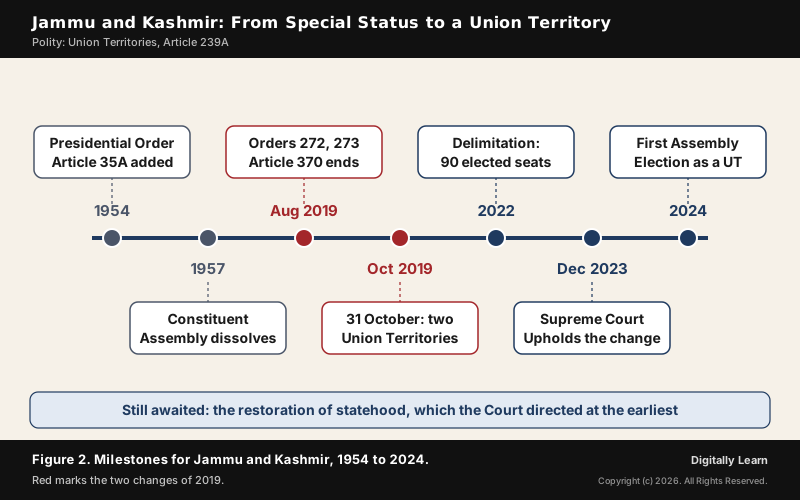
Jammu and Kashmir's special status rested on Article 370, the provision that decided how much of the Indian Constitution applied to the State. It sat in Part XXI, titled 'Temporary, Transitional and Special Provisions', under the marginal note 'Temporary provisions with respect to the State of Jammu and Kashmir'. It empowered the Constituent Assembly of Jammu and Kashmir to recommend how far the Constitution should apply to the State, and the 1954 Presidential Order was issued on its recommendations.
The Article grew out of the way the State joined India. Jammu and Kashmir's accession, like that of the other princely states, covered three matters: defence, foreign affairs and communications. The State set up its own Constituent Assembly, and Article 370 let the Union's other powers reach the State only with the concurrence of its government, a concurrence that had to be ratified by that Assembly. Its clauses worked as follows:
- Clause (1)(b): Parliament’s power to make laws for the State was limited to the Union and Concurrent List matters that corresponded to the Instrument of Accession, and to other matters the President specified with the concurrence of the State Government.
- Clause (1)(c): Article 1 and Article 370 itself applied to the State in full.
- Clause (1)(d): Other provisions of the Constitution applied only with such exceptions and modifications as the President specified by order.
- Clause (2): A concurrence given before the State’s Constituent Assembly met had to be placed before that Assembly for its decision.
- Clause (3): The President could declare by public notification that the Article would cease to be operative, but only on the recommendation of the State’s Constituent Assembly.
Why did a 'temporary' Article last so long? The State's Constituent Assembly dissolved itself on 25 January 1957 without recommending that Article 370 be abrogated or amended, and from then on the Article was considered a permanent feature of the Constitution. That reading is the heart of the 2016 Mains question.
Article 35A: Permanent Residents, Privileges and the Domicile Rule
The same 1954 Presidential Order added Article 35A to the Constitution. It let the State legislature define the State's permanent residents and their privileges in immovable property, settlement in the State and employment. Under the State's own constitution, only permanent residents could buy land and immovable property, vote and contest State elections and seek government jobs; other Indian citizens could not, even if they lived there.
Article 35A lost its force in August 2019: once the whole Constitution applied, the State's separate constitution stopped operating, and the privileges went with it. In their place came domicile: a person who has lived in Jammu and Kashmir for 15 years, or studied there for seven years and taken the Class 10 or 12 examination there, is deemed a domicile of the territory. The 73rd and 74th Amendments on panchayats and municipalities also became applicable, and the Right to Education was implemented.
Abrogation of Article 370 in August 2019: Constitution Orders 272 and 273
The special status ended in three steps over two days in August 2019. The President first applied the whole Constitution to the State, Parliament then recommended that Article 370 cease to apply, and the President issued a second order to that effect:
- 5 August 2019: Constitution Order 272 superseded the 1954 order and applied all the provisions of the Constitution to Jammu and Kashmir; the Rajya Sabha passed the resolution and the reorganisation Bill.
- 6 August 2019: The Lok Sabha passed both, and the President issued Constitution Order 273, under which Article 370 ceased to apply from that day.
- 9 August 2019: The Jammu and Kashmir Reorganisation Act, 2019 received the President’s assent.
- 31 October 2019: The State was reorganised into two Union Territories.
Supreme Court on Article 370 (2023): Holdings and the Statehood Direction
On 11 December 2023 a five-judge Constitution Bench of the Supreme Court unanimously upheld the ending of Article 370. Its conclusions answer most of what an examiner can ask about the change:
- No sovereignty: Jammu and Kashmir kept no element of sovereignty after the Instrument of Accession; Article 370 was a feature of asymmetric federalism, not sovereignty.
- Temporary provision: Its history and its place in Part XXI show that Article 370 was temporary, and the President’s power under Article 370(3) survived the dissolution of the State’s Constituent Assembly.
- The two orders: Using Article 367 to amend Article 370 through Constitution Order 272 was invalid, but applying all of the Constitution through that order was valid, and Constitution Order 273 was valid.
- Ladakh: Carving a Union Territory out of a State is permitted by Article 3(a) read with Explanation I.
- State constitution: The Constitution of the State of Jammu and Kashmir is inoperative and has become redundant.
One question was left open: whether Parliament can turn a whole State into one or more Union Territories under Article 3. The Court did not decide it because the Solicitor General stated that statehood would be restored. It directed elections to the Assembly by 30 September 2024 and the restoration of statehood 'at the earliest and as soon as possible'. The elections were held within that time; statehood has not yet been restored.
Jammu and Kashmir Union Territory Under the Reorganisation Act 2019
Jammu and Kashmir Reorganisation Act 2019: Two Union Territories
The Jammu and Kashmir Reorganisation Act, 2019 divided the State into two Union Territories from 31 October 2019. Section 3 formed the Union Territory of Ladakh, 'without Legislature', from the Kargil and Leh districts; section 4 formed the Union Territory of Jammu and Kashmir, 'with Legislature', from the rest of the State.
- Legislature: Article 239A, as it applies to Puducherry, also applies to Jammu and Kashmir (section 13); the old Legislative Council was abolished (section 57).
- Parliament: Jammu and Kashmir keeps 4 Rajya Sabha seats; in the Lok Sabha it has 5 seats and Ladakh 1.
- High Court: The High Court of Jammu and Kashmir became the common High Court for both Union Territories, with its costs shared in the ratio of their populations.
- Failure of machinery: Section 73 lets the President suspend the Act in Jammu and Kashmir on the Lieutenant Governor’s report or otherwise, much as Article 356 works for a State.
The direction of change is what makes the case unusual. Earlier reorganisations turned Union Territories into States, as Himachal Pradesh, Manipur, Tripura and Goa show; in 2019 a State was bifurcated into two Union Territories. The earlier history of the territories is traced in the article on the Union Territories of India.
Is Jammu and Kashmir a Union Territory: Assembly Seats and Members
Yes. Jammu and Kashmir is today a Union Territory with a Legislative Assembly, and statehood has not yet been restored. The 2019 Act fixed 107 seats to be filled by direct election; an amendment of December 2023 raised this to 114. Of these, 24 seats stay vacant for the areas under Pakistan's occupation and are not counted in the Assembly's total.
- Elected seats: The delimitation of 2022 gave 90 seats to be filled, 43 in the Jammu division and 47 in the Kashmir division; 7 are reserved for Scheduled Castes and 9 for Scheduled Tribes.
- Nominations: The Lieutenant Governor may nominate 2 women if women are not adequately represented, up to 2 Kashmiri Migrants (one of them a woman), and 1 displaced person from Pakistan-occupied Jammu and Kashmir.
- Term: Five years, down from six before 2019.
- Women’s reservation: One-third of the directly elected seats, to take effect after a delimitation based on the first census taken after the 2023 amendment.
The first election to the Union Territory's Assembly was held in September and October 2024. An alliance led by the Jammu and Kashmir National Conference formed the first government, with Omar Abdullah as Chief Minister.
Powers of the Jammu and Kashmir Assembly and the Lieutenant Governor
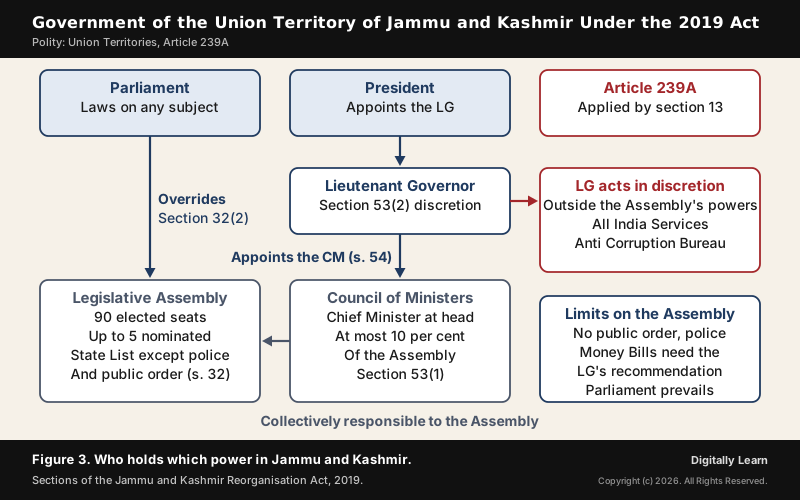
Under section 32 of the Act, the Assembly can make laws on any matter in the State List except public order and police, and on the Concurrent List, so far as these apply to Union Territories. Parliament's power to legislate for the territory is untouched. A Bill on taxation or on money from the Consolidated Fund can be introduced only on the Lieutenant Governor's recommendation.
A Council of Ministers of not more than 10 per cent of the Assembly, headed by the Chief Minister, aids and advises the Lieutenant Governor on matters within the Assembly's powers. Here Jammu and Kashmir differs from both Delhi and Puducherry: the Lieutenant Governor, not the President, appoints the Chief Minister, and the ministers hold office at the Lieutenant Governor's pleasure while remaining collectively responsible to the Assembly.
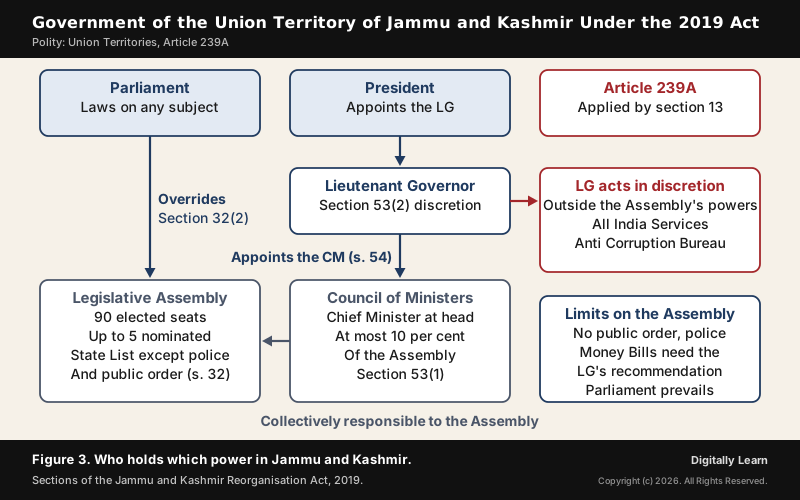
- Matters outside the Assembly’s powers: The Lieutenant Governor acts in his or her discretion.
- All India Services and the Anti Corruption Bureau: Also matters of discretion.
- Final say: If a question arises whether a matter is one of discretion, the Lieutenant Governor’s decision is final, and what advice the ministers gave cannot be inquired into in any court.
Ladakh Union Territory Without a Legislature
Is Ladakh a Union Territory: Lieutenant Governor, Hill Councils and Districts
Yes. Ladakh became a Union Territory on 31 October 2019, formed from the Kargil and Leh districts, and it has no Legislative Assembly. The President administers it through a Lieutenant Governor appointed under Article 239, and may make regulations for it under Article 240; such a regulation can repeal or amend an Act of Parliament as it applies to Ladakh.
- Local self-government: Two elected Autonomous Hill Development Councils, for Leh and for Kargil, work with village panchayats on economic development, health, education, land use, taxation and local governance.
- Districts: Five new districts, Zanskar, Drass, Sham, Nubra and Changthang, were announced in August 2024 and notified on 27 April 2026, taking Ladakh from two districts to seven.
- Representation: One Lok Sabha seat and no Rajya Sabha seat.
- Size: The largest Union Territory by area, and the second least populous.
- Map: An order of 2019 defines Leh district to include the 1947 areas of Gilgit, Gilgit Wazarat, Chilhas and the Tribal Territory, so India’s official map shows these within Ladakh.
Without a legislature, laws for Ladakh are made by Parliament or by presidential regulation, and the hill councils are its only elected bodies. That gap is what drives Ladakh's politics: local leaders have asked for constitutional safeguards that the hill councils cannot give.
Ladakh Sixth Schedule Demand: NCST Recommendation and High-Powered Committee
The Sixth Schedule applies, under Article 244(2), to the tribal areas of Assam, Meghalaya, Tripura and Mizoram. Each autonomous district there has a District Council of not more than 30 members, of whom not more than 4 are nominated by the Governor and the rest elected. A council can make laws on land, forests other than reserved forests, shifting cultivation, village administration, inheritance, marriage and divorce and social customs, and can run primary schools, dispensaries and markets. The Fifth Schedule gives a weaker form of protection to Scheduled Areas elsewhere; both exist to protect the interests of Scheduled Tribes.
The National Commission for Scheduled Tribes recommended on 11 September 2019 that Ladakh be brought under the Sixth Schedule, calling the new Union Territory predominantly a tribal region. It gave four reasons:
- Democratic devolution of powers.
- Preserving and promoting the distinct culture of the region.
- Protecting agrarian rights, including rights on land.
- Faster development of Ladakh through greater transfers of funds.
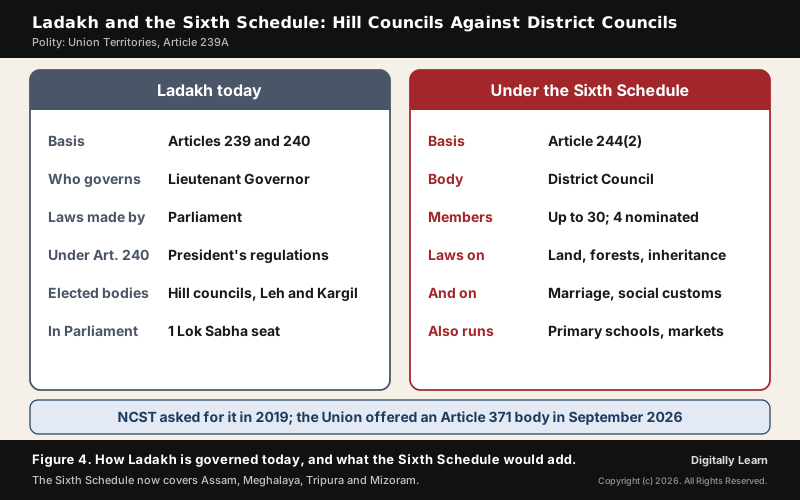
The Ministry of Home Affairs set up a High-Powered Committee, chaired by the Minister of State for Home Affairs, to talk with the Apex Body Leh and the Kargil Democratic Alliance. Its mandate covers culture and language, land and jobs, the hill councils and constitutional safeguards. The Union has reported that the talks raised reservation for Ladakh's Scheduled Tribes from 45 to 84 per cent, gave women one-third of the seats in the hill councils and made Bhoti and Purgi official languages.
Article 371 Proposal for Ladakh: A Directly Elected Body (2026)
The Union has since offered a different route. After talks on 22 May 2026 promised a 'customised sui generis model', the Ministry of Home Affairs proposed on 9 September 2026 an elected body for Ladakh through a new Chapter K under Article 371, the Article whose chapters A to J already carry special provisions for 12 States. The body would be chosen by direct election and would make laws on land, culture and language, forest, environment, natural resources and other subjects reserved for the Union Territory under Article 240.
Ladakh's Chief Secretary described it as neither statehood nor a Union Territory with a legislature, but a body of its own kind with legislative, executive and financial powers. The Leh Apex Body called the meeting a disappointment: it repeated what had been said in May, and no detailed draft proposal had been shared.
Previous Year UPSC-CSE Questions
Previous Year UPSC-CSE Questions By the end you will be able to draft model answers for the following UPSC questions. Each question carries a collapsible framework showing how to approach it in the exam.
- UPSC Mains 2025 GS-IIDiscuss the nature of Jammu and Kashmir Legislative Assembly after the Jammu and Kashmir Reorganization Act, 2019. Briefly describe the powers and functions of the Assembly of the Union Territory of Jammu and Kashmir.
Answer outline: how to structure the answer
What the question asks, the main arguments, relevant examples and the direction of the conclusion. This is not a full model answer.
Introduction: Introduce the 2019 Act, which made Jammu and Kashmir a Union Territory with a unicameral Assembly by applying Article 239A through section 13.
Body (sub-themes to develop):
- Nature: a legislature created by Parliament's law, not by the Constitution; 114 seats with 24 vacant; 90 elected, up to 5 nominated; a five-year term; the Legislative Council abolished.
- Powers: laws on the State List except public order and police, and on the Concurrent List (section 32); a Council of Ministers of at most 10 per cent, collectively responsible to the Assembly.
- Limits: Parliament's overriding power; money Bills only on the Lieutenant Governor's recommendation; the Lieutenant Governor appoints the Chief Minister and acts in discretion on the All India Services, the Anti Corruption Bureau and matters outside the Assembly's powers.
- Context: the first election in 2024; the Supreme Court's direction to restore statehood at the earliest.
Conclusion: Conclude that the Assembly restores elected government within a Union Territory frame, and that its powers will widen only when statehood is restored.
- UPSC Mains 2016 GS-IITo what extent is Article 370 of the Indian Constitution, bearing marginal note “Temporary provision with respect to the State of Jammu and Kashmir”, temporary? Discuss the future prospects of this provision in the context of Indian polity.
Answer outline: how to structure the answer
What the question asks, the main arguments, relevant examples and the direction of the conclusion. This is not a full model answer.
Introduction: Introduce Article 370's place in Part XXI, 'Temporary, Transitional and Special Provisions', with a marginal note calling it temporary.
Body (sub-themes to develop):
- Temporary: its scope depended on the State's Constituent Assembly, which could recommend its abrogation or amendment.
- Seen as permanent: the Constituent Assembly dissolved on 25 January 1957 without recommending either; the 1954 order and Article 35A shaped the State's distinct status.
- Future, as since decided: Constitution Orders 272 and 273 in August 2019; the 2023 Constitution Bench held the Article temporary and upheld its end, while directing statehood to be restored.
Conclusion: Conclude that the question of its temporariness has been settled by the 2019 orders and the 2023 judgment, leaving statehood as the open issue.
- UPSC Prelims 2015 Prelims-GSThe provisions in Fifth Schedule and Sixth Schedule in the Constitution of India are made in order to
How to approach this Prelims question
Approach: Step 1: recall what each Schedule governs. Article 244 applies the Fifth Schedule to Scheduled Areas and Scheduled Tribes, and the Sixth to the tribal areas of Assam, Meghalaya, Tripura and Mizoram. Step 2: both concern Scheduled Tribes, so the purpose they share is protecting tribal interests. Step 3: the other options describe other parts of the Constitution.
Trap to watch: Border States and boundaries sound plausible because the Sixth Schedule States lie on the border, but the Schedules are about tribes, not borders.
Key facts to recall:
- (a) Protect the interests of Scheduled Tribes: right. Both Schedules exist for this, through Scheduled Areas and District Councils.
- (b) Determine the boundaries between States: wrong. Boundaries are changed by Parliament under Article 3, not by these Schedules.
- (c) Determine the powers of Panchayats: wrong. That is Part IX and the Eleventh Schedule.
- (d) Protect the interests of all the border States: wrong. Many border States have no Sixth Schedule areas; the Schedules follow tribal areas.
Answer signal: Protect the interests of Scheduled Tribes: option (a), the official answer, because both Schedules govern tribal areas.
- UPSC Prelims 2010 Prelims-GSWith reference to Pondicherry (now Puducherry), consider the following statements :
- The first European power to occupy Pondicherry were the Portuguese.
- The second European power to occupy Pondicherry were the French.
- The English never occupied Pondicherry.
Which of the statements given above is/are correct ?
How to approach this Prelims question
Approach: Step 1: statement 1: the colonial period began with the Portuguese in 1521, so it is correct. Step 2: statement 2: the Dutch and the Danes followed in the 17th century, before the French settled in 1674, so the French were not second; incorrect. Step 3: statement 3: the British captured Pondicherry in 1761 and returned it in 1763; incorrect. Step 4: only statement 1, option (a).
Trap to watch: The French are so closely tied to Pondicherry that it is easy to assume they came early; they arrived after three other powers.
Key facts to recall:
- (a) 1 only: right. The Portuguese came first, in 1521.
- (b) 2 and 3 only: wrong. The Dutch and Danes preceded the French, and the British did occupy Pondicherry in 1761.
- (c) 3 only: wrong. The British captured it in 1761 and returned it under the Treaty of Paris in 1763.
- (d) 1, 2 and 3: wrong. Statements 2 and 3 are both incorrect.
Answer signal: 1 only: option (a), the official answer, because the Portuguese were first and the other two statements fail.
- UPSC Prelims 2012 Prelims-GSConsider the following statements :
- Union Territories are not represented in the Rajya Sabha.
- It is within the purview of the Chief Election Commissioner to adjudicate the election disputes.
- According to the Constitution of India, the Parliament consists of the Lok Sabha and the Rajya Sabha only.
Which of the statements given above is/are correct?
How to approach this Prelims question
Approach: Step 1: statement 1: the Fourth Schedule gives Rajya Sabha seats to Delhi (3) and Puducherry (1), and today to Jammu and Kashmir (4); incorrect. Step 2: statement 2: an election can be questioned only by an election petition under Article 329(b), decided by the courts, not by the Chief Election Commissioner; incorrect. Step 3: statement 3: under Article 79 Parliament consists of the President and the two Houses; incorrect. Step 4: none is correct, option (d).
Trap to watch: Statement 3 sounds right because people speak of Parliament as its two Houses, but Article 79 includes the President.
Key facts to recall:
- (a) 1 only: wrong. Union Territories with legislatures do have Rajya Sabha seats.
- (b) 2 and 3: wrong. Election disputes go to the courts by election petition, and Parliament includes the President.
- (c) 1 and 3: wrong. Both statements are incorrect.
- (d) None: right. All three statements are incorrect.
Answer signal: None: option (d), the official answer, because each statement contradicts the Constitution.
Sources
- Legislative Department, Ministry of Law and Justice: The Constitution of India
- The Jammu and Kashmir Reorganisation Act, 2019 (Act 34 of 2019), gazette text
- Gazette of India: The Jammu and Kashmir Reorganisation (Amendment) Act, 2023
- Gazette of India: The Jammu and Kashmir Reorganisation (Second Amendment) Act, 2023
- Supreme Court of India: In Re: Article 370 of the Constitution, 11 December 2023
- Ministry of Home Affairs: Maps of the newly formed Union Territories of Jammu and Kashmir and Ladakh, November 2019
- PIB: NCST recommends including the Union Territory of Ladakh under the Sixth Schedule, 11 September 2019
- PIB: Meeting of the High Powered Committee for Ladakh, 4 December 2023
- PIB: Press release on Ladakh, 24 September 2025
- PIB: Government remains committed to dialogue in Ladakh, 14 March 2026
- NCERT: Indian Constitution at Work, Class 11, Chapter 7, Federalism
- The Hindu (Delhi): MHA proposes new Chapter 'K' under Article 371 for Ladakh, 10 September 2026
- The Hindu (Delhi): Ladakh Chief Secretary on the sui generis model, 11 September 2026
- The Hindu (Delhi): Shutdown, prayers mark one year of Ladakh violence, 25 September 2026
- The Hindu (Delhi): The Jammu and Kashmir Statehood resolution, 4 October 2026
- Wikipedia: Fourteenth Amendment of the Constitution of India
- Wikipedia: Pondicherry
- Wikipedia: History of Puducherry
- Wikipedia: Puducherry (union territory)
- Wikipedia: Puducherry Legislative Assembly
- Wikipedia: 2026 Puducherry Legislative Assembly election
- Wikipedia: Article 370 of the Constitution of India
- Wikipedia: Article 35A of the Constitution of India
- Wikipedia: Revocation of the special status of Jammu and Kashmir
- Wikipedia: Jammu and Kashmir (union territory)
- Wikipedia: Jammu and Kashmir Legislative Assembly
- Wikipedia: Ladakh
- Wikipedia: Leh district
- Wikipedia: Sixth Schedule to the Constitution of India
- UPSC: Civil Services Examination question papers
Editorial Disclaimer
This article explains the Union Territories with legislatures from the Constitution, the Reorganisation Act and its amendments, the Supreme Court's judgment, official releases and the other sources listed.


