


Overview
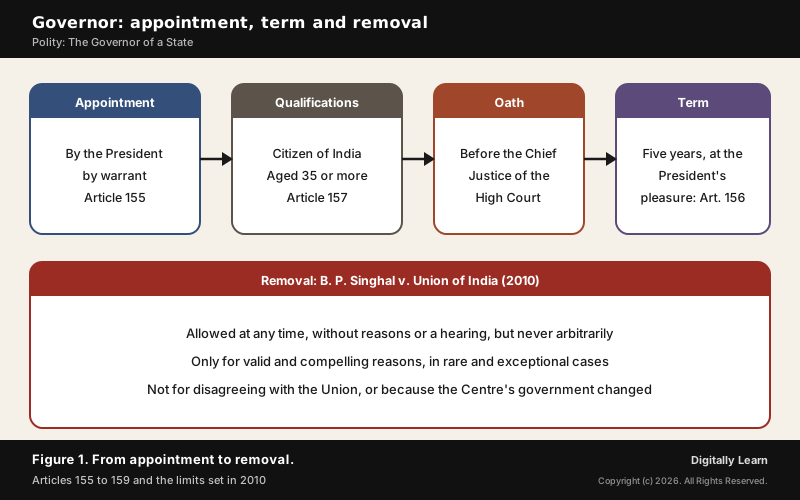
The Governor of a State is its constitutional head, appointed by the President under Article 155 and holding office for five years during the President's pleasure under Article 156. The Governor acts on the advice of the State Council of Ministers except where the Constitution requires discretion, is also the Union's link with the State, and carries special duties for Scheduled and tribal areas.
Governor of a State: Office Under Articles 153 and 154
Constitutional Head of the State and Agent of the Centre
Every State has a Governor. Article 153 provides that there shall be a Governor for each State, and Article 154 vests the executive power of the State in the Governor, to be exercised directly or through subordinate officers. In practice a Council of Ministers headed by the Chief Minister aids and advises the Governor under Article 163, so the Governor, like the President, is a constitutional head.
The office has a dual role. The Governor is the head of the State and also acts as an agent of the Central government, the channel through which the Centre exercises some control over the States. That is why the Sarkaria Commission called the Governor's role one of the key issues in Union-State relations, recording criticism of Governors' conduct in recommending President's Rule and reserving Bills for the President. How the Governor uses power over Bills and ordinances is on the powers of the Governor page.
Who Appoints the Governor of a State and Why the Governor Is Not Elected
Appointment by the President Under Article 155, and One Governor for Two States
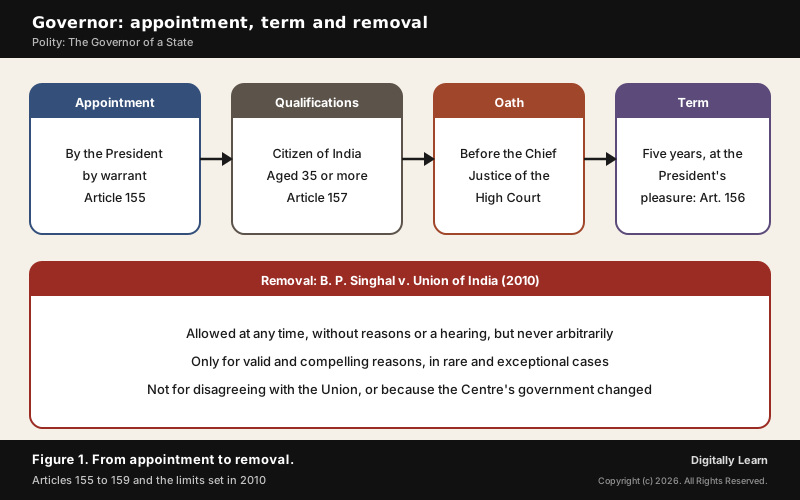
The Governor is neither elected by the people nor chosen by an electoral college, as the President is. Under Article 155, the President appoints the Governor by warrant under his hand and seal, and since the President acts in accordance with the advice of the Union Council of Ministers (Article 74), the choice is in practice the Union government's. Yet the Supreme Court held in 1979 that the office is not an employment under the Central government: it is an independent constitutional office, not subordinate to the Centre.
In choosing appointment, India followed the Canadian model, where the governor of a province is appointed by the Centre, and set aside the American model of an elected State head. The President may also transfer a Governor to another State for the rest of the term, and a Governor whose term has ended may be reappointed in the same or another State.
- Two or more States: The Seventh Amendment of 1956 added a proviso to Article 153 so that one person may be Governor of two or more States. Article 158(3A) then shares the Governor’s emoluments among those States in the proportion the President fixes.
- Union territory: Under Article 239(2), the President may appoint a Governor as administrator of an adjoining Union territory; there the Governor acts independently of the State Council of Ministers.
- Gaps: Article 160 lets the President provide for the Governor’s functions in any contingency the chapter does not cover, such as the death of a sitting Governor; the Chief Justice of the State High Court may then be asked to discharge the functions.
Why the Governor Is Appointed, Not Elected: Constituent Assembly Reasons
The Draft Constitution provided for a directly elected Governor. The Constituent Assembly gave the idea up, and Jawaharlal Nehru argued that election would encourage a separatist provincial tendency. The main reasons were:
- Parliamentary system: Direct election does not fit a State run by a Chief Minister responsible to the legislature.
- Conflict: An elected Governor beside an elected Chief Minister would be more likely to clash with him.
- Cost and neutrality: A nominal head does not need an expensive election, and an elected Governor would belong to a party.
- Unity and control: Election could encourage separatist tendencies, while nomination lets the Centre maintain its control over the States.
| Feature | Governor | President |
|---|---|---|
| How chosen | Appointed by the President (Art. 155) | Elected by an electoral college (Art. 54) |
| Minimum age | 35 (Art. 157) | 35 (Art. 58) |
| Oath before | Chief Justice of the High Court | Chief Justice of India |
| Term | Five years, at the President's pleasure | Five years |
| Removal | Withdrawal of pleasure, within B. P. Singhal | Impeachment (Art. 61) |
More on the President's election and impeachment is on the President of India page.
Qualifications of Governor, Conditions of Office, Salary and Immunities
Qualifications of Governor and Conditions of Office: Articles 157 and 158
The Constitution sets only two qualifications: the Governor must be a citizen of India and must have completed 35 years of age (Article 157). Two conventions have grown up beside them, though both have been broken at times: the Governor should be an outsider, not from the State, and the President should consult the State's Chief Minister before appointing.
- No seat: The Governor may not be a member of Parliament or of a State legislature; a member appointed Governor vacates the seat on taking office (Article 158).
- Office of profit: No other office of profit may be held.
- Residence: An official residence, the Raj Bhavan, without paying rent.
- Salary: Emoluments, allowances and privileges are fixed by Parliament by law and cannot be reduced during the term. Parliament raised the salary from ₹36,000 to ₹1.10 lakh a month in 2008, and in 2018 the Government decided on ₹3,50,000.
Selection Criteria for Governors: Sarkaria and Punchhi Commissions
Because the Constitution sets no test of suitability, commissions have proposed one. The Sarkaria Commission recommended that a Governor should be:
- Eminent in some walk of life.
- A person from outside the State.
- A detached figure, not too closely connected with local politics.
- Someone who has not taken too great a part in politics generally, and particularly in the recent past.
It drew these tests from Nehru's remarks in the Constituent Assembly, added that persons from minority groups should continue to get a chance, and favoured consulting the Chief Minister, the Vice-President and the Speaker. The NCRWC proposed in 2001 to write consultation with the Chief Minister into Article 155. The Punchhi Commission found in 2010 that parties in power at the Centre had given the criteria scant attention, producing a politicised governorship.
Oath of the Governor and Immunities Under Article 361
Under Article 159, the Governor takes an oath before the Chief Justice of the High Court of the State, or in that Chief Justice's absence the senior-most available judge. The Governor swears to execute the office faithfully, to preserve, protect and defend the Constitution and the law, and to devote the office to the service and well-being of the people of the State. Article 361 then gives the Governor, like the President, four immunities during the term:
- Official acts: Not answerable to any court for the exercise of the powers and duties of the office.
- Criminal proceedings: None may be instituted or continued in any court, even for personal acts.
- Arrest: No process for arrest or imprisonment may issue.
- Civil suits: For personal acts, only after two months’ written notice.
Tenure of Governor and Removal Under Article 156
Tenure of Governor: Five Years at the Pleasure of the President
Under Article 156, the Governor holds office during the pleasure of the President, may resign by writing to the President, and, subject to these, holds office for five years. The Governor continues after the term ends until a successor enters upon the office, so that a State is never without a Governor.
Two things follow. A Governor can be removed before five years, because the term is subject to the President's pleasure, and may serve beyond five years while awaiting a successor. The Constitution lays down no grounds for removal and no impeachment. Governments have used this freely: in 1989 the National Front government asked all Governors to resign, in 1991 the new Congress government changed fourteen Governors, and on 2 July 2004 the Governors of Uttar Pradesh, Gujarat, Haryana and Goa were removed together.
B. P. Singhal v. Union of India (2010) and Security of Tenure
The 2004 removals led to B. P. Singhal v. Union of India, decided by a Constitution Bench on 7 May 2010. The Court accepted that under Article 156(1) the President can remove a Governor at any time, without giving reasons or a hearing. But it held that the pleasure doctrine is not unlimited:
- Not arbitrary: The power cannot be used in an arbitrary, capricious or unreasonable way.
- Compelling reasons: Removal must be rare and exceptional, for valid and compelling reasons.
- Not for disagreement: A Governor cannot be removed for being out of step with the Union’s policies, or because the Union has lost confidence in the Governor.
- Not for a change of government: A new government at the Centre is not a ground for removing Governors.
Judicial review is narrow. If a removed Governor shows prima facie that the removal was arbitrary or mala fide, the court will ask the Union to disclose its reasons, and will interfere only if they are irrelevant, arbitrary, whimsical or mala fide, not merely because another view is possible.
The Sarkaria Commission wanted the five-year tenure left undisturbed except rarely and for some extremely compelling reason. It declined to propose impeachment, because the grounds for removing a Governor, whose role has heavy political content, cannot be proved by judicial standards. The Punchhi Commission went further in 2010: a fixed five-year term, replacing "during the pleasure of the President" in Article 156, and impeachment of a Governor on the lines of Article 61.
Governor and the State Council of Ministers
Constitutional Position of the Governor Compared With the President
The Constitution sets up a parliamentary government in the States as at the Centre, so the Governor is a nominal executive and the real executive is the Council of Ministers headed by the Chief Minister, which is collectively responsible to the Assembly (Article 164). At the State level the executive therefore comprises the Governor and the Chief Minister with the Council of Ministers. The Governor's position still differs from the President's in two ways:
- Discretion: The Constitution envisages the Governor acting at times in discretion; it envisages no such thing for the President.
- Binding advice: After the 42nd Amendment of 1976, ministerial advice binds the President; no such provision was made for the Governor.
| Kind of discretion | Examples |
|---|---|
| Constitutional (express) | Reserving a Bill for the President; recommending President's Rule; acting as administrator of an adjoining Union territory; seeking information from the Chief Minister |
| Situational | Choosing a Chief Minister when no party has a clear majority; dismissing a Ministry that cannot prove its majority; dissolving the Assembly when the Ministry has lost its majority |
Aid and Advice Under Article 163, Discretion and the Chief Secretary
Article 163(1) requires the Governor to act on the aid and advice of the Council of Ministers except where the Constitution requires discretion. If a question arises whether a matter lies within that discretion, the Governor's decision is final (Article 163(2)), and no court may inquire into the advice given (Article 163(3)). Under Article 164 the Governor appoints the Chief Minister, and the other Ministers on the Chief Minister's advice; Article 167 obliges the Chief Minister to keep the Governor informed.
- Express discretion: The Governors of Arunachal Pradesh, Assam, Meghalaya, Mizoram, Nagaland, Sikkim and Tripura have functions in their discretion under Articles 371A, 371F and 371H and the Sixth Schedule.
- Implied discretion: It may arise when the Council’s advice is not available.
- Narrow reading: In Nabam Rebia (2016) the Supreme Court held that discretion exists only where a provision expressly gives it or cannot be read otherwise, and it repeated this in the Tamil Nadu judgment of 2025.
The Punchhi Commission warned that Article 163(2) wrongly suggests a wide, undefined discretion. How these limits apply to Bills and hung Assemblies is explained on the powers of the Governor page.
Under Article 166(1), all executive action of the State Government is expressed as taken in the name of the Governor, but the choices behind it belong to the government. The Chief Secretary, usually the senior-most IAS officer of the senior-most batch, is chosen with the Chief Minister's approval, on ability and the Chief Minister's confidence. The post has no fixed tenure and the term can be extended.
Special Responsibilities of the Governor: Scheduled and Tribal Areas
Fifth Schedule Scheduled Areas and the Governor's Powers
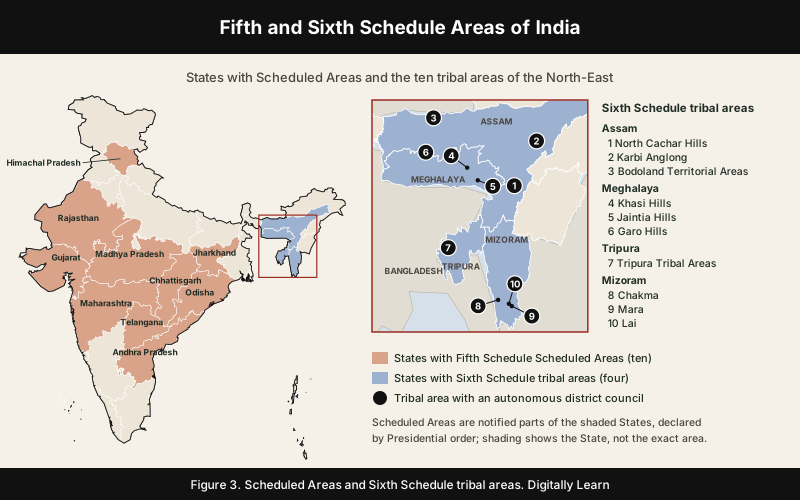
Scheduled Areas are declared by the President by order, after consulting the State's Governor (paragraph 6 of the Fifth Schedule). The criteria are a preponderance of tribal population, compactness and reasonable size, a viable administrative unit such as a district or block, and economic backwardness. Ten States have them: Andhra Pradesh, Telangana, Chhattisgarh, Gujarat, Himachal Pradesh, Jharkhand, Madhya Pradesh, Maharashtra, Odisha and Rajasthan. The State's executive power still extends to them.
- Annual report: The Governor reports to the President on their administration, and the Union may give the State directions.
- Tribes Advisory Council: Of not more than twenty members, about three-fourths of them Scheduled Tribe members of the Assembly.
- Applying laws: The Governor may direct that an Act of Parliament or the State shall not apply, or apply with changes, to a Scheduled Area.
- Regulations: For peace and good government, such as restricting land transfer and money-lending, after consulting the Council and with the President’s assent.
Sixth Schedule Tribal Areas, Article 371 and Scheduled Tribes
Under Article 244(2) and the Sixth Schedule, the tribal areas of Assam, Meghalaya, Tripura and Mizoram are run as autonomous districts, with district or regional councils holding legislative, judicial and executive powers. By notification the Governor may create, enlarge, shrink, unite or rename autonomous districts.
| State | Tribal areas (paragraph 20) |
|---|---|
| Assam | North Cachar Hills; Karbi Anglong; Bodoland Territorial Areas |
| Meghalaya | Khasi Hills; Jaintia Hills; Garo Hills |
| Tripura | Tripura Tribal Areas |
| Mizoram | Chakma; Mara; Lai |
- Article 371: The Governors of Maharashtra and Gujarat can be made responsible for development boards for regions such as Vidarbha, Marathwada, Saurashtra and Kutch; Article 371J does the same for the Hyderabad-Karnataka region; the Governors of Nagaland and Arunachal Pradesh are responsible for law and order (Articles 371A and 371H).
- Scheduled Tribes: Under Article 342(1) the President, after consulting the Governor, specifies the Scheduled Tribes of each State, so a tribe listed in one State need not be listed in another.
Reforming the Governor's Office: Commissions from 1969 to 2010
Administrative Reforms Commission, Sarkaria, NCRWC and Punchhi Commissions
Four reviews have shaped the debate. The Administrative Reforms Commission recommended in 1969 that the Inter-State Council frame guidelines on the Governor's discretion, but the Government preferred to leave the matter to conventions. The Sarkaria Commission, set up in June 1983, laid down the selection criteria and the rule against disturbing tenure. The NCRWC's paper of 2001 endorsed it, and the Punchhi Commission, constituted in 2007, reported in March 2010 on tenure, impeachment and discretion.
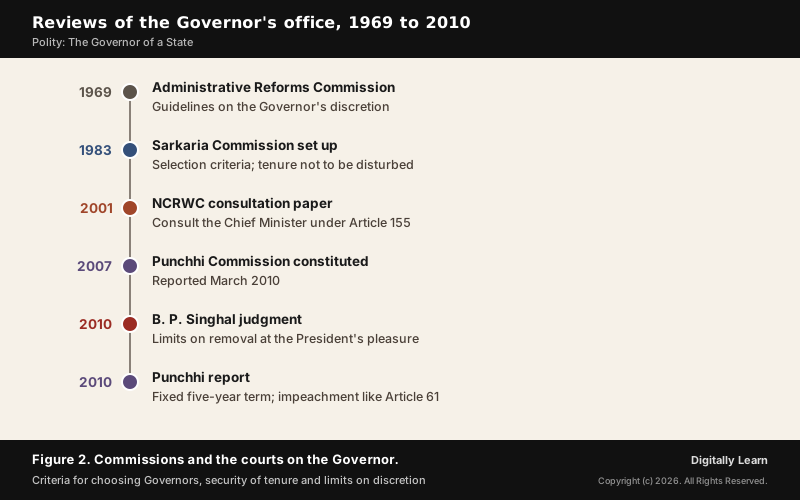
Their common answer is a nominated Governor chosen by clear criteria, secure in tenure and confined to a narrow, defined discretion. How this fits the wider balance between the Union and the States is discussed under the federal features of the Constitution.
Previous Year UPSC-CSE Questions
Previous Year UPSC-CSE Questions By the end you will be able to draft model answers for the following UPSC questions. Each question carries a collapsible framework showing how to approach it in the exam.
- UPSC Prelims 2019 GS-IWhich one of the following suggested that the Governor should be an eminent person from outside the State and should be a detached figure without intense political links or should not have taken part in politics in the recent past?
How to approach this Prelims question
Approach: Match the four criteria to the commission that framed them, not the ones that endorsed them.
Trap to watch: The NCRWC agreed with Sarkaria, which makes option (d) tempting.
Key facts to recall:
- Sarkaria Commission: set up June 1983.
- Four criteria from Nehru's remarks.
- NCRWC 2001 paper endorsed them.
Answer signal: The Sarkaria Commission framed the criteria, so option (c) is the answer.
- UPSC Prelims 2018 GS-IConsider the following statements:
- No criminal proceedings shall be instituted against the Governor of a State in any court during his term of office.
- The emoluments and allowances of the Governor of a State shall not be diminished during his term of office.
Which of the statements given above is/are correct?
How to approach this Prelims question
Approach: Locate each statement in Article 361 and Article 158.
Trap to watch: Statement 2 sounds like a judges' protection, but it applies to Governors too.
Key facts to recall:
- Article 361(2): no criminal proceedings.
- Article 158(4): emoluments not diminished.
- Article 361(4): civil suits after two months' notice.
Answer signal: Both statements are correct, so option (c) is the answer.
- UPSC Prelims 2025 GS-IWith reference to the Indian polity, consider the following statements:
- The Governor of a State is not answerable to any court for the exercise and performance of the powers and duties of his/her office.
- No criminal proceedings shall be instituted or continued against the Governor during his/her term of office.
- Members of a State Legislature are not liable to any proceedings in any court in respect of anything said within the House.
Which of the statements given above are correct?
How to approach this Prelims question
Approach: Assign statements I and II to Article 361 and statement III to Article 194(2).
Trap to watch: Statement III concerns legislators, not the Governor, which may make it look out of place.
Key facts to recall:
- Article 361(1): official acts.
- Article 361(2): criminal proceedings.
- Article 194(2): legislators' speech and votes.
Answer signal: All three statements are correct, so option (d) is the answer.
- UPSC Prelims 1995 GSArticle 156 of the Constitution of India provides that a Governor shall hold office for a term of five years from the date on which he enters upon his office. Which of the following can be deduced from this?
- No Governor can be removed from office till completion of his term.
- No Governor can continue in office beyond a period of five years.
Select the correct answer from the codes given below:
How to approach this Prelims question
Approach: Read clause (3) together with clause (1) and the proviso.
Trap to watch: A fixed-sounding five-year term tempts both deductions.
Key facts to recall:
- Article 156(1): pleasure of the President.
- Proviso: continues until successor.
- B. P. Singhal: removal needs compelling reasons.
Answer signal: Neither deduction follows, so option (d) is the answer.
- UPSC Prelims 2025 GS-IWith reference to the Constitution of India, if an area in a State is declared as Scheduled Area under the Fifth Schedule
- the State Government loses its executive power in such areas and a local body assumes total administration
- the Union Government can take over the total administration of such areas under certain circumstances on the recommendations of the Governor
Which of the statements given above is/are correct?
How to approach this Prelims question
Approach: Read paragraphs 2 and 3 of the Fifth Schedule.
Trap to watch: The Union's power to give directions can be mistaken for a power to take over.
Key facts to recall:
- Paragraph 2: State executive power extends.
- Paragraph 3: annual report and Union directions.
- Paragraph 5: Governor's regulations.
Answer signal: Neither statement is correct, so option (d) is the answer.
- UPSC Prelims 2016 GS-IConsider the following statements:
- The Chief Secretary in a State is appointed by the Governor of that State.
- The Chief Secretary in a State has a fixed tenure.
Which of the statements given above is/are correct?
How to approach this Prelims question
Approach: Separate the formal order in the Governor's name from the government's choice.
Trap to watch: Article 166 puts every order in the Governor's name, which suggests the Governor appoints.
Key facts to recall:
- Chief Secretary: approved by the Chief Minister.
- No fixed tenure; can be extended.
- Article 166(1): action in the Governor's name.
Answer signal: Neither statement is correct, so option (d) is the answer.
- UPSC Prelims 2024 GS-IConsider the following statements:
- It is the Governor of the State who recognizes and declares any community of that State as a Scheduled Tribe.
- A community declared as a Scheduled Tribe in a State need not be so in another State.
Which of the statements given above is/are correct?
How to approach this Prelims question
Approach: Identify who specifies and in relation to what.
Trap to watch: The Governor is consulted, which makes statement 1 look plausible.
Key facts to recall:
- Article 342(1): President specifies.
- After consultation with the Governor.
- Lists are in relation to each State.
Answer signal: Only statement 2 is correct, so option (b) is the answer.
Sources and Further Reading
- Legislative Department, Ministry of Law and Justice: The Constitution of India
- Supreme Court of India: B. P. Singhal v. Union of India (7 May 2010)
- Wikipedia: State of Tamil Nadu v. Governor of Tamil Nadu (2025 INSC 481; the official judgment is on the Supreme Court website)
- Inter-State Council Secretariat: Sarkaria Commission Report, Chapter IV, Role of the Governor
- Inter-State Council Secretariat: Commission on Centre-State Relations (Punchhi), Volume II, March 2010
- Ministry of Home Affairs: Commission on Centre-State Relations, constitution and terms of reference
- Department of Legal Affairs: NCRWC consultation paper, The Institution of Governor under the Constitution (11 May 2001)
- Ministry of Tribal Affairs: Scheduled Areas
- NCERT: Indian Constitution at Work, Class 11, Chapter 4, Executive
- Wikipedia: Chief secretary (India)
- Wikipedia: Sarkaria Commission
- Wikipedia: Dima Hasao district, Karbi Anglong district, Bodoland Territorial Region and the Sixth Schedule councils (map positions)
- Wikipedia: Governor (India)
Editorial Disclaimer
This article is for UPSC preparation and explains the office of the Governor. The map shows the States that contain Scheduled Areas, not the exact notified areas, and the official text of the Constitution governs any question of law.


