


Overview
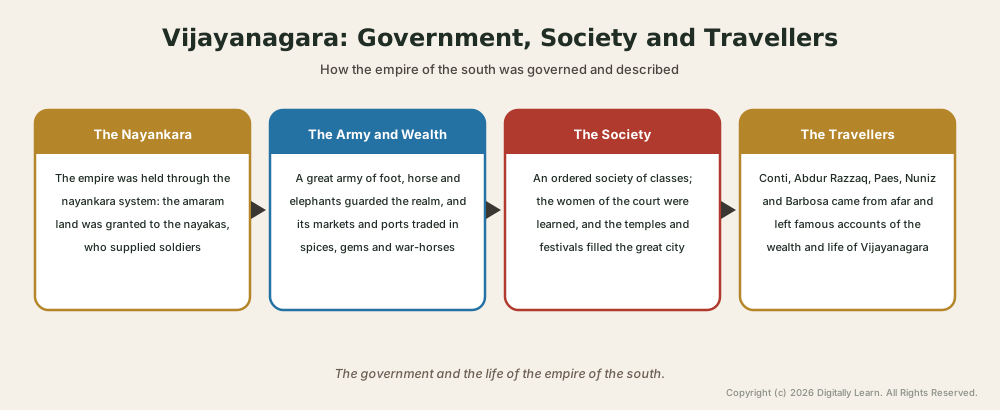
The Vijayanagara Empire was governed through the nayankara system, by which the land was divided into amaras, the amaram, granted to the great military chiefs, the nayakas, who held the provinces and supplied soldiers to the king. A strong army of foot, horse and elephants guarded the realm, and its markets and ports made it one of the richest lands of the age. Its society was ordered and its capital splendid, and a succession of foreign travellers, the Venetian Conti, the Persian Abdur Razzaq, and the Portuguese Paes, Nuniz and Barbosa, left famous accounts of its wealth and life. This part covers the administration, the society, the travellers, and the exam focus.
The Administration of Vijayanagara
The Nayankara System and the Provinces
What is the significance of the nayankara system: it was the framework by which the empire was held together, binding the great chiefs to the crown through grants of land.
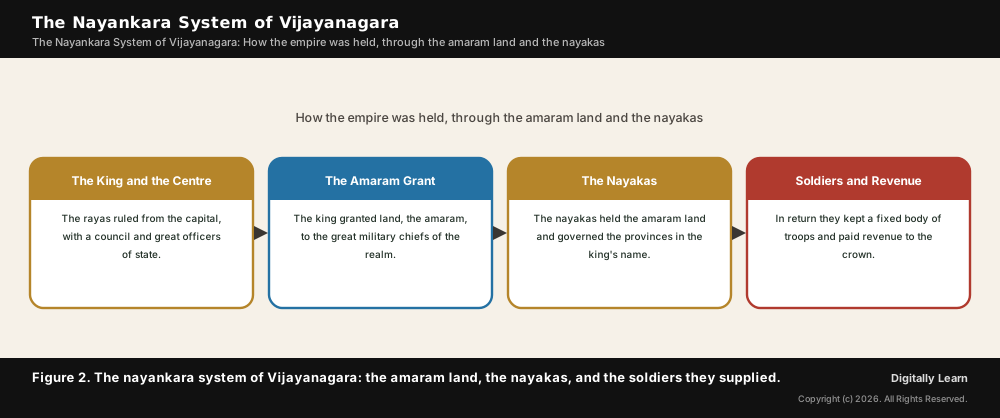
The empire was held through the nayakas. The land of Vijayanagara was divided into estates, the amaram, which the king granted to the great military chiefs, the nayakas. Each nayaka governed his lands and the people on them, and in return kept a fixed body of soldiers, horse and foot, ready for the king's service, and paid a part of his revenue to the crown. This was the nayankara system, the feudal order on which the empire rested.
The king ruled from the centre. Above the nayakas stood the raya, the emperor, who ruled from the capital with a council of ministers and great officers of state, and kept his own army apart from the levies of the chiefs. The figure below sets out the nayankara system.
The Army, the Trade and the Wealth
Distinguishing the strength of the state: the wealth of its trade and the size of its army made Vijayanagara the greatest power of the south.
It kept a great army. The empire maintained a vast force of foot, horse and war-elephants, the largest army of the south, and looked to the Portuguese on the coast for the war-horses of the western trade, on which its cavalry depended. The strength of this army was the wonder of the foreign travellers.
It was a land of great wealth. Vijayanagara was rich in farms and in trade, and its markets and ports dealt in spices, cloth, gems and horses, with merchants of many lands. The revenue of this trade and of the land, much of it gathered through the nayakas, filled the treasury and paid for the splendour of the capital that the travellers describe.
The Society and the City
The People, the Women and the Festivals
What is the significance of the society: the life of Vijayanagara, its classes, its women and its festivals, is known to us in unusual fullness through the foreign accounts.
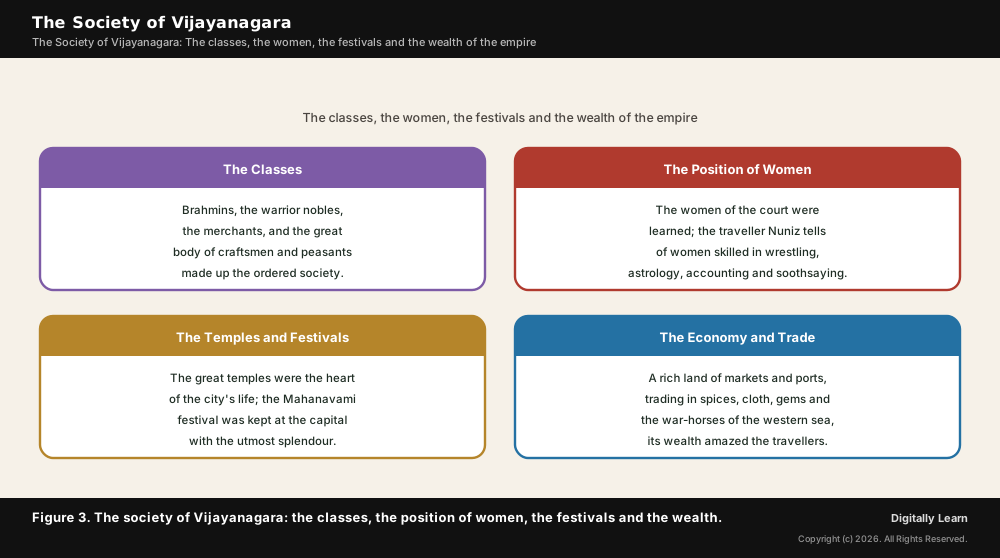
It was an ordered society. The people fell into the old classes, the brahmins, the warrior nobles, the merchants, and the great body of craftsmen and peasants who tilled the land and plied the trades.
The position of women was a notable one. The women of the court were learned, and the traveller Nuniz tells of women skilled in wrestling, in astrology, in accounting and in soothsaying, and of women who served as guards and attendants of the king.
The temples and festivals filled the city. The great temples were the heart of the capital's life, centres of worship, of learning and of trade alike; and the Mahanavami festival, the great nine-night festival of the autumn, was kept at the capital with a splendour of processions, music and arms that amazed the foreign visitors. The figure below sets out the society of the empire.
The Foreign Travellers
The Travellers Who Described the Empire
What is the significance of the travellers: the foreign visitors who came to Vijayanagara left the fullest and most vivid accounts we have of any Indian kingdom of the age.
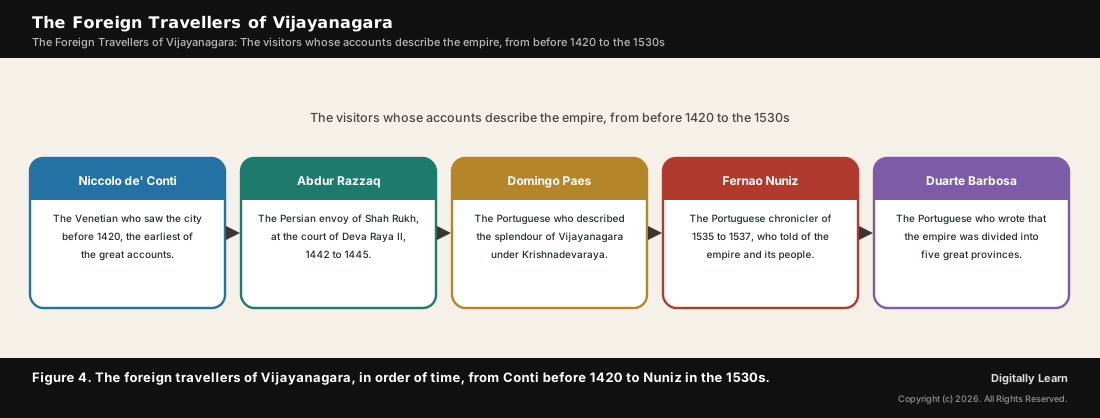
They came from many lands across two centuries. The Venetian Niccolo de' Conti saw the city before 1420; the Persian Abdur Razzaq, the envoy of Shah Rukh, came to the court of Deva Raya II between 1442 and 1445; the Portuguese Domingo Paes described the empire in the reign of Krishnadevaraya; Fernao Nuniz wrote his chronicle between 1535 and 1537; and Duarte Barbosa told that the empire was divided into five great provinces. The table below sets them out.
| Traveller | From | When | What he saw |
|---|---|---|---|
| Niccolo de' Conti | Venice | Before 1420 | The earliest account of the city. |
| Abdur Razzaq | Persia (envoy of Shah Rukh) | 1442 to 1445 | The court of Deva Raya II. |
| Domingo Paes | Portugal | About 1520 | The empire under Krishnadevaraya. |
| Fernao Nuniz | Portugal | 1535 to 1537 | The empire and its people. |
| Duarte Barbosa | Portugal | Early sixteenth century | The five great provinces. |
Their accounts are a priceless source. From the writings of these travellers we know the wealth of the markets, the strength of the army, the splendour of the festivals and the life of the people of Vijayanagara, in a fullness rare for any kingdom of medieval India. The figure below sets them in their order of time.
UPSC Relevance and Exam Focus
Where Vijayanagara Administration Fits in the UPSC-CSE Syllabus
This topic belongs to General Studies Paper I: medieval Indian history, and the administration, society and foreign travellers of Vijayanagara are a favourite ground for questions in the Prelims.
The questions most often test the nayankara and amaram system, the position of women as the travellers describe it, and the matching of each traveller to his land and his age.
Several linked points recur and are worth holding in working memory:
- The nayankara system: The amaram land was granted to the nayakas, who supplied soldiers to the king.
- Amaram: The Vijayanagara land grant, to be matched with the empire, not with the Delhi Sultans or the Mughals.
- The women: Nuniz tells of women skilled in wrestling, astrology, accounting and soothsaying.
- Abdur Razzaq: The Persian envoy at the court of Deva Raya II, in the fifteenth century.
- Paes and Nuniz: The Portuguese chroniclers of the sixteenth century.
A 2021 question asked in what skills the women of Vijayanagara were expert according to Nuniz; the answer was all four, wrestling, astrology, accounting and soothsaying, as this part has shown.
A 2000 question matched the land grant called amaram with the Vijayanagara Empire, against the iqta of the Delhi Sultans, the jagir of the Mughals and the mokasa of the Marathas; the amaram is the grant of Vijayanagara.
Previous Year UPSC-CSE Questions
Previous Year UPSC-CSE Questions By the end you will be able to draft model answers for the following UPSC questions. Each question carries a collapsible framework showing how to approach it in the exam.
- UPSC Prelims 2021 GS-IAccording to Portuguese writer Nuniz, the women in Vijayanagara Empire were expert in which of the following areas?
- Wrestling
- Astrology
- Accounting
- Soothsaying
Select the correct answer using the code given below.
How to approach this Prelims question
Approach: Recall Nuniz's account of the women of Vijayanagara, expert in wrestling, astrology, accounting and soothsaying; all four named skills are correct.
Trap to watch: Do not drop any one of the four; Nuniz credits the women with all of wrestling, astrology, accounting and soothsaying.
Key facts to recall:
- Nuniz was the Portuguese chronicler of Vijayanagara (1535-1537).
- He described the women of the court as learned and skilled.
- Their skills included wrestling, astrology, accounting and soothsaying.
Answer signal: 1, 2, 3 and 4.
- UPSC Prelims 2000 GS-IMatch List I (the land grant) with List II (the state that used it) and select the correct answer using the codes given below. List II: A) Marathas, B) Delhi Sultans, C) Mughals, D) Vijayanagara.
- I. Iqta
- II. Jagir
- III. Amaram
- IV. Mokasa
Select the correct answer using the codes given below the Lists.
How to approach this Prelims question
Approach: Match each grant to its state: iqta = Delhi Sultans, jagir = Mughals, amaram = Vijayanagara, mokasa = Marathas. This gives I-B, II-C, III-D, IV-A.
Trap to watch: The amaram is the Vijayanagara grant, not the Delhi or Mughal one; anchor on amaram = Vijayanagara to fix the code.
Key facts to recall:
- Amaram was the Vijayanagara land grant of the nayankara system.
- Iqta belonged to the Delhi Sultans and jagir to the Mughals.
- Mokasa was a Maratha grant.
Answer signal: I-B, II-C, III-D, IV-A.
Sources and Further Reading
Editorial Disclaimer
This article is for UPSC preparation. The administration and society of Vijayanagara rest on the inscriptions, the foreign accounts and the standard scholarship on the medieval Deccan.