


Overview
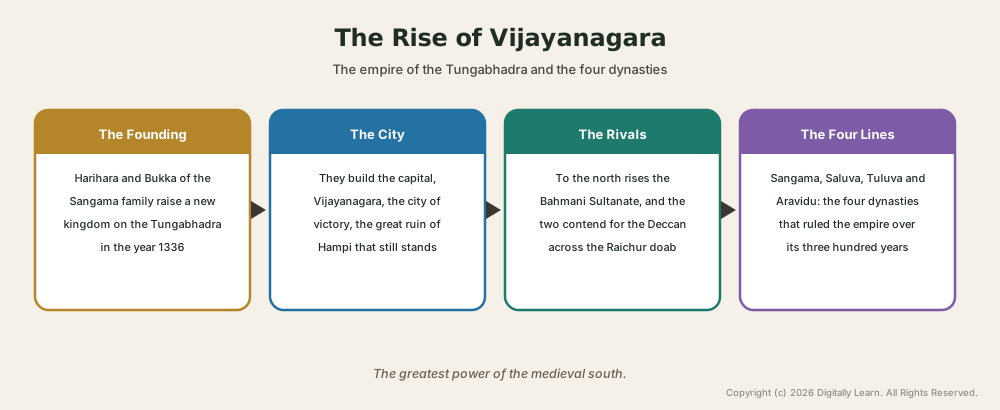
The Vijayanagara Empire was the last great Hindu empire of southern India. It was founded in 1336 by the brothers Harihara I and Bukka Raya I of the Sangama family, who raised a new kingdom on the river Tungabhadra as the old order of the south fell into ruin. They built their capital at Vijayanagara, the city of victory, the modern Hampi, and Harihara ruled as the agent of the god Virupaksha, lord of the southern land. For three centuries the empire guarded the culture of the south and contended with the Bahmani Sultanate for the Deccan. This part covers the founding, the Sangama dynasty, the four dynasties, and the exam focus.
The Birth of Vijayanagara
The Founding of 1336
What is the significance of the founding: it raised, in the ruin of the old southern order, the last and greatest Hindu empire of the south, which would guard its culture for three hundred years.
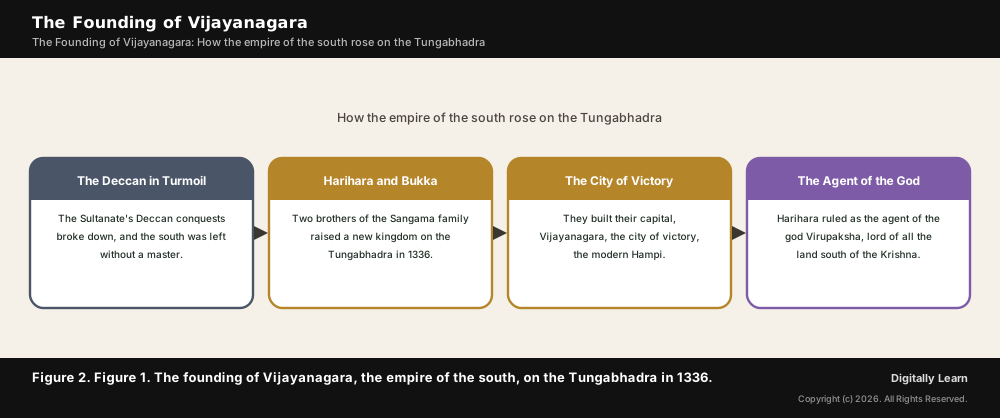
The empire was born of an age of trouble. The armies of the Delhi Sultanate had swept into the Deccan and the south, but their hold soon broke, and the southern land lay open. Into this opening rose two brothers, Harihara I and Bukka Raya I of the Sangama family, who in 1336 raised a new kingdom on the river Tungabhadra.
By tradition the brothers were inspired and guided by Vidyaranya, the sage of the Sringeri monastery, though the part he played in the founding is not certain. What is sure is that from a small beginning the new state grew swiftly to be the master of the south. The figure below sets out the founding.
The City on the Tungabhadra
Distinguishing the capital: the brothers built their seat at Vijayanagara, the city of victory, on the south bank of the Tungabhadra, a strong and well-watered site that became one of the great cities of the world.
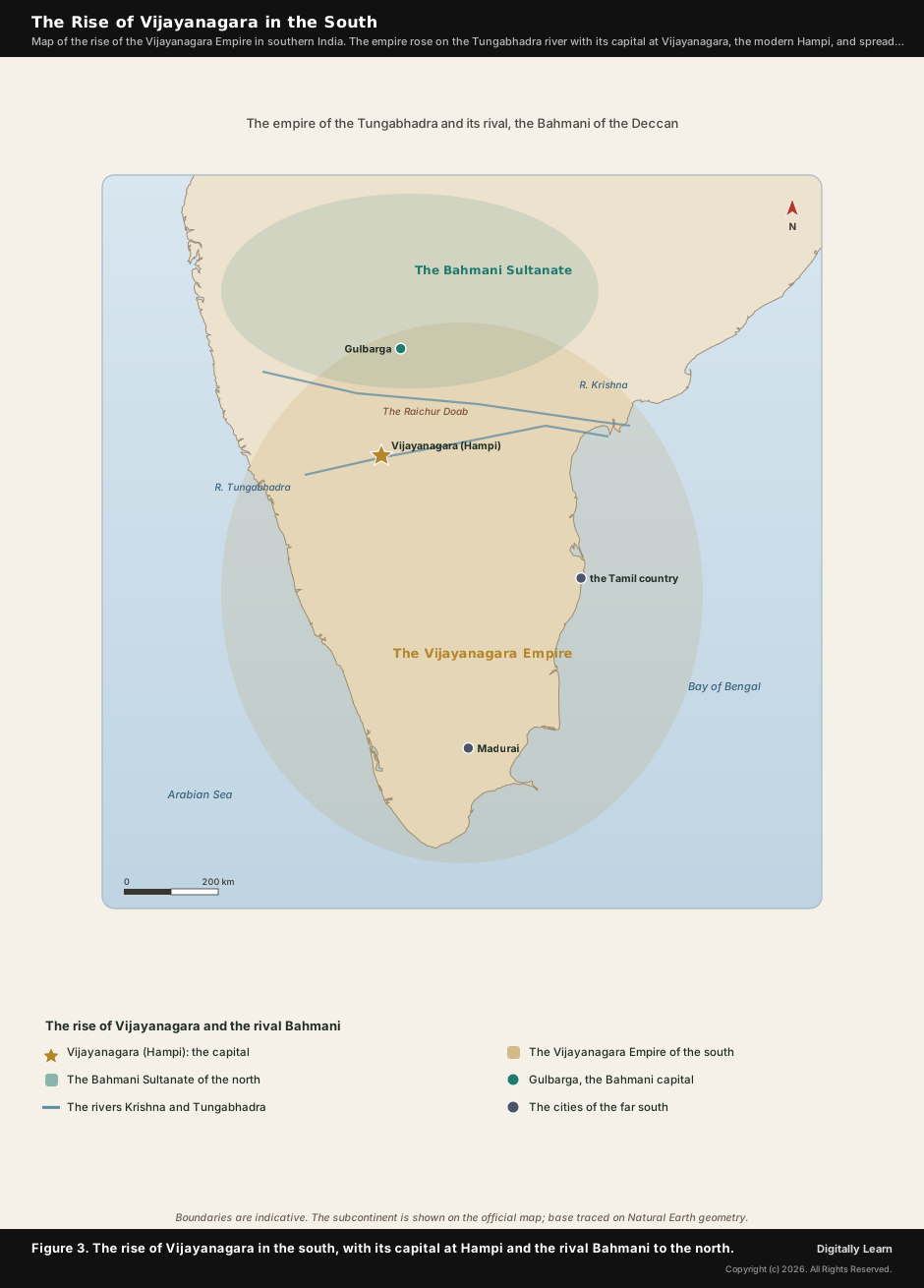
The capital was Vijayanagara, the city of victory, whose ruins stand today at Hampi in Karnataka. It rose on the south bank of the Tungabhadra, a tributary of the Krishna, ringed by rocky hills that made it a fortress. From it Harihara ruled, in the words of the tradition, as the agent of the god Virupaksha, to whom all the land south of the Krishna was held to belong.
The site was no accident. It lay on the very edge of the contest for the Deccan, for across the Tungabhadra and the Krishna, in the doab between the two rivers, lay the lands that Vijayanagara and its great rival the Bahmani Sultanate would fight over for two centuries. The map sets out the empire of the south and its northern rival.
The Sangama Dynasty and the Early Empire
Harihara, Bukka and the Early Expansion
What is the significance of the Sangama kings: they were the founding line, who in three generations carried the new kingdom from a fort on the Tungabhadra to the mastery of the whole south.
The first kings were the founders themselves. Harihara I and his brother Bukka Raya I subdued the chiefs of the south one by one and spread their power from sea to sea, so that within a generation the Sangama kings ruled the land from the Tungabhadra to the southern cape.
Their rise met a rival. In 1347, eleven years after Vijayanagara, the Bahmani Sultanate rose in the northern Deccan, and the two powers fell at once into the long contest for the lands between them. The struggle for the Deccan, which the next parts take up, was the constant theme of the empire's history.
Deva Raya II, the Greatest of the Sangama Kings
Distinguishing the height of the Sangama line: under Deva Raya II the first dynasty reached its peak, and the fame of the empire spread as far as Persia.
The greatest of the Sangama kings was Deva Raya II, who ruled in the first half of the fifteenth century. He strengthened the army, took Muslim horsemen and archers into his service, and held the empire firm against the Bahmani. In his reign the Persian envoy Abdur Razzaq, sent by the ruler of Persia, came to his court and left a famous account of the wealth and splendour of Vijayanagara.
The Sangama line ruled until 1485, when it gave way to a new dynasty. In all, four dynasties would rule the empire in turn. The table below sets out these four lines, whose stories the later parts of this series tell.
| Dynasty | Period | Note |
|---|---|---|
| Sangama | 1336 to 1485 | The founding line of Harihara, Bukka and Deva Raya II. |
| Saluva | From 1485 | Founded by Saluva Narasimha, who seized the throne. |
| Tuluva | Early sixteenth century | The line of Krishnadevaraya, the empire's height. |
| Aravidu | 1542 to 1646 | The last line, which carried on after Talikota. |
The Four Dynasties of Vijayanagara
From the Sangama to the Aravidu Kings
What is the significance of the four dynasties: the long life of the empire, three hundred years, was carried by a succession of four ruling lines, each rising as the last grew weak.
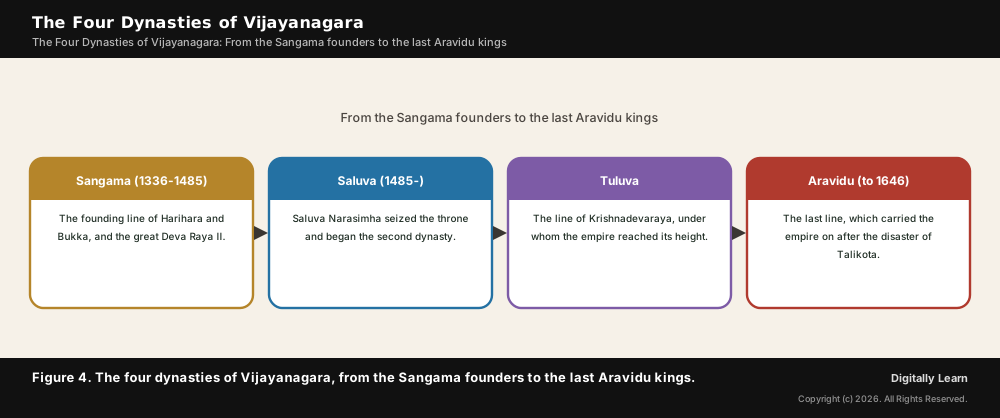
The four dynasties followed one another as the throne passed, often by usurpation, from line to line. The Sangama, the founders, ruled until 1485; the Saluva, begun by Saluva Narasimha, held the throne briefly; the Tuluva, the line of the great Krishnadevaraya, raised the empire to its height; and the Aravidu, the last, carried it on after the disaster of Talikota until 1646.
It is worth marking at the outset that the most famous king, Krishnadevaraya, belonged not to the founding Sangama line but to the third dynasty, the Tuluva, and ruled nearly two centuries after the founding. His reign, and the others, are the matter of the parts that follow. The figure below sets out the four dynasties.
UPSC Relevance and Exam Focus
Where the Rise of Vijayanagara Fits in the UPSC-CSE Syllabus
This topic belongs to General Studies Paper I: medieval Indian history, and the founding of Vijayanagara is a regular ground for questions on the medieval south.
The questions most often test the founders Harihara and Bukka, the Sangama dynasty, the capital at Hampi on the Tungabhadra, and the four dynasties of the empire.
Several linked points recur and are worth holding in working memory:
- Harihara and Bukka: The brothers of the Sangama family who founded Vijayanagara in 1336.
- The capital: Vijayanagara, the modern Hampi, on the river Tungabhadra.
- Vidyaranya: The Sringeri sage who, by tradition, inspired the founding.
- Deva Raya II: The greatest Sangama king, at whose court Abdur Razzaq came.
- The four dynasties: Sangama, Saluva, Tuluva and Aravidu, in that order.
A 2015 question asked who founded a new city on the south bank of a tributary of the Krishna and ruled as the agent of a deity; the answer is Harihara I, who built Vijayanagara on the Tungabhadra and ruled as the agent of the god Virupaksha.
A common trap names Krishnadevaraya as the founder of the empire; in truth he belonged to the Tuluva dynasty, the third line, and ruled nearly two centuries after Harihara and Bukka founded it.
Previous Year UPSC-CSE Questions
Previous Year UPSC-CSE Questions By the end you will be able to draft model answers for the following UPSC questions. Each question carries a collapsible framework showing how to approach it in the exam.
- UPSC Prelims 2015 GS-IWho of the following founded a new city on the south bank of a tributary to river Krishna and undertook to rule his new kingdom as the agent of a deity to whom all the land south of the river Krishna was supposed to belong?
How to approach this Prelims question
Approach: Recall the founding: Harihara I built the new city on the Tungabhadra (a tributary of the Krishna) and ruled as the agent of the god Virupaksha.
Trap to watch: Do not pick the earlier southern kings (Amoghavarsha the Rashtrakuta, Ballala the Hoysala, Prataparudra the Kakatiya); the founder of Vijayanagara was Harihara I.
Key facts to recall:
- Harihara I and Bukka founded Vijayanagara in 1336.
- The capital lay on the Tungabhadra, a tributary of the Krishna.
- Harihara ruled as the agent of the god Virupaksha.
Answer signal: Harihara I.
Sources and Further Reading
Editorial Disclaimer
This article is for UPSC preparation. The history of Vijayanagara rests on the inscriptions, the Persian and Portuguese accounts, and the standard scholarship on the medieval south.