


Overview

Deccan Sultanate architecture is the Indo-Islamic building of the Bahmani Sultanate (from 1347) and the five sultanates that followed it on the Deccan plateau until the Mughal conquest of 1686 and 1687. Its great works are the Bahmani tombs and madrasa of Bidar, the Gol Gumbaz and Ibrahim Rauza of Bijapur, and the Golconda Fort and Charminar of the Qutb Shahis.
Deccan Sultanate Architecture: Meaning, Dynasties and Centres
What Is Deccan Sultanate Architecture: The Deccani Style of Indo-Islamic Building
Deccan Sultanate architecture is the building of the Muslim kingdoms of the Deccan plateau from the fourteenth to the seventeenth century: first the Bahmani Sultanate and then the five sultanates that succeeded it. It is a regional variant of Indo-Islamic architecture, shaped by the Delhi Sultanate and later by Mughal building, with Persian and Central Asian features, and it differs greatly from the Hindu temple architecture of the same region.
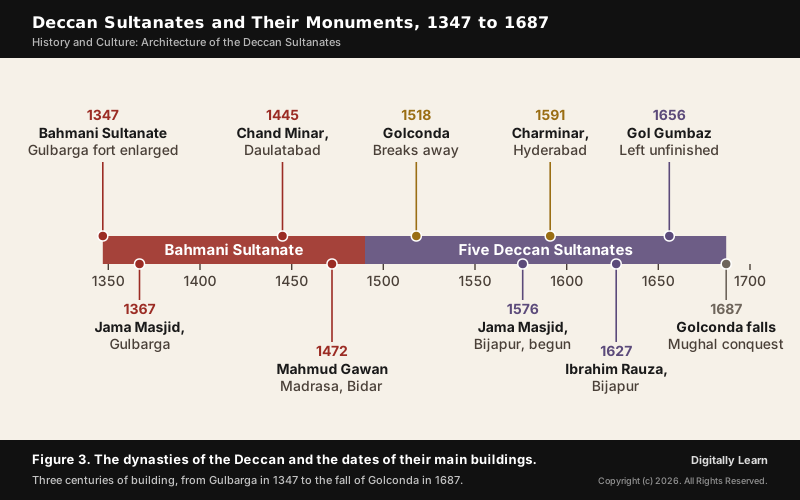
The Bahmani Sultanate was founded in 1347 with its capital at Gulbarga, later moved to Bidar. As it broke up, five successor kingdoms arose: Ahmadnagar, Bijapur and Berar declared independence in 1490, Bidar in about 1492 and Golconda by 1518. All of them claimed to be the heirs of the Bahmanis. Ahmadnagar conquered Berar in 1574 and Bijapur annexed Bidar in 1619; the Mughals took Ahmadnagar by 1636 and ended with Bijapur and Golconda in Aurangzeb's campaign of 1686 and 1687.
| Dynasty | Capital | Best-known buildings |
|---|---|---|
| Bahmani (1347 onward) | Gulbarga, then Bidar | Gulbarga Fort and Jama Masjid; Bidar Fort; Bahmani tombs; Mahmud Gawan Madrasa; Chand Minar |
| Adil Shahi | Bijapur | Gol Gumbaz; Ibrahim Rauza; Jama Masjid; Gagan Mahal |
| Qutb Shahi | Golconda, then Hyderabad | Golconda Fort; Charminar; Makkah Masjid; Qutb Shahi tombs |
| Nizam Shahi | Ahmadnagar | Palaces such as Farah Bagh (1583) |
| Barid Shahi and Imad Shahi | Bidar; Achalpur in Berar | Barid Shahi tombs at Bidar; the forts of Gavilgad and Narnala |

The political story of these kingdoms is told in the Bahmani Sultanate and the five Deccan Sultanates; this page follows their buildings.
Who Built the Deccan Monuments: Persian Architects and Local Craftsmen
The style came from a mixed court. The Bahmani rulers generally employed Persian architects to design the main features of a building, while Hindu masons and craftsmen supervised the construction and filled in the details. At Bijapur, Muhammad Adil Shah called architects and engineers from different parts of the subcontinent for his tomb and hired local workers for its decoration. Abyssinians held high office at Bijapur: Malik Sandal oversaw the Ibrahim Rauza, and Malik Yaqut completed the city's Jama Masjid.
Ideas moved across the region's frontiers as well. The elephant stables of the Vijayanagara rulers were strongly influenced by the architecture of the neighbouring sultanates of Bijapur and Golconda, though the two sides were rivals; in 1565 the sultanates allied to defeat Vijayanagara at Talikota. The Vijayanagara side is covered in Vijayanagara architecture at Hampi.
Bahmani Architecture: Gulbarga, Bidar and Daulatabad
Gulbarga Fort, Its Jama Masjid and the Haft Gumbaz Tombs
Gulbarga, now Kalaburagi in Karnataka, was the first Bahmani capital. Ala-ud-Din Bahman Shah greatly enlarged its fort in 1347, after breaking with the Delhi Sultanate, and mosques, palaces and tombs were built inside it.
- Jama Masjid (1367): Built inside the fort in the Persian style, fully enclosed under domes on arched columns, to mark the founding of Bahmani rule at Gulbarga; it covers 38,000 square feet, and its congregational courtyard is roofed over, which is unique in the region.
- Haft Gumbaz: A group of seven tombs of the fourteenth and fifteenth centuries, four of them of Bahmani sultans, in a style that recalls Tughlaq building. Its double-chambered tombs, one chamber for the king and one for his family, are found nowhere else; the tomb of Firuz Shah Bahmani is the largest.
- Later history: Vijayanagara razed the fort; Yusuf Adil Shah of Bijapur rebuilt it after 1565, and Aurangzeb took it in 1687.
Gulbarga remained the capital until the early fifteenth century, when the sultans moved to Bidar, a place with a better climate. The earlier Bahmani sultans lie in the Haft Gumbaz; the later ones are buried at Bidar.
Bidar: Fort, Bahmani Tombs and the Mahmud Gawan Madrasa
Bidar became the Bahmani capital under Ahmad Shah I Wali (1422 to 1436), who rebuilt its old fort and raised madrasas, mosques, palaces and gardens. The fort stands on the edge of the Bidar plateau as an irregular rhombus, with sheer walls on the north and east, and holds over 30 monuments. Its long, winding walls of stone and mortar were built by Persian and Turkish architects with stone from the moat.
- Bahmani tombs: The necropolis of the dynasty at Bidar, built from 1436 to 1535, beginning with Ahmad Shah’s own tomb. Square tombs under bulbous domes, of black trap masonry laid in lime, once faced with encaustic tiles of floral, geometric and calligraphic design. Ahmad Shah’s tomb has painted interiors and inscriptions in the Kufic and Thuluth scripts. The later tombs grow smaller as Bahmani power declined.
- Mahmud Gawan Madrasa (1471 to 1472): Built by Mahmud Gawan, the Bahmani prime minister, a Persian trader from Gilan who came to Bidar in 1453. Built with his own money, it worked like a residential university on the model of the madrasas of Khurasan: three storeys of rooms around a courtyard, entered from the east between two minarets about 30 metres high.
The madrasa shows how buildings suffer. Under the Mughals it was used as a cavalry barrack; gunpowder stored in it exploded and destroyed about a quarter of the building, and a lightning strike in 1695 or 1696 left it disused. The Archaeological Survey of India took it over in 1914. Mahmud Gawan's career is covered in Mahmud Gawan and the height of the Bahmani Sultanate.
Daulatabad: Chand Minar and the Defences of the Fort
The Chand Minar, the Tower of the Moon, stands at Daulatabad in Maharashtra. It was raised in 1445 to celebrate a Bahmani victory over Vijayanagara and was inspired by the Qutb Minar of Delhi. About 63 metres high, it rises in four storeys; its facade once carried chevron patterns in encaustic tile and bold bands of Quranic verses, and its balconies rest on brackets, an Indian feature. It was the joint work of local architects with others from Delhi and Iran.
The fort around it, earlier called Devagiri, was built to confound an attacker. Its entrances were staggered so that elephants could not force the gates; it had twin forts, one inside the other at a higher level; and a wrong turn in its winding passages could leave an enemy soldier going in circles or falling several hundred feet.
Adil Shahi Architecture of Bijapur: Gol Gumbaz and Ibrahim Rauza
Gol Gumbaz, Bijapur: The Great Dome of Muhammad Adil Shah
The Gol Gumbaz, round dome, is the tomb of Muhammad Adil Shah (1626 to 1656), the seventh sultan of the Adil Shahi dynasty of Bijapur, now Vijayapura in Karnataka. The sultan built it himself; work stopped at his death in 1656, so the tomb was left unfinished, yet it remains a striking building. It stands in a walled garden with a gateway, a Naqqar Khana, a mosque and a sarai.
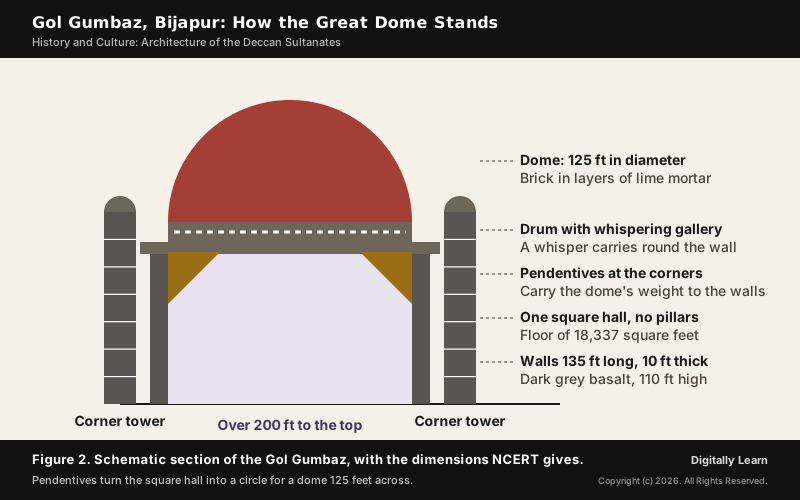
- Material: Dark grey basalt with decorated plasterwork; the great dome itself is of brick laid in layers of lime mortar.
- Size: Each wall is 135 feet long, 110 feet high and 10 feet thick; with the drum and dome the building rises over 200 feet.
- Dome: A hemispherical dome with a diameter of 125 feet over a single square chamber, covering an uninterrupted floor of 18,337 square feet; measured on the outside, the dome is about 44 metres (144 feet) across.
- Structure: Pendentives at the corners shape the dome and carry its weight down to the walls; arch-nets of intersecting arches cover the angles.
- Whispering gallery: A gallery runs round the drum, where a whisper against the wall is heard at any other point and sounds echo many times.
- Corners and cornice: A seven-storeyed octagonal tower at each corner holds a staircase to the dome; a heavily bracketed cornice on corbels runs along the facade.
The tomb chamber holds the cenotaphs of the sultan and his family, whose real graves lie in a vault below. The dome, arches, proportions and load-bearing method recall Timurid and Persian building, but the material is local and the surface ornament is Deccani. In its time it was among the largest domes in the world built before the modern age.
Ibrahim Rauza and the Jama Masjid of Bijapur
The Ibrahim Rauza, garden tomb, is the finest building of Ibrahim Adil Shah II's reign. Its Persian inscriptions show that his queen Taj Sultana built it, completed in 1626 or 1627, and that the Abyssinian Malik Sandal oversaw the work; after the sultan's death it became the family tomb. Because of its skyline it is popularly called the Black Taj Mahal or the Taj of the South.
- Plan: A tomb and a mosque of matching outline face each other on one raised plinth, with a fountain and cistern between them, inside a walled enclosure.
- Ornament: Fine stone carving, perforated stone windows (jalis) carved with calligraphy, and calligraphy on a scale not seen elsewhere; the calligrapher, Sayyid Naqi al-Din al-Husaini, signed his work.
- Setting: Outside the Mecca Darwaza of the old city, on the road to Nauraspur, the new city Ibrahim II began in 1599.
The Jama Masjid of Bijapur, the city's largest mosque, was begun in 1576 by Ali Adil Shah I with money taken in the battle of Talikota, and it was never completed. It holds 4,000 worshippers; its prayer hall opens in seven arches, only the central one decorated, under a hemispherical dome, and its floor was later divided by Aurangzeb into 2,250 rectangles like prayer mats. The Gagan Mahal, a palace believed to date from 1561, served as both royal residence and audience hall.
Qutb Shahi Architecture of Golconda and Hyderabad: Charminar and the Tombs
Golconda Fort: The Granite Citadel of the Qutb Shahis
Golconda began as a small mud fort of the Kakatiya kings and passed to the Bahmanis. Sultan Quli, their governor, declared independence in 1518 and made it his capital. Over 62 years the first three Qutb Shahi sultans turned it into a granite fortress about 5 kilometres round, and an outer wall of 7 kilometres enclosed the city. It remained the capital until 1590, when Hyderabad was founded.
- Defence: Concentric outer walls, so an enemy had to break through each in turn.
- Acoustics: A hand clap below the dome at the Fateh Darwaza entrance can be heard at the Bala Hisar pavilion, the highest point, almost a kilometre away.
- Wealth: The diamond mines nearby made Golconda a byword for riches; the Koh-i-Noor and the Hope diamond were once kept in its vault.
- Fall: The fort fell to Aurangzeb in 1687 after an eight-month siege, and the last sultan, Abul Hasan Qutb Shah, was taken captive.
Charminar and Makkah Masjid: The Heart of Qutb Shahi Hyderabad
Muhammad Quli Qutb Shah, the fifth Qutb Shahi ruler, moved his capital from Golconda to the new city of Hyderabad and built the Charminar, four minarets, at its centre in 1591. It is widely held to commemorate the end of a plague; the French traveller Thevenot linked it instead to the start of the second Islamic millennium.
- Arches and minarets: A square structure, each side 20 metres long, with a great arch on each side facing a cardinal point; a fluted minaret 56 metres high rises at each corner, built into the main structure.
- Mosque on the roof: A mosque occupies the top floor, with 45 prayer spaces; the rest of the roof served as a royal court.
- Granite and stucco: Granite, limestone, mortar and pulverised marble, with a profusion of stucco decoration, balustrades and balconies.
- City plan: It stands where the trade route to the port of Machilipatnam crossed the city, and the old city was laid out in four quarters around it, with four gateways, the Char Kaman, to the north.
The Makkah Masjid, just south of the Charminar, was begun in 1617 by Muhammad Qutb Shah, who had bricks made from soil brought from Mecca for its central arch, which gave the mosque its name. About 8,000 workers built it, and it was completed by Aurangzeb in 1694; with room for 10,000 worshippers it is the largest mosque of the city.
Qutb Shahi Tombs at Ibrahim Bagh, Golconda
Near the Golconda Fort, in the Ibrahim Bagh, stand the tombs of seven of the eight Qutb Shahi sultans and their families. They are domed buildings on square bases ringed by pointed arches, a blend of Persian and Indian forms, standing on raised platforms; the smaller tombs have galleries of one storey, the larger of two, and the domes were once covered with blue and green tiles.
The tombs were held in great respect under the Qutb Shahis, with carpets, chandeliers and readers of the Quran. In the siege of 1687 the Mughal army turned them into barracks and mounted guns on them. Restored in the nineteenth century by Salar Jung III, they were restored again from 2013 by the Telangana State Archaeology and Museums Department with the Aga Khan Trust for Culture, and the restoration was unveiled on 10 March 2020.
Features of Deccan Sultanate Architecture
Characteristics of the Deccani Style: Domes, Minarets, Stucco and Stone
The Deccani style is easiest to remember by comparing its three centres. Each used the same Indo-Islamic language of domes, arches and minarets, but with its own stone and ornament, as the timeline in Figure 3 shows.
| Centre | Material | What stands out |
|---|---|---|
| Bidar and Gulbarga (Bahmani) | Black trap masonry laid in lime | Persian plans by Persian architects; encaustic tiles; a covered mosque at Gulbarga |
| Bijapur (Adil Shahi) | Dark grey basalt; brick dome | Great domes on pendentives; Gol Gumbaz; carved stone and calligraphy at Ibrahim Rauza |
| Golconda and Hyderabad (Qutb Shahi) | Granite, lime and stucco | Minarets built into the structure; rich stucco; tiled domes of the tombs |
- Forts: Concentric walls at Golconda, double lines of walls at Bidar, staggered gates and a labyrinth at Daulatabad.
- Domes: Hemispherical and bulbous domes, the largest at the Gol Gumbaz; the Charminar’s minarets end in small domes with petal-like bases.
- Minarets and towers: The tapering Chand Minar; corner towers at the Gol Gumbaz; the minarets of the Charminar.
- Surface: Encaustic tiles in Bidar, Persian blue tiles at Daulatabad, stucco in Hyderabad, carved stone in Bijapur.
- Mixture: Persian and Central Asian structure, Indian brackets and local craftsmanship.
Deccani Painting, Music and Literature at the Sultanate Courts
Deccani Painting: The Schools of Ahmadnagar, Bijapur and Golconda
The same courts built a school of painting of their own. Deccani painting grew from the late sixteenth century until the Mughal conquest of the 1680s, in rich, intense colour, dense composition and an air of romance, with high horizons and gold skies taken from Persia, and women in south Indian dress like the figures of the Lepakshi murals.
- Ahmadnagar: The earliest Deccani paintings illustrate a volume of poems on the reign of Hussain Nizam Shah I (1553 to 1565), the Tarif-i-Hussain Shahi.
- Bijapur: The Nujum al-Ulum (1570), an encyclopaedia with 876 miniatures of weapons, utensils and constellations; Ali Adil Shah I and Ibrahim II were the patrons; Ibrahim II may have commissioned a Ragamala series in the 1590s.
- Golconda: The wealthiest Deccan kingdom by the end of the sixteenth century, through east-coast trade and, from the seventeenth, diamonds; its portraits of sultans were carried to Europe by Dutch merchants.
A painting of the Hyderabad school in the National Museum shows the Sufi saint Nizamuddin Auliya listening to his disciple Amir Khusrau, the poet regarded as the father of qawwali, the devotional singing of the Sufis.
Ibrahim Adil Shah II, Kitab-i-Nauras and Dakhani Literature
Ibrahim Adil Shah II (1580 to 1627), under whom Bijapur reached its greatest extent, was a musician, poet and patron, known as Jagadguru Badshah. He wrote the Kitab-i-Nauras, a book of songs in Dakhani set to different ragas and raginis, in which he praised the goddess Saraswati along with the Prophet Muhammad and the Sufi saint Khwaja Banda Nawaz Gesudaraz of Gulbarga.
- Music: He played the tanpura, which he called Moti Khan, and drew the best musicians and dancers of his age to Bijapur.
- Nauraspur: In 1599 he began a new city of learning and art, Nauraspur, west of Bijapur; it was never completed.
- Learning: Under his orders Firishta wrote the Tarikh-i-Firishta, a history of the Deccan sultanates in Persian.
- Golconda’s poet-king: Muhammad Quli Qutb Shah wrote in Dakhani, Persian and Telugu and left a collection of Dakhani poems, the Kulliyat.
Significance and Conservation of the Deccan Sultanate Monuments
Why the Deccani Style Matters: Synthesis, Dakhani Culture and World Heritage Bid
The Deccan monuments show a frontier culture at work. Persian architects, Abyssinian nobles, Hindu masons and local poets built a style that was neither a copy of Delhi nor of Iran, and the same courts made Dakhani a language of literature and gave Indian music a royal patron in Ibrahim II.
- World Heritage bid: On 15 April 2014 the Monuments and Forts of the Deccan Sultanate were placed on UNESCO’s tentative list: the Bahmani and Barid Shahi monuments at Bidar, the Adil Shahi monuments at Bijapur, the Qutb Shahi monuments at Hyderabad, and with them the Haft Gumbaz and the madrasa of Mahmud Gawan.
- Engineering: The Gol Gumbaz dome, one of the largest of the pre-modern world, and the acoustics of its gallery and of the Golconda gate.
- Town planning: Hyderabad laid out in quarters round the Charminar on a trade route to the coast.
Conserving the Deccan Monuments: Neglect, Barracks and Restoration
Many of these buildings came close to ruin. After the Mughal conquest of 1686, Bijapur was largely abandoned and lost its people to famine, floods and cholera, and the Gol Gumbaz stood neglected; the Qutb Shahi tombs and the madrasa of Mahmud Gawan were turned into Mughal barracks. Today the Haft Gumbaz at Gulbarga is hemmed in by shops and institutions that have encroached on the complex.
- Survey and museums: The Gol Gumbaz was opened to the public with a museum in 1892, and the Archaeological Survey of India took charge of it in 1962; the Survey has administered the Mahmud Gawan Madrasa since 1914.
- Restoration partnerships: The Telangana State Archaeology and Museums Department and the Aga Khan Trust for Culture have restored the Qutb Shahi tombs since 2013, with the step-wells funded by the US Ambassadors Fund for Cultural Preservation.
- Recognition: The tentative World Heritage listing of 2014 places the Deccan forts and tombs before an international standard of care.
Previous Year UPSC-CSE Questions
Previous Year UPSC-CSE Questions By the end you will be able to draft model answers for the following UPSC questions. Each question carries a collapsible framework showing how to approach it in the exam.
- UPSC Prelims 1995 Prelims-GSWhich one of the following monuments has a dome which is said to be one of the largest in the world?
How to approach this Prelims question
Approach: Step 1: the question asks for a dome counted among the largest in the world. Step 2: the Gol Gumbaz at Bijapur, the tomb of Muhammad Adil Shah, has a dome 125 feet in diameter over a single hall of 18,337 square feet. Step 3: the other three are well-known tombs and a mosque, but none is famed for the size of its dome.
Trap to watch: The Jama Masjid of Delhi is the largest mosque of India, not the building with the largest dome; do not confuse the two kinds of size.
Key facts to recall:
- (a) Tomb of Sher Shah, Sasaram: wrong. The dome said to be among the world's largest is that of the Gol Gumbaz, not of this Sur tomb.
- (b) Jama Masjid, Delhi: wrong. It is known as the largest mosque in India, roofed by three domes; its fame is the size of the mosque, not of one dome.
- (c) Tomb of Ghiyas-ud-din Tughlaq, Delhi: wrong. This Delhi Sultanate tomb is not the one whose dome is counted among the largest; that is the Gol Gumbaz.
- (d) Gol Gumbaz, Bijapur: right. Its dome, 125 feet in diameter, was among the largest of the pre-modern world.
Answer signal: Option (d), the official answer: Gol Gumbaz, Bijapur.
- UPSC Prelims 2003 Prelims-GSConsider the following statement:
- Kitab-I-Nauras, a collection of songs in praise of Hindu deities and Muslim saints, was written by Ibrahim Adil Shah II
- Amir Khusrau was the originator in India of the early form of the musical style known as Qawwali.
Which of these statements is/are correct?
How to approach this Prelims question
Approach: Step 1: statement 1. Ibrahim Adil Shah II of Bijapur wrote the Kitab-i-Nauras, songs set to ragas praising the goddess Saraswati and the Sufi saint Banda Nawaz along with the Prophet; correct. Step 2: statement 2. Amir Khusrau is regarded as the father of qawwali, the devotional singing of the Sufis; correct. Step 3: both are correct.
Trap to watch: Statement 1 describes Hindu deities and Muslim saints in one book; that mixture is exactly what makes the Kitab-i-Nauras famous, so it is not a trick.
Key facts to recall:
- (a) Only 1: wrong. Statement 2 is also correct: Amir Khusrau is regarded as the father of qawwali.
- (b) Only 2: wrong. Statement 1 is also correct: Ibrahim Adil Shah II wrote the Kitab-i-Nauras.
- (c) Both 1 and 2: right. The Bijapur sultan's songbook and Khusrau's qawwali are both correctly described.
- (d) Neither 1 nor 2: wrong. Both statements are correct.
Answer signal: Option (c), the official answer: both statements are correct.
- UPSC Mains 2018 GS-ISafeguarding the Indian art heritage is the need of the moment. Discuss.
Answer outline: how to structure the answer
What the question asks, the main arguments, relevant examples and the direction of the conclusion. This is not a full model answer.
Introduction: Introduce India's art heritage as the record of its composite culture, with the monuments of the Deccan Sultanates as an example beyond Delhi and Agra.
Body (sub-themes to develop):
- Why it matters: a mixed culture of Persian architects, Abyssinian nobles, Hindu masons and Dakhani poets; engineering such as the Gol Gumbaz dome; town planning in Hyderabad.
- What damages it: abandonment and depopulation (Bijapur after 1686); misuse (Mughal barracks in the Qutb Shahi tombs and the Mahmud Gawan Madrasa, a gunpowder explosion); lightning; encroachment by shops and institutions (Haft Gumbaz).
- What has been done: the Archaeological Survey of India (the madrasa from 1914, the Gol Gumbaz from 1962); site museums (1892); state and private partnerships (the Telangana department and the Aga Khan Trust at the Qutb Shahi tombs, 2013 to 2020); the tentative World Heritage listing of 2014.
- What remains: removing encroachments, keeping restoration going and winning the World Heritage inscription that the 2014 listing seeks.
Conclusion: Conclude that safeguarding art heritage is urgent because neglect and encroachment work faster than age does, and that the Qutb Shahi restoration shows what partnership can do.
Sources
- NCERT: An Introduction to Indian Art, Part I (Class XI), Some Aspects of Indo-Islamic Architecture
- NCERT: An Introduction to Indian Art, Part II (Class XII), The Deccani Schools of Painting
- NCERT: Our Pasts II (Class VII), Rulers and Buildings
- UNESCO World Heritage Centre: Monuments and Forts of the Deccan Sultanate (Tentative List, 15 April 2014)
- Archaeological Survey of India: Red Fort Complex and Jama Masjid, Delhi (World Heritage)
- The Hindu (Delhi), 29 May 2026: the Qutb Shahi dynasty on film
- Wikipedia: Deccan sultanates
- Wikipedia: Architecture of the Deccan sultanates
- Wikipedia: Bahmani Kingdom
- Wikipedia: Gulbarga Fort
- Wikipedia: Haft Gumbaz
- Wikipedia: Bidar Fort
- Wikipedia: Bahmani Tombs
- Wikipedia: Mahmud Gawan Madrasa
- Wikipedia: Chand Minar
- Wikipedia: Gol Gumbaz
- Wikipedia: Ibrahim Rauza
- Wikipedia: Jama Mosque, Bijapur
- Wikipedia: Gagan Mahal
- Wikipedia: Bijapur Sultanate
- Wikipedia: Ibrahim Adil Shah II
- Wikipedia: Golconda
- Wikipedia: Charminar
- Wikipedia: Makkah Masjid, Hyderabad
- Wikipedia: Qutb Shahi tombs
- Wikipedia: Deccan painting
- Wikipedia: Amir Khusrau
- Wikipedia: Qawwali
- UPSC: Civil Services Examination question papers
Editorial Disclaimer
Dates of buildings follow NCERT where it gives them and the sources listed on this page otherwise; some accounts differ by a few years.