


Overview
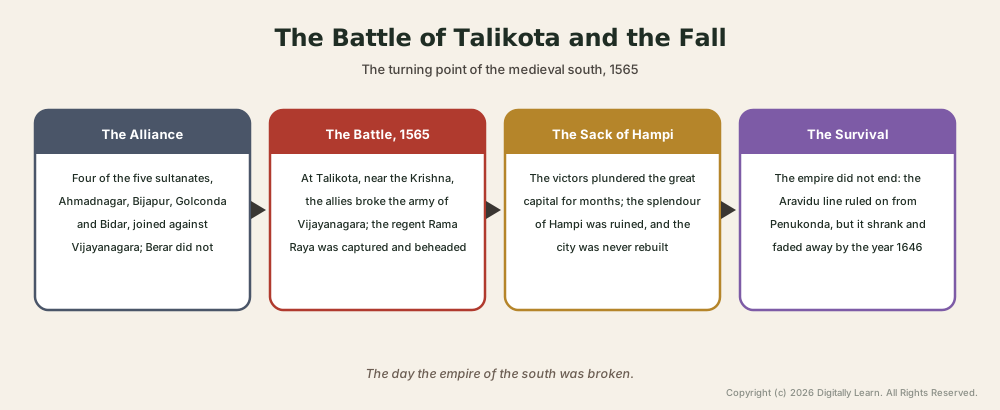
The Battle of Talikota, fought in 1565, was the great turning point in the history of the medieval south, the battle in which the Vijayanagara Empire was broken. Four of the five Deccan Sultanates, Ahmadnagar, Bijapur, Golconda and Bidar, laid aside their quarrels and allied against Vijayanagara; the fifth, Berar, did not join. The allies met the army of Vijayanagara near the river Krishna and routed it; the regent Rama Raya was captured and beheaded, and the splendid capital, Hampi, was sacked and ruined. Yet the empire did not end at once: the Aravidu line carried it on from Penukonda until it faded away by 1646. This part covers the alliance, the battle, the sack and the survival, and the exam focus.
The Gathering Storm
Rama Raya and the Politics of the Deccan
What is the significance of the gathering storm: the policy of Rama Raya, who played the sultanates against one another, at last drove them to unite and destroy him.
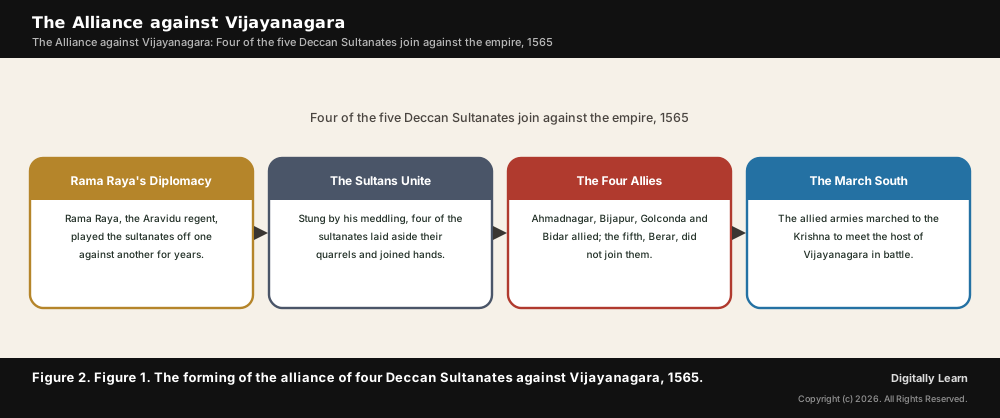
Rama Raya ruled Vijayanagara in fact. After Krishnadevaraya the throne passed to weaker kings, and the real power fell to Rama Raya, the regent of the Aravidu house, who governed the empire from about 1542. A bold and able man, he made Vijayanagara the arbiter of the Deccan, taking a hand in every quarrel of the sultanates.
He played the sultanates off against each other. Rama Raya allied now with one sultanate, now with another, helping each in turn against the rest, so that none could grow too strong. But his interference bred a deep resentment, and the sultans came to feel that only by uniting could they be rid of him. The figure below sets out how the alliance against Vijayanagara was formed.
The Battle of Talikota, 1565
The Alliance of Four and the Battle
What is the significance of the battle: at Talikota the combined strength of four sultanates broke the army of Vijayanagara in a single day, and the empire never recovered.
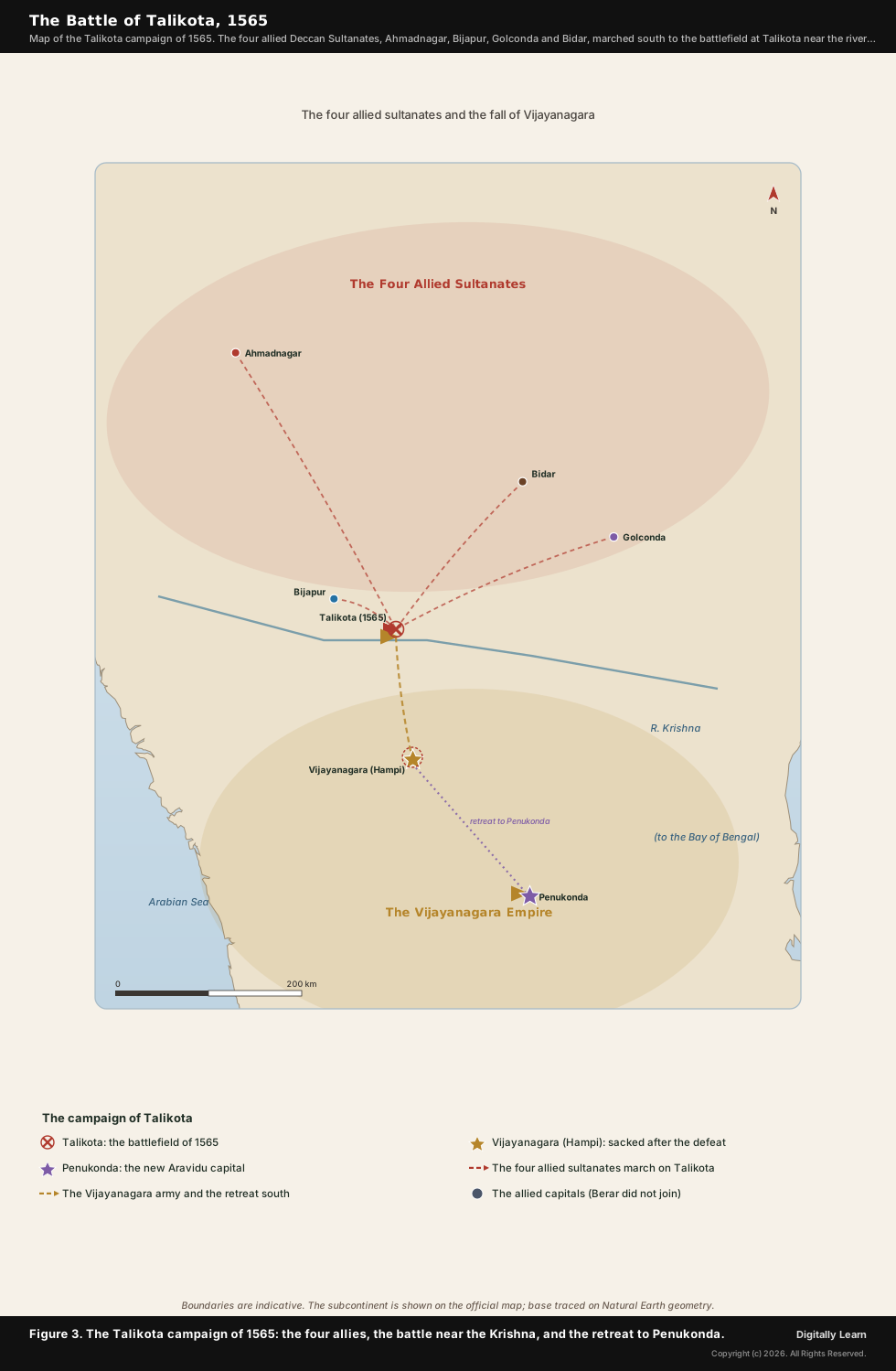
Four of the five sultanates allied. In 1565 Ahmadnagar, Bijapur, Golconda and Bidar joined in a grand alliance against Vijayanagara; the fifth, Berar, did not join. The allied armies marched south and met the great host of Vijayanagara near the river Krishna, at the Battle of Talikota, also called the battle of Rakkasagi-Tangadigi after the villages near the field.
The battle was lost in an hour. At first the army of Vijayanagara had the better of the day; but in the thick of the fight the old regent Rama Raya was taken and at once beheaded, and at the sight of his head the Vijayanagara army broke and fled. The table below sets out the four allied sultanates and their rulers.
| Sultanate | Dynasty | Ruler at Talikota |
|---|---|---|
| Ahmadnagar | Nizam Shahi | Hussain Nizam Shah I |
| Bijapur | Adil Shahi | Ali Adil Shah I |
| Golconda | Qutb Shahi | Ibrahim Quli Qutb Shah |
| Bidar | Barid Shahi | Ali Barid Shah I |
| Berar (Imad Shahi) | did not join | the fifth sultanate stayed away |
The map below sets out the campaign, the march of the four allies on Talikota, the battle near the Krishna, the sack of the capital and the retreat of the survivors to the south.
The Sack of Vijayanagara
Distinguishing the sack of the city: the fall of the army was followed by the ruin of the capital, one of the great cities of the world, which was destroyed and never rebuilt.
The victors plundered Hampi. After the battle the armies of the sultanates marched on the undefended capital and gave it over to plunder. For months they sacked the great city of Vijayanagara, stripping its temples and palaces, burning and breaking, until the splendour that the travellers had marvelled at was a field of ruins.
The city was never rebuilt. The site of Hampi, the city of victory, was left desolate, and stands to this day a vast field of broken temples and palaces, the greatest ruin of the medieval south. The empire would go on, but its heart was dead.
The Survival of the Empire
The Aravidu Line and the Long Decline
What is the significance of the survival: a common and serious error is to think Vijayanagara ended at Talikota; in truth the empire lived on, under a fourth dynasty, for eighty years more.
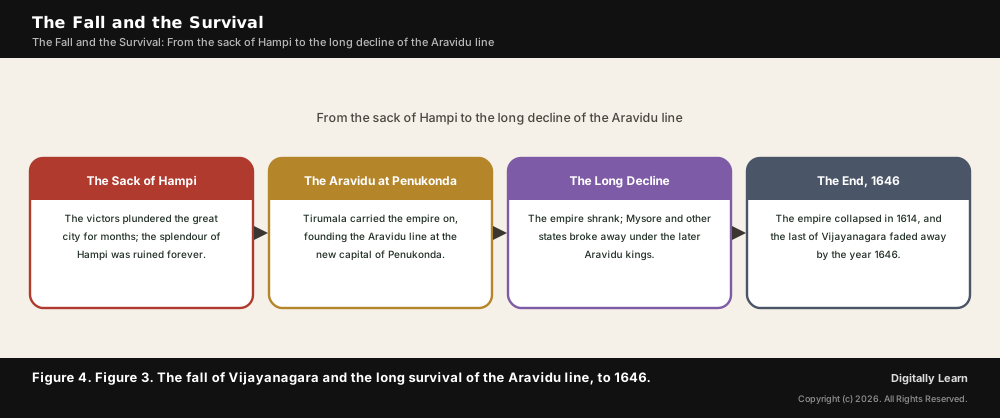
The empire did not end in 1565. After the disaster, Tirumala Deva Raya, the brother of Rama Raya, carried the royal family and the treasure to safety and founded the fourth and last dynasty, the Aravidu, ruling from a new capital at Penukonda to the south of the old. The empire, much shrunken, lived on.
It declined for eighty years. The later Aravidu kings could not hold the great empire together, and province after province broke away; under Venkata II the kingdom of Mysore, under its Wodeyar rajas, grew into a power of its own. The empire collapsed about 1614, and its last remnants faded away by 1646. The figure below sets out the fall and the long survival.
The Aftermath and the Successors
Distinguishing the successors: out of the wreck of Vijayanagara rose the new powers of the south, the nayaka states and the kingdom of Mysore.
The successors carried on the old order. The great military chiefs, the nayakas, who had held the provinces for Vijayanagara, became kings in their own right, founding the nayaka states of Madurai, Tanjore and Gingee. The kingdom of Mysore, under the Wodeyars, rose in the same way out of the declining empire, as the next century would show.
The age of Vijayanagara passed. The empire that had guarded the Hindu south for two hundred years was gone, and the Deccan lay open to the Mughals from the north, who would in time take the very sultanates that had broken Vijayanagara. The figure below sets out the fall and what came after.
UPSC Relevance and Exam Focus
Where the Battle of Talikota Fits in the UPSC-CSE Syllabus
This topic belongs to General Studies Paper I: medieval Indian history, and the Battle of Talikota, with its alliance, its date and its aftermath, is one of the most frequently examined events of the medieval south.
The questions most often test the alliance of four sultanates, the date of 1565, the fate of Rama Raya, and the survival of the empire under the Aravidu line and its successors such as Mysore.
Several linked points recur and are worth holding in working memory:
- The alliance: Four sultanates, Ahmadnagar, Bijapur, Golconda and Bidar, allied at Talikota; Berar did not join.
- The date: The Battle of Talikota was fought in 1565.
- Rama Raya: The Vijayanagara regent, captured and beheaded in the battle.
- The Aravidu line: The fourth dynasty, which ruled on from Penukonda after the fall.
- Mysore: The Wodeyar kingdom that emerged from the declining Vijayanagara Empire.
A 2021 question asked which states emerged from older powers, and one correct statement was that the kingdom of Mysore emerged out of the Vijayanagara Empire; the Wodeyars rose, as this part has shown, out of the declining empire after Talikota.
A 2006 question asked who ruled Vijayanagara when Raja Wodeyar founded the kingdom of Mysore; the answer was Venkata II, a king of the Aravidu line, under whom Mysore broke away as the empire declined.
Previous Year UPSC-CSE Questions
Previous Year UPSC-CSE Questions By the end you will be able to draft model answers for the following UPSC questions. Each question carries a collapsible framework showing how to approach it in the exam.
- UPSC Prelims 2021 GS-IWith reference to Indian history, which of the following statements is/are correct?
- The Nizamat of Arcot emerged out of Hyderabad State.
- The Mysore Kingdom emerged out of Vijayanagara Empire.
- Rohilkhand Kingdom was formed out of the territories occupied by Ahmad Shah Durrani.
Select the correct answer using the code given below.
How to approach this Prelims question
Approach: Test each: Arcot from Hyderabad (1, not correct as framed); Mysore from Vijayanagara (2, correct); Rohilkhand from Ahmad Shah Durrani (3, not correct). Only statement 2 holds.
Trap to watch: The on-topic and correct statement is the Mysore-from-Vijayanagara link; the other two concern unrelated eighteenth-century states.
Key facts to recall:
- The Mysore kingdom, under the Wodeyars, emerged from the Vijayanagara Empire.
- It rose as Vijayanagara declined after Talikota.
- The Aravidu kings could not hold the provinces.
Answer signal: 2 only.
- UPSC Prelims 2006 GS-IWhen Raja Wodeyar founded the kingdom of Mysore, who was the ruler of the Vijayanagar Empire?
How to approach this Prelims question
Approach: Recall the Aravidu line that ruled after Talikota: Venkata II was the Vijayanagara ruler under whom the Wodeyars of Mysore broke away.
Trap to watch: Tirumala and Ranga were earlier Aravidu names; the ruler when Raja Wodeyar founded Mysore was Venkata II.
Key facts to recall:
- The Aravidu line ruled Vijayanagara after Talikota.
- Venkata II was the ruler when Raja Wodeyar founded Mysore.
- Mysore broke away as the empire declined.
Answer signal: Venkata II.
Sources and Further Reading
Editorial Disclaimer
This article is for UPSC preparation. The history of the Battle of Talikota rests on the Persian chronicles, the foreign accounts and the standard scholarship on the medieval Deccan.