


Overview
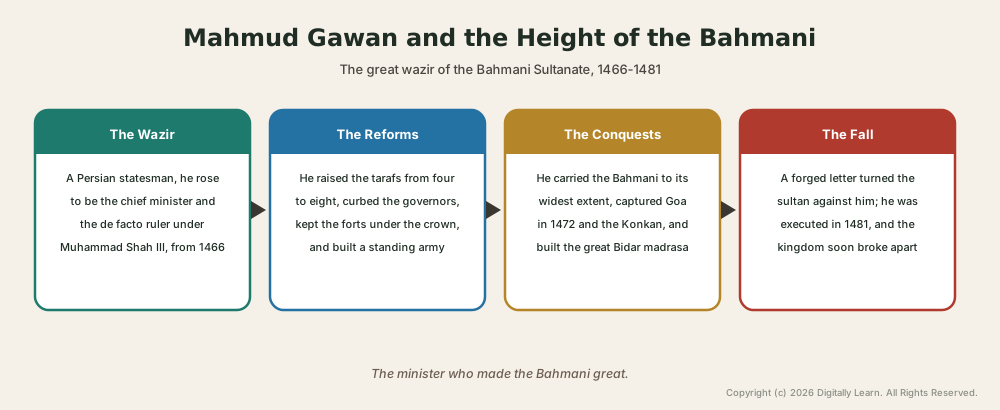
Mahmud Gawan was the great Persian wazir, or chief minister, of the Bahmani Sultanate, and its de facto ruler from 1466 to 1481, under whom the kingdom reached its widest extent. A statesman, scholar and soldier, he reorganised the provinces, raising the tarafs from four to eight and curbing the over-mighty governors; he captured Goa and the Konkan; and he built the great madrasa at Bidar, a centre of Persian learning. His execution in 1481, on a forged letter laid before the sultan by jealous nobles, broke the strength of the kingdom and opened the way to its split into the five Deccan Sultanates. This part covers the wazir, his reforms, his fall, and the exam focus.
Mahmud Gawan, the Wazir of the Bahmani
The Persian Statesman and the Chief Minister
What is the significance of Mahmud Gawan: he was the ablest minister the Bahmani ever had, and under him the kingdom of the Deccan reached the height of its power.
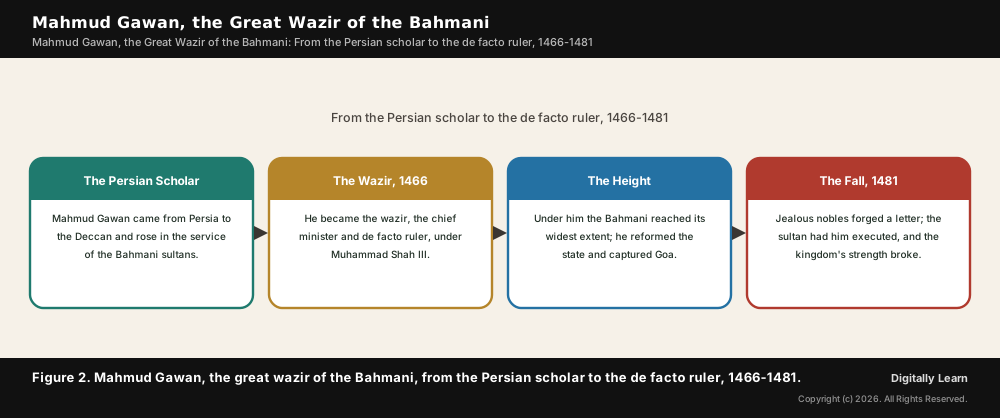
Mahmud Gawan came from Persia. A scholar and a merchant of Gilan, he came to the Deccan and entered the service of the Bahmani sultans, where his learning and his skill in war and government carried him swiftly upward. He served under more than one sultan, and under Muhammad Shah III he rose to be the wazir, the chief minister of the kingdom.
He was the de facto ruler. From 1466 until his death in 1481 Mahmud Gawan governed the Bahmani in fact as well as in name, the real master of the state under a young sultan. The figure below sets out his rise and his fall.
The Height of the Bahmani Sultanate
Distinguishing the height of the kingdom: under Mahmud Gawan the Bahmani reached its widest extent, from sea to sea across the Deccan.
The wazir was a great conqueror. He led the armies of the Bahmani west and east, and in 1472 he captured the rich port of Goa, with the Konkan coast, opening the kingdom to the trade of the western sea. Under him the Bahmani stretched across the breadth of the peninsula, the greatest of the powers of the Muslim Deccan.
He was a man of learning as well as war. Mahmud Gawan kept up a correspondence with the scholars of Persia and Arabia, gathered a great library, and was himself the author of works in Persian. His court at Bidar was a centre of the Persian culture that the Bahmani had brought to the Deccan, of which Part 10 tells more.
The Reforms of Mahmud Gawan
The Reorganisation of the Provinces and the Army
What is the significance of the reforms: Mahmud Gawan set out to bind the over-mighty provincial governors to the crown and to make the central power strong.
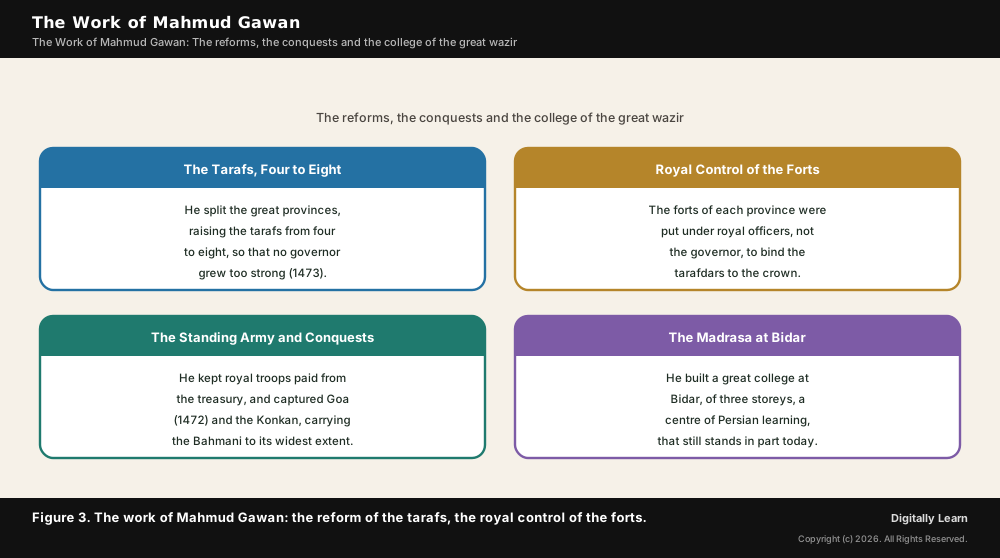
He reorganised the provinces. The Bahmani was divided into great provinces, the tarafs, each under a governor, or tarafdar, who had grown almost a king in his own land. Gawan broke up the great provinces, raising the tarafs from four to eight, so that no single governor held too much; and he put the forts of each province under royal officers, not the governor, to bind the tarafdars to the crown.
He strengthened the army and the treasury. He kept a body of royal troops, paid from the treasury rather than from land granted to nobles, and brought order to the revenue. The table below sets out the chief measures of his work, and the figure that follows sets out the reforms and the conquests together.
| Measure | What it did |
|---|---|
| The tarafs, four to eight | Split the great provinces so that no governor grew too strong (1473). |
| Royal control of the forts | Put the forts of each province under royal officers, not the tarafdar. |
| A standing royal army | Kept troops paid from the treasury, bound to the crown, not to the nobles. |
| The Bidar madrasa | Built a great college at Bidar, a centre of Persian learning. |
The Madrasa at Bidar
Distinguishing the madrasa: the great college that Mahmud Gawan built at Bidar was the finest monument of his rule and a centre of learning for the whole Deccan.
The madrasa was a great college. Mahmud Gawan built at Bidar, the capital, a madrasa of three storeys, with lecture halls, a library and lodgings for teachers and students, faced with coloured tiles in the Persian manner. It drew scholars from across the Islamic world and taught the sciences as well as the law and the faith.
It still stands in part. Though damaged by later war and by lightning, the Mahmud Gawan madrasa survives at Bidar to this day, one of the chief works of Bahmani architecture, of which the last part of this series tells more.
The Fall of Mahmud Gawan
The Forged Letter and the End of the Bahmani
What is the significance of the fall: the death of Mahmud Gawan removed the one man who held the kingdom together, and the Bahmani soon broke apart.
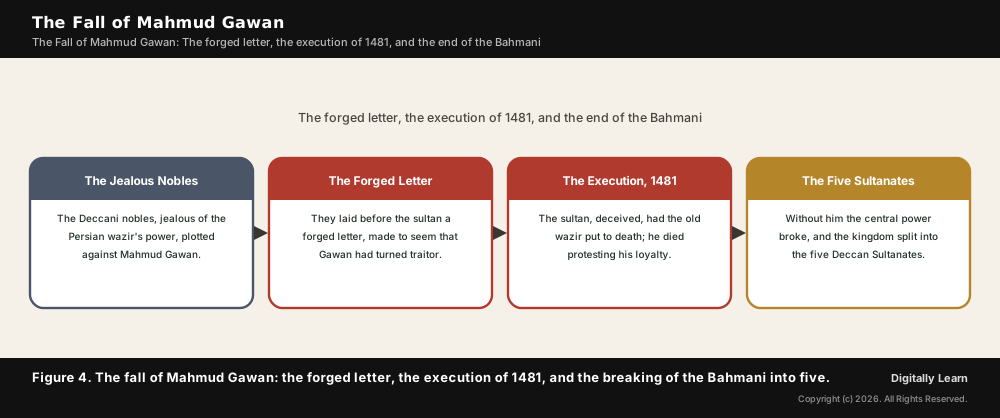
The nobles turned against him. The Deccani nobles, jealous of the power of the foreign wazir and resentful of his reforms, plotted against him. They laid before the sultan a forged letter, made to seem that Gawan had invited an enemy to invade the kingdom, and the sultan, deceived, ordered the old minister put to death. In 1481 Mahmud Gawan was executed, protesting his loyalty to the last.
The kingdom fell with him. With Mahmud Gawan gone, there was no one to hold the over-mighty governors to the crown. The central power weakened, the tarafdars grew into independent princes, and about 1490 the Bahmani broke into the five Deccan Sultanates, whose story Part 6 tells. The figure below sets out his fall and its consequence.
UPSC Relevance and Exam Focus
Where Mahmud Gawan Fits in the UPSC-CSE Syllabus
This topic belongs to General Studies Paper I: medieval Indian history, and Mahmud Gawan, the great Bahmani minister, is a favourite subject for questions on the administration and the decline of the Deccan kingdom.
The questions most often test his office as wazir, the reform of the tarafs from four to eight, the capture of Goa, the Bidar madrasa, and his execution on a forged letter.
Several linked points recur and are worth holding in working memory:
- The wazir: Mahmud Gawan was the chief minister and de facto ruler of the Bahmani, 1466 to 1481.
- The tarafs: He raised the provinces from four to eight, to curb the over-mighty governors.
- Goa: He captured the port of Goa and the Konkan for the Bahmani in 1472.
- The madrasa: He built the great college at Bidar, a centre of Persian learning.
- The fall: He was executed in 1481 on a forged letter, and the kingdom soon broke into five.
A 2022 question asked which statements on the European trade were correct, one of them being that Albuquerque captured Goa from the Bijapur Sultanate, which was true. Goa had been won for the Bahmani by Mahmud Gawan in 1472, and after the kingdom split it passed to Bijapur, from whom the Portuguese took it in 1510.
A reader who knows that Mahmud Gawan captured Goa for the Bahmani, and that Bijapur was the Bahmani's heir on that coast, can see why Goa was a Bijapur possession for Albuquerque to seize. A common trap wrongly credits the reforms of the iqta-branding system, the dagh and the chehra, to Gawan; those belong to the Delhi Sultanate, not to him, and his own work was the reform of the tarafs.
Previous Year UPSC-CSE Questions
Previous Year UPSC-CSE Questions By the end you will be able to draft model answers for the following UPSC questions. Each question carries a collapsible framework showing how to approach it in the exam.
- UPSC Prelims 2022 GS-IWith reference to Indian history, consider the following statements:
- The Dutch established their factories/warehouses on the east coast on lands granted to them by Gajapati rulers.
- Alfonso de Albuquerque captured Goa from the Bijapur Sultanate.
- The English East India Company established a factory at Madras on a plot of land leased from a representative of the Vijayanagara empire.
Which of the statements given above are correct?
How to approach this Prelims question
Approach: Test each statement: the Dutch-Gajapati grant (1) is wrong; Albuquerque took Goa from Bijapur (2) is correct, the heir of Gawan's 1472 Bahmani conquest; the English at Madras leased from a Vijayanagara representative (3) is correct.
Trap to watch: Do not reject statement 2 by forgetting that Goa was a Bijapur possession; it had been won for the Bahmani by Mahmud Gawan and passed to Bijapur after the split.
Key facts to recall:
- Mahmud Gawan captured Goa for the Bahmani in 1472.
- After the Bahmani split, Goa passed to Bijapur (Adil Shahi).
- Albuquerque captured Goa from Bijapur in 1510.
Answer signal: 2 and 3 only.
Sources and Further Reading
Editorial Disclaimer
This article is for UPSC preparation. The history of Mahmud Gawan rests on the Persian chronicles and the standard scholarship on the medieval Deccan.