


Overview
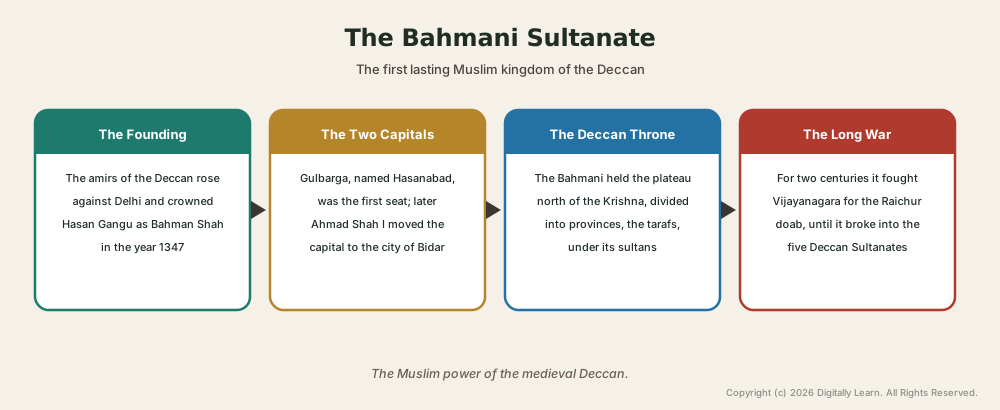
The Bahmani Sultanate was the first lasting Muslim kingdom of the Deccan, and for two centuries the great rival of Vijayanagara. It was founded in 1347, when the Muslim governors of the Deccan rose against the Delhi Sultanate and crowned Hasan Gangu as their king, with the title Alauddin Hasan Bahman Shah. Its first capital was Gulbarga, which he named Hasanabad; a later sultan moved the seat to Bidar. The kingdom held the plateau north of the Krishna and fought Vijayanagara across the Raichur doab, until at the last it broke into the five Deccan Sultanates. This part covers the founding, the two capitals, the Bahmani state and its legacy, and the exam focus.
The Founding of the Bahmani
Hasan Gangu and the Revolt of 1347
What is the significance of the founding: it set up the first lasting Muslim kingdom of the Deccan, which would rule the northern plateau for nearly two centuries.
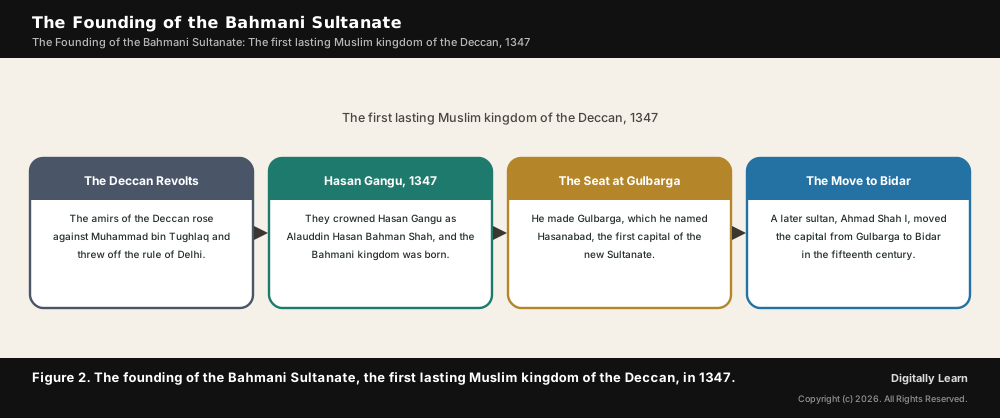
The kingdom was born of a revolt. The harsh rule of Muhammad bin Tughlaq, whose schemes had carried the Delhi Sultanate to the Deccan and back, drove the Muslim amirs of the south into rebellion. In 1347 they threw off the rule of Delhi and crowned one of their own, Hasan Gangu, as their king, with the title Alauddin Hasan Bahman Shah, from which the dynasty took its name.
The new state held firm. Unlike the brief Deccan rule of the Tughlaqs, the Bahmani kingdom lasted, and grew to be the master of the northern Deccan. The figure below sets out its founding.
Gulbarga and Bidar, the Two Capitals
Distinguishing the two capitals: the Bahmani ruled first from Gulbarga and later from Bidar, and the move of the seat marks the two ages of the kingdom.
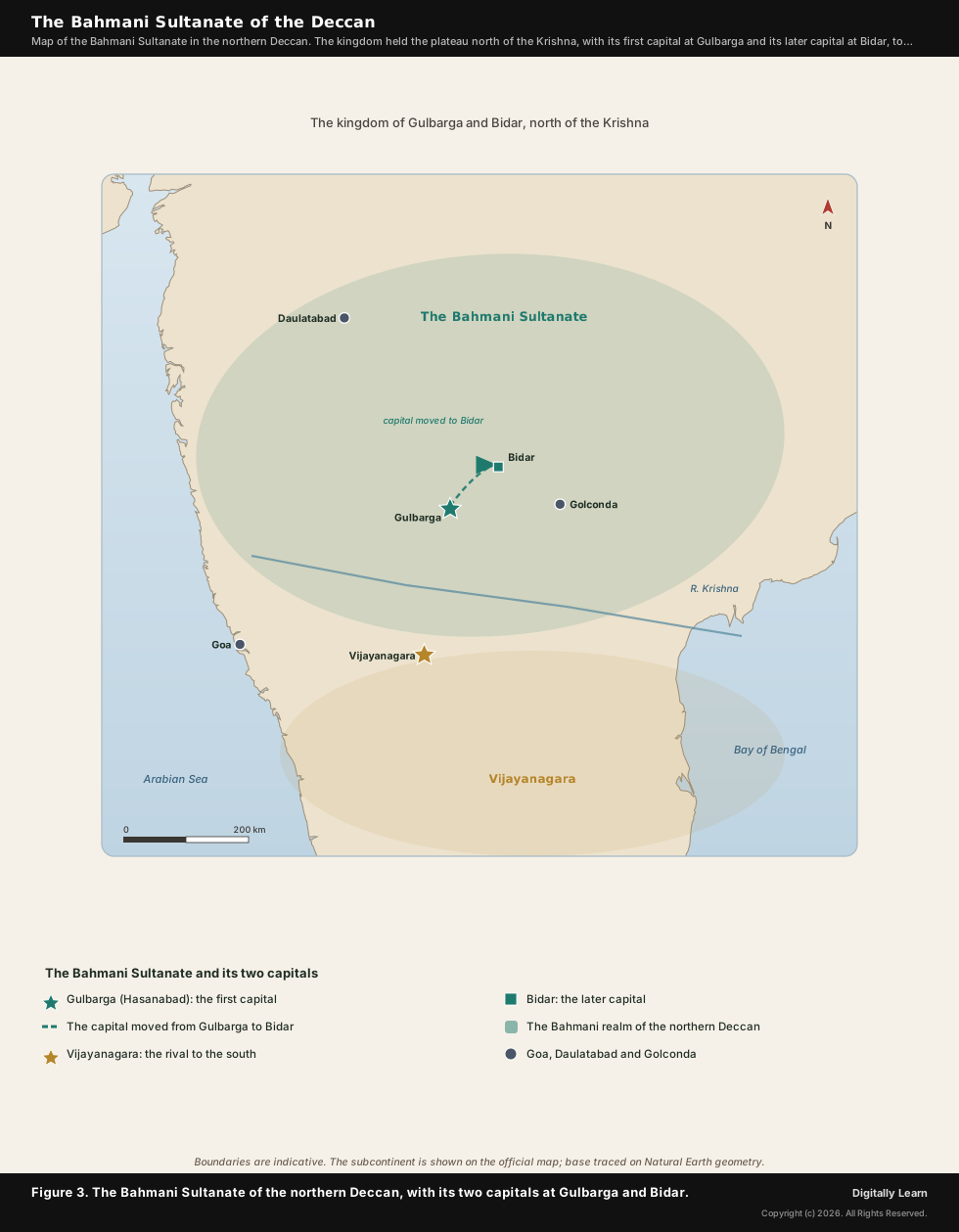
The first capital was Gulbarga, which Hasan Gangu named Hasanabad, in the western Deccan. From it the early sultans ruled and warred. In the fifteenth century, however, the sultan Ahmad Shah I moved the seat of the kingdom eastward to Bidar, which became the capital of its later and most splendid age.
The realm lay across the northern Deccan, the broad plateau north of the river Krishna. To the south, across that river and the Tungabhadra, lay the Vijayanagara Empire, the great rival with which the Bahmani would fight for two hundred years. The map sets out the Bahmani kingdom and its two capitals.
The Bahmani State and the Deccan Rivalry
The Sultans, the Provinces and the Court
What is the significance of the Bahmani state: it built in the Deccan a Muslim kingdom of Persian culture, ruled through provinces and served by men drawn from across the Islamic world.
The kingdom was divided into provinces called tarafs, each under a governor who held it for the sultan and led its troops. The court was a Persian one, and the Bahmani sultans drew to their service soldiers, scholars and ministers from Persia and the wider Islamic world, among them the great Mahmud Gawan, whose age the next part but one describes.
The kingdom had its kings, from the founder Bahman Shah to Muhammad Shah III, in whose reign the Bahmani reached its height. The table below sets out the chief stages of the kingdom's history.
| Stage | Mark |
|---|---|
| The founding, 1347 | Hasan Gangu crowned as Alauddin Hasan Bahman Shah. |
| The first capital | Gulbarga, which the founder named Hasanabad. |
| The later capital | Bidar, to which Ahmad Shah I moved the seat. |
| The height | Under Muhammad Shah III and his wazir Mahmud Gawan. |
The Struggle for the Raichur Doab
Distinguishing the great rivalry: the whole history of the Bahmani was bound up with its long war against Vijayanagara for the mastery of the Deccan.
The two powers fought for the land between them. The chief prize was the Raichur doab, the rich tract between the Krishna and the Tungabhadra, which lay on the border of the two realms and changed hands again and again in the long wars. The struggle was bitter, and was fought, on both sides, with great armies and much slaughter.
It was a contest of two worlds, the Muslim Deccan of the Bahmani and the Hindu south of Vijayanagara, that ran through the whole age. The detailed story of these wars, and of the height of the Bahmani under Mahmud Gawan, the later parts of this series tell. The figure below sets out the legacy of the kingdom.
The Legacy of the Bahmani
From the Bahmani to the Five Sultanates
What is the significance of the Bahmani legacy: out of the one Bahmani kingdom grew the five Deccan Sultanates, and from them the rich Indo-Islamic culture of the Deccan.
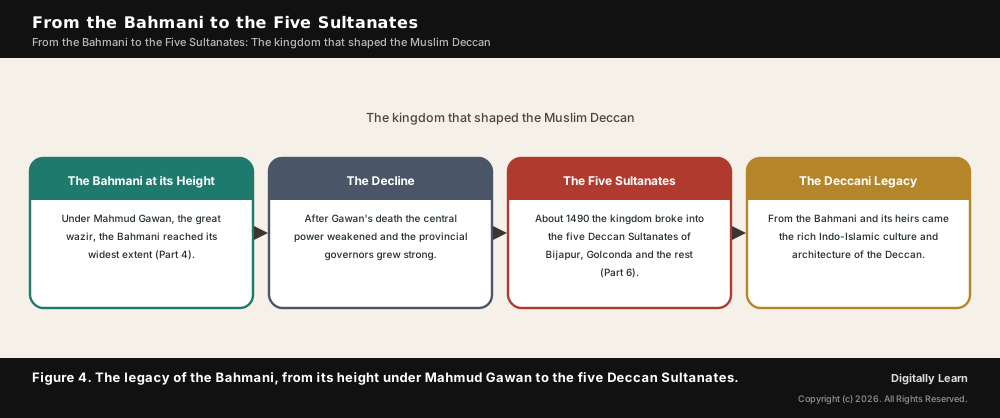
The kingdom reached its height in the later fifteenth century, under the wazir Mahmud Gawan, whose reforms and conquests Part 4 describes. But after his death the central power weakened, the provincial governors grew strong, and about 1490 the one kingdom began to break apart.
Out of the Bahmani rose five new states, the Deccan Sultanates of Bijapur, Golconda, Ahmadnagar, Berar and Bidar, whose story is told in Part 6. From the Bahmani and its heirs came the great Deccani architecture, the Gol Gumbaz and the Charminar, that the last part of this series describes. The figure below sets out this legacy.
UPSC Relevance and Exam Focus
Where the Bahmani Sultanate Fits in the UPSC-CSE Syllabus
This topic belongs to General Studies Paper I: medieval Indian history, and the Bahmani, with its capitals and its successor states, is a regular ground for questions on the medieval Deccan.
The questions most often test the founder Hasan Gangu, the two capitals of Gulbarga and Bidar, and the line of the Bahmani down to the five Deccan Sultanates.
Several linked points recur and are worth holding in working memory:
- Hasan Gangu: The founder of the Bahmani, crowned as Alauddin Hasan Bahman Shah in 1347.
- Gulbarga: The first capital, which the founder named Hasanabad.
- Bidar: The later capital, to which Ahmad Shah I moved the seat.
- The tarafs: The provinces into which the Bahmani kingdom was divided.
- The five Sultanates: Bijapur, Golconda, Ahmadnagar, Berar and Bidar, the Bahmani’s heirs.
A 2024 question asked who gave the Portuguese leave to build a fort at Bhatkal; the answer was Krishnadevaraya of Vijayanagara, but two of its choices belonged to the Muslim Deccan this part begins: Muhammad Shah III, a Bahmani sultan, and Yusuf Adil Shah, the founder of Bijapur.
A reader who knows the Bahmani and its heirs can place those two distractors at once and see that neither is the answer. A common trap confuses the Bahmani capital Gulbarga with the later seat of Bidar; Gulbarga was the first, and Ahmad Shah I moved the capital to Bidar.
Previous Year UPSC-CSE Questions
Previous Year UPSC-CSE Questions By the end you will be able to draft model answers for the following UPSC questions. Each question carries a collapsible framework showing how to approach it in the exam.
- UPSC Prelims 2024 GS-IWho of the following rulers of medieval India gave permission to the Portuguese to build a fort at Bhatkal?
How to approach this Prelims question
Approach: Place each ruler: Krishnadevaraya (Vijayanagara, the answer) gave the Bhatkal fort; Muhammad Shah III is Bahmani; Narasimha Saluva is the Vijayanagara Saluva founder; Yusuf Adil Shah founded Bijapur.
Trap to watch: Do not pick the Deccan-Muslim rulers (Muhammad Shah III the Bahmani, Yusuf Adil Shah of Bijapur); the answer is Krishnadevaraya of Vijayanagara.
Key facts to recall:
- Krishnadevaraya of Vijayanagara allowed the Portuguese a fort at Bhatkal.
- Muhammad Shah III was a Bahmani sultan; Yusuf Adil Shah founded Bijapur.
- Narasimha Saluva founded the Saluva dynasty of Vijayanagara.
Answer signal: Krishnadevaraya.
Sources and Further Reading
Editorial Disclaimer
This article is for UPSC preparation. The history of the Bahmani rests on the Persian chronicles and the standard scholarship on the medieval Deccan.