


Overview
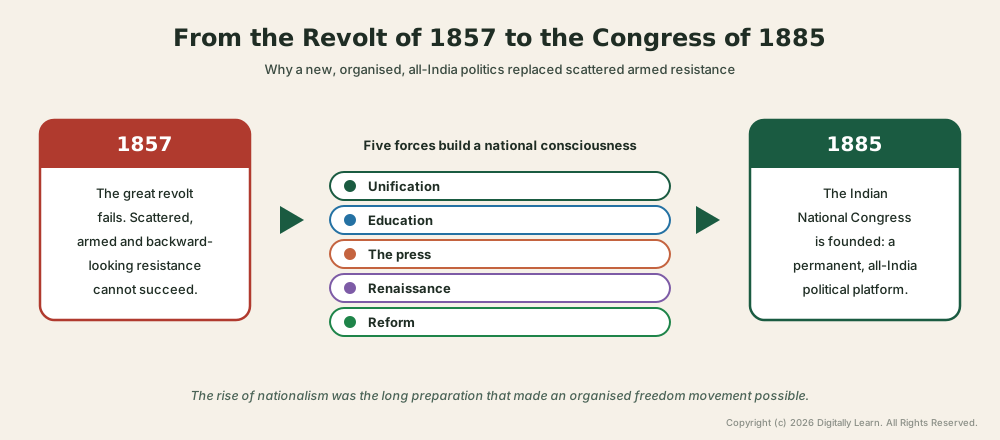
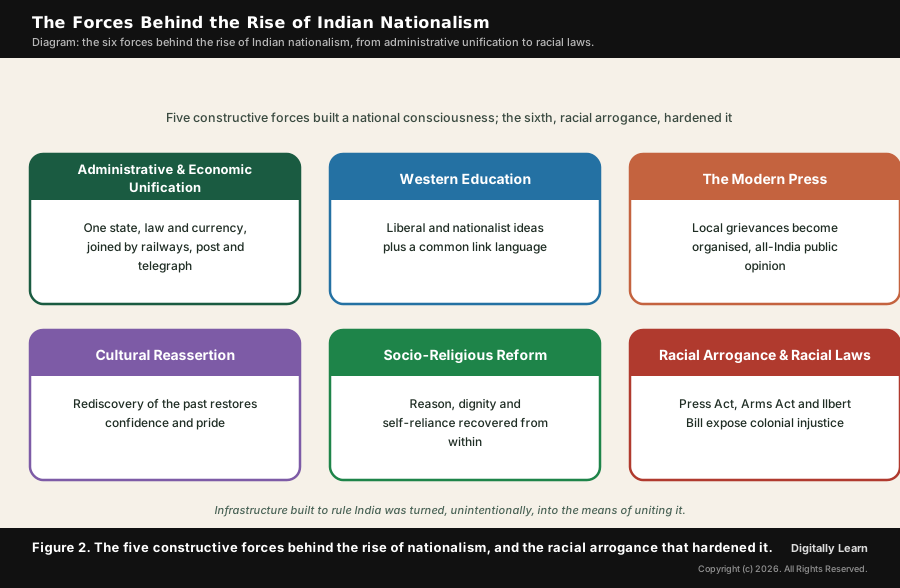
The rise of Indian nationalism describes the growth, in the second half of the nineteenth century, of a shared political consciousness that bound Indians across regions, religions and castes into a single people with common grievances against colonial rule. It was not the work of a few leaders but the product of deep forces: the administrative and economic unification of the subcontinent, the spread of Western education and a modern press, a cultural rediscovery of India's past, and the racial arrogance of an alien government. Together these forces created, for the first time, an Indian public opinion that could express itself on an all-India scale, and they prepared the ground for the founding of the Indian National Congress in 1885.
Administrative and Economic Unification under Colonial Rule
Political Unification: Single Administration, Law and Currency
Why this matters: a people cannot act as a nation until it is governed as one. Before the British, India was a patchwork of kingdoms with different laws, currencies and rulers. By the later nineteenth century the East India Company and the Crown had welded it into a single administrative structure, with one law and one bureaucracy. This political unification, though meant to serve colonial control, gave Indians a common framework within which a common politics could grow.
Uniform laws and a centralised administration meant that a grievance in Bombay was, increasingly, a grievance in Bengal as well. The same land-revenue rules, the same courts and the same officials pressed on people from Punjab to Madras, so that discontent which had once been local now had a single, identifiable source in the colonial state. A shared subjection slowly produced a shared sense of being Indian.
Railways, Telegraph and the Postal Network as Unifiers
What is the significance of this infrastructure: the railway, the telegraph and the postal network, all built to serve trade and military control, became the physical sinews of a new national life. The railways, begun in the 1850s, let leaders, newspapers and ideas travel across the subcontinent in days rather than months. The telegraph carried news almost at once, and a cheap postal system let associations correspond across provinces.
Pilgrims, traders, students and political workers now moved along the same lines, met one another, and discovered shared concerns. The very tools the colonial state used to bind India for its own purposes allowed Indians to imagine and organise themselves as one community. This is why early nationalist writers spoke of the railway and the press as the unintended gifts of an empire that meant only to rule.
Economic Exploitation, Famines and the Early Drain Critique
Distinguishing features of colonial economics sharpened the new consciousness, and three stand out as the roots of nationalist economic thought.
- Deindustrialisation: Indian handicrafts and handlooms decayed as machine-made British goods flooded the market, throwing artisans back onto the land.
- Famine and revenue: Heavy land revenue and recurring famines, including the great famine of 1876 to 1878, exposed the human cost of colonial priorities.
- An early drain critique: A growing body of writers argued that India’s wealth was being steadily transferred to Britain.
Dadabhai Naoroji gave this argument its sharpest form, naming it the drain of wealth in his writings from 1867 onward, and economists such as R.C. Dutt and G.V. Joshi developed the case. Their work shifted the debate from whether British rule was well meaning to whether it was economically ruinous. Economic grievance thus became the hard core of the nationalist critique, a theme developed fully in the later part of this series on the drain of wealth.
Western Education, the Press and a New Intelligentsia
English Education and Liberal-Nationalist Ideas
The colonial state introduced English-language schooling to produce clerks and intermediaries, but it had a consequence the rulers never intended. The Universities of Calcutta, Bombay and Madras, established in 1857, and the colleges that fed them trained a generation that read Mill, Burke, Spencer and Rousseau and studied the European struggles for liberty. Ideas of representative government, the rule of law and national self-determination entered Indian minds through the language of the rulers themselves.
These ideas became a standard against which colonial rule was measured and found wanting. Educated Indians asked why the liberty and equality celebrated in English books were denied to them in their own country. English also served as a common link language across a subcontinent of many tongues, letting a Bengali, a Maratha and a Tamil argue the same political case in the same words.
The Vernacular and English Press as Political Educator
What is the significance of the press: it turned scattered grievances into organised public opinion. A vigorous Indian-owned press grew through the later nineteenth century, with papers such as the Amrita Bazar Patrika and the Bengalee in Bengal, The Hindu in Madras and the Kesari in Maharashtra. These journals reported official excesses, criticised policy, and carried the demands of one region into the homes of another.
The press educated readers in their rights, taught them the vocabulary of constitutional politics, and built a sense of belonging to a single political nation. It also shaped opinion in Britain, where Indian grievances were laid before a wider public. Precisely because the press was so effective, the colonial state came to fear it, and moved to muzzle it through laws such as the Vernacular Press Act of 1878.
The Rise of the Educated Middle Class
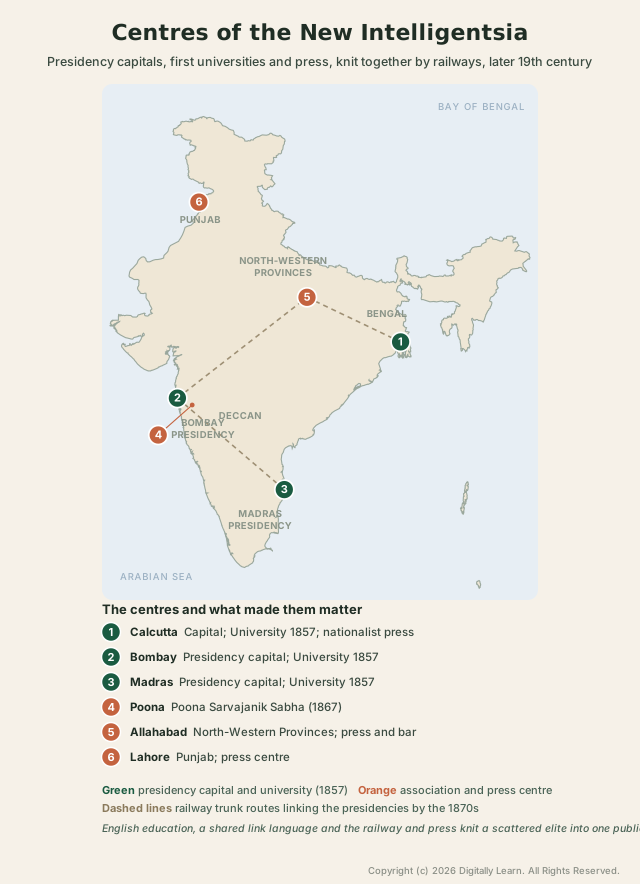
The cumulative result was a new social formation: an English-educated middle class of lawyers, teachers, journalists, doctors and officials, concentrated in the presidency capitals but linked across them. This class was small, yet it was articulate, mobile and self-confident, and it supplied almost the entire early leadership of the national movement. It was, in a real sense, a class created by colonial policy that would turn against its creator.
The map below shows where this intelligentsia gathered and how it was connected. The three presidency capitals, each with a university founded in 1857, were the great centres, and the early political associations and newspapers clustered in the same cities. The railway trunk lines that joined them meant that an educated public in Calcutta, Bombay and Madras could increasingly act together.
Cultural Reassertion and Socio-Religious Reform
Rediscovery of India's Past and the Orientalist Scholarship
Why this matters: confidence is the seedbed of nationalism, and confidence had to be recovered. Colonial writing often portrayed India as a land without history or civilisation, fit only to be ruled. The work of Orientalist scholars, beginning with William Jones and the Asiatic Society of Bengal founded in 1784, and continued by figures such as Max Muller, recovered India's ancient texts, languages and achievements.
Indian scholars built on this rediscovery to argue that their civilisation was ancient, sophisticated and worthy of pride. This cultural reassertion answered the colonial claim of inferiority and gave the educated class a usable past. A people that had been told it had no history now had one to defend, and the defence of that heritage became part of the case for self-rule.
Socio-Religious Reform Movements and National Confidence
The great socio-religious reform movements of the nineteenth century worked in the same direction. The Brahmo Samaj, the Arya Samaj founded by Dayananda Saraswati in 1875, the Ramakrishna Mission and the Theosophical Society attacked superstition, defended reason, and insisted that Indian society could reform itself from within. In doing so they restored self-respect and weakened the colonial argument that India needed foreign rule to civilise it.
These movements had a double effect. They produced a confident, reform-minded generation that could face the modern world, and they spread, through their schools, presses and gatherings, a sense that Indians shared a common cultural and moral inheritance. The Indian renaissance of thought and the emergence of a national identity were, in this way, closely linked, a connection examiners have asked candidates to examine directly.
Racial Arrogance and Lytton's Reactionary Measures
The Vernacular Press Act and the Arms Act (1878)
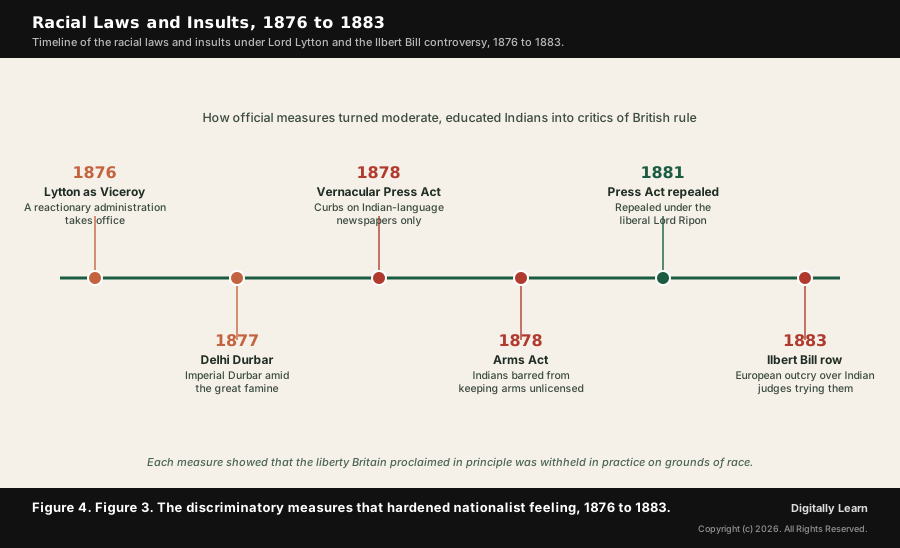
Observable outcomes of racial arrogance did more than any book to make nationalists of moderate men. The administration of Lord Lytton, viceroy from 1876, was marked by measures that insulted educated Indians. The Vernacular Press Act of 1878 imposed harsh restrictions on Indian-language newspapers while leaving the English press untouched, an openly racial distinction. In the same year the Arms Act of 1878 made it an offence for Indians, but not Europeans, to keep arms without a licence.
These laws taught a sharp lesson. The liberty the rulers proclaimed in principle was withheld in practice on grounds of race, and the educated class that had trusted British fairness began to lose that trust. Lytton deepened the offence by holding a lavish Imperial Durbar at Delhi in 1877 to proclaim Queen Victoria Empress of India, even as a terrible famine spread across the country.
The Ilbert Bill Controversy (1883)
The Ilbert Bill controversy of 1883 was the most revealing episode of all. The bill, introduced under the liberal viceroy Lord Ripon, sought a modest reform: to let senior Indian magistrates try Europeans in criminal cases, putting Indians and Europeans on the same footing in the courts. To Indians this was simple justice; to the European community in India it was an outrage.
The furious agitation of the European residents forced the government to water the bill down almost to nothing. The episode exposed two things with great clarity. First, that racial privilege, not law, governed colonial society. Second, and more important for the future, it showed Indians the power of organised agitation, for the Europeans had won by exactly the methods of association and protest that Indians would soon adopt for themselves.
The ICS Age-Limit Grievance
The Indian Civil Service carried its own deep grievance. The examination was held only in distant England, and the maximum age for candidates was lowered to nineteen, making it almost impossible for Indians to compete on fair terms. The service that governed India was thus kept overwhelmingly European by design.
Educated Indians demanded that the examination be held simultaneously in India and England and that the age limit be raised. The campaign, led by figures such as Surendranath Banerjee, who had himself been removed from the service on a slender pretext, became an early rallying point. The demand for a fair Indianisation of the services would stay central to nationalist politics for decades.
International Influences and the Legacy of 1857
Foreign Inspirations and the Shadow of the Great Revolt
Contemporary linkages abroad fed the new spirit, as educated Indians drew lessons from three movements in particular.
- The American and French revolutions: The ideas of liberty, equality and popular sovereignty that they proclaimed.
- The unification of Italy: The example of Mazzini and Garibaldi welding a divided people into a single nation.
- The Irish Home Rule struggle: A subject people pressing constitutionally for self-government within an empire.
These foreign examples supplied both inspiration and a vocabulary of liberty and nationhood, and showed that a subject people could organise to assert its right to self-government.
Closer to home, the memory of the Revolt of 1857, examined in our series on the great uprising, cast a long shadow. Its failure taught a generation that scattered, armed and backward-looking resistance could not succeed, and that a new kind of politics, constitutional, organised and all-India, was needed. The transfer of power from the Company to the Crown in 1858 made the colonial state more centralised and more directly answerable, giving nationalists a single government to address.
Significance and the Road to an All-India Platform
How the Separate Streams Converged by the 1880s
What is the significance of this whole process: by the early 1880s the separate streams of unification, education, the press, cultural revival and racial grievance had converged into a single current. India now had a connected educated public, a shared political vocabulary, organised newspapers and a list of common demands. What it lacked was a permanent, all-India body to give that current direction.
The early political associations, in Calcutta, Bombay, Madras and Poona, were the first attempts to fill this gap, and they pointed directly towards a national organisation. In 1885 that organisation arrived in the form of the Indian National Congress, whose foundation is the subject of the next part of this series. The rise of nationalism was, in the end, the long preparation that made the Congress both possible and necessary.
| Factor | How it fed the rise of nationalism |
|---|---|
| Administrative and economic unification | One state, law and currency, joined by railways, post and telegraph |
| Western education | Liberal and nationalist ideas, plus a common link language |
| The modern press | Local grievances became organised, all-India public opinion |
| Cultural reassertion | Rediscovery of the past restored confidence and pride |
| Socio-religious reform | Reason, dignity and self-reliance recovered from within |
| Racial arrogance and racial laws | The Press Act, Arms Act and Ilbert Bill exposed injustice |
Previous Year UPSC-CSE Questions
Previous Year UPSC-CSE Questions By the end you will be able to draft model answers for the following UPSC questions. Each question carries a collapsible framework showing how to approach it in the exam.
- UPSC Mains 2019 GS-IExamine the linkages between 19th centuries ‘Indian renaissance’ and emergence of national identity.
How to structure the answer in the exam
Introduction: Open by defining the 'Indian renaissance' as the nineteenth-century revival of cultural confidence and reform.
Body (sub-themes to develop):
- Orientalist rediscovery (Asiatic Society, 1784) and Indian scholarship recovered a usable, respected past.
- Reform movements (Brahmo Samaj, Arya Samaj 1875) defended reason and rejected the claim of civilisational inferiority.
- A reformed, shared cultural inheritance gave the educated class a basis for a common national identity.
- Western education and the press carried this identity across regions, linking renaissance to organised nationalism.
Conclusion: Conclude that the renaissance supplied the self-respect and shared identity on which political nationalism, and the Congress of 1885, was built.
- UPSC Prelims 2003 GS Paper IWith reference to colonial rule in India, what was sought by the Ilbert Bill in 1883?
How to approach this Prelims question
Approach: Recall the specific aim of the Ilbert Bill and separate it from the other racial measures of the period.
Trap to watch: The distractors describe the Vernacular Press Act (press), simultaneous ICS examinations and the Arms Act; do not confuse these with the Ilbert Bill.
Key facts to recall:
- Ilbert Bill 1883
- Introduced under Lord Ripon
- Allowed Indian magistrates to try Europeans
- Diluted after European agitation
Answer signal: It sought equal criminal jurisdiction, so option (a).
Sources and Further Reading
- Wikipedia: Indian nationalism
- Wikipedia: Indian National Congress
- Wikipedia: Vernacular Press Act
- Wikipedia: Ilbert Bill
- Wikipedia: Arya Samaj
- Wikipedia: Asiatic Society of Bengal
- NCERT, Our Pasts III (The Making of the National Movement)
- Ministry of Culture: Indian Culture Freedom Archive
- Azadi Ka Amrit Mahotsav (Freedom Movement portal)
- Press Information Bureau, Government of India
- National Portal of India: Profile and History
Editorial Disclaimer
This article is prepared for UPSC examination preparation. Verify key facts and interpretations against standard reference histories before relying on them.