


Overview
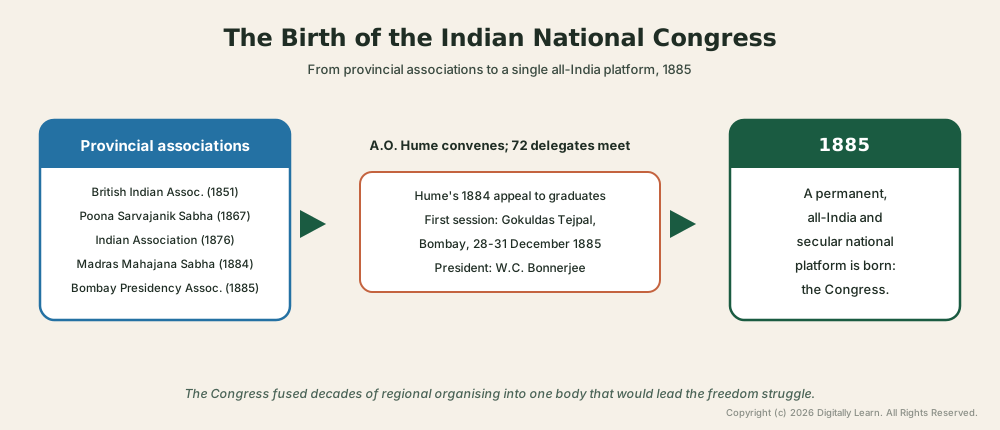
The Indian National Congress was founded at Bombay in December 1885, the first permanent, all-India and broadly secular political organisation in the country's history. It did not appear from nothing: for half a century, regional political associations in Bengal, Bombay, Madras and the Deccan had been petitioning, organising and training a public in constitutional politics. The Congress fused these scattered provincial bodies into a single national platform, and although a retired British official, A.O. Hume, played a central convening role, the Congress was the natural culmination of an Indian political awakening already long under way.
The First Political Associations of British India
The Landholders' Society and the British Indian Association
Why this matters: the Congress inherited a habit of organised political work that older bodies had already built. The earliest associations were dominated by landholders and spoke for narrow interests, but they established the practice of petitioning government in an organised way. The Landholders' Society, founded in Calcutta in 1838, was the first such body, formed to defend zamindari interests.
In 1851 several Bengal bodies merged into the British Indian Association, with Radhakanta Deb as its first president. Though still led by landed and propertied men, it submitted detailed petitions on the renewal of the Company's charter and won minor concessions. These early associations were limited in membership and aim, yet they taught a generation how to frame demands and address the colonial state.
The East India Association and the Poona Sarvajanik Sabha
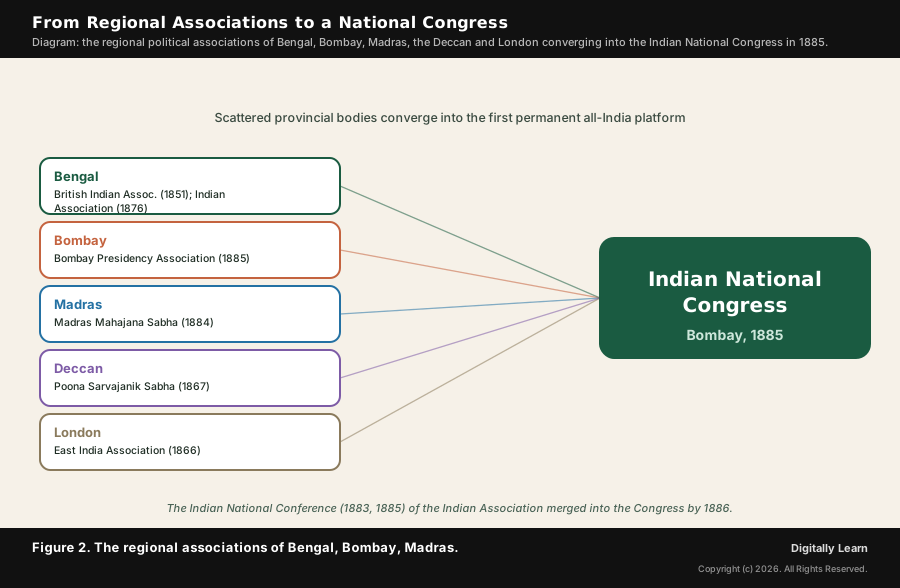
As the educated class grew, the associations widened. Dadabhai Naoroji founded the East India Association in London in 1866 to put the Indian case before the British public and Parliament, the first sustained attempt at lobbying at the seat of power. It gave the later Congress a model of trans-imperial campaigning.
In western India the Poona Sarvajanik Sabha, founded in 1867 under the influence of M.G. Ranade, claimed to represent the people of the region as a link between the government and the public. It conducted serious enquiries into revenue and economic questions, and it trained leaders who would later be prominent in the Congress.
The Indian Association and the Indian National Conference
The most important immediate forerunner of the Congress was the Indian Association of Calcutta, founded in 1876 by Surendranath Banerjee and Ananda Mohan Bose. Unlike the landlord bodies, it aimed at a wider, more popular base and took up causes such as the unfair age limit for the Civil Service examination, drawing in the younger English-educated generation.
The Indian Association went further and convened an Indian National Conference, first in December 1883 and again in December 1885, to bring delegates from different provinces together. This conference was, in effect, a rehearsal for an all-India body, and it merged into the broader Congress framework by 1886.
| Association | Year | City | Key figure |
|---|---|---|---|
| Landholders' Society | 1838 | Calcutta | Dwarkanath Tagore |
| British Indian Association | 1851 | Calcutta | Radhakanta Deb |
| East India Association | 1866 | London | Dadabhai Naoroji |
| Poona Sarvajanik Sabha | 1867 | Poona | M.G. Ranade |
| Indian Association | 1876 | Calcutta | Surendranath Banerjee |
| Madras Mahajana Sabha | 1884 | Madras | M. Viraraghavachariar |
| Bombay Presidency Association | 1885 | Bombay | Pherozeshah Mehta |
The Madras Mahajana Sabha and the Bombay Presidency Association
The southern and western presidencies organised in the same years. The Madras Mahajana Sabha, founded in 1884 by M. Viraraghavachariar, G. Subramania Iyer and P. Ananda Charlu, became the leading political body of the south. It should not be confused with the earlier Madras Native Association of 1852, which was a narrower, landlord-led group.
In Bombay the Bombay Presidency Association was founded in 1885 by the three figures often called the city's statesmen: Pherozeshah Mehta, Kashinath Telang and Badruddin Tyabji. By the time the Congress met later that year, every major presidency had its own organised political association ready to send delegates.
The Founding of the Indian National Congress in 1885
A.O. Hume and the Convening of the First Session
Allan Octavian Hume, a retired officer of the Indian Civil Service and a student of Indian affairs, was the convenor who gave the new body its final push. In 1884 he issued an appeal to the graduates of Calcutta University, calling on the educated class to organise for the country's mental, moral and political regeneration.
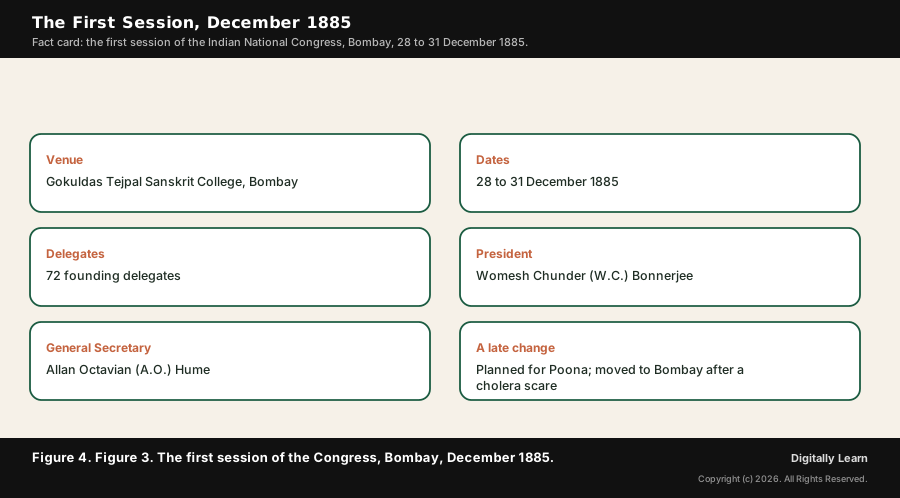
Hume corresponded with leaders across the presidencies and helped bring them together for a national meeting. He became the first General Secretary of the Congress and held the post for over twenty years. His central role would later feed a long debate about why exactly the Congress was founded, examined further below.
The Bombay Session: Date, Venue and the 72 Delegates
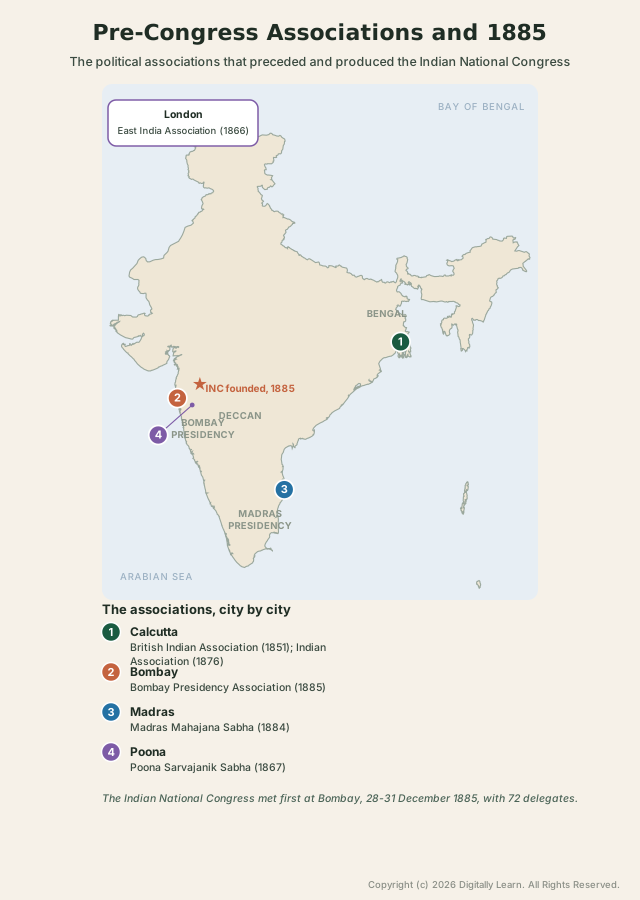
The first session was originally planned for Poona, but a cholera outbreak there forced a late change of venue to Bombay. It was held at the Gokuldas Tejpal Sanskrit College from 28 to 31 December 1885, attended by 72 delegates drawn from across the provinces.
The delegates included leading figures of the presidency associations, lawyers, journalists, teachers and merchants. Surendranath Banerjee was absent because the Indian National Conference was meeting in Calcutta at the same time, a clash resolved the next year when the two bodies came together.
W.C. Bonnerjee and the Early Aims and Objectives
Womesh Chunder (W.C.) Bonnerjee, a Calcutta barrister, presided over the first session as the Congress's first president. The early Congress set itself modest, nation-building aims rather than a demand for self-rule.
- National unity: To promote friendship among nationalist workers and to erode prejudices of race, creed and province.
- Public opinion: To train and organise an informed Indian public opinion on questions of the day.
- Popular demands: To formulate and present the demands of educated India to the government in an orderly way.
These aims look cautious today, but they were the foundation on which everything later was built. The Congress was, from the start, a secular and all-India body, and that character became its most lasting contribution.
Theories on the Foundation of the Congress
The Safety-Valve Theory and the "Seven Volumes" Question
What is the significance of this debate: how one answers it shapes whether the Congress is seen as a British creation or an Indian achievement. The safety-valve theory holds that Hume and sympathetic officials engineered the Congress as a safe outlet for educated discontent, to prevent a violent explosion like 1857. The theory rests largely on a story that Hume had seen seven volumes of secret reports warning of unrest.
Later writers, including Lala Lajpat Rai, used the safety-valve reading to criticise the early Congress as a tool of the rulers. The difficulty is that the seven volumes have never been found, and there is no firm evidence for them. Most historians now treat the safety-valve story as unproven and probably exaggerated.
The Lightning-Conductor and Indian-Initiative View
The opposing view, argued strongly by Bipan Chandra, is that the early nationalists deliberately used Hume as a kind of lightning conductor. A respected retired official at the head of the new body would deflect official suspicion and let the Congress establish itself without being crushed at birth.
On this reading the Congress was the organic product of the Indian political awakening described in the previous part of this series, not a gift from above. Hume was a useful ally and convenor, but the demand, the leaders and the ideas were Indian. This is the interpretation most historians accept today.
The Social Composition of the Early Congress
Who the Early Congressmen Were
The early Congress was overwhelmingly a body of the English-educated professional class, lawyers, journalists, teachers, doctors and officials, drawn from the presidency capitals. Within that class certain communities were prominent, including the Bengali bhadralok and the Chitpavan and Tamil Brahmin elites of the west and south.
This narrow base had real consequences. The participation of Muslims, peasants and the lower castes was limited in the early years, and the Aligarh movement under Sir Syed Ahmad Khan kept its distance. Recognising this elite character is essential to a fair judgement of the Moderate phase, which the later parts of this series examine.
Significance: An All-India Secular Platform Takes Shape
Why 1885 Was a Turning Point
Contemporary linkages run directly from 1885 to the rest of the freedom struggle. The Congress gave the movement a permanent organisation, an annual meeting that rotated across the country, and a single forum where leaders from every province could shape common demands. No earlier association had managed this.
It also set two enduring features: an all-India reach that refused to be confined to one region, and a secular character that sought to speak for Indians of every community. These foundations, laid in a modest college hall in Bombay, were what the Moderates would build on and, in time, what Gandhi would turn into a mass movement. The earlier awakening that produced them is traced in the opening part of this series.
Previous Year UPSC-CSE Questions
Previous Year UPSC-CSE Questions By the end you will be able to draft model answers for the following UPSC questions. Each question carries a collapsible framework showing how to approach it in the exam.
- UPSC Mains 2021 GS-ITo what extent did the role of the moderates prepare a base for the wider freedom movement? Comment.
How to structure the answer in the exam
Introduction: Open by noting that the wider freedom movement rested on a base laid by the early nationalists from 1885 onward.
Body (sub-themes to develop):
- Organisational base: regional associations (British Indian Association, Indian Association, Poona Sarvajanik Sabha) fused into the all-India Congress in 1885.
- An annual, rotating, all-India and secular platform created a single forum for national demands.
- Early aims trained a public in constitutional politics and produced a national leadership cadre.
- Limits: a narrow, English-educated, professional base with little Muslim, peasant or lower-caste participation.
Conclusion: Conclude that the early nationalists prepared a substantial organisational base, even if a narrow one, on which the mass movement was later built.
- UPSC Prelims 2017 GS Paper IConsider the following pairs:
- Radhakanta Deb : First President of the British Indian Association
- Gazulu Lakshminarasu Chetty : Founder of the Madras Mahajana Sabha
- Surendranath Banerjee : Founder of the Indian Association
Which of the above pairs is/are correctly matched?
How to approach this Prelims question
Approach: Check each pairing against the founders and offices of the pre-Congress associations.
Trap to watch: Pair 2 is wrong: Gazulu Lakshminarasu Chetty founded the Madras Native Association, not the Madras Mahajana Sabha; pairs 1 and 3 are correct.
Key facts to recall:
- Radhakanta Deb: first president, British Indian Association (1851)
- Surendranath Banerjee: founder, Indian Association (1876)
- Madras Mahajana Sabha founded 1884 by Viraraghavachariar and others
Answer signal: Pairs 1 and 3 are correct, so option (b).
Sources and Further Reading
- Wikipedia: Indian National Congress
- Wikipedia: Allan Octavian Hume
- Wikipedia: Indian National Association
- Wikipedia: British Indian Association
- Wikipedia: Surendranath Banerjee
- Wikipedia: Dadabhai Naoroji
- NCERT, Our Pasts III (The Making of the National Movement)
- Ministry of Culture: Indian Culture Freedom Archive
- Azadi Ka Amrit Mahotsav (Freedom Movement portal)
- Press Information Bureau, Government of India
- National Portal of India
Editorial Disclaimer
This article is prepared for UPSC examination preparation. Verify key facts and interpretations against standard reference histories before relying on them.