
Overview
Previous Year UPSC-CSE Questions By the end you will be able to draft model answers for the following UPSC questions. Each question carries a collapsible framework showing how to approach it in the exam.
- UPSC Mains 2020 GS-IEvaluate the policies of Lord Curzon and their long-term implications on the national movements.
How to structure the answer in the exam
Introduction: Open with Curzon as a reactionary viceroy whose flagship policy, the partition of Bengal, backfired.
Body (sub-themes to develop):
- The partition of Bengal (1905): stated administrative convenience versus the real aim of divide and rule.
- Immediate implication: the Swadeshi and boycott movement, the first mass agitation.
- Long-term implication: the rise of the Extremists, mass politics and techniques later used by Gandhi.
- The partition was annulled in 1911, a measure of how far the agitation had succeeded.
Conclusion: Conclude that Curzon's partition, meant to weaken Indian nationalism, instead became the seedbed of mass politics.
- UPSC Prelims 2009 GS Paper IIn the context of the Indian freedom struggle, 16th October 1905 is well known for which one of the following reasons?
How to approach this Prelims question
Approach: Recall the specific event of 16 October 1905.
Trap to watch: Option (a) is the trap: the Town Hall proclamation/boycott resolution was 7 August 1905, not 16 October; 16 October is the day the partition itself took effect.
Key facts to recall:
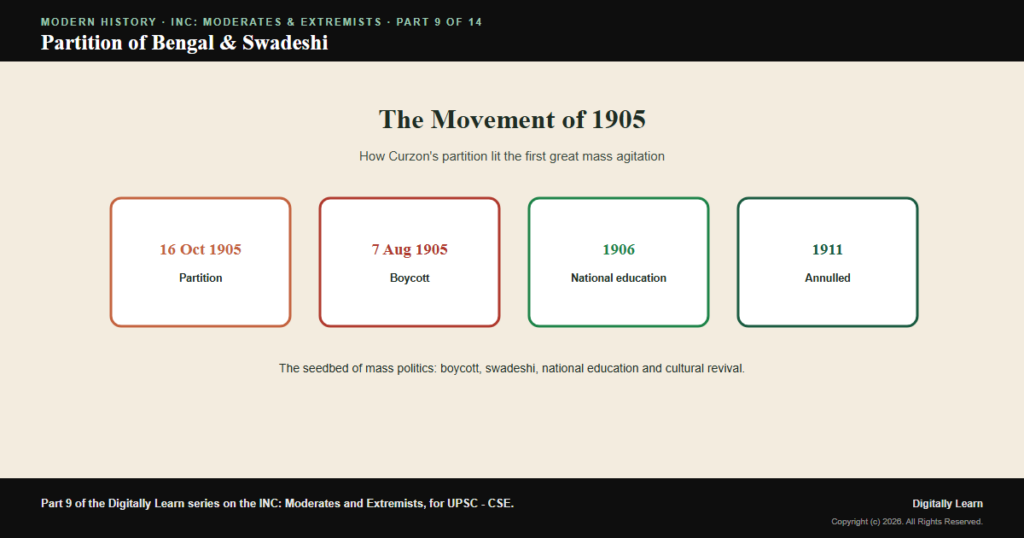
- 16 October 1905: the partition of Bengal took effect
- 7 August 1905: the boycott resolution at the Calcutta Town Hall
- 16 October was observed as a day of mourning
Answer signal: Partition of Bengal took effect, so option (b).
- UPSC Prelims 2016 GS Paper IThe 'Swadeshi' and 'Boycott' were adopted as methods of struggle for the first time during the
How to approach this Prelims question
Approach: Identify the movement during which swadeshi and boycott were first adopted as methods.
Trap to watch: Swadeshi/boycott were revived in the Non-Cooperation Movement, but they were adopted for the FIRST time during the anti-partition agitation of 1905.
Key facts to recall:
- Swadeshi and boycott were first adopted in 1905
- The trigger was the partition of Bengal
- The boycott resolution: Calcutta Town Hall, 7 August 1905
Answer signal: Agitation against the Partition of Bengal, so option (a).
The partition of Bengal was Lord Curzon's 1905 division of the huge province of Bengal into two, an act Indians saw as a deliberate attempt to divide and rule. It provoked the Swadeshi movement, the first great mass agitation of the freedom struggle, which combined the boycott of British goods with a positive programme of swadeshi enterprise, national education and cultural revival. Strongest in Bengal but spreading across India, the movement declined by 1908; the partition itself was annulled in 1911.
The Partition of Bengal: Stated and Real Motives
The Decision, the Effective Date and Eastern Bengal and Assam
Why this matters: a single administrative measure became the spark of the first mass movement in Indian history. First mooted in 1903, the partition of the vast province of Bengal was formally decided in 1905 and took effect on 16 October 1905. The province, with a population of some eighty million, was split into two.
The eastern half was joined to Assam to form a new province, Eastern Bengal and Assam, with its capital at Dhaka; the western remainder, including Bihar and Orissa, kept its capital at Calcutta. The new eastern province had a Muslim majority, a fact that, as Indians quickly recognised, was no accident. The geography of the division is shown below.
Administrative Convenience versus Divide and Rule
Distinguishing the stated from the real motive is the heart of the topic. Curzon defended the partition as a matter of administrative convenience: Bengal, he argued, was simply too large to govern as one unit. There was a genuine administrative case, but it was not the whole story, nor the part that mattered.
The real motive, as nationalists saw it, was political: to divide and rule. By splitting Bengal, the government would set the Muslim-majority east against the Hindu-majority west, weaken the most politically advanced province in India, and break the back of the Bengali nationalist press and intelligentsia. The contrast is set out below.
| Dimension | Stated motive (official) | Real motive (nationalist reading) |
|---|---|---|
| Justification | Administrative convenience | Political divide and rule |
| The problem | Bengal too large to administer | Bengali nationalism too strong |
| The method | A neater boundary for efficiency | Setting Muslim east against Hindu west |
| The effect sought | Better government | A weaker, divided province |
The Anti-Partition Agitation and the Boycott Resolution
From Protest to the Boycott of 7 August 1905
What is the significance of the anti-partition agitation: it transformed protest into a new weapon. As the partition loomed, moderate petitions and public meetings gave way to something far more potent. On 7 August 1905, a great meeting at the Calcutta Town Hall passed the famous boycott resolution, formally launching the swadeshi and boycott movement and calling on Indians to shun British goods.
When the partition took effect on 16 October 1905, the day was observed across Bengal as a day of mourning. Shops and schools closed; people fasted and bathed in the Ganges. Rabindranath Tagore gave the day a moving symbol, urging Hindus and Muslims to tie rakhi threads on one another's wrists as a pledge of unity against the division.
The boycott was both a moral protest and a practical weapon. By refusing to buy British cloth and goods, Indians could strike at the economic interest that lay behind the empire. The forms the boycott took were several.
- Foreign cloth and goods: The public burning and refusal of Manchester cloth and other imports.
- Government schools and colleges: Students withdrew from official institutions in protest.
- Law courts and official functions: Lawyers and citizens boycotted the colonial courts and ceremonies.
- Titles and honours: The refusal or surrender of titles conferred by the government.
The Four Strands of the Swadeshi Movement
Boycott of Foreign Goods, Courts and Schools
Distinguishing features of the Swadeshi movement can be seen in its four connected strands. The first was boycott, the negative weapon. The refusal of British goods, courts, schools and titles was meant to make colonial rule costly and to demonstrate that Indians could withdraw their cooperation at will.
Boycott was effective precisely because it was economic and visible. The bonfires of foreign cloth, the empty British shops and the withdrawal of students from government schools turned a political grievance into daily, collective action that ordinary people could join. The other three strands gave this negative weapon a positive purpose.
Swadeshi Enterprise and Indigenous Industry
Observable outcomes of the positive programme appeared in a wave of swadeshi enterprise. If foreign goods were to be boycotted, Indians had to make their own. The movement spurred the founding of indigenous mills, banks, insurance companies and workshops, from textile mills and soap and match factories to chemical works, in an effort to replace imported manufactures.
In the south, V.O. Chidambaram Pillai founded the Swadeshi Steam Navigation Company at Tuticorin to challenge British shipping. Much swadeshi enterprise was small and short-lived, but the principle, that economic self-reliance was a path to freedom, took deep root and outlasted the movement itself.
National Education and the Bengal National College
What is the significance of national education: it sought to free Indian minds from a colonial schooling. Since students were boycotting government colleges, the movement built its own. In 1906 the National Council of Education was founded in Bengal, and it established the Bengal National College, whose first principal was Aurobindo Ghosh.
National education aimed to teach an Indian curriculum in an Indian spirit, joining literary, scientific and technical instruction to national feeling. Though it reached only a small number, it created a model of self-reliant education that the later movement would revive, and it gave the Swadeshi years one of their most lasting institutions.
Cultural Revival, Tagore and the Bengal School
Contemporary linkages between politics and culture were never closer than in these years. The fourth strand was a cultural revival that gave the movement its soul. Rabindranath Tagore poured out patriotic songs, among them the hymn later adopted as Bangladesh's anthem, and his music carried the swadeshi spirit to every village.
In painting, Abanindranath Tagore and the Bengal School of art turned away from imitation of the West to draw on Indian themes and techniques. This flowering of song, art and literature gave the movement an emotional depth and a sense of national pride that no purely political programme could have supplied.
Organisation, Atmasakti and the Social Base
The Samitis and the Anti-Circular Society
Distinguishing features of the movement's organisation lay in its volunteer societies, the samitis. Bodies such as the Swadesh Bandhab Samiti of Barisal, led by Ashwini Kumar Dutta, carried the swadeshi message into the villages, organised arbitration courts, relief work and physical training, and embodied the ideal of atmasakti, or self-power.
When the government tried to stop students from joining the agitation through official circulars, the nationalists formed the Anti-Circular Society to defend and organise them. These bodies gave the movement a grassroots structure, and they pioneered a style of constructive, self-reliant organisation that the freedom struggle would draw on for decades.
Participation of Women, Students and Labour
Observable outcomes of the movement's reach can be seen in who took part. For the first time, large numbers of students threw themselves into a political agitation, and women, traditionally confined to the home, joined processions, picketed shops and gave up foreign goods, a striking widening of the political nation.
There were also early stirrings among labour and the lower middle class. Yet the movement's social base remained limited: it was strongest among the Hindu educated classes and made little lasting headway among the Muslim peasantry of eastern Bengal, a weakness that would prove costly. Its mass character was real but incomplete.
The All-India Spread and the Decline by 1908
An All-India Agitation
What is the significance of the spread: the Swadeshi movement was the first agitation to reach beyond a single province. Though its core was in Bengal, the message of boycott and swadeshi was carried across the country: Tilak spread it in Maharashtra, Lajpat Rai and Ajit Singh in Punjab, V.O. Chidambaram Pillai in the Madras region, and the Congress endorsed swadeshi at its session of 1905.
This all-India reach, shown on the map below, marked a new stage in the freedom struggle. For the first time, a local grievance had become a national cause, and the techniques pioneered in Bengal entered the common stock of Indian politics.
The Decline of the Movement by 1908
Distinguishing the causes of decline is important for the examination. By 1908 the movement had lost much of its force. Severe government repression, with arrests, bans on meetings and the deportation of leaders, broke its momentum, and the Surat split of 1907, examined in the next part, divided the Congress that had given it national voice.
The movement also suffered from internal weaknesses: a lack of effective, sustained organisation, a failure to draw in the Muslim peasantry, and a tendency to rely on the enthusiasm of the educated few. By 1908 the open mass phase was over, though some of its energy flowed into the revolutionary nationalism examined later in this series.
The Annulment of the Partition (1911)
Reunion and the Move of the Capital to Delhi
Observable outcomes of the long agitation came in 1911. At the Delhi Durbar of December that year, the government announced that the hated partition would be annulled and Bengal reunited. It was a clear, if grudging, admission that the Swadeshi agitation had made the partition impossible to sustain.
In the same announcement, the capital of British India was moved from Calcutta to Delhi, partly to remove the seat of government from the turbulent province. The reversal was a real victory for Indian agitation, even if eastern Bengal's Muslims, who had gained from the partition, felt betrayed by its undoing. The full arc is shown below.
Significance: The Seedbed of Mass Politics
The First Experiment in Mass Politics
Contemporary linkages run from the Swadeshi years straight to the great movements of the twentieth century. The agitation was the first experiment in mass politics, the first time nationalism reached towards students, women and the wider public rather than the narrow educated elite alone.
It pioneered the techniques, boycott, swadeshi, national education and self-reliant organisation, that Gandhi would later deploy on a national scale, and it gave Indian nationalism a new confidence and emotional depth. The partition of Bengal, intended to weaken Indian politics, instead became the seedbed of the mass movement that would one day end British rule.
Prelims MCQ practice
Each question below tests one specific concept on the topic. Click to reveal the answer and a full option-wise explanation.
Q1. The partition of Bengal carried out by Lord Curzon took effect on:
- 7 August 1905
- 16 October 1905
- 1 November 1905
- 12 December 1911
Show answer and explanation
Answer: 16 October 1905
Explanation.
Option (b) is correct. The partition of Bengal took effect on 16 October 1905, observed as a day of mourning. (7 August 1905 was the boycott resolution.) Hence option (b).
Q2. The boycott resolution that formally launched the Swadeshi movement was passed at the:
- Calcutta session of the Congress, 1906
- Calcutta Town Hall on 7 August 1905
- Surat session of the Congress, 1907
- Banaras session of the Congress, 1905
Show answer and explanation
Answer: Calcutta Town Hall on 7 August 1905
Explanation.
Option (b) is correct. The boycott resolution was passed at the Calcutta Town Hall on 7 August 1905. Hence option (b).
Q3. With reference to the partition of Bengal (1905), consider the following statements:
- The eastern half was joined to Assam to form the province of Eastern Bengal and Assam, with its capital at Dhaka.
- The partition was annulled in 1911 and the capital of British India was moved to Delhi.
Which of the statements given above is/are correct?
- 1 only
- 2 only
- Both 1 and 2
- Neither 1 nor 2
Show answer and explanation
Answer: Both 1 and 2
Explanation.
Both are correct. The new eastern province was Eastern Bengal and Assam (capital Dhaka), and the partition was annulled in 1911 with the capital moved to Delhi. Hence option (c).
Q4. The first principal of the Bengal National College, founded under the National Council of Education in 1906, was:
- Rabindranath Tagore
- Aurobindo Ghosh
- Satish Chandra Mukherjee
- Ashwini Kumar Dutta
Show answer and explanation
Answer: Aurobindo Ghosh
Explanation.
Option (b) is correct. Aurobindo Ghosh was the first principal of the Bengal National College (1906). Hence option (b).
Q5. The Swadesh Bandhab Samiti, a notable volunteer society of the Swadeshi movement, was associated with:
- Ashwini Kumar Dutta
- Bipin Chandra Pal
- Surendranath Banerjee
- Rabindranath Tagore
Show answer and explanation
Answer: Ashwini Kumar Dutta
Explanation.
Option (a) is correct. The Swadesh Bandhab Samiti of Barisal was led by Ashwini Kumar Dutta. Hence option (a).
Q6. Consider the following strands of the Swadeshi movement:
- Boycott of foreign goods and institutions.
- National education through bodies like the National Council of Education.
Which of the above were features of the Swadeshi movement?
- 1 only
- 2 only
- Both 1 and 2
- Neither 1 nor 2
Show answer and explanation
Answer: Both 1 and 2
Explanation.
Both were strands of the Swadeshi movement: the boycott and national education. Hence option (c).
Sources and Further Reading
- Wikipedia: Partition of Bengal (1905)
- Wikipedia: Swadeshi movement
- Wikipedia: National Council of Education
- Wikipedia: Rabindranath Tagore
- Wikipedia: V. O. Chidambaram Pillai
- NCERT, Our Pasts III (The Making of the National Movement)
- Ministry of Culture: Indian Culture Freedom Archive
- Azadi Ka Amrit Mahotsav (Freedom Movement portal)
- Press Information Bureau, Government of India
- National Portal of India
Editorial Disclaimer
This article is prepared for UPSC examination preparation. Verify key facts and interpretations against standard reference histories before relying on them.