


Overview
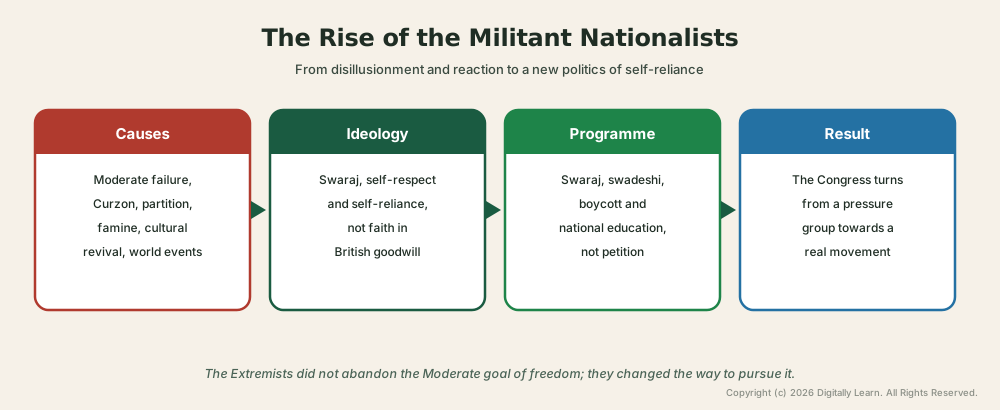
The Extremists, or militant nationalists, were the wing of the Congress that rose after about 1905 to challenge the cautious methods of the Moderates. Disillusioned by the meagre results of petition, provoked by Lord Curzon and above all by the partition of Bengal, and emboldened by world events that shattered the myth of European invincibility, they demanded Swaraj, or self-government, and pursued it through self-reliance: swadeshi, boycott, national education and passive resistance. They did not abandon the goal of freedom; they changed the way it was to be won.
Why the Extremists Rose: Disillusionment and Grievance
Disillusionment with the Moderate Method
Why this matters: the Extremists were born of frustration with the Moderates they grew up admiring. Two decades of loyal petition had won only the meagre Indian Councils Act of 1892, which a new generation saw as proof that prayer and protest could never wring real power from a reluctant ruler. The faith in British goodwill that had sustained the Moderates now looked, to younger eyes, like weakness.
This disillusionment was the soil in which extremism grew. If the constitutional method had failed, then a new method, based on Indian self-reliance rather than British favour, was needed. The grievances that followed, examined below, gave that conviction its force.
The Accumulating Grievances
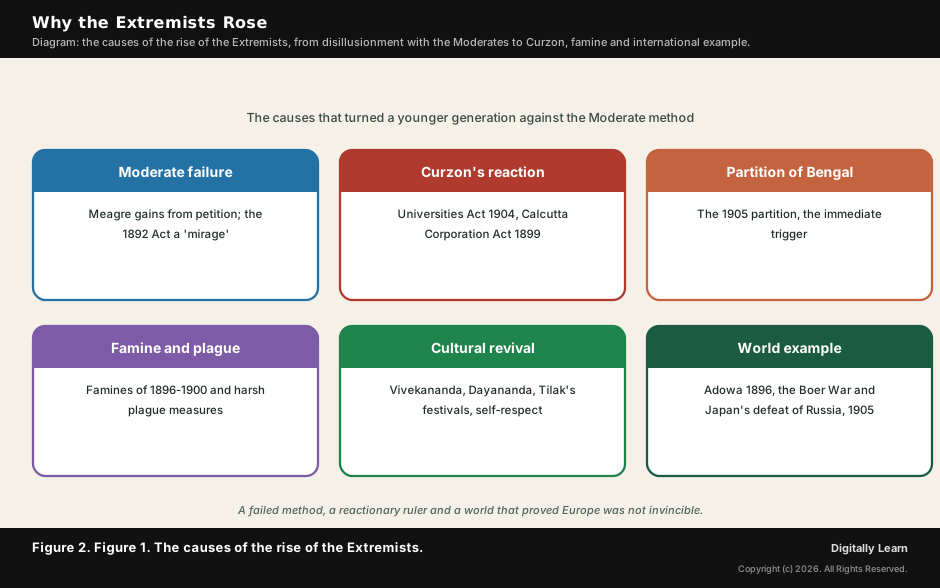
Distinguishing features of the years around 1900 pushed many towards extremism. Several grievances accumulated at once, each deepening the sense that British rule was both unjust and contemptuous of Indians.
- Meagre reform: The failure of the Moderate method to win real concessions.
- Curzon’s measures: A reactionary administration that insulted educated India.
- The partition of Bengal: The 1905 partition, seen as a deliberate blow at Bengali nationalism.
- Famine and plague: Mass suffering and harsh control measures in the late 1890s.
- World events: Foreign examples that proved European power was not invincible.
No single grievance, taken alone, would have produced extremism. It was their accumulation, a failed method, a contemptuous ruler, a wounded province, mass suffering and a changing world, that convinced a rising generation that the time for patient petition was over.
Curzon's Provocations and the Partition of Bengal
The Universities Act and the Calcutta Corporation Act
What is the significance of Curzon's rule: more than any other viceroy, he turned moderate men into militants. Lord Curzon, viceroy from 1899, governed with an arrogance that educated India found intolerable. The Calcutta Corporation Act of 1899 reduced the Indian elected element in the city's government, and the Indian Universities Act of 1904 brought the universities under tighter official control.
Each measure was read as part of a pattern: a deliberate effort to curb Indian voice and Indian institutions. Curzon's open contempt, his remark that the Congress was 'tottering to its fall', only sharpened the anger. His rule, the nationalists felt, showed the true face behind the talk of benevolent reform.
The Partition of Bengal as the Immediate Trigger
The partition of Bengal was the spark. Announced in July 1905 and brought into effect on 16 October 1905, it split the large province in two. Curzon defended it as an administrative convenience, but Indians saw the real aim as dividing Hindus from Muslims and breaking the most politically advanced province in the country.
The response was immediate and furious, launching the Swadeshi movement examined later in this series. For the rising Extremists, the partition was the final proof that petition was useless and that only organised, self-reliant resistance could defend Indian interests.
Famine, Plague and the Revival of Self-Respect
Economic Distress and Harsh Administration
Observable outcomes of colonial economic policy fed the new mood. The terrible famines of 1896 to 1900 and the plague epidemic of the late 1890s caused immense suffering, and the harsh, intrusive measures used to control the plague, especially in Poona, were deeply resented as an assault on dignity and custom.
These calamities, set against the spectacle of a government that seemed indifferent, hardened the conviction that British rule was a burden, not a blessing. They gave the Extremists a charge of feeling that the Moderates' dry constitutionalism could never match.
Cultural Revival and the Assertion of Pride
A cultural and religious revival gave extremism its emotional power. The teachings of Swami Vivekananda and Dayananda Saraswati, and the writings that celebrated India's past, restored a sense of pride and self-respect that pure constitutionalism lacked. Nationalism began to draw on the deep wells of religion and history.
In Maharashtra, Bal Gangadhar Tilak used the Ganpati and Shivaji festivals to reach a mass audience and to give the movement popular, cultural roots. This appeal to tradition was powerful, though it also carried a danger, examined in later parts, of alienating Muslims by tying nationalism to Hindu symbols.
International Inspirations and the Myth of European Invincibility
Adowa, the Boer War and Japan's Defeat of Russia
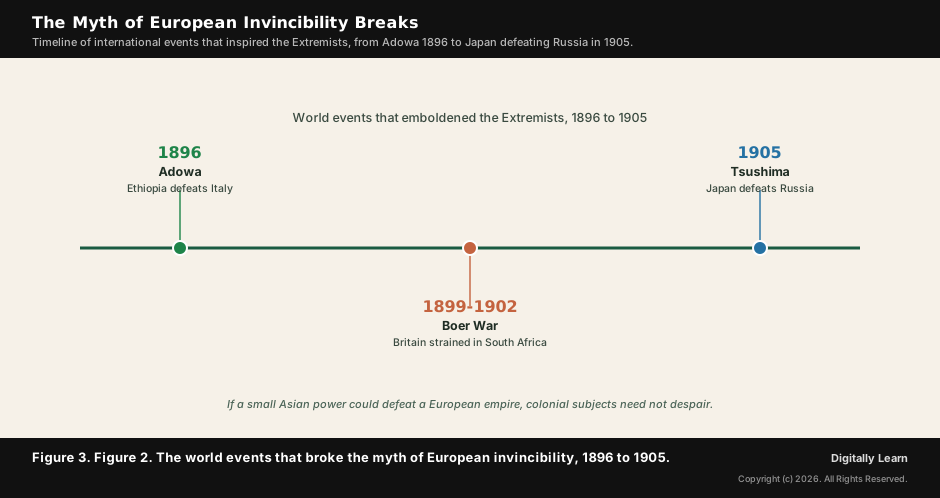
Contemporary linkages abroad gave the Extremists hope and confidence. A series of events shattered the comforting colonial myth that Europeans were invincible. In 1896, Ethiopia defeated Italy at the battle of Adowa; the long Boer War of 1899 to 1902 strained the British Empire; and, most striking of all, in 1905 the Asian power of Japan defeated Russia.
Japan's victory was electrifying. If a small Asian nation could defeat a great European empire, then colonial subjects need not accept their subjection as permanent. These foreign examples, drawn from across the world, convinced the Extremists that self-reliant struggle could succeed.
The Extremist Programme: Swaraj, Swadeshi, Boycott, National Education
Self-Reliance in Place of Petition
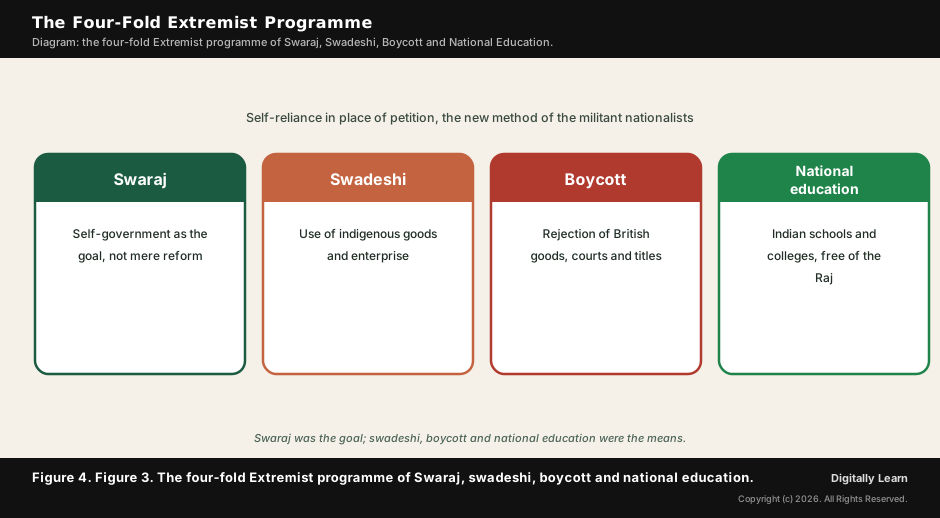
What is the significance of the Extremist programme: it replaced a politics of request with a politics of self-reliance. The goal was no longer reform but Swaraj, self-government, and the means were Indian action rather than British favour. The programme rested on four connected ideas.
Each of the four was a form of self-help. Swaraj named the goal; swadeshi built Indian enterprise; boycott struck at British trade and prestige; and national education freed Indian minds from a colonial schooling. Together they turned the Indian from a petitioner into a participant.
The Ideology of Self-Respect and Passive Resistance
Beneath the four-fold programme lay a deeper ideology. The Extremists preached self-respect, self-reliance and sacrifice, and they were willing to use passive resistance and non-cooperation where the Moderates had used only petition. They sought to draw the masses into politics, not merely to speak for them in distant councils.
This was the heart of the Extremist creed, and it is what the examination means by the extremist ideology: obtaining self-government by self-reliant, assertive means in place of petitions and constitutional ways. It was a change of method and of spirit, not of ultimate goal.
Moderates versus Extremists and the Path Forward
A Bridging Comparison of the Two Wings
Distinguishing the two wings sharpens the meaning of the change. The Moderates and Extremists shared the ultimate aim of Indian advancement, but they differed in goal, method, social base and inspiration. The fuller historiographical comparison is taken up in the final part of this series; the table below sets out the essential contrast.
The contrast should not be overdrawn. The two wings shared the same ultimate aim, and many leaders moved between them; the quarrel was over method and tempo, not over whether India should one day be free.
| Aspect | Moderates | Extremists |
|---|---|---|
| Immediate goal | Reform within the colonial system | Swaraj, or self-government |
| Method | Prayer, petition and protest | Swadeshi, boycott, passive resistance |
| Social base | A narrow, English-educated elite | Wider, with an appeal to the masses |
| Attitude to Britain | Faith in British justice | Self-reliance and distrust |
| Inspiration | Western liberalism | Indian tradition and cultural pride |
Significance: From Pressure Group towards a Movement
Contemporary linkages run from the Extremists straight to the mass movement. By demanding Swaraj and using boycott and swadeshi, they turned the Congress from an annual gathering of the elite towards a genuine popular movement, and they forged the very techniques that Gandhi would later perfect on a national scale.
Their rise also set the stage for the great clashes that followed: the Swadeshi movement, the Surat split and the government's repression, all examined in the next parts of this series. The Extremists, in short, gave Indian nationalism a new militancy and a new reach that it never afterwards lost.
Previous Year UPSC-CSE Questions
Previous Year UPSC-CSE Questions By the end you will be able to draft model answers for the following UPSC questions. Each question carries a collapsible framework showing how to approach it in the exam.
- UPSC Mains 2020 GS-IEvaluate the policies of Lord Curzon and their long-term implications on the national movements.
How to structure the answer in the exam
Introduction: Open with Curzon as a reactionary viceroy whose policies backfired on British rule.
Body (sub-themes to develop):
- Reactionary measures: Calcutta Corporation Act 1899 and Universities Act 1904 curbed Indian voice.
- The partition of Bengal (1905) was read as divide-and-rule and triggered mass protest.
- Long-term implication: the rise of the Extremists, the Swadeshi movement and a more militant Congress.
- His rule discredited the Moderate faith in British goodwill and radicalised nationalism.
Conclusion: Conclude that Curzon's policies, intended to strengthen British rule, instead galvanised Indian nationalism.
- UPSC Prelims 1998 GS Paper IWhich one of the following defines extremist ideology during the early phase of Indian freedom movement?
How to approach this Prelims question
Approach: Identify the option that captures the core extremist ideology, not just one of its methods.
Trap to watch: Swadeshi (option 1) and national education (option 3) were methods within the programme, not the defining ideology; military revolt (option 4) describes the revolutionaries, not the Extremists.
Key facts to recall:
- Extremist ideology: Swaraj by self-reliant, assertive means
- Swadeshi, boycott, national education were the methods
- Distinct from revolutionary terrorism
Answer signal: Self-government by aggressive means in place of petitions, so option (b).
Sources and Further Reading
- Wikipedia: Indian National Congress
- Wikipedia: Lord Curzon
- Wikipedia: Partition of Bengal (1905)
- Wikipedia: Bal Gangadhar Tilak
- Wikipedia: Swadeshi movement
- Wikipedia: Russo-Japanese War
- NCERT, Our Pasts III (The Making of the National Movement)
- Ministry of Culture: Indian Culture Freedom Archive
- Azadi Ka Amrit Mahotsav (Freedom Movement portal)
- Press Information Bureau, Government of India
- National Portal of India
Editorial Disclaimer
This article is prepared for UPSC examination preparation. Verify key facts and interpretations against standard reference histories before relying on them.