
Overview
Previous Year UPSC-CSE Questions By the end you will be able to draft model answers for the following UPSC questions. Each question carries a collapsible framework showing how to approach it in the exam.
- UPSC Mains 2019 GS-IExamine the linkages between 19th centuries ‘Indian renaissance’ and emergence of national identity.
How to structure the answer in the exam
Introduction: Open with the nineteenth-century revival of pride in India's religion, history and culture.
Body (sub-themes to develop):
- The renaissance restored self-respect and a sense of a glorious past.
- It was turned into politics: cultural symbols (Kali, Shivaji, the Gita, the motherland) inspired action.
- The revolutionaries embodied the most intense form: a sacred duty to die for the nation.
- This forged an assertive national identity, though its religious idiom carried its own risks.
Conclusion: Conclude that the renaissance supplied the self-respect and the symbols on which an assertive national identity, including revolutionary sacrifice, was built.
- UPSC Prelims 1999 GS Paper I'Abhinav Bharat' a secret society of revolutionaries was organised by
How to approach this Prelims question
Approach: Recall who founded the Abhinav Bharat secret society.
Trap to watch: Khudiram Bose and Prafulla Chaki belong to revolutionary Bengal (the Muzaffarpur bomb); Bhagat Singh is of the later 1920s; Abhinav Bharat was Savarkar's.
Key facts to recall:
- Abhinav Bharat: founded by V.D. Savarkar (from Mitra Mela)
- It was a Maharashtra secret society
- Distinct from the Bengal societies
Answer signal: V.D. Savarkar, so option (b).
- UPSC Prelims 2005 GS Paper IWhere were the Ghadar revolutionaries, who became active during the outbreak of the World War I, based?
How to approach this Prelims question
Approach: Recall where the Ghadar Party was based.
Trap to watch: San Francisco is in North America; the distractors (Central, West, South America) name no real Ghadar base.
Key facts to recall:
- Ghadar Party: founded 1913 at San Francisco
- San Francisco is in North America
- It planned an armed rising around the First World War
Answer signal: North America (San Francisco), so option (b).
Revolutionary nationalism was the strand of the freedom struggle that, despairing of both petition and open agitation, turned to armed action: secret societies, the assassination of officials, dacoities to raise funds and the smuggling of arms. Rising after the partition of Bengal and the repression of the Swadeshi years, it was strongest in Bengal and Maharashtra, with networks abroad in London, Paris and America. Few in number and quickly crushed, the early revolutionaries nonetheless kept the spirit of sacrifice alive through the lean years.
The Origins and Character of Revolutionary Nationalism
Why Young Men Turned to the Bomb
Why this matters: revolutionary nationalism was the answer of the desperate and the disillusioned. After the partition of Bengal and the failure of the Swadeshi movement, after the Surat split and the harsh repression, a section of the youth lost faith in both petition and open agitation. To them, only armed action could shake the empire.
This strand was strongest in Bengal and Maharashtra, the two most politically charged provinces, and it reached out to networks abroad. Its method was the secret society, the assassination of unpopular officials and the dacoity to raise funds; its geography is shown on the map below.
The Character and Inspiration of the Revolutionaries
Distinguishing features of the revolutionaries set them apart from the Congress. They were mostly young, educated and idealistic, organised in small secret cells, and they drew their inspiration as much from religion and culture as from politics. The cult of the motherland, the worship of Kali, the example of Shivaji and the gospel of selfless action in the Bhagavad Gita gave their sacrifice a spiritual intensity.
This was the most assertive expression of the cultural and religious revival of the age: the renaissance of pride in India's past, turned into a willingness to kill and to die for the nation. The principal organisations, region by region, are set out below.
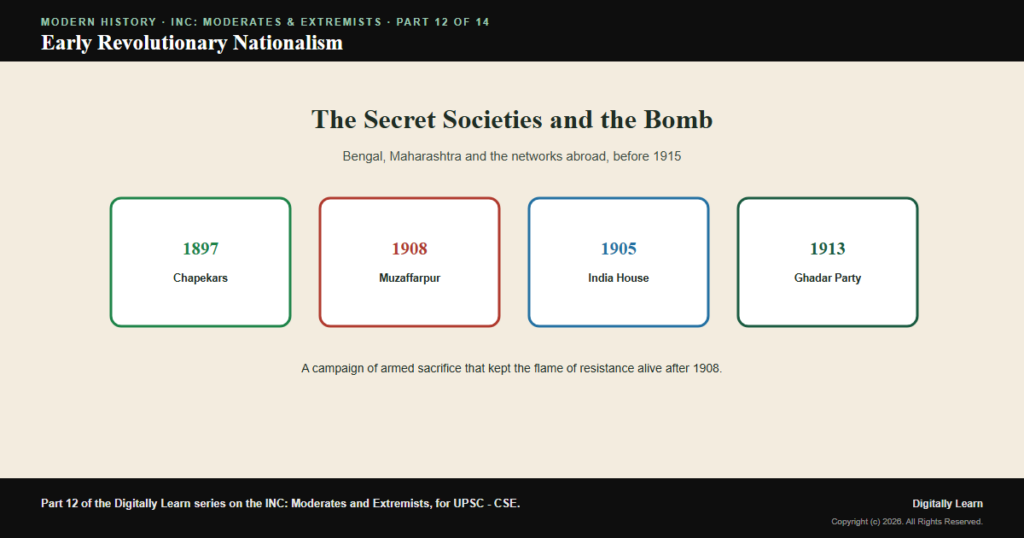
| Region | Organisation | Key figures | Signature act |
|---|---|---|---|
| Bengal | Anushilan Samiti, Jugantar | Barindra Ghosh, Khudiram Bose | The Muzaffarpur bomb, 1908 |
| Maharashtra | Abhinav Bharat | V.D. Savarkar, the Chapekars | The killing of Rand, 1897 |
| London | India House | Krishna Varma, Madan Lal Dhingra | The Curzon-Wyllie assassination, 1909 |
| America | Ghadar Party | Lala Hardayal and the diaspora | A plan for armed revolution |
Revolutionary Bengal: Secret Societies and the Bomb
The Anushilan Samiti and the Jugantar Group
What is the significance of revolutionary Bengal: it was the heartland of the early movement. The Anushilan Samiti, founded in 1902, grew into a network of secret societies across Bengal, combining physical training with the preparation for armed struggle, and it had a powerful branch in Dhaka.
From it sprang the militant Jugantar group, associated with Barindra Kumar Ghosh and the Jugantar newspaper, which openly preached revolution. These societies recruited the young, schooled them in secrecy and sacrifice, and turned the frustration of the Swadeshi years into a disciplined conspiracy.
The Muzaffarpur Incident and Khudiram Bose (1908)
Observable outcomes of this conspiracy came in 1908. Two young revolutionaries, Khudiram Bose and Prafulla Chaki, were sent to Muzaffarpur to kill the hated magistrate Kingsford. They bombed a carriage they mistook for his, killing two Englishwomen instead.
Prafulla Chaki shot himself to avoid capture; Khudiram Bose was arrested and, still in his teens, was hanged in 1908. His youth and courage made him a martyr across Bengal, and his name became a byword for the cult of sacrifice that the movement preached.
The Alipore Bomb Case and its Aftermath
Distinguishing features of the government's response appeared in the Alipore Bomb Case of 1908 to 1909, the great conspiracy trial that followed the Muzaffarpur affair. Barindra Kumar Ghosh and many others were arrested, and Barin was sentenced to transportation; the case against Aurobindo Ghosh collapsed, and he was acquitted.
The trial broke the first wave of Bengal revolution, but it did not end it. The societies regrouped, and revolutionary activity in Bengal continued in fits and starts, feeding into the larger movement of later decades. Repression had scattered the movement, not destroyed its spirit.
Revolutionary Maharashtra: From the Chapekars to Abhinav Bharat
The Chapekar Brothers and the Assassination of Rand (1897)
What is the significance of Maharashtra: it produced the very first act of revolutionary terrorism. In 1897, during the harsh plague-control measures in Poona, the Chapekar brothers assassinated W.C. Rand, the unpopular Plague Commissioner, and a British officer. It was the opening shot of the revolutionary tradition.
The killing, carried out in protest at the humiliating conduct of the plague administration, drew on the same well of resentment and cultural pride that Tilak's festivals had stirred. Damodar Chapekar was caught and hanged, the first of a long line of revolutionary martyrs.
Savarkar, Mitra Mela and the Nasik Conspiracy
Observable outcomes of the Maharashtra tradition centred on Vinayak Damodar Savarkar. From his youthful society Mitra Mela he built Abhinav Bharat, a secret revolutionary organisation, and he became a powerful propagandist of armed struggle, later carrying the cause to London.
In Maharashtra, the movement culminated in the Nasik conspiracy, in which a British official, the Collector Jackson, was assassinated. The government struck back hard, and Savarkar himself was eventually arrested and transported, but Abhinav Bharat had given the revolutionary idea a second great centre outside Bengal.
Punjab, Delhi and the Hardinge Bomb (1912)
Rash Behari Bose and the Delhi Conspiracy
Distinguishing features of the movement in the north appeared in its most audacious act. On 23 December 1912, as the Viceroy, Lord Hardinge, made his ceremonial entry into the new capital of Delhi, a bomb was thrown at his howdah, wounding him and killing an attendant. The Viceroy himself survived.
The act was the work of a network led by Rash Behari Bose, with Basanta Kumar Biswas, linking Bengal, Punjab and Delhi. The Hardinge bomb showed that the revolutionaries could strike at the very summit of British power, and it spread alarm through the government far out of proportion to the revolutionaries' actual strength.
The Revolutionaries Abroad: London, Paris and America
India House, Shyamji Krishna Varma and Madan Lal Dhingra
What is the significance of the revolutionaries abroad: from the safety of foreign cities they could publish, propagandise and plot freely. In London, Shyamji Krishna Varma founded India House in 1905 and the journal The Indian Sociologist, making it a hostel and a hothouse for young Indian radicals, among them Savarkar.
It was from this circle that Madan Lal Dhingra, in 1909, assassinated the official Sir William Curzon-Wyllie in London, an act that electrified Indian opinion and for which he went calmly to the gallows. The abroad networks, shown below, gave the movement a global reach.
Madame Cama, the Paris Group and the Ghadar Precursors
Observable outcomes of the overseas effort appeared in Paris and America. Madame Bhikaji Cama, working from Paris, became a tireless propagandist for the cause and famously unfurled an early version of an Indian national flag at an international gathering abroad in 1907.
Across the Atlantic, the Punjabi diaspora on the west coast of America built the Ghadar Party, founded at San Francisco in 1913, with its own newspaper and a bold plan for an armed revolution in India. Though its great rising was later crushed, the Ghadar movement carried the revolutionary flame to a new continent.
Methods, Ideology and the Limits of the Phase
Individual Heroism and its Limits
Contemporary linkages between method and outcome explain both the appeal and the failure of the movement. The revolutionaries relied on individual heroism: the secret society, the assassination of officials, the dacoity for funds and the smuggling of arms, deeds of conspicuous courage by a dedicated few.
But this method had clear limits, which the timeline of their acts, shown below, makes plain. Without a mass base, the revolutionaries could be hunted down one by one; their isolated acts, however brave, could not overthrow an empire. Their strengths and their weaknesses were two sides of the same coin.
- The secret society: Small, disciplined cells built on secrecy and an oath of sacrifice.
- The political assassination: The killing of unpopular officials as acts of protest and vengeance.
- The dacoity for funds: Armed robberies to finance arms and propaganda.
- The fatal limit: No mass base, so the movement could be isolated and crushed.
Significance: Keeping the Spirit of Sacrifice Alive
The Legacy of the Early Revolutionaries
Contemporary linkages run from these early revolutionaries to the whole later freedom struggle. Their great achievement was not military but moral: at a time when the open movement lay crushed and divided, they showed that Indians were willing to die for freedom, and they kept the spirit of resistance alive.
Their cult of courage and sacrifice inspired a later and far larger revolutionary movement in the 1920s, and their memory entered the national imagination as a tradition of fearless patriotism. The early revolutionaries failed in their immediate aim, but they enriched the freedom struggle with an example of selfless heroism that it never forgot.
Prelims MCQ practice
Each question below tests one specific concept on the topic. Click to reveal the answer and a full option-wise explanation.
Q1. The Anushilan Samiti, an early revolutionary secret society, was based primarily in:
- Punjab
- Bengal
- Madras
- Bombay
Show answer and explanation
Answer: Bengal
Explanation.
Option (b) is correct. The Anushilan Samiti was a Bengal revolutionary society (with a strong Dhaka branch). Hence option (b).
Q2. Khudiram Bose and Prafulla Chaki are associated with the 1908 bomb attack at:
- Alipore
- Muzaffarpur
- Chittagong
- Lahore
Show answer and explanation
Answer: Muzaffarpur
Explanation.
Option (b) is correct. The 1908 bomb (aimed at the magistrate Kingsford) was thrown at Muzaffarpur. Hence option (b).
Q3. With reference to revolutionary nationalism, consider the following statements:
- The Chapekar brothers assassinated the Plague Commissioner Rand at Poona in 1897.
- Madan Lal Dhingra assassinated Curzon-Wyllie in London in 1909.
Which of the statements given above is/are correct?
- 1 only
- 2 only
- Both 1 and 2
- Neither 1 nor 2
Show answer and explanation
Answer: Both 1 and 2
Explanation.
Both are correct. The Chapekars killed Rand (Poona, 1897) and Dhingra killed Curzon-Wyllie (London, 1909). Hence option (c).
Q4. The Hardinge bomb attack of 1912, during the Viceroy's entry into Delhi, is associated with:
- Bhagat Singh
- Rash Behari Bose
- Khudiram Bose
- Surya Sen
Show answer and explanation
Answer: Rash Behari Bose
Explanation.
Option (b) is correct. The Delhi (Hardinge) bomb conspiracy of 1912 was led by Rash Behari Bose. Hence option (b).
Q5. India House, the centre of Indian revolutionaries in London, was founded by:
- Madame Cama
- Shyamji Krishna Varma
- Lala Hardayal
- V.D. Savarkar
Show answer and explanation
Answer: Shyamji Krishna Varma
Explanation.
Option (b) is correct. India House (1905) was founded by Shyamji Krishna Varma. Hence option (b).
Q6. Consider the following revolutionary centres abroad:
- The Ghadar Party was based at San Francisco.
- India House was located in London.
Which of the pairs given above is/are correctly matched?
- 1 only
- 2 only
- Both 1 and 2
- Neither 1 nor 2
Show answer and explanation
Answer: Both 1 and 2
Explanation.
Both are correct: the Ghadar Party (San Francisco) and India House (London). Hence option (c).
Sources and Further Reading
- Wikipedia: Anushilan Samiti
- Wikipedia: India House
- Wikipedia: Ghadar Party
- Wikipedia: Khudiram Bose
- Wikipedia: Vinayak Damodar Savarkar
- NCERT, Our Pasts III (The Making of the National Movement)
- Ministry of Culture: Indian Culture Freedom Archive
- Azadi Ka Amrit Mahotsav (Freedom Movement portal)
- Press Information Bureau, Government of India
- National Portal of India
Editorial Disclaimer
This article is prepared for UPSC examination preparation. Verify key facts and interpretations against standard reference histories before relying on them.