
Overview
Previous Year UPSC-CSE Questions By the end you will be able to draft model answers for the following UPSC questions. Each question carries a collapsible framework showing how to approach it in the exam.
- UPSC Mains 2019 GS-IExamine the linkages between 19th centuries ‘Indian renaissance’ and emergence of national identity.
How to structure the answer in the exam
Introduction: Open with the nineteenth-century revival of pride in India's religion, history and culture.
Body (sub-themes to develop):
- The renaissance restored self-respect: Vivekananda, Dayananda and the celebration of India's past.
- Leaders converted revival into politics: Tilak's festivals, Lajpat Rai's Arya Samaj, Aurobindo's spiritual nationalism.
- Cultural symbols (Shivaji, the Gita, Bande Mataram) gave the movement an emotional, national identity.
- The danger: tying identity too closely to Hindu symbols risked alienating Muslims.
Conclusion: Conclude that the renaissance supplied the self-respect on which a national identity, and the demand for Swaraj, was built.
- UPSC Prelims 2008 GS Paper IWho among the following gave a systematic critique of the moderate politics of the Indian National Congress in a series of articles entitled New Lamps for Old?
How to approach this Prelims question
Approach: Recall the author of the 'New Lamps for Old' critique of the Moderates.
Trap to watch: R.C. Dutt was an economic nationalist (the drain), and Syed Ahmad Khan a loyalist reformer; neither wrote 'New Lamps for Old'.
Key facts to recall:
- Aurobindo Ghosh wrote 'New Lamps for Old' (1890s, from Baroda)
- It was a systematic critique of Moderate politics
- Aurobindo later edited Bande Mataram
Answer signal: Aurobindo Ghosh, so option (a).
- UPSC Prelims 2018 GS Paper IHe wrote biographies of Mazzini, Garibaldi, Shivaji and Shrikrishna; stayed in America for some time; and was also elected to the Central Assembly. He was
How to approach this Prelims question
Approach: Match the clues, biographies of foreign patriots, a stay in America and election to the Central Assembly, to the leader.
Trap to watch: Aurobindo (Bengal, Pondicherry) and Pal (Bengal) do not fit the America stay and the Central Assembly; the writer of these biographies is Lajpat Rai.
Key facts to recall:
- Lajpat Rai wrote biographies of Mazzini, Garibaldi, Shivaji and Shri Krishna
- He spent time in the United States
- He was elected to the Central Legislative Assembly
Answer signal: Lala Lajpat Rai, so option (c).
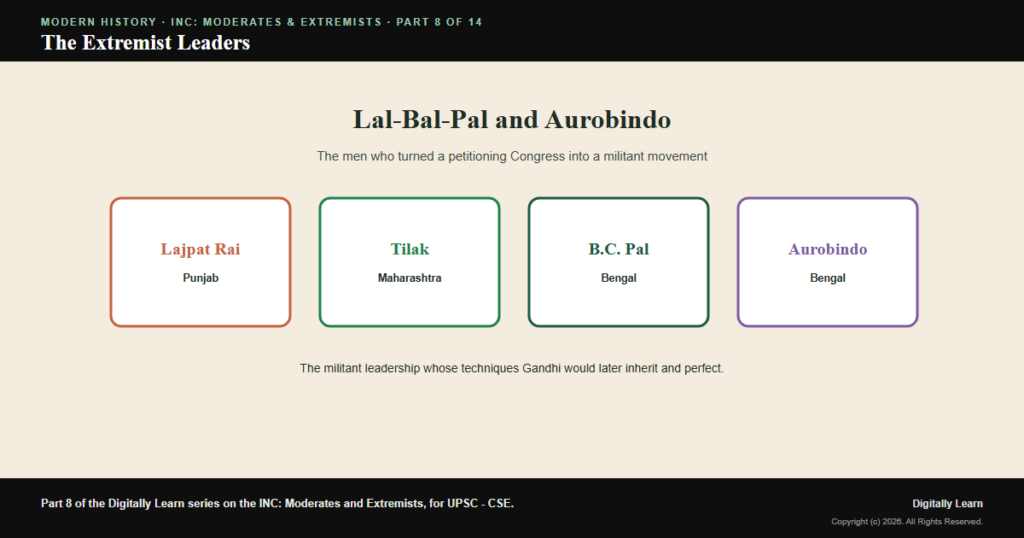
The Extremist leaders were the militant nationalists who, after about 1905, gave the new politics of self-reliance its voice and its organisation. The famous trio of Lal-Bal-Pal, Lala Lajpat Rai of Punjab, Bal Gangadhar Tilak of Maharashtra and Bipin Chandra Pal of Bengal, together with Aurobindo Ghosh, demanded Swaraj and pursued it through swadeshi, boycott, national education and passive resistance. They worked through a fearless press, mass festivals and indigenous institutions, and they suffered sedition trials, deportation and imprisonment for it.
Bal Gangadhar Tilak: Lokmanya and the Father of Indian Unrest
Lokmanya Tilak and the Quartet of Extremism
Why this matters: the Extremist creed examined in the previous part was carried into the country by a small group of remarkable leaders. The foremost of them was Bal Gangadhar Tilak of Maharashtra, hailed as Lokmanya, 'revered by the people', and dubbed by a British writer 'the father of Indian unrest'. Around him stood the famous trio of Lal-Bal-Pal and the philosopher of the movement, Aurobindo Ghosh.
These four men came from three different regions and differed in temperament, yet they shared one conviction: that freedom would be won by Indian self-reliance, not by appeals to British goodwill. This part profiles each in turn, then draws out the creed and the geography they had in common.
Kesari, Mahratta and the Festivals of Mass Mobilisation
Distinguishing features of Tilak's method were the press and the festival. Through his newspapers Kesari, in Marathi, and Mahratta, in English, he reached a wide public in their own language and taught them to think politically. His pen was fearless, and his columns made the grievances of ordinary people a national concern.
Tilak also gave nationalism a popular, cultural form. He turned the Ganpati festival into a grand public event in 1894 and founded the Shivaji festival in 1895, making religious and historical celebration into occasions for mass gathering and political education. This was a powerful technique, though, as later parts show, the use of Hindu symbols also carried the danger of alienating Muslims from the movement.
The Sedition Trials and the Mandalay Imprisonment
Observable outcomes of Tilak's defiance were repeated clashes with the law. He was tried for sedition in 1897 and imprisoned, and after the partition agitation he was tried again in 1908 and sentenced to six years' transportation, which he served at Mandalay in Burma until 1914. In prison he wrote his philosophical work on the Bhagavad Gita, the Gita Rahasya.
Tilak's imprisonment made him a martyr and a symbol. The famous slogan associated with him, 'Swaraj is my birthright and I shall have it', belongs to the later Home Rule period of about 1916, examined in Part 13 of this series, and should not be read back into this earlier phase. On his release he returned to active leadership.
Lala Lajpat Rai: The Lion of Punjab
The Arya Samaj, DAV Institutions and Self-Reliance
What is the significance of Lala Lajpat Rai: he carried extremism into Punjab and tied it to social reform and self-help. Known as the Lion of Punjab and 'Punjab Kesari', he was a devoted follower of the Arya Samaj and a builder of indigenous institutions, above all the Dayanand Anglo-Vedic, or DAV, schools and colleges that offered an Indian-rooted modern education.
For Lajpat Rai, self-reliance was not only a political slogan but a way of life. He promoted Indian enterprise, was associated with the founding of Indian financial institutions, and wrote widely, including admiring biographies of foreign patriots. His chief contributions can be set out simply.
- The Arya Samaj: A reformist movement that gave Punjab nationalism its social and religious base.
- DAV institutions: Schools and colleges offering a national, self-reliant education.
- Patriotic writing: Biographies of Mazzini, Garibaldi, Shivaji and Shri Krishna, to inspire a younger generation.
- Work abroad: A long stay in the United States, where he argued India’s case and was later elected to the Central Legislative Assembly.
The Deportation of 1907
Distinguishing features of the state's response to Lajpat Rai came early. In 1907, amid agrarian unrest in Punjab, the government deported him to Mandalay in Burma without trial, alongside the agitator Ajit Singh. The deportation, ordered on mere suspicion, showed how nervous the authorities had become of the new leadership.
The action backfired. Far from silencing the movement, the deportation made Lajpat Rai a national hero and exposed the arbitrary character of British rule. He was released within a few months, his stature greatly enhanced, a pattern of repression breeding sympathy that would recur throughout the freedom struggle.
Bipin Chandra Pal and the Politics of Boycott
The Orator of Boycott and Bande Mataram
What is the significance of Bipin Chandra Pal: he was the great orator and publicist of the Bengal extremism, completing the Lal-Bal-Pal trio. A powerful speaker and writer, he preached the full programme of swadeshi, boycott, national education and passive resistance with a fervour that stirred audiences across the country, and he is often called a father of revolutionary thought in India.
Pal was closely associated with the famous nationalist daily Bande Mataram, which he helped to found and which Aurobindo Ghosh edited. Through it he carried the message of assertive, fearless nationalism, insisting that boycott was not merely an economic weapon but a moral and political one, a way for Indians to withdraw their cooperation from an unjust government.
Like the other Extremists, Pal believed that self-reliance rather than petition was the road to freedom. His later political path diverged from the mainstream, but in the high years of the Swadeshi movement his voice was among the most influential in the land.
Aurobindo Ghosh: From New Lamps for Old to Passive Resistance
From the Indian Civil Service to New Lamps for Old
What is the significance of Aurobindo Ghosh: he gave extremism its sharpest early critique of the Moderates and its deepest philosophy. Educated in England, he passed the Indian Civil Service examination but was disqualified for failing the riding test, and then entered the service of the princely state of Baroda.
It was from Baroda that, as a young man in the 1890s, he wrote a celebrated series of articles entitled 'New Lamps for Old', a systematic and biting critique of the cautious, mendicant politics of the Moderate Congress. The series marked him out early as a voice of the coming militancy, demanding a politics of strength in place of prayer.
Bande Mataram and the Doctrine of Passive Resistance
Distinguishing features of Aurobindo's mature politics appeared during the Swadeshi years. As editor of Bande Mataram, he became the foremost theorist of the movement, setting out a clear doctrine of passive resistance: the organised refusal of cooperation with the colonial state, through boycott, swadeshi and national education.
For Aurobindo, the goal was complete Swaraj, and the method was the disciplined withdrawal of Indian help from a government that ruled only by Indian acquiescence. This doctrine of non-cooperation, worked out in 1907 and 1908, anticipated in striking ways the mass satyagraha that Gandhi would later lead.
The Alipore Bomb Case and the Turn to Pondicherry
Observable outcomes of the government's fear of Aurobindo came in the Alipore Bomb Case of 1908 to 1909, in which he was arrested and tried in connection with revolutionary activity in Bengal. After a long trial, in which he was defended by the nationalist lawyer C.R. Das, he was acquitted.
The experience marked a turning point. In 1910 Aurobindo withdrew from active politics to Pondicherry, then under French rule, where he devoted the rest of his life to philosophy and spiritual practice. His political career was brief, but his intellectual influence on the extremist phase was profound.
Shared Ideology and the Regional Distribution of Extremism
A Common Creed of Self-Reliance and Sacrifice
What is the significance of the shared creed: for all their differences, the Extremist leaders held a common faith that distinguished them sharply from the Moderates. They demanded Swaraj, not mere reform; they trusted in Indian self-reliance, not British justice; and they were willing to suffer and sacrifice, accepting prison and deportation as the price of leadership.
They also shared a method of mass mobilisation: the fearless press, the public festival, the indigenous school and the boycott. And they drew openly on India's cultural and religious heritage, on Shivaji and the Gita, on the Arya Samaj and the hymn Bande Mataram, to give the movement an emotional depth that pure constitutionalism had lacked. The table below sets out their distinct contributions.
| Leader | Region | Method and institutions | Signature contribution |
|---|---|---|---|
| Bal Gangadhar Tilak | Maharashtra | Kesari and Mahratta; Ganpati and Shivaji festivals | Mass mobilisation through press and festival |
| Lala Lajpat Rai | Punjab | Arya Samaj; DAV schools and colleges | Self-help, social reform and national education |
| Bipin Chandra Pal | Bengal | Bande Mataram; public oratory | The fullest preaching of boycott and swadeshi |
| Aurobindo Ghosh | Bengal and Baroda | New Lamps for Old; Bande Mataram | The philosophy of passive resistance and Swaraj |
The Geography of Extremism: Punjab, Maharashtra and Bengal
Contemporary linkages of place mattered to the movement. Extremism was strongest in three regions, and the famous label Lal-Bal-Pal captures the fact neatly: Lajpat Rai in Punjab, Bal Gangadhar Tilak in Maharashtra and Bipin Chandra Pal in Bengal, with Aurobindo Ghosh active in Bengal and earlier in Baroda.
These were among the most politically advanced provinces of the country, with a vigorous press, a large educated class and, in Bengal, the direct experience of the partition. Their leadership made extremism a genuinely multi-regional force, rather than the affair of a single province, as the map shows.
Significance: The Techniques Gandhi Would Inherit
The Inheritance of Method
Contemporary linkages run directly from these leaders to the mass movement of the twentieth century. The Extremists pioneered the very techniques of struggle, boycott, swadeshi, passive resistance, the use of the press and of cultural symbols, the willingness to court imprisonment, that Gandhi would later take up, refine and deploy on a national scale.
They also drew on the nineteenth-century cultural and religious revival and turned it into a politics of national identity, linking the renaissance of Indian self-respect to the demand for self-rule. In doing so they transformed the Congress from a body that petitioned the government into one that increasingly confronted it, a change whose full consequences, the Surat split and the years of repression, are examined in the parts that follow.
Prelims MCQ practice
Each question below tests one specific concept on the topic. Click to reveal the answer and a full option-wise explanation.
Q1. The Extremist trio popularly known as 'Lal-Bal-Pal' consisted of Lala Lajpat Rai, Bal Gangadhar Tilak and:
- Bipin Chandra Pal
- Aurobindo Ghosh
- Surendranath Banerjee
- Madan Mohan Malaviya
Show answer and explanation
Answer: Bipin Chandra Pal
Explanation.
Option (a) is correct. 'Lal-Bal-Pal' stands for Lajpat Rai, Bal Gangadhar Tilak and Bipin Chandra Pal. Hence option (a).
Q2. Bal Gangadhar Tilak published which pair of newspapers to spread the nationalist message?
- Bande Mataram and Sandhya
- Kesari and Mahratta
- Young India and Harijan
- The Hindu and Swadesamitran
Show answer and explanation
Answer: Kesari and Mahratta
Explanation.
Option (b) is correct. Tilak published Kesari (Marathi) and Mahratta (English). Hence option (b).
Q3. With reference to Lala Lajpat Rai, consider the following statements:
- He was a follower of the Arya Samaj and associated with the DAV institutions.
- He was deported to Mandalay in 1907 without trial.
Which of the statements given above is/are correct?
- 1 only
- 2 only
- Both 1 and 2
- Neither 1 nor 2
Show answer and explanation
Answer: Both 1 and 2
Explanation.
Both are correct. Lajpat Rai was an Arya Samajist linked to the DAV institutions and was deported to Mandalay in 1907 without trial. Hence option (c).
Q4. The nationalist daily 'Bande Mataram', associated with Bipin Chandra Pal, was edited by:
- Bal Gangadhar Tilak
- Aurobindo Ghosh
- Lala Lajpat Rai
- Surendranath Banerjee
Show answer and explanation
Answer: Aurobindo Ghosh
Explanation.
Option (b) is correct. Aurobindo Ghosh edited Bande Mataram, which Bipin Chandra Pal helped to found. Hence option (b).
Q5. Bal Gangadhar Tilak served his term of transportation imposed in the 1908 sedition trial at:
- The Andaman Islands
- Mandalay in Burma
- Aden
- The Yerwada jail
Show answer and explanation
Answer: Mandalay in Burma
Explanation.
Option (b) is correct. Tilak was imprisoned at Mandalay in Burma from 1908 to 1914. Hence option (b).
Q6. Consider the following Extremist leaders and their regions:
- Lala Lajpat Rai : Punjab
- Bal Gangadhar Tilak : Maharashtra
Which of the pairs given above is/are correctly matched?
- 1 only
- 2 only
- Both 1 and 2
- Neither 1 nor 2
Show answer and explanation
Answer: Both 1 and 2
Explanation.
Both pairs are correctly matched: Lajpat Rai with Punjab and Tilak with Maharashtra. Hence option (c).
Sources and Further Reading
- Wikipedia: Lal Bal Pal
- Wikipedia: Bal Gangadhar Tilak
- Wikipedia: Lala Lajpat Rai
- Wikipedia: Bipin Chandra Pal
- Wikipedia: Sri Aurobindo
- Wikipedia: Alipore bomb case
- NCERT, Our Pasts III (The Making of the National Movement)
- Ministry of Culture: Indian Culture Freedom Archive
- Azadi Ka Amrit Mahotsav (Freedom Movement portal)
- Press Information Bureau, Government of India
- National Portal of India
Editorial Disclaimer
This article is prepared for UPSC examination preparation. Verify key facts and interpretations against standard reference histories before relying on them.