
Overview
Previous Year UPSC-CSE Questions By the end you will be able to draft model answers for the following UPSC questions. Each question carries a collapsible framework showing how to approach it in the exam.
- UPSC Mains 2017 GS-IWhy did the ‘Moderates’ failed to carry conviction with the nation about their proclaimed ideology and political goals by the end of the nineteenth century?
How to structure the answer in the exam
Introduction: Open with the Moderates' constitutional ideology and limited goals.
Body (sub-themes to develop):
- The 1892 Act delivered far less than was demanded, exposing the limits of petition.
- Excessive faith in British goodwill looked naive as the government met loyalty with reaction.
- A narrow, English-educated base with no mass contact weakened their claim to speak for the nation.
- The 'political mendicancy' charge captured the rising impatience of a younger generation.
Conclusion: Conclude that meagre results, a narrow base and misplaced faith cost the Moderates conviction, opening the way to the Extremists.
- UPSC Prelims 1998 GS Paper IRead the Assertion (A) and the Reason (R) below:
- Assertion (A): Partition of Bengal in 1905 brought to an end the Moderates’ role in the Indian freedom movement.
- Reason (R): The Surat session of Indian National Congress separated the Extremists from the Moderates.
Select the correct answer using the code given below.
How to approach this Prelims question
Approach: Test the assertion and the reason separately for truth.
Trap to watch: The Assertion is false: the Moderates' role did not end in 1905; they retained control of the Congress after the 1907 Surat split. The Reason is true: Surat (1907) separated the two wings.
Key facts to recall:
- Moderates kept control of the Congress after the 1907 Surat split
- Gokhale remained influential into the 1910s
- Surat session 1907 separated Extremists from Moderates
Answer signal: A is false but R is true, so option (d).
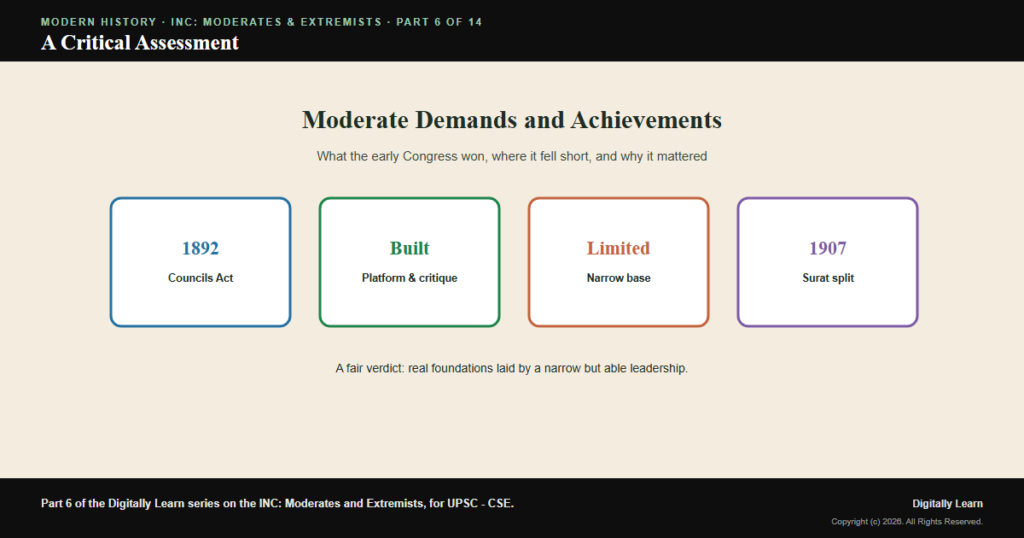
The Moderate phase of the Congress, from 1885 to 1905, is best judged by what it actually demanded, what it achieved and where it fell short. The Moderates asked for constitutional reform within the colonial system, and their one solid legislative gain was the limited Indian Councils Act of 1892. Their deeper achievements lay in building an all-India platform, exposing the economic basis of colonial rule and training a political public; their limitations lay in a narrow social base and an excessive faith in British goodwill. A fair assessment finds them neither the failures nor the mere petitioners their later critics claimed.
The Constitutional and Administrative Demands Recalled
What the Moderates Asked For
Why this matters: the Moderates must be judged against what they actually sought, not against later goals. Their demands were for reform within the colonial framework, not for self-rule. They pressed for a larger Indian share in the legislative councils, the Indianisation of the services, the separation of the judiciary from the executive, and the protection of basic civil rights.
These demands were moderate by design, framed to be acceptable to a fair-minded ruler. Each flowed from the conviction that British rule could be reformed from within, and together they amounted to a programme of steady, constitutional progress rather than a challenge to the colonial state itself.
| Demand | What the Moderates sought |
|---|---|
| Legislative councils | More elected Indian members and the right to discuss the budget |
| The services | Indianisation and a simultaneous ICS examination in India |
| The judiciary | Separation of the judiciary from the executive |
| Civil rights | Freedom of speech, the press and association |
| Expenditure | Reduction of military and home-charges spending |
The Indian Councils Act of 1892: Demand versus Delivery
Provisions: Enlarged Councils and the Right to Discuss the Budget
What is the significance of the 1892 Act: it was the Moderates' single legislative gain, and its inadequacy taught them how little patient petition could win. The Indian Councils Act of 1892 enlarged the legislative councils and allowed a small, indirectly chosen Indian element, along with a limited right to discuss the budget and to put questions.
But the Act withheld far more than it gave. There was no real election, only a power of recommendation; there was no right to vote on the budget, only to discuss it; and the official majority was carefully retained, so that the government could never be outvoted.
Why the Act Fell Short of Moderate Expectations
The gap between demand and delivery was wide enough that even the Moderates were disappointed. Naoroji and others had asked for a genuine, elected voice and real budgetary power; what they received was a consultative role in councils the government still controlled completely.
This disappointment had consequences. If two decades of loyal, constitutional pressure could win only this, a younger generation began to ask whether the method itself was at fault, a doubt that would feed directly into the rise of the Extremists.
The Achievements of the Moderates
An All-India National Consciousness and a Political Cadre
Distinguishing features of the Moderate achievement go well beyond legislation. Their greatest success was to create, for the first time, a permanent all-India platform and a sense of national consciousness that crossed region, religion and caste. The annual Congress brought leaders together and taught a public to think in national terms.
This was no small thing in a land of many languages and communities. By insisting that it spoke for all of India, and by meeting each year in a different city, the Congress built a habit of national thinking that outlasted the Moderates and that no later movement had to create afresh.
- A national platform: A permanent, all-India and secular organisation that survived to lead the movement.
- Political training: A public and a leadership schooled in debate, organisation and constitutional methods.
- The economic critique: The drain of wealth and the exposure of colonial exploitation.
- A limited reform: The Indian Councils Act of 1892, modest but real.
The Economic Critique and the Exposure of Colonial Rule
The Moderates' economic critique, the drain of wealth and the analysis of deindustrialisation, was their most enduring intellectual achievement. It shifted the argument from the honesty of administration to the structure of colonial rule, and it gave nationalism a factual basis that no later movement abandoned.
In exposing the true character of British rule, the Moderates also trained Indians to see their poverty as a political and economic problem with a political solution. This was a profound change in consciousness, and it was the work of the very leaders later dismissed as timid petitioners.
The Limitations and the Narrow Social Base
Excessive Faith in British Goodwill and Slow Methods
Observable outcomes exposed the Moderates' weaknesses as clearly as their strengths. They placed an excessive faith in British goodwill, believing that reasoned appeal would move a ruler who in fact had little reason to concede, and their methods were slow and produced meagre tangible gains.
By the early twentieth century this looked increasingly naive. The government met patient loyalty with reaction, not reform, and the charge of political mendicancy captured a real failing: a politics of request had reached the limit of what it could achieve.
The Absence of a Mass Programme
The deepest limitation was social. The Moderates were a narrow, English-educated class of professionals, and they made little attempt to reach the peasantry, the artisans or the urban poor. The Congress was, in these years, an annual gathering of the elite, not a mass movement.
This narrow base limited both their pressure and their conviction. Without the masses behind them, the Moderates could neither frighten the government nor claim to speak for the whole nation, a gap that the Extremists, and later Gandhi, would set out to close.
A Balanced Assessment of the Moderate Era
Neither Failures nor Mendicants
A fair verdict must judge the Moderates by the standards of their own time, not by those of the mass movement that followed. Measured this way, they were neither failures nor mendicants. They built the institutions, the critique and the leadership that everything later rested on, and they did so when no precedent existed to guide them.
It is also wrong to think their role simply ended in 1905. The Moderates retained control of the Congress after the Surat split of 1907, which separated them from the Extremists, and leaders like Gokhale remained influential into the 1910s. Their dominance waned, but their work endured.
Significance: The Foundation the Movement Inherited
What the Later Movement Took From the Moderates
Contemporary linkages run from the Moderate phase into everything that followed. The mass movement inherited the Moderates' all-India organisation, their economic critique, their trained leadership and their demand for representative government, even as it rejected their methods. The foundation was theirs; the building was done by others.
The later constitutional advances, beginning with the Morley-Minto Reforms of 1909, were also the delayed fruit of Moderate-style pressure. The Moderates' patient work, in short, was the indispensable first stage of the freedom struggle, and the next part of this series turns to the Extremists who arose in reaction to its limits.
Prelims MCQ practice
Each question below tests one specific concept on the topic. Click to reveal the answer and a full option-wise explanation.
Q1. The chief legislative achievement of the Moderate phase of the Congress was the:
- Indian Councils Act of 1861
- Indian Councils Act of 1892
- Morley-Minto Reforms of 1909
- Government of India Act of 1858
Show answer and explanation
Answer: Indian Councils Act of 1892
Explanation.
Option (b) is correct. The Indian Councils Act of 1892 was the Moderates' main legislative gain, modest though it was. Hence option (b).
Q2. Which of the following was NOT granted by the Indian Councils Act of 1892?
- Enlargement of the legislative councils
- The right to discuss the budget
- A non-official majority at the Centre
- The right to ask questions
Show answer and explanation
Answer: A non-official majority at the Centre
Explanation.
Option (c) is correct. The 1892 Act enlarged councils and allowed budget discussion and questions, but the official majority was retained; there was no non-official majority at the Centre. Hence option (c).
Q3. With reference to the Moderates, consider the following statements:
- Their methods relied on petitions, resolutions and constitutional pressure.
- They built a permanent, all-India and secular political platform.
Which of the statements given above is/are correct?
- 1 only
- 2 only
- Both 1 and 2
- Neither 1 nor 2
Show answer and explanation
Answer: Both 1 and 2
Explanation.
Both are correct. The Moderates used constitutional methods and built a permanent all-India secular platform. Hence option (c).
Q4. The criticism that the Moderates indulged in 'political mendicancy' was made chiefly by the:
- Moderates themselves
- Extremists
- British government
- Muslim League
Show answer and explanation
Answer: Extremists
Explanation.
Option (b) is correct. The Extremists, notably Tilak, derided the Moderate method as political mendicancy. Hence option (b).
Q5. A major limitation of the Moderate phase of the Congress was its:
- Reliance on violent methods
- Narrow, English-educated social base
- Demand for complete independence
- Opposition to the economic critique
Show answer and explanation
Answer: Narrow, English-educated social base
Explanation.
Option (b) is correct. The Moderates drew on a narrow, English-educated professional class with little mass contact. Hence option (b).
Q6. Consider the following statements about the end of the Moderate phase:
- The Surat session of 1907 separated the Extremists from the Moderates.
- The Moderates retained control of the Congress after the 1907 split.
Which of the statements given above is/are correct?
- 1 only
- 2 only
- Both 1 and 2
- Neither 1 nor 2
Show answer and explanation
Answer: Both 1 and 2
Explanation.
Both are correct. The 1907 Surat split separated the two wings, and the Moderates kept control of the Congress afterwards. Hence option (c).
Sources and Further Reading
- Wikipedia: Indian Councils Act 1892
- Wikipedia: Indian National Congress
- Wikipedia: Gopal Krishna Gokhale
- Wikipedia: Surat Split
- Wikipedia: Dadabhai Naoroji
- Wikipedia: Moderates (Indian independence movement)
- NCERT, Our Pasts III (The Making of the National Movement)
- Ministry of Culture: Indian Culture Freedom Archive
- Azadi Ka Amrit Mahotsav (Freedom Movement portal)
- Press Information Bureau, Government of India
- National Portal of India
Editorial Disclaimer
This article is prepared for UPSC examination preparation. Verify key facts and interpretations against standard reference histories before relying on them.