
Overview
Previous Year UPSC-CSE Questions By the end you will be able to draft model answers for the following UPSC questions. Each question carries a collapsible framework showing how to approach it in the exam.
- UPSC Mains 2017 GS-IWhy did the ‘Moderates’ failed to carry conviction with the nation about their proclaimed ideology and political goals by the end of the nineteenth century?
How to structure the answer in the exam
Introduction: Open with the Moderates' proclaimed ideology of constitutional reform and faith in British justice.
Body (sub-themes to develop):
- Methods of prayer, petition and protest produced only meagre concessions (the 1892 Act seen as a 'mirage').
- Excessive faith in British goodwill looked naive as repression continued.
- A narrow, English-educated base with no mass contact limited their conviction.
- Tilak's 'political mendicancy' charge captured the rising impatience of a younger generation.
Conclusion: Conclude that meagre results, a narrow base and misplaced faith cost the Moderates conviction and opened the way to the Extremists.
- UPSC Prelims 2015 GS Paper IWho of the following was/were economic critic/critics of colonialism in India?
- Dadabhai Naoroji
- G. Subramania Iyer
- R.C. Dutt
Select the correct answer using the code given below.
How to approach this Prelims question
Approach: Recall the economic-nationalist writers of the Moderate phase.
Trap to watch: All three were economic critics; do not exclude G. Subramania Iyer, who is less famous than Naoroji and Dutt.
Key facts to recall:
- Dadabhai Naoroji: drain of wealth
- R.C. Dutt: economic history of India
- G. Subramania Iyer: economic-nationalist writer and editor
Answer signal: All three are economic critics, so option (d).
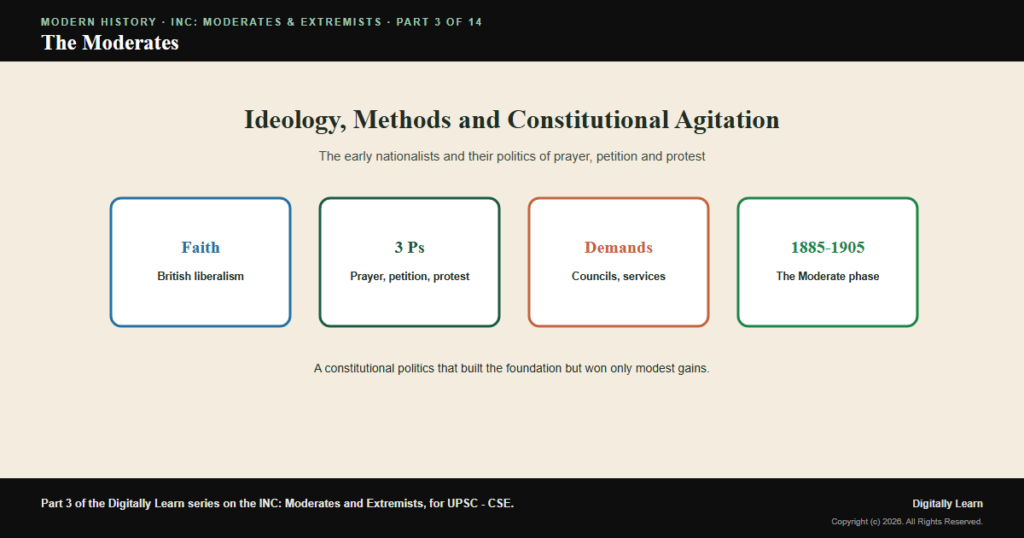
The Moderates were the early leaders who dominated the Indian National Congress in its first phase, from 1885 to 1905. They believed that British rule could be reformed from within, and they pursued their aims through constitutional agitation: prayers, petitions, resolutions and a reasoned appeal to the British sense of justice. Drawn from the English-educated professional class, they did not yet demand self-rule, but they trained a public in politics, built a national platform, and produced a powerful economic critique of colonial rule that became their most lasting contribution.
The Moderate Worldview and Faith in British Liberalism
Constitutionalism, Gradualism and the Nation-in-the-Making
Why this matters: the Moderates' beliefs explain both their achievements and their limits. They held that India was a nation in the making, not yet ready for self-government, and that progress would come gradually through reform. They trusted the constitutional traditions of Britain and believed that a patient, reasoned case would, in time, persuade a fair-minded ruler to grant Indians a larger share in their own government.
This was a politics of gradualism. The Moderates sought to widen Indian rights step by step, working within the existing system rather than against it. They valued order and legality, feared that agitation would invite repression, and saw their task as the slow education of both the Indian public and the British conscience.
Loyalty to the Crown with Reform from Within
The Moderates were loyal to the British Crown and said so openly. They believed the British connection was, on balance, providential for India, and that the remedy for misgovernment was not to end British rule but to make it more just. Their loyalty was genuine, and it shaped a politics of appeal rather than confrontation.
This faith had a cost. By resting their hopes on British goodwill, the Moderates made themselves dependent on a ruler who had little reason to concede, and when the concessions proved meagre, a younger generation began to ask whether prayer and petition could ever be enough. That doubt would produce the Extremists, examined later in this series.
Methods of the Moderates: Prayer, Petition and Protest
Petitions, Memoranda, Resolutions and Deputations
Distinguishing features of the Moderate method were summed up in the phrase the three Ps: prayer, petition and protest. In practice this meant passing resolutions at the annual Congress, sending memoranda and petitions to the government, organising deputations to officials, and putting the Indian case before the public through speeches and the press. It was a wholly constitutional method, and it relied on persuasion rather than pressure.
The annual Congress session was the centrepiece of this method. Each year the delegates debated and passed resolutions that set out India's grievances and demands, which were then forwarded to the government and publicised through the press. Between sessions, the work of petition and deputation was carried on by the provincial associations.
The British Committee and the Journal "India"
The Moderates understood that real decisions were taken in London, so they carried their campaign to Britain. The British Committee of the Congress, set up in 1889, and its journal India, started in 1890, worked to inform British public opinion and to lobby members of Parliament. Dadabhai Naoroji even won election to the British House of Commons, the better to argue India's case at the centre of power.
This trans-imperial lobbying was a serious effort, not a token one, and it reflected the Moderate faith that an informed British public would press for reform. Its results were limited, but it built links and arguments that later nationalists would also use.
The "Political Mendicancy" Critique
Observable outcomes of the petition method were modest, and critics seized on this. Bal Gangadhar Tilak and other younger leaders mocked the Moderates' approach as political mendicancy, a politics of begging that asked favours from the rulers instead of demanding rights. The jibe was unfair to the Moderates' real achievements, but it captured a genuine weakness.
By the early twentieth century the gap between the Moderates' patient appeals and the government's meagre response had become hard to defend. The charge of mendicancy was the sharpest sign that the Moderate method had reached its limits and that a more assertive politics was coming.
The Core Political and Administrative Demands
Legislative Council Reform and Budgetary Rights
What is the significance of these demands: they show that the Moderates wanted a real, if limited, share in government. They pressed for the expansion of the legislative councils, for more elected Indian members, and for the right to discuss and to vote on the budget. These were the central constitutional demands, and the partial concession of some of them in the Indian Councils Act of 1892 was the Moderates' main legislative gain.
The Moderates did not ask for an elected majority or for control of the executive. They sought a larger Indian voice inside councils that the government would still dominate, together with the right to question and criticise official policy. Even this limited demand was conceded only in part, which deepened the later impatience with constitutional methods.
Indianisation of Services and Simultaneous ICS Examinations
The Moderates demanded the Indianisation of the higher services, above all the Indian Civil Service. They asked that the ICS examination be held simultaneously in India and in England, and that the maximum age be raised, so that Indians could compete on fair terms. The service that governed India, they argued, should be open to Indians in fact and not only in principle.
They also pressed for the reduction of military and home-charges expenditure, which fell heavily on Indian revenues. These administrative demands flowed directly from the economic critique that was the heart of their case, examined below.
Separation of Judiciary from Executive and Civil Rights
The Moderates demanded the separation of the judiciary from the executive, so that the same officials who governed could not also judge, a basic safeguard of the rule of law. They also defended civil rights: freedom of speech, of the press and of association, which the racial laws of the period had openly curtailed.
These were not abstract points. The racial laws of the period, the press and arms restrictions and the executive's grip on the courts, had shown educated Indians how easily their liberties could be withdrawn, and the demand for legal safeguards followed directly from that experience.
- Constitutional: Enlarged councils, elected members and the right to discuss the budget.
- Administrative: Indianisation of services and a fair, simultaneous ICS examination.
- Civil and judicial: Separation of powers and the freedoms of speech, press and association.
The Economic Critique as the Moderate Cornerstone
The Drain of Wealth and Economic Nationalism
The most powerful and lasting Moderate contribution was their economic critique of colonialism. Dadabhai Naoroji, R.C. Dutt, G. Subramania Iyer and G.V. Joshi argued that British rule was draining India's wealth to Britain through home charges, official salaries, the interest on debt and military spending. Naoroji named this the drain of wealth, and R.C. Dutt traced it through his economic history of India.
This critique changed the terms of the argument. It moved the debate from whether British administration was honest to whether British rule was economically ruinous, and it gave nationalism a hard, factual core. The drain theory is developed fully in the part of this series on Moderate economic nationalism; here it stands as the cornerstone of the whole Moderate case.
Significance and the Build-up to the Extremist Challenge
What the Moderates Achieved and Where They Fell Short
Contemporary linkages run from the Moderate phase straight into the rest of the freedom struggle. The Moderates created a permanent national platform, trained a leadership and a public in politics, exposed the economic basis of colonial rule, and won the limited Indian Councils Act of 1892. These were real foundations, and it is unfair to dismiss the Moderates as mere petitioners.
Yet their limitations were real too: a narrow social base, an excessive faith in British goodwill, and methods too slow to satisfy a rising generation. By 1905, with the partition of Bengal, that impatience boiled over into the Extremist challenge, the subject of the next stage of this series. The full assessment of the Moderates is taken up in the dedicated assessment part.
| Achievements | Limitations |
|---|---|
| Built a permanent, all-India national platform | A narrow, English-educated social base |
| Produced the economic critique and the drain theory | Excessive faith in British goodwill |
| Trained a public and a leadership in politics | Slow methods and meagre tangible gains |
| Won the Indian Councils Act of 1892 | No programme of mass mobilisation |
Prelims MCQ practice
Each question below tests one specific concept on the topic. Click to reveal the answer and a full option-wise explanation.
Q1. The Moderate phase of the Indian National Congress is generally dated to the period:
- 1885 to 1905
- 1905 to 1916
- 1916 to 1947
- 1857 to 1885
Show answer and explanation
Answer: 1885 to 1905
Explanation.
Option (a) is correct. The Moderate phase ran from the foundation of the Congress in 1885 to about 1905, after which the Extremists rose. Hence option (a).
Q2. The 'three Ps' associated with the Moderate method were:
- Petition, Protest, Partition
- Prayer, Petition, Protest
- Press, Platform, Petition
- Prayer, Protest, Partition
Show answer and explanation
Answer: Prayer, Petition, Protest
Explanation.
Option (b) is correct. The Moderate method is summed up as prayer, petition and protest, all constitutional means. Hence option (b).
Q3. With reference to the methods of the Moderates, consider the following statements:
- The British Committee of the Congress was set up in London to influence British opinion.
- The Moderates pursued their aims mainly through constitutional methods rather than mass agitation.
Which of the statements given above is/are correct?
- 1 only
- 2 only
- Both 1 and 2
- Neither 1 nor 2
Show answer and explanation
Answer: Both 1 and 2
Explanation.
Both are correct. The British Committee (1889) lobbied British opinion, and the Moderates relied on constitutional methods, not mass agitation. Hence option (c).
Q4. The taunt of 'political mendicancy' against the Moderates is most associated with:
- Gopal Krishna Gokhale
- Bal Gangadhar Tilak
- Dadabhai Naoroji
- W.C. Bonnerjee
Show answer and explanation
Answer: Bal Gangadhar Tilak
Explanation.
Option (b) is correct. Tilak and other Extremists derided the Moderate method as political mendicancy. Hence option (b).
Q5. The main legislative gain of the Moderate phase was the:
- Indian Councils Act of 1861
- Indian Councils Act of 1892
- Indian Councils Act of 1909
- Government of India Act of 1858
Show answer and explanation
Answer: Indian Councils Act of 1892
Explanation.
Option (b) is correct. The Indian Councils Act of 1892, which slightly enlarged the councils, was the Moderates' chief legislative gain. Hence option (b).
Q6. Consider the following pairs of contribution and figure:
- Drain of wealth theory : Dadabhai Naoroji
- Economic history of India : R.C. Dutt
Which of the pairs given above is/are correctly matched?
- 1 only
- 2 only
- Both 1 and 2
- Neither 1 nor 2
Show answer and explanation
Answer: Both 1 and 2
Explanation.
Both pairs are correct. Naoroji developed the drain of wealth theory, and R.C. Dutt wrote the economic history of India. Hence option (c).
Sources and Further Reading
- Wikipedia: Indian National Congress
- Wikipedia: Dadabhai Naoroji
- Wikipedia: Indian Councils Act 1892
- Wikipedia: Romesh Chunder Dutt
- Wikipedia: Gopal Krishna Gokhale
- Wikipedia: Drain of wealth
- NCERT, Our Pasts III (The Making of the National Movement)
- Ministry of Culture: Indian Culture Freedom Archive
- Azadi Ka Amrit Mahotsav (Freedom Movement portal)
- Press Information Bureau, Government of India
- National Portal of India
Editorial Disclaimer
This article is prepared for UPSC examination preparation. Verify key facts and interpretations against standard reference histories before relying on them.