
Overview
Previous Year UPSC-CSE Questions By the end you will be able to draft model answers for the following UPSC questions. Each question carries a collapsible framework showing how to approach it in the exam.
- UPSC Mains 2021 GS-ITo what extent did the role of the moderates prepare a base for the wider freedom movement? Comment.
How to structure the answer in the exam
Introduction: Open by noting that the base of the freedom movement was built by the early Moderate leadership.
Body (sub-themes to develop):
- Institutions: the Servants of India Society, the Indian Association and the East India Association.
- Intellectual base: Naoroji's drain theory and the economic critique of colonialism.
- Human base: a trained successor generation, including Gandhi through his mentor Gokhale.
- Limits: a narrow, English-educated, professional leadership with little mass contact.
Conclusion: Conclude that the Moderate leaders prepared a substantial institutional and intellectual base, even if a socially narrow one.
- UPSC Prelims 2015 GS Paper IConsider the following statements:
- The first woman President of the Indian National Congress was Sarojini Naidu.
- The first Muslim President of the Indian National Congress was Badruddin Tyabji.
Which of the statements given above is/are correct?
How to approach this Prelims question
Approach: Check each statement against the record of Congress presidents.
Trap to watch: Statement 1 is wrong: the first woman president was Annie Besant (1917); Sarojini Naidu was the first Indian woman president (1925). Statement 2 is correct: Badruddin Tyabji (1887).
Key facts to recall:
- Badruddin Tyabji: first Muslim INC president (1887)
- Annie Besant: first woman INC president (1917)
- Sarojini Naidu: first Indian woman INC president (1925)
Answer signal: Only statement 2 is correct, so option (b).
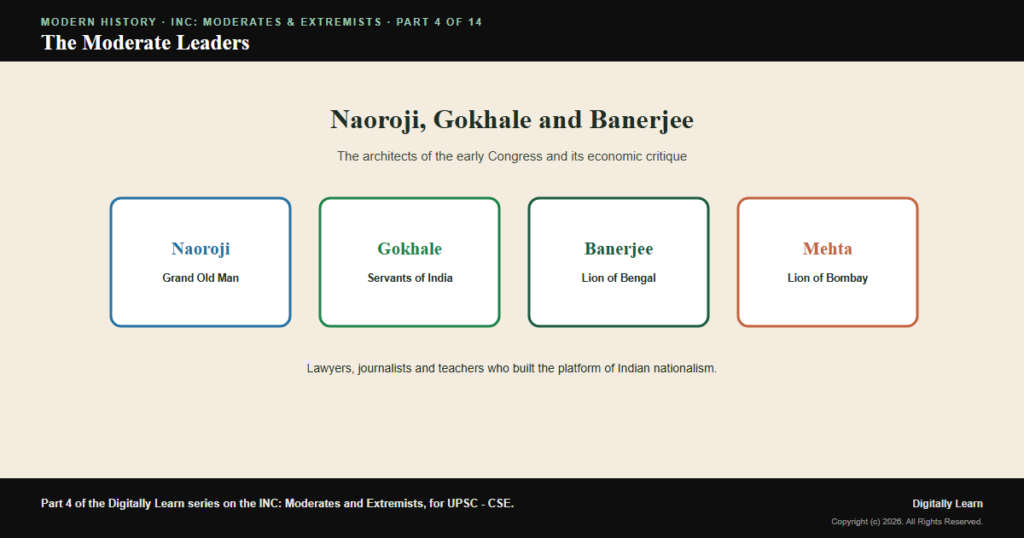
The Moderate leaders were the men who built and led the Indian National Congress in its first phase, from 1885 to 1905. They were an English-educated professional class of lawyers, journalists and teachers, and the foremost among them were Dadabhai Naoroji, the Grand Old Man of India, Gopal Krishna Gokhale, the mentor of Gandhi, and Surendranath Banerjee, the Lion of Bengal, with Pherozeshah Mehta, M.G. Ranade and Dinshaw Wacha beside them. Between them they founded the lasting institutions, the newspapers and the economic critique on which the whole national movement was later built.
Dadabhai Naoroji: The Grand Old Man of India
The East India Association and the Drain Theory
Why this matters: no single figure did more to shape early nationalism than Dadabhai Naoroji, known with affection as the Grand Old Man of India. A Parsi scholar and businessman, he founded the East India Association in London in 1866 to put India's case before the British public, and he devoted his long life to exposing the economic cost of colonial rule.
Naoroji's lasting contribution was the drain of wealth theory, which he set out from 1867 onward and developed in his book Poverty and Un-British Rule in India. He argued that British rule was steadily transferring India's wealth to Britain, and this idea became the intellectual foundation of nationalist economics, the subject of the next part of this series.
First Indian in the British House of Commons (1892)
Naoroji carried the Indian case to the very centre of British power. In 1892 he was elected to the British House of Commons as a Liberal member, the first Indian to sit there, and he used the platform to argue for Indian reform before British legislators.
He also led the Congress three times, in 1886, 1893 and 1906, an authority no other early leader matched. It was at the 1906 Calcutta session, over which he presided, that the Congress first declared Swaraj, or self-government, as its goal, a sign of how far the movement had travelled in his lifetime.
Gopal Krishna Gokhale and the Servants of India Society
Council Work, Budget Speeches and Pragmatic Reform
Gopal Krishna Gokhale was the foremost Moderate of the next generation, a careful, pragmatic reformer admired even by his opponents. As a member of the Imperial Legislative Council, he mastered public finance and delivered powerful budget speeches that exposed the burdens colonial policy placed on ordinary Indians.
In 1905 he founded the Servants of India Society, whose members took vows of poverty and service to work for the country's welfare and political education. It was the mature institutional expression of the Moderate ideal, and it outlived the Moderate phase itself.
Political Mentor to Gandhi
Gokhale's most far-reaching legacy was personal. When Mohandas Gandhi returned from South Africa, he took Gokhale as his political mentor and toured India on his advice before entering public life. Through this link, the patient, constitutional spirit of the Moderates passed directly to the leader of the mass movement.
Gandhi later called Gokhale his political guru, and the habits of careful organisation and constitutional pressure that Gokhale practised shaped Gandhi's own early method. The bridge between the Moderate phase and the later mass movement was, in part, this personal one.
Surendranath Banerjee: The Lion of Bengal
The Indian Association and the Indian National Conference
Surendranath Banerjee, called the Lion of Bengal for his oratory, was among the most important pre-Congress organisers. Expelled from the Indian Civil Service early in life on a slender pretext, he turned to public work and in 1876 founded the Indian Association of Calcutta, a body with a wider, more popular base than the older landlord associations.
Banerjee convened the Indian National Conference in 1883, an all-India gathering that was, in effect, a rehearsal for the Congress, and it merged with the Congress soon after. He presided over the Congress twice and was a bridge between the early associations and the national body.
"The Bengalee" and the Anti-Partition Agitation
Banerjee edited the influential newspaper The Bengalee, through which he shaped political opinion in Bengal for decades. The press was central to the Moderate method, and Banerjee was one of its most effective practitioners.
When Lord Curzon partitioned Bengal in 1905, Banerjee threw himself into the agitation against it, becoming a leading voice of the protest. That movement, examined later in this series, marked the point where Moderate methods began to give way to a more assertive politics.
Pherozeshah Mehta, M.G. Ranade and Dinshaw Wacha
Pherozeshah Mehta: The Lion of Bombay
Pherozeshah Mehta, the Lion of Bombay, dominated the public life of his city for a generation. A barrister and a master of municipal affairs, he helped found the Bombay Presidency Association, shaped the Bombay Municipal Corporation, and presided over the Congress in 1890. He later founded the newspaper the Bombay Chronicle.
Mehta was a formidable parliamentarian and organiser whose authority held the western wing of the Congress together. Alongside him, Dinshaw Wacha, a close associate of Naoroji, managed the finances and organisation of the early Congress and presided over it in 1901.
M.G. Ranade and the Tradition of Indian Economics
Mahadev Govind Ranade, a judge and scholar of Pune, was the intellectual conscience of western Indian reform. He shaped the Poona Sarvajanik Sabha, founded the Indian National Social Conference in 1887 to press social reform alongside politics, and laid the groundwork of Indian economic thought.
Ranade's deepest mark on the movement came through mentorship. He guided a younger generation, above all Gokhale, and through them his careful, reformist temper passed into the mainstream of the Congress. Badruddin Tyabji, who in 1887 became the first Muslim president of the Congress, was another of the broad-based early leaders; the first woman president, Annie Besant, came only later, in 1917.
A Comparative Profile of the Moderate Leadership
The Leaders at a Glance
Distinguishing features united this leadership even as they came from different regions and communities. They were almost all English-educated professionals, mostly lawyers and journalists, drawn from the presidency capitals, and they shared a faith in constitutional methods and a gift for organisation and the written word.
They differed in temperament and region. Naoroji and Mehta anchored Bombay, Gokhale and Ranade the Deccan, and Banerjee Bengal, while Tyabji's presidency showed the early Congress reaching across communities. Yet all worked through the same constitutional methods, as the comparison below sets out.
| Leader | Region | Sobriquet or office | Signature contribution |
|---|---|---|---|
| Dadabhai Naoroji | Bombay / London | Grand Old Man of India | The drain of wealth theory; first Indian MP (1892) |
| Gopal Krishna Gokhale | Pune | Mentor of Gandhi | The Servants of India Society (1905); budget speeches |
| Surendranath Banerjee | Calcutta | Lion of Bengal | The Indian Association; The Bengalee newspaper |
| Pherozeshah Mehta | Bombay | Lion of Bombay | Bombay civic life; the Bombay Chronicle |
| M.G. Ranade | Pune | Judge and teacher | Indian economic thought; social reform |
| Badruddin Tyabji | Bombay | First Muslim president (1887) | A broad-based, secular early Congress |
Significance: Institutions, Newspapers and a Leadership Cadre
What the Moderate Leaders Left Behind
What is the significance of this leadership: it left behind far more than speeches. The Moderate leaders built lasting institutions and edited influential newspapers, creating a public life and an organisational base that long outlived them.
- Servants of India Society (Gokhale, 1905): Members vowed to a life of public service and political education.
- The Indian Association (Banerjee, 1876): a broader-based political body and Congress forerunner.
- The Indian National Social Conference (Ranade, 1887): social reform pressed alongside politics.
- The press: The Bengalee (Banerjee) and the Bombay Chronicle (Mehta) carried nationalist opinion to a wide public.
Contemporary linkages run straight from this cadre to the rest of the freedom struggle. They produced the economic critique, trained the next generation, including Gandhi through Gokhale, and gave the movement its first national leadership. Their narrow social base was a real limit, but the foundations they laid were genuine, and they made the later mass movement possible.
Prelims MCQ practice
Each question below tests one specific concept on the topic. Click to reveal the answer and a full option-wise explanation.
Q1. Dadabhai Naoroji, the 'Grand Old Man of India', is best known for:
- The doctrine of passive resistance
- The drain of wealth theory
- The Home Rule League
- The Khilafat Movement
Show answer and explanation
Answer: The drain of wealth theory
Explanation.
Option (b) is correct. Naoroji developed the drain of wealth theory and was the first Indian in the British House of Commons. Hence option (b).
Q2. The Servants of India Society (1905) was founded by:
- Surendranath Banerjee
- Gopal Krishna Gokhale
- Pherozeshah Mehta
- M.G. Ranade
Show answer and explanation
Answer: Gopal Krishna Gokhale
Explanation.
Option (b) is correct. Gokhale founded the Servants of India Society in 1905; he was also Gandhi's political mentor. Hence option (b).
Q3. With reference to the Moderate leaders, consider the following statements:
- Dadabhai Naoroji was the first Indian elected to the British House of Commons.
- Surendranath Banerjee founded the Indian Association of Calcutta in 1876.
Which of the statements given above is/are correct?
- 1 only
- 2 only
- Both 1 and 2
- Neither 1 nor 2
Show answer and explanation
Answer: Both 1 and 2
Explanation.
Both are correct. Naoroji was the first Indian elected to the British Commons (1892), and Banerjee founded the Indian Association in 1876. Hence option (c).
Q4. The sobriquet 'Lion of Bengal' is associated with:
- Bipin Chandra Pal
- Surendranath Banerjee
- Aurobindo Ghosh
- W.C. Bonnerjee
Show answer and explanation
Answer: Surendranath Banerjee
Explanation.
Option (b) is correct. Surendranath Banerjee was called the Lion of Bengal for his oratory. Hence option (b).
Q5. Who among the following was Mahatma Gandhi's acknowledged political mentor?
- Bal Gangadhar Tilak
- Gopal Krishna Gokhale
- Dadabhai Naoroji
- Lala Lajpat Rai
Show answer and explanation
Answer: Gopal Krishna Gokhale
Explanation.
Option (b) is correct. Gandhi took Gopal Krishna Gokhale as his political mentor on returning from South Africa. Hence option (b).
Q6. Consider the following pairs of leader and sobriquet or office:
- Pherozeshah Mehta : the Lion of Bombay
- Badruddin Tyabji : first Muslim President of the Congress
Which of the pairs given above is/are correctly matched?
- 1 only
- 2 only
- Both 1 and 2
- Neither 1 nor 2
Show answer and explanation
Answer: Both 1 and 2
Explanation.
Both pairs are correct. Pherozeshah Mehta was the Lion of Bombay, and Badruddin Tyabji was the first Muslim president of the Congress (1887). Hence option (c).
Sources and Further Reading
- Wikipedia: Dadabhai Naoroji
- Wikipedia: Gopal Krishna Gokhale
- Wikipedia: Surendranath Banerjee
- Wikipedia: Pherozeshah Mehta
- Wikipedia: Mahadev Govind Ranade
- Wikipedia: Badruddin Tyabji
- NCERT, Our Pasts III (The Making of the National Movement)
- Ministry of Culture: Indian Culture Freedom Archive
- Azadi Ka Amrit Mahotsav (Freedom Movement portal)
- Press Information Bureau, Government of India
- National Portal of India
Editorial Disclaimer
This article is prepared for UPSC examination preparation. Verify key facts and interpretations against standard reference histories before relying on them.