
Overview
Previous Year UPSC-CSE Questions By the end you will be able to draft model answers for the following UPSC questions. Each question carries a collapsible framework showing how to approach it in the exam.
- UPSC Mains 2021 GS-ITo what extent did the role of the moderates prepare a base for the wider freedom movement? Comment.
How to structure the answer in the exam
Introduction: Open with the early Congress as the seedbed of the later mass movement.
Body (sub-themes to develop):
- The Moderates built the institutions, the constitutional method and the educated leadership.
- The Extremists added Swaraj, mass methods and a wider social reach.
- By 1916 the two converged: reunion, the Lucknow Pact and the Home Rule Leagues.
- This united, organised movement was the base Gandhi inherited and expanded.
Conclusion: Conclude that the early phase, culminating in 1916, prepared substantially the base on which the wider freedom movement was built.
- UPSC Prelims 2013 GS Paper IAnnie Besant was:
- Responsible for starting the Home Rule Movement.
- The founder of the Theosophical Society.
- Once the President of the Indian National Congress.
Select the correct statement/statements using the codes given below.
How to approach this Prelims question
Approach: Test each statement about Annie Besant against the facts.
Trap to watch: Statement 2 is the trap: Besant LED (was president of) the Theosophical Society but did NOT found it (Blavatsky and Olcott founded it in 1875).
Key facts to recall:
- Besant started the Home Rule Movement (1916)
- She was Congress president in 1917 (first woman)
- She was president, not founder, of the Theosophical Society
Answer signal: Statements 1 and 3 are correct, so option (c).
- UPSC Prelims 1995 GS Paper IWhat is the correct chronological sequence of the following events?
- I. The Lucknow Pact
- II. The Introduction of Dyarchy
- III. The Rowlatt Act
- IV. The Partition of Bengal
Choose the correct answer from the codes given below:
How to approach this Prelims question
Approach: Date each event and order them: Partition of Bengal (1905), Lucknow Pact (1916), Rowlatt Act (1919), dyarchy (1919 to 1921).
Trap to watch: The partition of Bengal (1905) comes first, not the Lucknow Pact; dyarchy (under the 1919 Act) comes last.
Key facts to recall:
- Partition of Bengal: 1905
- Lucknow Pact: 1916
- Rowlatt Act: 1919
- Dyarchy: from 1921 under the 1919 Act
Answer signal: IV, I, III, II, so option (b).
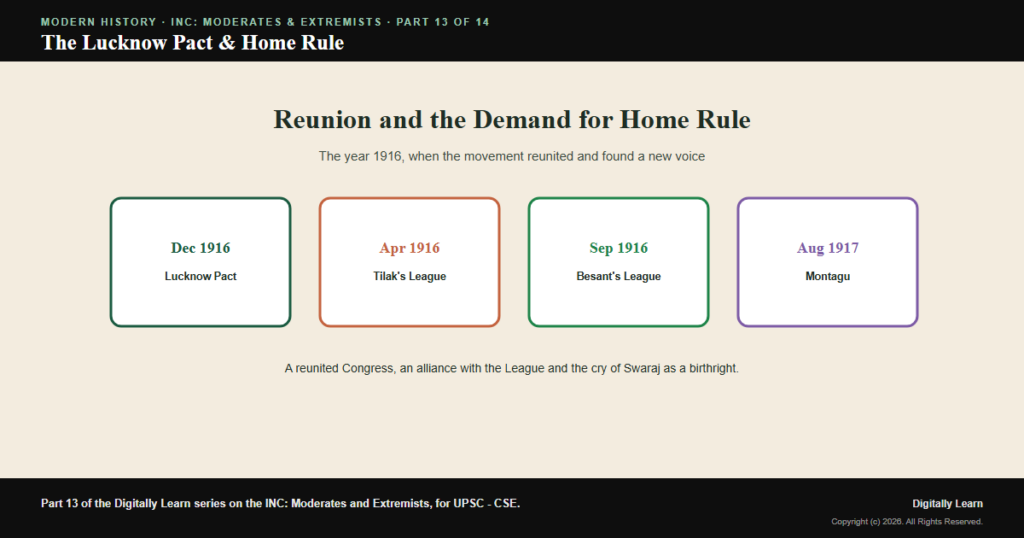
The year 1916 was a turning point. After nine years of division, the Indian National Congress reunited its Moderate and Extremist wings at the Lucknow session, and at the same time signed the Lucknow Pact with the Muslim League, a rare moment of Hindu-Muslim political unity. Alongside, the two Home Rule Leagues of Tilak and Annie Besant launched a popular agitation for self-government during the First World War. Together these events ended the lean years and set the stage for the Gandhian mass phase.
The Road to Reunion after the Surat Split
The Deaths of Gokhale and Mehta and Tilak's Return
Why this matters: the reunion of the Congress became possible only when the obstacles to it were removed. Bal Gangadhar Tilak returned from his imprisonment at Mandalay in 1914, chastened and eager to rejoin the mainstream, and he now sought readmission to the Congress rather than confrontation.
On the other side, the two Moderate leaders most opposed to the Extremists, Gopal Krishna Gokhale and Pherozeshah Mehta, both died in 1915. With the hardliners of both wings gone or softened, the path to reunion lay open, as the timeline of these years shows.
The First World War and the Expectation of Reform
Distinguishing features of the moment owed much to the First World War. India contributed men and money to the imperial war effort, and nationalists of every shade expected that this loyalty would be rewarded with a substantial measure of self-government once the war was won.
This widely shared expectation of reform gave the movement a new urgency and a new unity of purpose. If India was to press its claim effectively, the nationalists reasoned, it must speak with one voice, a logic that drove both the reunion of the Congress and its pact with the Muslim League.
The Lucknow Session and the Congress-League Pact (1916)
Tilak, Jinnah and the Acceptance of Separate Electorates
What is the significance of the Lucknow session: it achieved a double unity in a single meeting. At the Lucknow session of December 1916, the Congress formally readmitted the Extremists, ending the split of 1907, and at the same session it concluded the famous Lucknow Pact with the Muslim League.
The architect of the pact on the Muslim side was Muhammad Ali Jinnah, then a member of both the Congress and the League and hailed as the ambassador of Hindu-Muslim unity. To win the League's cooperation, the Congress made a momentous concession: it accepted separate electorates for Muslims, the very communal principle it had condemned in 1909. The two streams that met at Lucknow are shown below.
The Weightage Formula and the Joint Demands
Distinguishing features of the pact lay in its terms. The Congress conceded not only separate electorates but a weightage formula: Muslims were given a fixed, generous share of seats in the legislative councils, about one-third at the centre, more than their share of the population in some provinces and less in others.
In return, the two bodies agreed on a joint scheme of constitutional reform, a common set of demands for self-government to put before the British. The main provisions are set out below. The pact was a calculated bargain: unity now, in the hope of reform, at the price of a communal concession whose dangers would appear only later.
| Provision of the Lucknow Pact | What it meant |
|---|---|
| Separate electorates for Muslims | Congress accepted the communal principle |
| A weightage of seats | Muslims given about one-third of the central seats |
| An elected majority in the councils | A joint demand for a larger Indian voice |
| A joint scheme of reforms | Congress and League spoke with one voice |
The Home Rule Leagues of 1916
Tilak's Indian Home Rule League (April 1916)
What is the significance of the Home Rule Leagues: they carried the demand for self-government from the council chamber into the country. The first was founded by Tilak in April 1916, at Belgaum, the Indian Home Rule League, with the resounding slogan that he made famous: 'Swaraj is my birthright and I shall have it'.
Tilak's League worked a defined territory: Maharashtra apart from Bombay city, Karnataka, and the Central Provinces and Berar. It gave the militant tradition of the Deccan a fresh, legal channel, turning the energy of the Extremists into an organised, popular campaign for Home Rule. The two Leagues and their comparison are shown below.
Annie Besant's All-India Home Rule League (September 1916)
Observable outcomes of the same impulse appeared a few months later. In September 1916, the Irish-born Theosophist Annie Besant founded the All India Home Rule League at Adyar, near Madras. She was a tireless organiser and propagandist, and through her journals New India and Commonweal she carried the message far and wide.
Besant, it should be noted, was the president of the Theosophical Society, not its founder, and she would go on to become the first woman president of the Indian National Congress in 1917. Her League covered the rest of India outside Tilak's territory, building a wide network of branches and volunteers.
Methods, Spread and the Territorial Division
Contemporary linkages between the two Leagues lay in a sensible division of labour. To avoid rivalry, they divided the country territorially: Tilak's League took the western and central Deccan, and Besant's the rest, as the map below shows. Their methods were those of a modern agitation: public meetings, the press, pamphlets and the enrolment of members.
The movement spread rapidly during 1916 and 1917, drawing in students, professionals and the lower middle class, and reaching towns and districts the Congress had never touched. For the first time since the Swadeshi years, nationalism was again a popular, energetic force, no longer the affair of an annual session alone.
Impact, the Montagu Declaration and the Decline
The Montagu Declaration and the Fading of the Movement
Observable outcomes of the agitation came quickly. Alarmed by its spread, the government interned Annie Besant in 1917, but the move backfired, provoking nationwide protest and swelling the movement further. The pressure told: on 20 August 1917, the Secretary of State, Edwin Montagu, declared that British policy aimed at the gradual development of responsible government in India.
The Montagu Declaration was a landmark, the first official admission that self-government was the goal, and it took much of the steam out of the Home Rule agitation. The movement then faded, as Besant's caution, Tilak's departure for England and, above all, the rise of Gandhi drew its energies into new channels. Its impact, however, was lasting.
- A revived movement: Home Rule re-energised national politics after the lean years.
- A wider base: It reached new towns, students and the middle class.
- The Montagu Declaration: It forced the first official promise of responsible government, in 1917.
- The stage set: It prepared the organisation and the mood that Gandhi would soon lead.
Significance: The Stage Set for the Gandhian Mass Phase
The Inheritance Gandhi Received
Contemporary linkages run directly from 1916 to the age of Gandhi. The events of that year left the national movement united, allied and energised: a reunited Congress, a pact with the Muslim League, a popular Home Rule organisation and an official promise of reform. This was the political inheritance that Mahatma Gandhi would take up from 1919.
The Home Rule Leagues had built the local organisation and the popular habit of agitation that the mass movements would need, and the Lucknow reunion had restored the Congress as a single national platform. The early phase of Indian nationalism, from 1885 to 1916, here passed on its whole inheritance, of organisation, method and ideal, to the mass movement that would follow.
Prelims MCQ practice
Each question below tests one specific concept on the topic. Click to reveal the answer and a full option-wise explanation.
Q1. The Lucknow Pact of 1916 was an agreement between the:
- Congress and the British government
- Congress and the Muslim League
- Moderates and the British government
- Muslim League and the British government
Show answer and explanation
Answer: Congress and the Muslim League
Explanation.
Option (b) is correct. The Lucknow Pact was between the Indian National Congress and the All-India Muslim League. Hence option (b).
Q2. At the Lucknow session of 1916, the Congress, to win the Muslim League's cooperation, accepted:
- Dyarchy
- Separate electorates for Muslims
- The partition of Bengal
- Universal adult franchise
Show answer and explanation
Answer: Separate electorates for Muslims
Explanation.
Option (b) is correct. The Congress accepted separate electorates for Muslims in the Lucknow Pact. Hence option (b).
Q3. With reference to the Home Rule Leagues of 1916, consider the following statements:
- Tilak founded the Indian Home Rule League in April 1916.
- Annie Besant founded the All India Home Rule League in September 1916.
Which of the statements given above is/are correct?
- 1 only
- 2 only
- Both 1 and 2
- Neither 1 nor 2
Show answer and explanation
Answer: Both 1 and 2
Explanation.
Both are correct. Tilak's League came in April 1916 and Besant's in September 1916. Hence option (c).
Q4. The slogan 'Swaraj is my birthright and I shall have it' is associated with:
- Annie Besant
- Bal Gangadhar Tilak
- Bipin Chandra Pal
- Lala Lajpat Rai
Show answer and explanation
Answer: Bal Gangadhar Tilak
Explanation.
Option (b) is correct. The slogan is associated with Tilak during the Home Rule agitation (around 1916). Hence option (b).
Q5. The Montagu Declaration of August 1917 promised the gradual development of:
- Complete independence
- Responsible government in India
- A separate Muslim state
- Provincial autonomy
Show answer and explanation
Answer: Responsible government in India
Explanation.
Option (b) is correct. Montagu's declaration promised the progressive realisation of responsible government in India. Hence option (b).
Q6. Consider the following about the year 1916:
- The Congress reunited its Moderate and Extremist wings at Lucknow.
- Annie Besant became the first woman President of the Indian National Congress.
Which of the statements given above is/are correct?
- 1 only
- 2 only
- Both 1 and 2
- Neither 1 nor 2
Show answer and explanation
Answer: 1 only
Explanation.
Only 1 is correct. The reunion was in 1916, but Besant became Congress president in 1917, not 1916. Hence option (a).
Sources and Further Reading
- Wikipedia: Lucknow Pact
- Wikipedia: All India Home Rule League
- Wikipedia: Annie Besant
- Wikipedia: Bal Gangadhar Tilak
- Wikipedia: Montagu-Chelmsford Reforms
- NCERT, Our Pasts III (The Making of the National Movement)
- Ministry of Culture: Indian Culture Freedom Archive
- Azadi Ka Amrit Mahotsav (Freedom Movement portal)
- Press Information Bureau, Government of India
- National Portal of India
Editorial Disclaimer
This article is prepared for UPSC examination preparation. Verify key facts and interpretations against standard reference histories before relying on them.