
Overview
Previous Year UPSC-CSE Questions By the end you will be able to draft model answers for the following UPSC questions. Each question carries a collapsible framework showing how to approach it in the exam.
- UPSC Mains 2017 GS-IWhy did the 'Moderates' failed to carry conviction with the nation about their proclaimed ideology and political goals by the end of the nineteenth century?
How to structure the answer in the exam
Introduction: Open with the Moderate faith in petition and constitutional reform.
Body (sub-themes to develop):
- Meagre results: two decades of petition won only the 1892 Act.
- A narrow social base, confined to the English-educated elite.
- Misplaced faith in British justice, discredited by Curzon and the partition.
- The Extremists, by contrast, carried conviction with Swaraj and mass methods.
Conclusion: Conclude that the Moderates failed to convince because their cautious method and narrow base could not match the national mood that the Extremists captured.
- UPSC Prelims 2000 GS Paper IConsider the following Assertion (A) and Reason (R):
- Assertion (A): The basic weakness of the early nationalist movement lay in its narrow social base.
- Reason (R): It fought for the narrow interests of the social groups which joined it.
Select your answer using the codes given below.
How to approach this Prelims question
Approach: Judge A and R separately, then their logical link.
Trap to watch: A is correct (narrow base), but R is false: the early nationalists fought for broad national interests, not the narrow interests of the groups that joined them.
Key facts to recall:
- The early movement's weakness was its narrow social base
- But its aims were broadly national, not narrowly sectional
- Hence A true, R false
Answer signal: A is true but R is false, so option (c).
- UPSC Prelims 1998 GS Paper IThe Indian Muslims, in general, were not attracted to the Extremist movement because of the
How to approach this Prelims question
Approach: Identify why Muslims were generally aloof from the Extremists.
Trap to watch: The cause was not an openly anti-Muslim attitude but the Extremists' Hindu cultural idiom (harping on the Hindu past), which made Muslims feel excluded.
Key facts to recall:
- Extremists drew on Hindu symbols (Shivaji, Kali, festivals)
- This Hindu idiom alienated many Muslims
- The Aligarh tradition also kept Muslims apart
Answer signal: The Extremists' policy of harping on the Hindu past, so option (d).
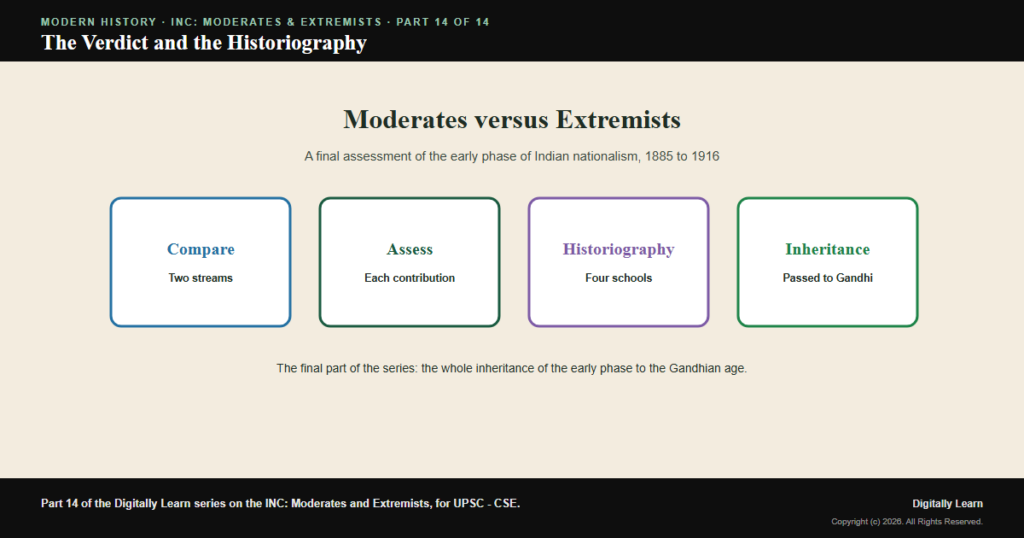
This final part draws the verdict on the first phase of organised Indian nationalism, from 1885 to 1916. It compares the Moderates and the Extremists point by point, assesses what each wing contributed, and surveys how historians have interpreted the period, through the Cambridge, nationalist, Marxist and subaltern schools. The conclusion is that the two wings were not rivals but two phases of a single evolving movement, which together built the organisation, the method and the ideal that the age of Gandhi would inherit.
Moderates and Extremists: A Structured Comparison
Goals, Methods, Social Base and Inspiration
Why this matters: the heart of the topic is the contrast between the two wings of the early Congress. They differed in four main respects: their immediate goal, their method, their social base and their sources of inspiration. The Moderates sought reform within the system; the Extremists demanded Swaraj.
Yet the contrast must not be overdrawn. Both wings shared the ultimate aim of Indian advancement and freedom, many leaders moved between them, and the quarrel was over method and tempo, not over whether India should one day be free. The point-by-point comparison is set out below.
| Aspect | The Moderates | The Extremists |
|---|---|---|
| Immediate goal | Reform within the colonial system | Swaraj, or self-government |
| Method | Prayer, petition and protest | Swadeshi, boycott, passive resistance |
| Social base | A narrow, English-educated elite | Wider, with an appeal to the masses |
| Attitude to Britain | Faith in British justice | Self-reliance and distrust |
| Inspiration | Western liberalism | Indian tradition and cultural pride |
Two Streams or One Evolving Movement?
What is the significance of this question: it shapes how we judge the whole period. It would be a mistake to see the Moderates and Extremists as two hostile parties. They are better understood as two phases of one evolving movement: the Moderate phase from 1885, and the Extremist phase from about 1905.
The Extremists grew out of the Moderate Congress, were disillusioned by its meagre results, and pushed it towards a bolder politics; but they kept its ultimate goal and worked within the same organisation, to which they returned in 1916. The continuity between the two phases, shown below, is as important as the contrast.
A Final Assessment of the Moderate Contribution
What the Moderates Achieved and Where They Fell Short
Distinguishing the achievements from the limits is the fair way to judge the Moderates. Their achievements were real and lasting: they founded the Indian National Congress, created a national platform, trained a generation in politics, and built the economic critique of colonialism, above all the theory of the drain of wealth.
Their limits were equally real. Their method of petition won meagre results; their social base was narrow, confined to the educated few; and they kept their faith in British justice long after events had discredited it. Their contribution, set beside the Extremists' below, was foundational but incomplete.
A Final Assessment of the Extremist Contribution
The Extremist Legacy of Militancy and Mass Politics
What is the significance of the Extremists: they transformed the character of Indian nationalism. Their great contribution was to set the goal of Swaraj, to pioneer the mass methods of swadeshi, boycott and passive resistance, and to draw on India's cultural heritage to give the movement an emotional depth and a wider reach.
Their limits, too, must be noted. Their reliance on a Hindu cultural idiom tended to alienate Muslims, a weakness that the examination itself has tested; their organisation was often weak; and their phase ended in the self-inflicted wound of the Surat split. Yet they bequeathed to the movement the militancy and the mass techniques that Gandhi would perfect.
The Historiography of Early Indian Nationalism
The Imperialist and Cambridge School (Anil Seal)
Contemporary linkages in scholarship begin with the imperialist and Cambridge readings. The Cambridge school, associated with Anil Seal and his work The Emergence of Indian Nationalism, plays down ideology and reads nationalism largely as a competition among elites for power, office and patronage under the Raj.
On this view, the early nationalists were less idealists than ambitious men manoeuvring for influence. The reading is valuable for its attention to faction and self-interest, but it is widely criticised for underrating the genuine idealism and the real grievances of the movement. The four main schools are summarised below.
The Nationalist School (Majumdar and Tara Chand)
Distinguishing features of the nationalist school set it against the Cambridge reading. Historians such as R.C. Majumdar and Tara Chand present early nationalism as a genuine national awakening, an idealistic and patriotic struggle of a people against colonial domination.
This school celebrates the early nationalists as the makers of the nation, and stresses the sincerity of their sacrifice and the justice of their cause. Its strength is its recognition of idealism and unity; its weakness, in the eyes of critics, is a tendency to gloss over divisions of class, region and community within the movement.
The Marxist School (R.P. Dutt and A.R. Desai)
Observable outcomes of a different method appear in the Marxist school. Historians such as R.P. Dutt, in India Today, and A.R. Desai, in his Social Background of Indian Nationalism, read the movement through the lens of class, seeing it as the political expression of a rising Indian bourgeoisie.
This school links the rise of nationalism to economic forces and class interests, and analyses how the leadership reflected the outlook of particular social groups. Its strength is its rigorous attention to economic structure; its limit, that it can reduce a complex national movement too narrowly to class.
The Subaltern School (Ranajit Guha)
Contemporary linkages to the most recent scholarship lie with the subaltern school. Founded in the 1980s by Ranajit Guha and his colleagues, it writes history from below, recovering the autonomous politics of the masses, the peasants, workers and ordinary people, rather than the elite leaders.
This school argues that the common people were not merely followers of the Congress but had their own initiatives and consciousness. Its great contribution is to restore the agency of the masses; its critics charge that it can underplay the role of leadership and organisation. Together, the four schools give the fullest picture of a complex period.
Why the 1885 to 1916 Phase Shaped the Freedom Struggle
The Foundations Laid in Three Decades
What is the significance of the early phase: it laid the foundations on which everything later was built. In three decades, the movement created a national organisation, the Congress; built the economic and political critique of colonial rule; set the goal of Swaraj; and pioneered the methods of swadeshi, boycott and passive resistance.
It also experienced, in miniature, the great fault lines of the later struggle: the tension between constitutional and mass methods, and the communal question that the Morley-Minto electorates and the Lucknow Pact had opened. The arc of these decades, shown below, is the necessary prologue to the age of Gandhi.
Significance: The Inheritance Passed to Gandhi
The Whole Inheritance of the Early Phase
Contemporary linkages run from the whole of this early phase into the Gandhian age that followed. When Mahatma Gandhi took the leadership of the movement from 1919, he inherited a ready-made foundation: a reunited national organisation, a tested set of methods, the goal of Swaraj and a tradition of sacrifice.
The early phase, from 1885 to 1916, had failed to win freedom, but it had built the movement that one day would. Its full inheritance, of organisation, method, ideal and even of unresolved problems, passed to Gandhi and the mass struggle. The principal legacies of the period can be summarised simply.
- A national organisation: The Congress, reunited and national in reach.
- A repertoire of methods: Swadeshi, boycott and passive resistance, ready to be mobilised.
- The goal of Swaraj: Self-government, now the accepted aim of the movement.
- A tradition of sacrifice: From the Moderates’ service to the revolutionaries’ martyrdom.
Prelims MCQ practice
Each question below tests one specific concept on the topic. Click to reveal the answer and a full option-wise explanation.
Q1. Which of the following best describes the relationship between the Moderates and the Extremists?
- Two entirely separate parties with no common aim
- Two phases of a single evolving national movement
- A religious and a secular party
- A rural and an urban party
Show answer and explanation
Answer: Two phases of a single evolving national movement
Explanation.
Option (b) is correct. They are best understood as two phases of one evolving movement, sharing the goal of freedom. Hence option (b).
Q2. The economic critique of colonialism, including the theory of the drain of wealth, was chiefly the contribution of the:
- Extremists
- Moderates
- Revolutionaries
- Muslim League
Show answer and explanation
Answer: Moderates
Explanation.
Option (b) is correct. The economic critique and the drain theory were the Moderates' chief intellectual contribution. Hence option (b).
Q3. With reference to the historiography of Indian nationalism, consider the following pairs:
- Cambridge school : Anil Seal
- Subaltern school : Ranajit Guha
Which of the pairs given above is/are correctly matched?
- 1 only
- 2 only
- Both 1 and 2
- Neither 1 nor 2
Show answer and explanation
Answer: Both 1 and 2
Explanation.
Both are correctly matched: Anil Seal (Cambridge school) and Ranajit Guha (subaltern school). Hence option (c).
Q4. The book 'The Social Background of Indian Nationalism', a Marxist study of the national movement, was written by:
- R.C. Majumdar
- A.R. Desai
- Anil Seal
- Tara Chand
Show answer and explanation
Answer: A.R. Desai
Explanation.
Option (b) is correct. A.R. Desai wrote 'Social Background of Indian Nationalism' (a Marxist study). Hence option (b).
Q5. The goal of 'Swaraj', or self-government, as the aim of the national movement, was chiefly the contribution of the:
- Moderates
- Extremists
- Cambridge school
- British Liberals
Show answer and explanation
Answer: Extremists
Explanation.
Option (b) is correct. The goal of Swaraj was the Extremists' defining contribution. Hence option (b).
Q6. Consider the following statements about the early phase of Indian nationalism (1885 to 1916):
- It founded the Indian National Congress as a national platform.
- It set the goal of Swaraj and pioneered swadeshi and boycott.
Which of the statements given above is/are correct?
- 1 only
- 2 only
- Both 1 and 2
- Neither 1 nor 2
Show answer and explanation
Answer: Both 1 and 2
Explanation.
Both are correct: the Congress was founded (1885) and the goal of Swaraj plus swadeshi and boycott were set in this phase. Hence option (c).
Sources and Further Reading
- Wikipedia: Indian National Congress
- Wikipedia: Indian nationalism
- Wikipedia: Cambridge School of historiography
- Wikipedia: Subaltern Studies
- Wikipedia: A. R. Desai
- NCERT, Our Pasts III (The Making of the National Movement)
- Ministry of Culture: Indian Culture Freedom Archive
- Azadi Ka Amrit Mahotsav (Freedom Movement portal)
- Press Information Bureau, Government of India
- National Portal of India
Editorial Disclaimer
This article is prepared for UPSC examination preparation. Verify key facts and interpretations against standard reference histories before relying on them.