
Overview
Previous Year UPSC-CSE Questions By the end you will be able to draft model answers for the following UPSC questions. Each question carries a collapsible framework showing how to approach it in the exam.
- UPSC Mains 2018 GS-I‘Communalism arises either due to power struggle or relative deprivation.’ Argue by giving suitable illustrations.
How to structure the answer in the exam
Introduction: Define communalism and note the two proposed drivers: power struggle and relative deprivation.
Body (sub-themes to develop):
- Power struggle: the British used separate electorates (1909) as a divide-and-rule instrument; the Simla Deputation bargained for communal power.
- Relative deprivation: the Muslim elite, fearing permanent minority status, sought protection through separate representation.
- Illustration: the institutionalisation of communal electorates and its long shadow to Partition.
- Balanced view: both drivers operated together; neither alone is sufficient.
Conclusion: Conclude that communalism in India drew on both a contest for power and a sense of relative deprivation, as the 1909 electorate shows.
- UPSC Prelims 1997 GS Paper IMatch List I (Events) with List II (Results) and select the correct answer using the codes given below the lists:
- I. Morley Minto Reforms
- II. Simon Commission
- III. The Chauri-Chaura incident
- IV. The Dandi March
- A. Country-wide agitation
- B. Withdrawal of a movement
- C. Communal Electorates
- D. Communal outbreaks
- E. Illegal manufacture of salt
Codes:
How to approach this Prelims question
Approach: Fix the Morley-Minto to Communal Electorates link first, then match the rest.
Trap to watch: Do not confuse 'Communal Electorates' (C, the Morley-Minto result) with 'Communal outbreaks' (D); the Morley-Minto Reforms gave separate electorates, not riots.
Key facts to recall:
- Morley-Minto 1909: communal/separate electorates
- Chauri-Chaura: withdrawal of Non-Cooperation
- Dandi March: illegal manufacture of salt
Answer signal: I-C, II-A, III-B, IV-E, so option (d).
- UPSC Prelims 2001 GS Paper IA London branch of the All-India Muslim League was established in 1908 under the presidency of
How to approach this Prelims question
Approach: Recall who headed the 1908 London branch of the Muslim League.
Trap to watch: The Aga Khan was the League's first honorary president in India, but the 1908 London branch was under Syed Ameer Ali; Jinnah and Liaquat Ali Khan belong to a later phase.
Key facts to recall:
- Muslim League founded at Dhaka, 1906
- Aga Khan: first honorary president in India
- London branch, 1908: Syed Ameer Ali
Answer signal: Ameer Ali, so option (b).
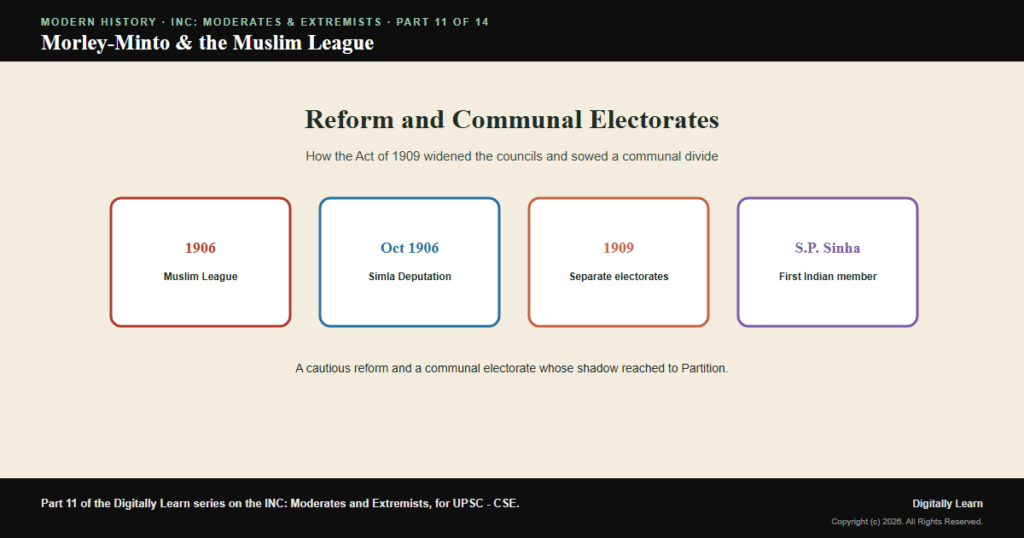
The Morley-Minto Reforms, enacted as the Indian Councils Act of 1909, were a cautious British concession after the Surat split. They enlarged the legislative councils and allowed a non-official majority in the provinces, but withheld real, responsible government. Their most fateful feature was the grant of separate electorates for Muslims, demanded by the newly founded All-India Muslim League (1906) and granted by a government keen to divide and rule. The communal electorate they created cast a long shadow over Indian politics.
The Context of Reform after the Surat Split
Why the British Offered Reform
Why this matters: the Morley-Minto Reforms were a calculated response to a divided and partly suppressed nationalism. After the Surat split of 1907 and the repression that followed, the government judged the moment right to win back the Moderates with a measured concession, while keeping the Extremists isolated.
The reforms were the work of John Morley, the Secretary of State, and Lord Minto, the Viceroy. Their aim was twofold: to conciliate moderate opinion with a show of reform, and to use the new Muslim League and separate electorates to divide the nationalist front. The two purposes ran together throughout the Act of 1909.
The Indian Councils Act of 1909: Provisions
Enlarged Councils and the Provincial Non-Official Majority
Distinguishing features of the Act lay first in the councils. The Indian Councils Act of 1909 enlarged both the central and the provincial legislative councils, giving Indians more seats and a louder, if still advisory, voice in government.
Crucially, it allowed a non-official majority in the provincial councils, though the government kept its official majority at the centre. Members won the right to discuss the budget, ask supplementary questions and move resolutions, real if limited gains, as the diagram of the Act's provisions shows.
Separate Electorates for Muslims
What is the significance of separate electorates: this was the Act's most fateful provision and its lasting poison. For the first time, the law created separate, communal electorates for Muslims: Muslim voters would vote on a separate roll to fill seats reserved for Muslims alone.
The principle, granted in response to the Muslim League's demand, meant that communities would vote apart rather than as a common citizenry. The contrast with a joint electorate, shown below, is sharp: a separate electorate built communal division into the very machinery of representation.
Indians on the Executive Councils: S.P. Sinha
Observable outcomes of the reforms included a symbolic but real advance. For the first time, an Indian was appointed to the Viceroy's Executive Council: Satyendra Prasanna Sinha, who joined as Law Member in 1909. Morley also brought two Indians onto his own council in London.
Sinha's appointment was a landmark, the first crack in the all-British wall of the highest executive. Yet it was a single seat, granted from above, and it did nothing to change the basic fact that real power remained entirely in British hands.
A Critical Assessment of the Reforms
What the Reforms Withheld: Responsible Government
Distinguishing what the reforms gave from what they withheld is the heart of the assessment. Morley was emphatic that the reforms were not intended to lead to parliamentary or responsible self-government; they did nothing to meet the Congress's central demand.
The enlarged councils remained advisory bodies without control over the executive or the purse. The contrast between the modest gains and the large refusals is set out below.
| What the reforms gave | What the reforms withheld |
|---|---|
| Larger legislative councils | Any control over the executive |
| A non-official majority in the provinces | An elected majority at the centre |
| The right to debate budgets and resolutions | Real power over finance |
| One Indian on the Executive Council | Responsible, parliamentary self-government |
Communal Electorates and the Seed of Separatism
What is the significance of the communal electorate: it was the deepest and most lasting damage the reforms did. By giving Muslims a separate electorate, the government formally recognised them as a distinct political community with separate interests, and encouraged their leaders to bargain as a community apart.
This served the British policy of divide and rule, and it planted a seed of separatism in the constitutional system itself. The consequences, which unfolded over the following decades, can be summarised simply.
- Institutionalised communalism: Religion became a permanent category of political representation.
- Divide and rule: The nationalist front was split along communal lines.
- Separate bargaining: Muslim leaders increasingly negotiated as a community apart.
- A long shadow: The principle ran through later reforms towards the demand for Partition.
The Foundation of the All-India Muslim League (1906)
The Aligarh Antecedent and the Dhaka Session
Contemporary linkages of the League ran back to the Aligarh movement. Its intellectual roots lay in Sir Syed Ahmad Khan and the Aligarh movement, which had urged Muslims to take modern education and to keep their distance from the Congress, and in the Muhammadan Educational Conference he had founded.
On 30 December 1906, at Dhaka, during a session of that Conference, the All-India Muslim League was founded, on the proposal of Nawab Salimullah of Dhaka, with the Aga Khan as its first honorary president. It was at first a loyalist body of the Muslim elite, and the founding flow is shown below.
The Simla Deputation and the Demand for Separate Electorates
Observable outcomes of this elite mobilisation appeared even before the League was formed. In October 1906, a deputation of Muslim leaders led by the Aga Khan waited on the Viceroy, Lord Minto, at Simla, the Simla Deputation, and asked for separate representation and weightage for Muslims in the councils.
Minto's encouragement was so marked that the episode was later called a command performance, a demand the government had quietly invited. The deputation's success in winning a promise of separate electorates, granted three years later in the Act of 1909, was the immediate spur to the founding of the League weeks afterwards. In 1908, Syed Ameer Ali founded the London Muslim League, an allied body carrying the cause to Britain.
Significance: The Long Road from Aligarh to Partition
From Separate Electorates to Two Nations
Contemporary linkages run from 1909 across the whole later history of the subcontinent. The separate electorate was a textbook case of communalism arising from a power struggle: a colonial government deliberately used a communal device to divide and rule, while a section of the Muslim elite, fearing permanent minority status, embraced it out of a sense of relative deprivation.
It would be wrong to say that 1909 made Partition inevitable; history is not so simple. But the separate electorate set Indian politics on a communal track, one that ran through the Lucknow Pact, later reforms and, in time, towards the demand for Pakistan and the Partition of 1947. The long arc is shown above. The seed planted at Aligarh and watered in 1909 bore, four decades later, a very bitter fruit.
Prelims MCQ practice
Each question below tests one specific concept on the topic. Click to reveal the answer and a full option-wise explanation.
Q1. The Morley-Minto Reforms were enacted through which legislation?
- The Indian Councils Act of 1892
- The Indian Councils Act of 1909
- The Government of India Act of 1919
- The Government of India Act of 1935
Show answer and explanation
Answer: The Indian Councils Act of 1909
Explanation.
Option (b) is correct. The Morley-Minto Reforms were enacted as the Indian Councils Act of 1909. Hence option (b).
Q2. The most significant and lasting feature of the Morley-Minto Reforms was the:
- Introduction of dyarchy
- Grant of separate electorates for Muslims
- Establishment of provincial autonomy
- Grant of universal adult franchise
Show answer and explanation
Answer: Grant of separate electorates for Muslims
Explanation.
Option (b) is correct. The grant of separate (communal) electorates for Muslims was the most fateful feature. (Dyarchy came in 1919.) Hence option (b).
Q3. With reference to the All-India Muslim League, consider the following statements:
- It was founded at Dhaka in 1906.
- The Aga Khan was its first honorary president.
Which of the statements given above is/are correct?
- 1 only
- 2 only
- Both 1 and 2
- Neither 1 nor 2
Show answer and explanation
Answer: Both 1 and 2
Explanation.
Both are correct. The Muslim League was founded at Dhaka in 1906, with the Aga Khan as its first honorary president. Hence option (c).
Q4. The first Indian to be appointed to the Viceroy's Executive Council, under the Morley-Minto Reforms, was:
- Dadabhai Naoroji
- Satyendra Prasanna Sinha
- Surendranath Banerjee
- Gopal Krishna Gokhale
Show answer and explanation
Answer: Satyendra Prasanna Sinha
Explanation.
Option (b) is correct. S.P. Sinha was the first Indian member of the Viceroy's Executive Council (1909). Hence option (b).
Q5. The Simla Deputation of 1906, which demanded separate representation for Muslims, was led by:
- Nawab Salimullah of Dhaka
- The Aga Khan
- Syed Ameer Ali
- Muhammad Ali Jinnah
Show answer and explanation
Answer: The Aga Khan
Explanation.
Option (b) is correct. The Simla Deputation was led by the Aga Khan to Viceroy Minto. Hence option (b).
Q6. Consider the following features of the Indian Councils Act of 1909:
- It allowed a non-official majority in the provincial legislative councils.
- It granted responsible, parliamentary self-government.
Which of the statements given above is/are correct?
- 1 only
- 2 only
- Both 1 and 2
- Neither 1 nor 2
Show answer and explanation
Answer: 1 only
Explanation.
Only 1 is correct. The Act allowed a provincial non-official majority but explicitly did NOT grant responsible self-government. Hence option (a).
Sources and Further Reading
- Wikipedia: Indian Councils Act 1909
- Wikipedia: All-India Muslim League
- Wikipedia: Aga Khan III
- Wikipedia: Syed Ahmad Khan
- Wikipedia: Satyendra Prasanno Sinha, 1st Baron Sinha
- NCERT, Our Pasts III (The Making of the National Movement)
- Ministry of Culture: Indian Culture Freedom Archive
- Azadi Ka Amrit Mahotsav (Freedom Movement portal)
- Press Information Bureau, Government of India
- National Portal of India
Editorial Disclaimer
This article is prepared for UPSC examination preparation. Verify key facts and interpretations against standard reference histories before relying on them.