


Overview

The partition of Bengal was Lord Curzon's division of the Bengal Presidency into two provinces, which took effect on 16 October 1905. Its official reason was that the province was too large to govern, but Indians saw it as a way to divide the Bengalis and weaken the national movement. The protest against it, the Swadeshi movement, launched on 7 August 1905, asked Indians to boycott British goods and build their own; the partition was annulled in 1911.
Partition of Bengal 1905: Curzon's Plan, Date and Reasons
Partition of Bengal Date: From the 1903 Plan to 16 October 1905
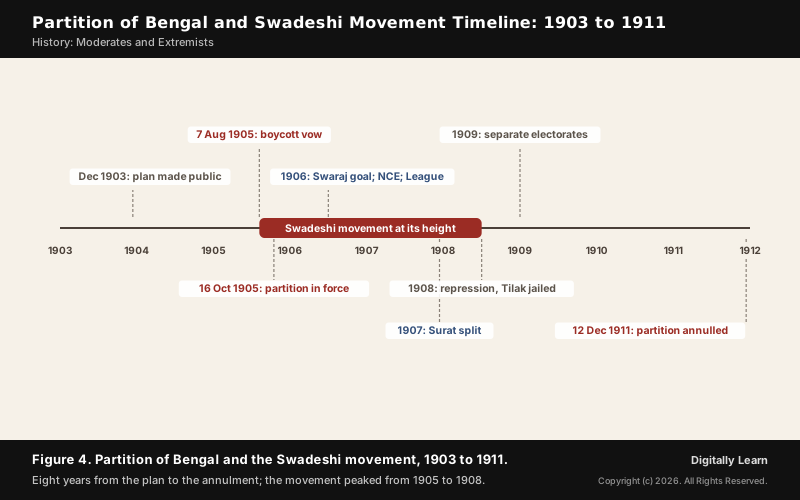
In 1905 Bengal was the biggest province of British India, with a population of 78.5 million, and it included Bihar and parts of Orissa. Curzon's plan joined fifteen eastern districts of Bengal with Assam to form a new province, Eastern Bengal and Assam. It held 31 million people, most of them Muslim, and its centre was Dacca. The western districts formed the other province with Bihar and Orissa.

- The new eastern province: Dacca, the former Mughal capital of Bengal, became a seat of government again, and Sir Bampfylde Fuller was the first Lieutenant Governor.
- The reduced Bengal: Joining western Bengal with Bihar and Orissa made Bengali speakers a minority in their own province.
- Lifespan: Eastern Bengal and Assam existed from 1905 to 1912.
Causes of Partition of Bengal 1905: Administrative Convenience or Divide and Rule
The official reason was size. For decades British officials had said that the huge province was hard to manage and that the poorer eastern region was neglected. But a province can be cut down in more than one way. Instead of removing the non-Bengali areas, the government separated East Bengal and merged it with Assam, and its main motives were probably to curtail the influence of Bengali politicians and to split the Bengali people.
- Dividing Bengalis: The new line separated the largely Muslim east from the largely Hindu west, and nationalists read it as a deliberate attempt to divide Bengal on religious grounds and weaken the nationalist cause.
- Courting eastern Muslims: On a tour of east Bengal in 1904, Curzon said the plan would give the Muslims there a unity they had not enjoyed since the days of the old Musalman viceroys and kings.
- Diluting Bengali weight: The western province, with Bihar and Orissa, left Bengali speakers in a minority.
- A settled fact: Curzon called the partition a settled fact that could not be unsettled; it was unsettled in 1911.
The English-educated middle class of Bengal, the bhadralok, saw the plan as a vivisection of their motherland and a way to reduce their influence. That feeling, more than the official case for efficiency, shaped the protest that followed.
Anti-Partition Movement and the Launch of the Swadeshi Movement
When Was the Swadeshi Movement Started: 7 August 1905 at the Calcutta Town Hall
The first response followed the old method. In the months before the partition, meetings collected petitions and sent them to the authorities, without effect. Surendranath Banerjee admitted that the petitions had failed and began to urge tougher steps, such as boycotting British goods, a move he preferred to call swadeshi rather than a boycott.
On 7 August 1905 thousands of students of all communities marched to the Calcutta Town Hall with cries of Vande Mataram, its first use as a political slogan. The meeting there adopted the boycott resolution and the vow of swadeshi. The word joins two Sanskrit words, swa, own, and desh, country, and means of one's own country.
- National Handloom Day: The government chose 7 August for the day in memory of the 1905 proclamation, and Prime Minister Narendra Modi launched the first on 7 August 2015 in Chennai.
16 October 1905: Partition Day, Raksha Bandhan and Amar Sonar Bangla
The day the partition took effect became a day of protest. Government schools were spurned, and on 16 October 1905 schools and shops were blockaded; police and army units cleared the demonstrators, and violent confrontations followed. The day also fell on Raksha Bandhan, and Rabindranath Tagore asked everyone to tie rakhi, especially to Muslims, to show that Bengal did not want to be divided.
Songs carried the protest. Tagore's Amar Sonar Bangla, an ode to Mother Bengal, belongs to these months: the date of composition is disputed, but one biographer records it being sung on 25 August 1905, and the lyrics were published in September 1905. The Provisional Government of Bangladesh adopted it as the national anthem in 1971.
What Is the Swadeshi Movement: Meaning and the Four Strands
Swadeshi Movement Definition: Self-Help, Boycott and Swaraj
All sections of the Congress, Moderates and Radicals alike, opposed the partition, and large meetings and demonstrations developed novel methods of mass protest. The Moderates led the boycott at first but drew back from it; the Radicals, fighting for swaraj, wanted mass mobilisation and a boycott of British institutions as well as goods. A few began to argue that revolutionary violence would be needed to overthrow British rule.
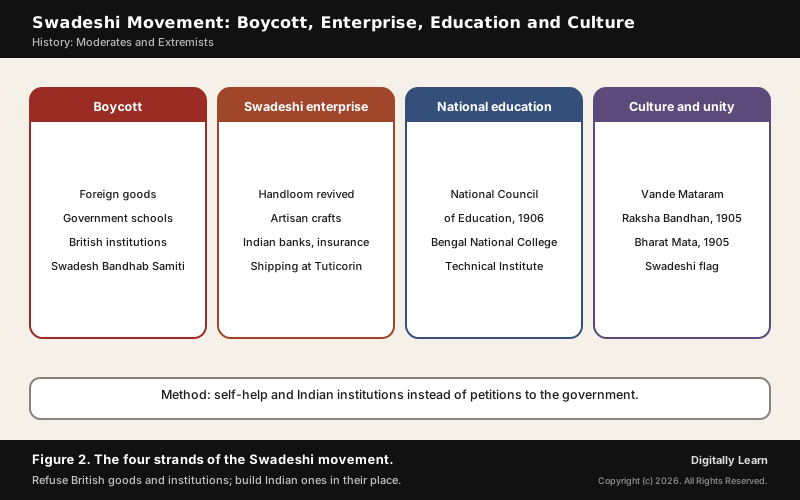
The programme became the Congress's own. At the Calcutta session of 1906, presided over by Dadabhai Naoroji, the Congress framed four objectives: Swaraj, Swadesh, boycott and national education. Mahatma Gandhi later called swadeshi the soul of swaraj.
Boycott of Foreign Goods and British Institutions
Boycott was the refusing half of swadeshi: turn away what Britain sold and the institutions it ran. It began with foreign goods and spread to government schools, which students left. In Barisal the lawyer and educationist Ashwini Kumar Dutta founded the Swadesh Bandhab Samiti to promote indigenous products and the boycott of foreign goods.
- Circulars against students: The government of the new eastern province banned Vande Mataram in schools and colleges, warned institutions of derecognition, and threatened students who joined the agitation with debarment from government service.
- Fines: In November 1905 each of 200 students of a school in Rangpur was fined five rupees for chanting Vande Mataram.
- Grants as a lever: R.W. Carlyle prohibited students from political meetings on the threat of withdrawing funding and grants.
- Barisal conference, April 1906: The authorities banned the public chanting of Vande Mataram at the Bengal Provincial Conference and then the conference itself; the delegates defied the order and faced police repression.
Swadeshi Enterprise: Handloom, Indian Banks and the Swadeshi Steam Navigation Company
Swadeshi was the building half: make at home what had been bought abroad. The movement stood for the revival of domestic products and production processes, and it tried to restore the dignity of labour and human creativity, with handloom weaving and village industries at its heart. In Bengal, Surendranath Tagore financed Indian-owned banks and insurance companies.
The boldest venture was at sea. V.O. Chidambaram Pillai, a pleader of Tuticorin, registered the Swadeshi Steam Navigation Company in October 1906, with a capital of ten lakh rupees, to break the monopoly of the British India Steam Navigation Company. It launched the first indigenous Indian shipping service, between Tuticorin and Colombo.
- Ships: The first, the SS Galia, was bought from France with the help of Tilak and Aurobindo Ghose and reached Tuticorin in 1907; it flew a flag with the slogan Vande Mataram.
- Trade war: When the British company cut its fare to one rupee, Pillai cut his to 50 paisa, and traders and passengers stayed with his ships out of nationalist feeling.
- Suppression: Pillai was arrested on 12 March 1908 and sentenced to two life terms, and the company was liquidated in 1911.
- Remembered: In 2011 the Union Cabinet renamed the Tuticorin Port Trust as the V.O. Chidambaranar Port Trust.
National Education: The National Council of Education and Bengal National College
Education became a front because the colleges were seen as training the Raj's servants. Nationalists called Calcutta University Goldighir Ghulamkhana, the slave-house by the lake. Curzon's Universities Act of 1904 was seen as a way to limit Indians' access to English education, and the government also chose to disaffiliate private Indian colleges it regarded as hotbeds of agitation. Since 1902 Satish Chandra Mukherjee's Dawn Society had called for national education with an emphasis on the sciences.
- National Council of Education, 1906: Founded in Bengal by Satyendranath Tagore and other nationalists at Raja Subodh Mullick’s house, to promote science and technology as part of a swadeshi industrialisation movement.
- Bengal National College: Set up by the Council; Aurobindo was appointed its first principal in 1906 and resigned in August 1907.
- Bengal Technical Institute: Founded on 25 July 1906; with the National College it later merged to form Jadavpur University, created on 24 December 1955.
- Under watch: The government saw the Council’s institutions as hotbeds of swadeshi activity and banned nationalist activities there, such as the singing of patriotic songs.
Cultural Revival: Vande Mataram, Bharat Mata and the Swadeshi Flag
The movement gave Indian nationalism its symbols. Vande Mataram, Bankim Chandra Chattopadhyay's hymn to the motherland from the 1870s, later part of his novel Anandamath, was widely sung during the Swadeshi movement. At the Varanasi session of the Congress in 1905 the song was adopted for all-India occasions.
- Prabhat pheris: The Bande Mataram Sampradaya, founded in North Calcutta in October 1905, sent members singing through the streets every Sunday, and Tagore sometimes joined them.
- Barisal procession: On 20 May 1906 over ten thousand Hindus and Muslims marched through Barisal carrying Vande Mataram flags.
- Bande Mataram daily: Launched in August 1906 under Bipin Chandra Pal, with Aurobindo later joining as joint editor.
- Bharat Mata: Moved by the Swadeshi movement, Abanindranath Tagore painted Bharat Mata in 1905 as a calm, ascetic figure dispensing learning, food and clothing.
- The Swadeshi flag: A tricolour of red, green and yellow, with eight lotuses for eight provinces of British India and a crescent moon for Hindus and Muslims.
Abanindranath led the Bengal School, the Indian style of painting associated with swadeshi, and in 1907 became the principal artist of the Indian Society of Oriental Art. The symbols had a cost too: when the images celebrated were drawn from Hindu iconography, people of other communities felt left out.
Spread, Muslim Response and Decline of the Swadeshi Movement
All-India Spread: Lal, Bal, Pal and the Vandemataram Movement
The partition angered people all over India, and protests spread to Bombay, Pune and Punjab; in deltaic Andhra the struggle was called the Vandemataram Movement. The Swadeshi movement of 1905 to 1907 greatly broadened the Congress's appeal among the middle classes and threw up towering leaders: Bal Gangadhar Tilak of Maharashtra, Bipin Chandra Pal of Bengal and Lala Lajpat Rai of Punjab, the trio known as Lal, Bal and Pal, whose names showed that the struggle now spanned India.

- Punjab: Lala Lajpat Rai started a journal called Vande Mataram from Lahore, and in May 1907 young protesters in Lahore defied orders to condemn the arrest of swadeshi leaders at Rawalpindi.
- Maharashtra: In November 1906 cries of Vande Mataram were raised at a large meeting at Dhulia.
- Tamil Nadu: On 27 February 1908 about a thousand workers of the Coral Mills at Tuticorin went on strike in solidarity with the Swadeshi Steam Navigation Company.
- Programme: Aurobindo and Pal were the chief exponents of a movement built on Purna Swaraj, swadeshi, boycott and national education.
Muslim Response to the Partition and the Muslim League of 1906
Muslim opinion changed during the controversy. When the plan was first announced in 1903, Muslim bodies such as the Central National Muhamedan Association condemned it. Once educated Muslims saw what a separate province could offer east Bengal, which had stayed backward while opportunities centred on Calcutta, most came to support it. On 16 October 1905 the Mohammedan Provincial Union was founded, with Khwaja Salimullah, the Nawab of Dacca, as its patron.
- Muslim League, 1906: A group of Muslim landlords and nawabs formed the All India Muslim League at Dacca in 1906, on Salimullah’s initiative, during the All India Muhammadan Educational Conference; it supported the partition.
- Separate electorates: The League wanted seats for Muslims elected by Muslim voters, a demand the government conceded in 1909.
- Dissenters: A few Muslims kept opposing the partition, among them Abdur Rasul and Maulvi Liaqat Hussain, and preachers such as Din Muhammad of Mymensingh spread swadeshi ideas.
- Fears: Because the movement was tied to the anti-partition cause and had Hindu overtones, many Muslims feared it would harm their community.
Decline of the Swadeshi Movement by 1908: Surat Split, Repression and Revolutionaries
The movement lost force after 1907. Gokhale, Banerjee and other senior leaders stopped supporting the boycott when John Morley became Secretary of State for India, because they expected him to reverse the partition. The Moderates felt boycott involved the use of force, and at Surat in 1907 the Congress split; the Moderates kept the Congress and Tilak's followers worked from outside. The split and the crackdown that followed are the subject of the Surat split and British repression.
- Repression: In 1908 the eastern government banned the Swadesh Bandhab Samiti and deported Ashwini Kumar Dutta, and Tilak was deported to Mandalay in Burma.
- Leaders removed: Lal, Bal and Pal had organised many samitis, but became inactive after 1908 because of deportations and arrests.
- The revolutionary turn: The Jugantar party, founded in April 1906 by Aurobindo, his brother Barin Ghosh and others, collected arms and explosives; on 30 April 1908 Khudiram Bose and Prafulla Chaki tried to kill Kingsford, the district judge of Muzaffarpur.
- Alipore Bomb Case: The inquiry that followed led to many arrests; Aurobindo was arrested in May 1908 in connection with the case and was acquitted.
Annulment of the Partition of Bengal and Lord Curzon's Legacy
Partition of Bengal Annulled: The Delhi Durbar of 12 December 1911
Unable to end the protests, the government agreed to reverse the partition. The Bengali-speaking districts were reunited, and Assam, Bihar and Orissa were separated from Bengal. The capital moved to Delhi. The Muslims of Bengal, who had seen the eastern province as a sign of the government's care for their interests, were shocked, and the move of the capital to a Mughal site was partly meant to reassure them.
Lord Curzon's Policies and Their Long-Term Implications for the National Movement
Curzon was Viceroy from 1899 to 1905. He appointed commissions on education, irrigation, police and other branches of administration, and laws followed their reports. He created the North West Frontier Province, sent Francis Younghusband's expedition to Tibet at the end of 1903, which ended in the Treaty of Lhasa in September 1904, and restored the Taj Mahal. He resigned in August 1905 after a dispute with Lord Kitchener over military organisation.
| Curzon's policy | Long-term implication |
|---|---|
| Universities Act, 1904 | Pushed nationalists to national education and the National Council of 1906 |
| Partition of Bengal, 1905 | Made boycott and swadeshi lasting methods of all-India struggle |
| Courting east Bengal's Muslims | Muslim League 1906, separate electorates 1909, precedent for 1947 |
| Dismissing the Congress | A revived, more active Congress and the rise of the Extremists |
Curzon had dismissed the Congress in 1900 as tottering to its fall. One historian's verdict is the reverse: his partition of Bengal and the controversy that followed did much to revitalise the Congress, which he left more active and effective than at any time in its history.
Previous Year UPSC-CSE Questions
Previous Year UPSC-CSE Questions By the end you will be able to draft model answers for the following UPSC questions. Each question carries a collapsible framework showing how to approach it in the exam.
- UPSC Mains 2020 GS-IEvaluate the policies of Lord Curzon and their long term implications on the national movement.
Answer outline: how to structure the answer
What the question asks, the main arguments, relevant examples and the direction of the conclusion. This is not a full model answer.
Introduction: Introduce Curzon, Viceroy 1899 to 1905, as an energetic reformer whose measures provoked the movement he dismissed.
Body (sub-themes to develop):
- Administration: commissions on education, irrigation and police; the Universities Act 1904.
- Frontier and foreign: the North West Frontier Province; Tibet, Treaty of Lhasa 1904.
- Partition of Bengal: administrative reason against divide and rule.
- Implications: swadeshi and boycott, national education, Extremists, mass protest.
- Communal implications: Muslim League 1906, separate electorates 1909, precedent for 1947.
Conclusion: Conclude that Curzon meant to bind India to the Raj but left the Congress more active than ever, while his partition also seeded communal politics.
- UPSC Prelims 2010 Prelims-GSWhat was the immediate cause for the launch of the Swadeshi movement?
How to approach this Prelims question
Approach: Step 1: the Swadeshi movement was proclaimed at the Calcutta Town Hall on 7 August 1905 as the protest against the partition of Bengal. Step 2: test each option's date against 1905: Tilak's 18 months came in 1897, the Chapekar episode in 1897 and the deportations in 1907. Only the partition launched the movement.
Trap to watch: The other options are separate episodes of repression; none of them set off the movement of 1905.
Key facts to recall:
- (a) The partition of Bengal by Lord Curzon: correct. The boycott resolution of 7 August 1905 was the answer to Curzon's partition.
- (b) Tilak's 18 months of rigorous imprisonment: wrong. That sentence was passed in 1897, eight years before the movement.
- (c) Deportation of Lala Lajpat Rai and Ajit Singh and the Punjab Colonization Bill: wrong. The deportations came in May 1907, when the movement was already under way.
- (d) Death sentence on the Chapekar brothers: wrong. The Chapekar brothers killed the plague commissioner Rand at Poona in 1897, a separate episode.
Answer signal: The partition of Bengal done by Lord Curzon, option (a).
- UPSC Prelims 2016 Prelims-GSThe 'Swadeshi' and 'Boycott' were adopted as methods of struggle for the first time during the
How to approach this Prelims question
Approach: Step 1: swadeshi and boycott were first adopted at the Calcutta Town Hall on 7 August 1905, in the agitation against the partition. Step 2: the other movements came later: Home Rule in 1916, Non-Cooperation in 1920, the Simon Commission in 1928.
Trap to watch: Non-Cooperation used boycott again in the 1920s, but not for the first time.
Key facts to recall:
- (a) Agitation against the Partition of Bengal: correct. The methods were first adopted at the Town Hall meeting of 7 August 1905.
- (b) Home Rule Movement: wrong. The Home Rule Leagues were founded in 1916, a decade after boycott was first used.
- (c) Non-Cooperation Movement: wrong. It began in 1920 and took boycott up as an existing method.
- (d) Visit of the Simon Commission: wrong. The commission reached India in 1928, more than twenty years later.
Answer signal: Agitation against the Partition of Bengal, option (a).
- UPSC Prelims 2009 Prelims-GSIn the context of the Indian freedom struggle, 16th October 1905 is well known for which one of the following reasons?
How to approach this Prelims question
Approach: Step 1: keep the two 1905 dates apart: 7 August, the Swadeshi resolution at the Calcutta Town Hall; 16 October, the partition in force. Step 2: Naoroji's Swaraj declaration belongs to the Calcutta session of 1906, and Tilak carried the movement to Poona after it began in Bengal.
Trap to watch: Option (a) is 7 August, not 16 October.
Key facts to recall:
- (a) Formal proclamation of the Swadeshi movement at the Calcutta Town Hall: wrong. That proclamation came on 7 August 1905.
- (b) Partition of Bengal took effect: correct. The partition came into force on 16 October 1905, a day of mourning in Bengal.
- (c) Dadabhai Naoroji declared Swaraj the goal of the Congress: wrong. He did so as president of the Calcutta session of 1906.
- (d) Tilak started the Swadeshi movement in Poona: wrong. The movement began in Calcutta; Tilak led it in Poona and Bombay as it spread.
Answer signal: Partition of Bengal took effect, option (b).
- UPSC Prelims 2014 Prelims-GSThe Partition of Bengal made by Lord Curzon in 1905 lasted until
How to approach this Prelims question
Approach: Step 1: the partition was annulled at the Delhi Durbar on 12 December 1911, announced by King George V. Step 2: every other option names a later date: the First World War from 1914, Civil Disobedience from 1930, the partition of India in 1947.
Trap to watch: 1947 was a second partition of Bengal, not the end of the first.
Key facts to recall:
- (a) Until the First World War, as a quid pro quo for Indian support: wrong. The annulment came in 1911, before the war began in 1914.
- (b) Until King George V abrogated it at the Royal Durbar in Delhi in 1911: correct. The annulment was announced at the Delhi Durbar on 12 December 1911.
- (c) Until Gandhiji launched Civil Disobedience: wrong. That movement began in 1930, long after Bengal was reunited.
- (d) Until the Partition of India in 1947: wrong. The 1905 partition had been undone in 1911; 1947 brought a second partition of Bengal.
Answer signal: King George V abrogated it at the Royal Durbar in Delhi in 1911, option (b).
- UPSC Prelims 2019 Prelims-GSWith reference to Swadeshi Movement, consider the following statements:
- It contributed to the revival of the indigenous artisan crafts and industries.
- The National Council of Education was established as a part of Swadeshi Movement.
Which of the statements given above is/are correct?
How to approach this Prelims question
Approach: Step 1: statement 1: the movement put handloom weaving and village industries at the heart of its programme, reviving artisan crafts; correct. Step 2: statement 2: the National Council of Education was founded in 1906 as part of the movement's national education; correct. Both statements are correct.
Trap to watch: Both strands, enterprise and education, belong to Swadeshi.
Key facts to recall:
- (a) 1 only: wrong. Statement 2 is also correct: the National Council of Education was set up in 1906 within the movement.
- (b) 2 only: wrong. Statement 1 is also correct: the movement revived handloom weaving and village industries.
- (c) Both 1 and 2: correct. The movement revived artisan crafts and industries and founded the National Council of Education.
- (d) Neither 1 nor 2: wrong. Both statements describe the movement's constructive programme.
Answer signal: Both 1 and 2, option (c).
- UPSC Prelims 2023 Prelims-GSConsider the following statements :
- Statement-I : 7th August is declared as the National Handloom Day.
- Statement-II : It was in 1905 that the Swadeshi Movement was launched on the same day.
Which one of the following is correct in respect of the above statements?
How to approach this Prelims question
Approach: Step 1: Statement I: the government observes 7 August as National Handloom Day, first held on 7 August 2015; correct. Step 2: Statement II: the Swadeshi movement was launched at the Calcutta Town Hall on 7 August 1905; correct. Step 3: the day was chosen in memory of that launch, so Statement II explains Statement I.
Trap to watch: The day was chosen because of 1905, so Statement-II explains Statement-I.
Key facts to recall:
- (a) Both statements correct, and Statement II explains Statement I: correct. National Handloom Day falls on 7 August because the Swadeshi movement began on that day in 1905.
- (b) Both correct, but Statement II does not explain Statement I: wrong. The date was chosen in memory of the 1905 launch, so it does explain it.
- (c) Statement I correct, Statement II incorrect: wrong. The Town Hall meeting of 7 August 1905 did launch the movement.
- (d) Statement I incorrect, Statement II correct: wrong. The first National Handloom Day was held on 7 August 2015.
Answer signal: Both correct and II explains I, option (a).
- UPSC Prelims 2007 Prelims-GSThe song ‘Amar Sonar Bangla’, written during the Swadeshi Movement of India, inspired the Liberation Struggle of Bangladesh and was adopted as the National Anthem of Bangladesh. Who wrote this song?
How to approach this Prelims question
Approach: Step 1: Amar Sonar Bangla was written in 1905, in the protest against the partition, and Bangladesh adopted it as its national anthem in 1971. Step 2: the other three names were composers of swadeshi songs of the same years, which is why they are plausible.
Trap to watch: Dwijendralal Ray also wrote songs in these years, but not this one.
Key facts to recall:
- (a) Rajni Kanta Sen: wrong. He wrote other patriotic songs of the Swadeshi years, not this one.
- (b) Dwijendralal Ray: wrong. He too composed swadeshi songs, but not Amar Sonar Bangla.
- (c) Mukunda Das: wrong. He was another composer of swadeshi songs, not the author of this one.
- (d) Rabindranath Tagore: correct. Tagore wrote Amar Sonar Bangla in 1905, and Bangladesh adopted it as its national anthem in 1971.
Answer signal: Rabindranath Tagore, option (d).
Sources
- NCERT: Our Pasts III (Class VIII History), The Making of the National Movement
- NCERT: India and the Contemporary World II (Class X History), Nationalism in India
- NCERT: Themes in Indian History Part III (Class XII History)
- NCERT: Craft Traditions of India (Class XII Heritage Crafts)
- PIB: PM to launch First National Handloom Day on 7 August 2015
- PIB: Renaming of Tuticorin Port Trust as V.O. Chidambaranar Port Trust (2011)
- PIB: Vande Mataram, 150 years (backgrounder, 2025)
- Rajya Sabha: Synopsis of debates, 10 December 2025
- Wikipedia: Partition of Bengal (1905)
- Wikipedia: Eastern Bengal and Assam
- Wikipedia: Swadeshi movement
- Wikipedia: Lord Curzon
- Wikipedia: National Council of Education
- Wikipedia: Jadavpur University
- Wikipedia: Swadeshi Steam Navigation Company
- Wikipedia: V. O. Chidambaram Pillai
- Wikipedia: Ashwini Kumar Dutta
- Wikipedia: Vande Mataram
- Wikipedia: Amar Shonar Bangla
- Wikipedia: Abanindranath Tagore
- Wikipedia: Bengal School of Art
- Wikipedia: All-India Muslim League
- Wikipedia: Anushilan Samiti
- Wikipedia: Jugantar
- Wikipedia: Aurobindo
- Wikipedia: Bipin Chandra Pal
- Wikipedia: National Handloom Day
- Wikipedia: Delhi Durbar
- UPSC: Civil Services Examination question papers
Editorial Disclaimer
This article draws on the NCERT history textbooks, PIB and the other sources listed on this page. The map shades present-day boundaries as an approximation of the historical district lines.