


Overview
The Morley-Minto Reforms are the changes made by the Indian Councils Act, 1909, a law of the British Parliament. They are named after John Morley, the Secretary of State for India, and Lord Minto, the Viceroy. The Act enlarged the legislative councils at the Centre and in the provinces, introduced indirect election to them, widened the members' right to debate and admitted the first Indian to the Viceroy's Executive Council. Its most lasting provision was the separate electorate for Muslims, under which Muslim members were elected by Muslim voters alone. That demand had been placed before Minto by the Simla Deputation of October 1906 and was taken up by the All-India Muslim League, founded at Dacca (now Dhaka) in December 1906. The reforms gave Indians a larger voice but no control over the government, and they wrote religion into the electoral system for the first time.
Background to the Morley-Minto Reforms, 1905‑1909
Liberal Government, Morley and Minto, and the Moderates
The Morley-Minto Reforms grew out of a change of government in Britain and a crisis in Indian politics. The Liberal Party came to power in Britain and won the general election of 1906, with John Morley, a Liberal philosopher, as Secretary of State for India; Lord Minto had become Viceroy after Curzon. In India the partition of Bengal in 1905 had set off the Swadeshi movement, and a younger, more assertive group within the Congress was questioning the slow methods of the Moderates.
Morley wished to "rally the moderates" against the rising tide of radical nationalism and political violence. In May and June 1906 he discussed reform of the councils with the Moderate leader Gopal Krishna Gokhale, and in July 1906, in his speech on the Indian Budget in the House of Commons, he announced that he would consider proposals for reform. After the Surat split of 1907 the Moderates and the Extremists stood apart, and the reforms were meant to keep the Moderates on the government's side.
The reforms also built on an earlier law. The Indian Councils Act, 1892, had increased the number of non-official members in the councils and allowed them to discuss the budget and to ask questions, but it kept an official majority everywhere and gave members no vote on the budget. The Act of 1909 took the same councils a step further without changing their advisory character.
Simla Deputation of 1906 and the Demand for Separate Electorates
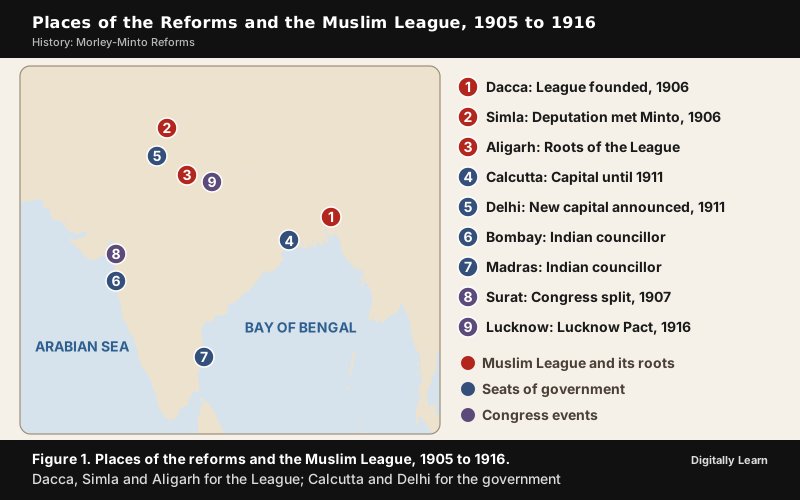
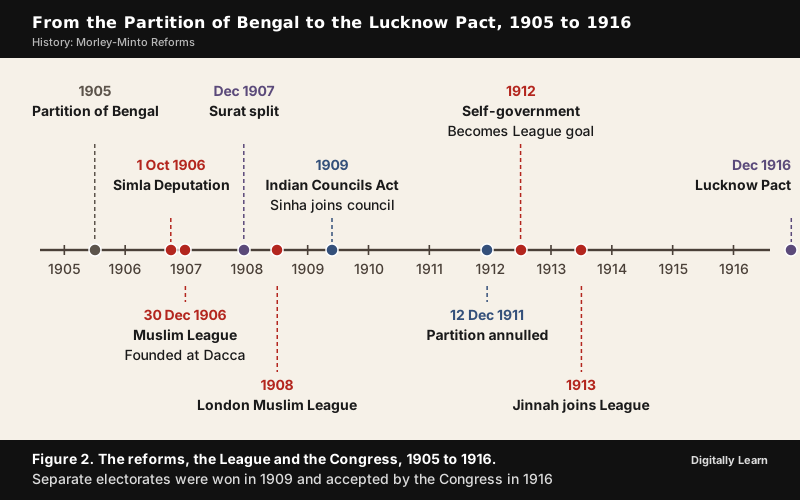
The Simla Deputation was a delegation of 35 prominent Muslim leaders, led by the Aga Khan (Aga Khan III), that met Lord Minto at the Viceregal Lodge in Simla (now Shimla) on 1 October 1906. Morley's budget speech of July 1906, which hinted at more Indian representation in the councils, prompted it. The address presented to the Viceroy was drafted by Syed Hussain Bilgrami with the help of Mohsin-ul‑Mulk, the successor of Syed Ahmad Khan at Aligarh.
The address made two demands that shaped the Act of 1909:
- Separate electorates: Muslims should elect their own representatives to the councils at every level.
- Weightage: Muslim representation should be "commensurate not merely with the numerical strength but also with their political importance", that is, larger than the community's share of the population.
The deputation praised British rule and did not criticise it. Minto agreed with its case, holding that any electoral representation in India that ignored "the beliefs and traditions of the communities" would fail, and he assured the members that their claims would be considered. Whether the deputation was arranged by the government has long been debated. The older view held that the British engineered it to set Muslims against the Congress; later research has argued that it began with the Muslim leaders themselves. Either way, Minto received the deputation with clear sympathy.
Foundation of the All-India Muslim League at Dacca, 1906
Aligarh Roots and the Muhammadan Educational Conference
The All-India Muslim League had its roots in the Aligarh movement of Syed Ahmad Khan. Syed Ahmad Khan urged Muslims to take up modern, English education, campaigned against the Indian National Congress from its early years and, in 1886, founded the All India Muhammadan Educational Conference. The Conference avoided politics at first, but it brought the Muslim upper classes together every year and gave them a common platform.
Two developments pushed the Muslim upper classes towards a political party of their own:
- Fear of being outnumbered: Many feared that Muslims would not be adequately represented in a largely Hindu-dominated Congress, and the Congress's efforts to address this concern had little success.
- The partition of Bengal: Nawab Khwaja Salimullah of Dacca and others supported the partition of 1905 because it promised a Muslim-majority province in eastern Bengal.
Both were the concerns of landed and commercial Muslim families.
Dacca Session of December 1906: Founders and Aims
The All-India Muslim League was founded at Dacca on 30 December 1906, at a meeting held with the twentieth session of the All India Muhammadan Educational Conference. Nawab Waqar-ul‑Mulk and Nawab Mohsin-ul‑Mulk, secretary of the Conference, led the gathering, and the proposal to form the party was moved by Nawab Khwaja Salimullah of Dacca. Salimullah had earlier suggested the name "All-India Muslim Confederacy", but "All-India Muslim League" was adopted. The Aga Khan, who led the Simla Deputation, became its first honorary president, though he did not attend the Dacca session. The League's constitution was framed in 1907, in the "Green Book" written by Mohammad Ali Jauhar.
The League's early aims were to preach loyalty to the British Empire and to keep the Muslim intelligentsia away from the Congress.
The League began as a body of the Muslim elite and represented only a small section of the community. The government encouraged it as an anti-Congress front.
The League's Course from 1907 to 1913
The League's early years were spent securing the electorates it had asked for and then slowly changing its outlook. In 1908 Syed Ameer Ali established the London Muslim League, which worked independently of the League in India. When the government's draft proposals of 1 October 1908 offered Muslims only a few reserved seats, and Morley suggested mixed electoral colleges instead of separate rolls, the League and the Muslim press protested that the Viceroy's assurance to the Simla Deputation had been broken.
In London the League's supporters opposed the Indian Councils Bill and won the backing of several members of Parliament. Morley then told the House of Lords that he accepted separate Muslim representation, and after the League's central committee renewed its demand on 12 September 1909, the Aga Khan accepted a compromise of two more reserved seats for Muslims in the Central Legislative Council.
On 12 December 1911 the partition of Bengal was annulled and the transfer of the capital from Calcutta to Delhi was announced. The annulment came as a rude shock to the Muslim political elite, above all to those who had supported the partition.
Younger Muslim leaders, among them Mohammad Ali Jauhar and Maulana Azad, were turning towards bolder nationalist politics. The Aga Khan resigned as president in 1912, and the League's session at Calcutta in 1912 committed it to working with other groups for "a system of self-government suited to India", provided this did not conflict with the protection of Muslim interests. Muhammad Ali Jinnah joined the League in 1913. These changes brought the League's goal close to the Congress's own and prepared the way for the Lucknow Pact of December 1916.
Provisions of the Indian Councils Act, 1909
Enlarged Councils, Indirect Election and Separate Electorates
The Indian Councils Act, 1909, considerably increased the size of the legislative councils, both central and provincial. The number of members of the Central (Imperial) Legislative Council was raised from 16 to 60, of whom 27 were to be elected. The size of the provincial councils was not uniform.
The Act treated the two levels differently:
- At the Centre: The official majority was retained, so the government could always carry its measures.
- In the provinces: The official majority was ended and the councils were allowed a non-official majority. Because some of the non-officials were nominated rather than elected, the elected members were still outnumbered by officials and nominated members together.
Election was introduced in a very indirect form. Local bodies elected an electoral college, which elected the members of the provincial councils, who in turn elected the members of the Central Legislative Council. Separate representation was also given to presidency corporations, chambers of commerce, universities and zamindars, so that special interests had seats of their own.
The Act also introduced a system of communal representation for Muslims by accepting the concept of the separate electorate, under which Muslims voted on their own roll for the seats set apart for them. Two further concessions went with it:
- Weightage: Muslims were given representation in excess of their share of the population.
- Lower qualification: The income qualification for Muslim voters was kept lower than that for Hindus.
The number of Muslim seats was itself the subject of hard bargaining between the League and the government, settled only in 1909 by the compromise of two extra seats at the Centre.

Wider Powers of Debate in the Councils
The Act enlarged the deliberative functions of the councils at both levels. Members could now:
- Move resolutions: Resolutions could be moved, including on the budget, though the government was not bound to accept them.
- Ask supplementary questions: Members could follow up an answer with a further question, which they had not been allowed to do before.
- Vote on budget items: Separate items of the budget could be voted on, though the budget as a whole could not.
The limits were firm. Members could not discuss foreign policy or relations with the princely states, and the British executive kept an absolute veto over all legislation.
| Feature | Indian Councils Act, 1892 | Indian Councils Act, 1909 |
|---|---|---|
| Size of the Central Legislative Council | 16 members | Raised from 16 to 60 members |
| Majority in the councils | Official majority at the Centre and in the provinces | Official majority at the Centre; non-official majority in the provinces |
| Choice of members | Non-official members nominated on the recommendation of bodies such as provincial councils and the Bengal Chamber of Commerce | Indirect election through local bodies and electoral colleges |
| Representation of communities | No separate representation | Separate electorates for Muslims |
| Budget | Discussion only | Resolutions and votes on separate items; no vote on the whole budget |
| Questions | Questions to the executive | Supplementary questions also allowed |
| Executive councils | No Indian members | First Indian on the Viceroy's Executive Council |
Indians on the Executive Councils: Satyendra Prasanna Sinha
The Act provided, for the first time, for the association of Indians with the executive councils of the Viceroy and the Governors. Satyendra Prasanna Sinha (also written Satyendra Prasad Sinha), a Calcutta lawyer and the first Indian Advocate-General of Bengal, became the first Indian member of the Viceroy's Executive Council in 1909, as Law Member. Accepting meant giving up much of an annual income of £10,000, and his first inclination was to refuse, but Gokhale and Jinnah persuaded him to accept. Indians were also admitted to the executive councils of Bombay and Madras. In London, Morley appointed two Indian members to the Secretary of State's council.
Sinha's later career shows how far the door had opened. He presided over the Bombay session of the Congress in 1915, and when the office of Governor was created in Bihar and Orissa in 1920, he became the first Governor of Indian origin. Yet in 1909 his appointment was a single seat granted from above, and real executive power stayed with British officials.
Assessment of the Morley-Minto Reforms
Reforms without Responsible Government
The reforms of 1909 gave Indians more seats and a louder voice, but they did not answer the Congress's central demand for self-government. Morley himself rejected any link with parliamentary rule: "If it could be said that this chapter of reforms led directly or indirectly to the establishment of a parliamentary system in India, I, for one, would have nothing at all to do with it."
The weaknesses lay in three places:
- No responsibility: Parliamentary forms were introduced but no responsibility was conceded, which sometimes led to thoughtless and irresponsible criticism of the government.
- Indirect election: Members passed through so many stages of election that the link between a voter and a member was very faint.
- A narrow franchise: Voting depended on an income qualification, and even under the Government of India Act, 1935, the electorate for the provincial bodies was no more than 10 to 15 per cent of the adult population.
Some members still used the councils well. Gokhale raised universal primary education, attacked repressive policies and drew attention to the plight of indentured labourers and Indian workers in South Africa. In the end the reforms gave the country a shadow rather than the substance of self-government.
Separate Electorates and the Growth of Communal Politics
Separate electorates were the provision with the longest consequences. By accepting the principle, the Act treated Muslims as a distinct political community whose members could be represented only by fellow Muslims. For this reason the Act is often said to have "legalised communalism", and Lord Minto came to be called the Father of Communal Electorate.
Communalism, in the Indian historical sense, is the belief that people who follow the same religion share the same secular interests in politics and the economy, and in its extreme form that the interests of two religious communities cannot be reconciled. The separate electorate fed this belief in two ways:
- A struggle for power: The government used separate electorates to divide the nationalist ranks and to win the Muslim elite to its side, while the Muslim leaders bargained for seats and weightage as a community.
- A sense of relative deprivation: Muslim professional and business classes had emerged later than Hindu ones, competed with them for jobs and trade, and feared being reduced to an insignificant minority in elected bodies; separate representation promised them a protected share.
The Muslim leaders who demanded separate electorates, and the officials who granted them, spoke of the whole community, but the benefit went to a small section of the Muslim elite. Once the principle was accepted, every later reform had to start from it, and politics increasingly ran along religious lines.
Congress Responses and the Later Course of Separate Electorates
Congress Opposition in 1909 and the Lucknow Pact of 1916
The Congress, now led by the Moderates, opposed the separate electorates, which it saw as an imperial attempt to control Indians through a policy of divide and rule.
By 1916 the Congress had changed its position. At Lucknow in December 1916 it reunited its two wings and, in its pact with the Muslim League, accepted separate electorates for Muslims in elections to the provincial and central councils, together with a fixed share of seats. The Congress gave up the principle it had opposed in 1909 in return for the League's support for a joint demand for self-government.
Separate Electorates from 1919 to the Constituent Assembly
Separate electorates did not stay confined to Muslims. The Government of India Act, 1919, extended the principle of communal representation by providing separate electorates for Sikhs, Indian Christians, Anglo-Indians and Europeans. In August 1932 the Communal Award of the British Prime Minister, Ramsay MacDonald, extended separate electorates to the Depressed Classes as well. Gandhi feared that this would permanently divide Hindu society and began a fast unto death; the Poona Pact then replaced separate electorates for the Depressed Classes with a larger number of reserved seats for them in the legislatures.
The Constituent Assembly rejected separate electorates altogether. After Partition most nationalists saw them as a measure deliberately introduced by the British to divide the people, and Sardar Patel called them a "poison that has entered the body politic of our country". The Constitution adopted reserved constituencies instead. In such a constituency all voters take part, but the candidates must belong to the community for which the seat is reserved. Seats in the Lok Sabha and the State Legislative Assemblies are reserved in this way for the Scheduled Castes and Scheduled Tribes, and under Article 334, as amended, this reservation runs for 80 years from the commencement of the Constitution, that is, up to 2030.
| Feature | Separate electorate (1909) | Joint electorate with reserved seats (Constitution of India) |
|---|---|---|
| Who votes | Only voters of the named community | All voters of the constituency |
| Who may stand | A member of the named community | A member of the community for whom the seat is reserved |
| Effect on politics | A member answers only to voters of one community | A member must seek votes from every community |
| Example | Muslim seats under the Act of 1909 | Seats reserved for the Scheduled Castes and Scheduled Tribes |
Previous Year UPSC‑CSE Questions
Each Prelims question is explained option by option, and each Mains question comes with an answer outline.
- UPSC Prelims 2012Which of the following is/are the principal feature(s) of the Government of India Act, 1919?
- Introduction of dyarchy in the executive government of the provinces
- Introduction of separate communal electorates for Muslims
- Devolution of legislative authority by the Centre to the provinces
How to approach this Prelims question
Approach: Test each statement against what the Act of 1919 began, as distinct from what it continued.
- Statement 1: Dyarchy was introduced in the provinces by the Act of 1919; correct.
- Statement 2: Separate electorates for Muslims had already been introduced by the Indian Councils Act, 1909, and the Act of 1919 only extended the principle to Sikhs, Indian Christians, Anglo-Indians and Europeans; wrong.
- Statement 3: The Act of 1919 demarcated central and provincial subjects and authorised the provincial legislatures to make laws on their own list; correct.
Trap to watch: Separate electorates do appear in the Act of 1919, so statement 2 looks right; the word "Introduction" makes it wrong, because they were introduced in 1909.
Why each option is right or wrong:
- (a) 1 only: Wrong. Statement 3 is also correct, since the Act of 1919 devolved legislative authority to the provinces through separate lists of subjects.
- (b) 2 and 3 only: Wrong. Statement 2 is wrong because separate electorates for Muslims began in 1909, and statement 1 on dyarchy is correct.
- (c) 1 and 3 only: Correct. Dyarchy and the devolution of legislative authority were features of the Act of 1919.
- (d) 1, 2 and 3: Wrong. Statement 2 is wrong; the Act of 1919 extended separate electorates but did not introduce them.
Answer: (c) 1 and 3 only. Separate electorates for Muslims were introduced by the Act of 1909, so only dyarchy and devolution belong to the Act of 1919.
- UPSC Prelims 2004Consider the following events during India's freedom struggle:
- Chauri-Chaura Outrage
- Minto-Morley Reforms
- Dandi March
- Montagu-Chelmsford Reforms
Which one of the following is the correct chronological order of the events above?
How to approach this Prelims question
Approach: Put a year against each event and arrange them. The Minto-Morley Reforms were enacted in 1909; the Montagu-Chelmsford Reforms followed in the Government of India Act, 1919; the Chauri Chaura incident took place on 4 February 1922; and the Dandi March ran from 12 March to 6 April 1930. The order is therefore 2, 4, 1, 3.
Trap to watch: The two sets of reforms are easily confused because both carry the names of a Secretary of State and a Viceroy; the Minto-Morley Reforms of 1909 came 10 years before the Montagu-Chelmsford Reforms of 1919.
Why each option is right or wrong:
- (a) 1 ‑ 3 ‑ 2 ‑ 4: Wrong. It begins with Chauri Chaura (1922), which came after both sets of reforms.
- (b) 2 ‑ 4 ‑ 1 ‑ 3: Correct. Minto-Morley 1909, Montagu-Chelmsford 1919, Chauri Chaura 1922 and the Dandi March 1930.
- (c) 1 ‑ 4 ‑ 2 ‑ 3: Wrong. It places the reforms of 1909 after Chauri Chaura (1922).
- (d) 2 ‑ 3 ‑ 1 ‑ 4: Wrong. It places the Dandi March (1930) before Chauri Chaura (1922) and the reforms of 1919 last.
Answer: (b) 2 ‑ 4 ‑ 1 ‑ 3. The reforms of 1909 and 1919 came before Chauri Chaura in 1922 and the Dandi March in 1930.
- UPSC Prelims 2001A London branch of the All-India Muslim League was established in 1908 under the presidency of
How to approach this Prelims question
Approach: Identify who founded and led the League's body in London in 1908. Syed Ameer Ali established the London Muslim League in 1908; the question calls it a London branch, though it worked independently of the League in India. The Aga Khan was the League's honorary president in India, and Jinnah joined the League only in 1913.
Trap to watch: The Aga Khan, the best-known name of the League's first years, is the tempting choice, but he was its honorary president in India; the London body of 1908 was Syed Ameer Ali's.
Why each option is right or wrong:
- (a) Agha Khan: Wrong. He was the first honorary president of the All-India Muslim League in India, not the head of the London body.
- (b) Ameer Ali: Correct. Syed Ameer Ali established the London Muslim League in 1908.
- (c) Liaquat Ali Khan: Wrong. Liaquat Ali Khan is not linked with the London body of 1908, which Syed Ameer Ali founded and led.
- (d) M. A. Jinnah: Wrong. Jinnah joined the Muslim League only in 1913, five years after the London League was formed.
Answer: (b) Ameer Ali. Syed Ameer Ali established the London Muslim League in 1908.
- UPSC Prelims 1997Match List I with List II and select the correct answer by using the codes given below the lists:List I (Events)
- I. Morley Minto Reforms
- II. Simon Commission
- III. The Chauri-Chaura incident
- IV. The Dandi March
List II (Results)
- A) Country-wide agitation
- B) Withdrawal of a movement
- C) Communal Electorates
- D) Communal outbreaks
- E) Illegal manufacture of salt
Codes:
How to approach this Prelims question
Approach: Match each event to the result it produced, starting with the Morley-Minto Reforms. The Indian Councils Act, 1909, introduced separate electorates for Muslims, so I goes with C. The Simon Commission had only British members and was boycotted across the country, so II goes with A. The violence at Chauri Chaura on 4 February 1922 led Gandhi to halt the Non-Cooperation Movement, so III goes with B. The Dandi March of 12 March to 6 April 1930 ended with Gandhi breaking the salt law, so IV goes with E. The full match is I‑C, II‑A, III‑B, IV‑E.
Trap to watch: Communal Electorates and Communal outbreaks sit side by side in List II; the reforms of 1909 created an electoral system, not riots.
Why each option is right or wrong:
- (a) I‑C, II‑D, III‑E, IV‑B: Wrong. Chauri Chaura led to the withdrawal of a movement, and the Dandi March to the illegal manufacture of salt.
- (b) I‑D, II‑A, III‑B, IV‑C: Wrong. The Morley-Minto Reforms produced communal electorates, not communal outbreaks.
- (c) I‑B, II‑C, III‑D, IV‑E: Wrong. The reforms of 1909 withdrew no movement, and the Simon Commission did not create communal electorates.
- (d) I‑C, II‑A, III‑B, IV‑E: Correct. Communal electorates in 1909, a country-wide boycott of the Simon Commission, withdrawal of Non-Cooperation after Chauri Chaura, and illegal salt-making on the Dandi March.
Answer: (d) I‑C, II‑A, III‑B, IV‑E. The Morley-Minto Reforms introduced communal electorates, and the other three events match the agitation, the withdrawal and the salt law.
- UPSC Prelims 1996Match List I with List II and select the correct answer by using the codes given below the lists:List I (Period)
- I. 1883
- II. 1906
- III. 1927
- IV. 1932
List II (Event)
- A) Announcement of Communal Award from Whitehall
- B) Formation of the All-India State Peoples Conference
- C) Foundation of Muslim League at Dacca
- D) First session of National Conference at Calcutta
Codes:
How to approach this Prelims question
Approach: Fix the pair most easily dated first, then date the other three events. The All-India Muslim League was founded at Dacca on 30 December 1906, so II goes with C. The first Indian National Conference was held at Calcutta in 1883, so I goes with D. The All India States Peoples' Conference held its first session in Bombay in December 1927, so III goes with B. The Communal Award was announced by the British Prime Minister, Ramsay MacDonald, on 16 August 1932, so IV goes with A. The full match is I‑D, II‑C, III‑B, IV‑A.
Trap to watch: A student may place the Communal Award in 1927, the year the Simon Commission was appointed, but the Award came in 1932; 1927 is the year of the first session of the States Peoples' Conference.
Why each option is right or wrong:
- (a) I – D, II – C, III – A, IV – B: Wrong. It gives 1927 to the Communal Award, which came in 1932, and 1932 to the States Peoples' Conference, whose first session was in 1927.
- (b) I – C, II – D, III – A, IV – B: Wrong. It puts the League's foundation in 1883, but the League was founded in 1906.
- (c) I – D, II – C, III – B, IV – A: Correct. National Conference 1883, Muslim League at Dacca 1906, States Peoples' Conference 1927 and Communal Award 1932.
- (d) I – C, II – D, III – B, IV – A: Wrong. It swaps 1883 and 1906; the League was founded at Dacca in 1906.
Answer: (c) I – D, II – C, III – B, IV – A. The Muslim League was founded at Dacca in 1906 and the National Conference met at Calcutta in 1883, which fixes the first two pairs.
- UPSC Mains 2018 GS‑I'Communalism arises either due to power struggle or relative deprivation.' Argue by giving suitable illustrations.
Answer outline
The outline sets out what the question asks, the main arguments, relevant examples and the direction of the conclusion; it is not a full model answer.
Introduction: Communalism is the belief that people of one religion share the same secular interests, and in its extreme form that the interests of two communities cannot be reconciled; both a struggle for power and a sense of relative deprivation can produce it.
Body (sub-themes to develop):
- Power struggle, the colonial side: The government granted separate electorates in 1909 to divide the nationalist ranks and to win over the Muslim elite.
- Power struggle, the elite side: The Simla Deputation of 1906 and the Muslim League bargained for separate electorates and weightage, seeking a protected share of power as a community.
- Relative deprivation: Muslim professional and business classes had emerged later than Hindu ones, competed for jobs and trade, and feared being reduced to an insignificant minority in elected bodies.
- The two together: The government's wish to divide met the elite's fear of falling behind; once granted, the principle was extended by each later reform and politics ran increasingly along religious lines.
- Beyond the League: The Communal Award of 1932 extended separate electorates to the Depressed Classes, showing how the same device could be used wherever a group felt deprived and the government sought to divide.
Conclusion: Communalism in India drew on both a contest for power and a sense of relative deprivation, as the separate electorate of 1909 shows, which is why the Constituent Assembly rejected separate electorates altogether.
Sources
- NCERT: Exploring Society: India and Beyond, Grade 8, Book 2, Chapter 2, India's Long Road to Independence
- NCERT: Indian Constitution at Work, Class 11, Chapter 3, Election and Representation
- NCERT: Indian Constitution at Work, Class 11, Chapter 10, The Philosophy of the Constitution
- NCERT: Themes in Indian History, Class 12, Book 3, Chapter 4, Framing the Constitution
- Press Information Bureau: Backgrounder, Constitution Day, 26 November 2021
- Lok Bhavan Bihar: History of Bihar Lok Bhavan
- Legislative Department, Ministry of Law and Justice: The Constitution of India (Articles 330 to 334)
- Wikipedia: Indian Councils Act 1909
- Wikipedia: Simla Deputation
- Wikipedia: All-India Muslim League
- Wikipedia: All-India Muhammadan Educational Conference
- Wikipedia: Khwaja Salimullah
- Wikipedia: Aga Khan III
- Wikipedia: Syed Ameer Ali
- Wikipedia: Satyendra Prasanna Sinha, 1st Baron Sinha
- Wikipedia: Imperial Legislative Council
- Wikipedia: Lucknow Pact
- Wikipedia: Government of India Act 1919
- Wikipedia: Communal Award
- Wikipedia: Indian National Association
- Wikipedia: All India States Peoples Conference
- Wikipedia: Chauri Chaura incident
- Wikipedia: Simon Commission
- Wikipedia: Salt March
- UPSC: Civil Services Examination question papers
Editorial Disclaimer
Facts are drawn from the current NCERT textbooks and the other sources cited. Where accounts give different figures, NCERT's are used.
See more of our UPSC articles in Google Search
Add to Preferred Sources