


Overview
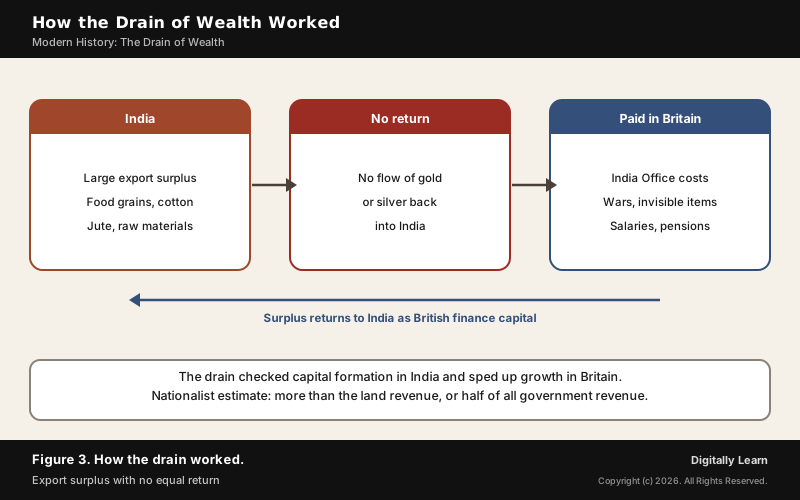
The drain of wealth theory holds that part of India's national product was sent to Britain under colonial rule without adequate economic or material return. It was given by Dadabhai Naoroji and set out in his book Poverty and Un-British Rule in India (1901). R. C. Dutt, M. G. Ranade, G. K. Gokhale and other early nationalists built on it into a full economic critique of British rule.
Drain of Wealth Theory: Meaning and Origin
What Is the Drain of Wealth? Who Gave the Theory
The drain of wealth theory was given by Dadabhai Naoroji. The economic drain was the part of India's national product that was not available for its people's consumption but was sent to Britain for political reasons, while India got no adequate economic or material return for it.
Naoroji did not object to every payment. He accepted that some tribute was due for services Britain provided, such as the new railways. His complaint was that the money earned from those services also left India, so the country kept paying for things that did not profit it directly.
The first educated Indians of the nineteenth century supported British rule, expecting it to modernise the country with new technology and capitalist organisation. After the 1860s, disillusionment set in, and politically conscious Indians began to probe the reality of British rule.
They concluded that India had been turned into a colonial economy: a supplier of foodstuffs and raw materials to Britain, a market for British manufactures and a field for British capital. The early nationalists, led by Naoroji, R. C. Dutt and Dinshaw Wacha, used this analysis to build an all-India opinion that British rule was the main cause of India's poverty and backwardness.
Dadabhai Naoroji and the Drain Theory
England's Duties to India (1867) and Poverty of India (1876)
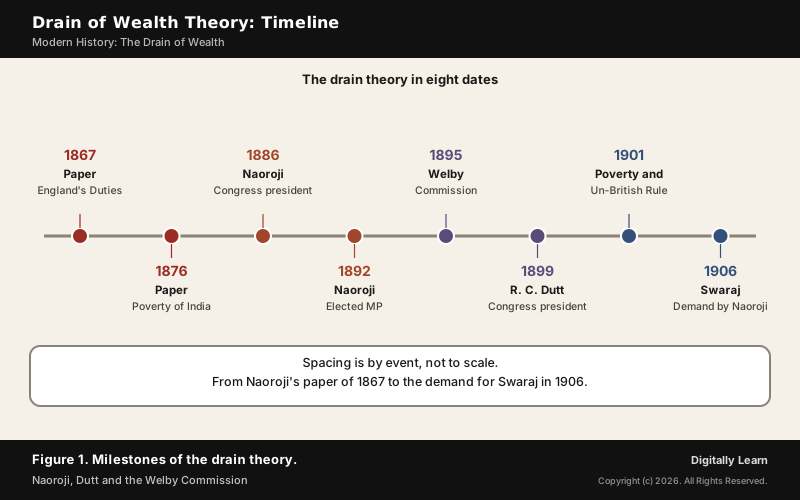
Naoroji built the theory with statistics. On 2 May 1867, in a paper called England's Duties to India, read to a mostly British audience at the East India Association, he accused Britain of siphoning wealth out of India. He calculated that the Home Charges alone had transferred about 100 million pounds from India to England since 1829, drawing on Parliamentary Returns of Indian Accounts.
- Poverty of India (1876): Read before the Bombay branch of the East Indian Association, it pointed out statistical fallacies and examined acreage, crop production, prices, consumption, imports and exports.
- Poverty line: Naoroji was the first in pre-independent India to discuss the concept of a poverty line. He priced a prisoner’s menu to arrive at a ‘jail cost of living’ and adjusted it for children.
- Estimates of income: He was among the early estimators of India’s national income, along with William Digby, Findlay Shirras, V. K. R. V. Rao and R. C. Desai.
His method mattered as much as his conclusion. He turned wages, taxes, rents, lending rates, farm output, trade figures and exchange rates into political arguments, which later leaders followed.
Poverty and Un-British Rule in India (1901): Six Causes of the Drain
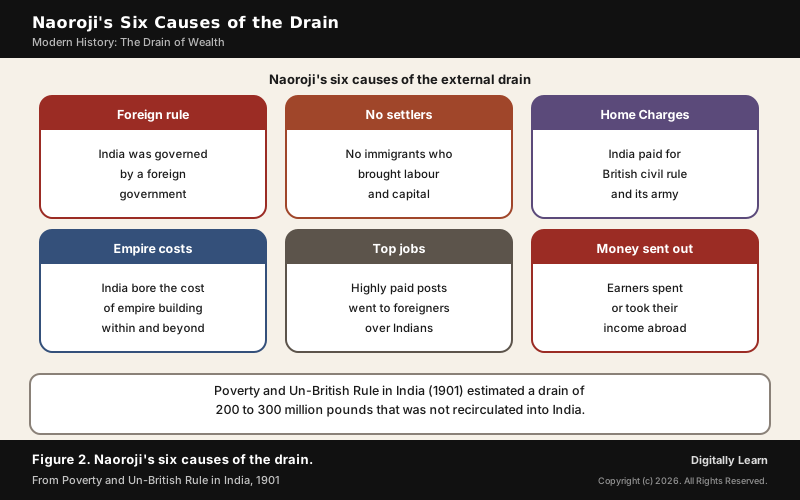
Naoroji's main work, Poverty and Un-British Rule in India, was published in 1901 and set out his economic drain theory in full. He chose the title because he held that such a policy went against British principles themselves. The book estimated a drain of 200 to 300 million pounds of India's revenue to Britain that was never recirculated into India.
- Foreign rule: India was governed by a foreign government.
- No settlers: India attracted no immigrants who brought labour and capital for growth.
- Home Charges: India paid for Britain’s civil administration in India and for its Indian army.
- Empire building: India bore the burden of empire building within and beyond its borders.
- Top jobs: Highly paid posts went to foreigners over equally qualified Indians.
- Money sent abroad: These earners spent their money outside India or left with it.
Naoroji's own words carried the charge. He wrote that India was being destroyed not by the pitiless operation of economic laws but by the pitiless action of British policy, and that under British rule the Indian's substance was drained away, unseen, peaceably and subtly.
Naoroji carried the argument into British politics. Elected in 1892, he was the first Indian in the House of Commons, and his work on the drain led to the Royal Commission on the Administration of Expenditure of India, known as the Welby Commission, set up in 1895, of which he was a member.
Components and Mechanism of the Drain
Home Charges, Salaries, Interest and Profits: Components of the Drain
The drain flowed through several channels. India paid for Britain's civil administration in India and for its Indian army in the form of the Home Charges.
- Salaries and pensions: Of British civil and military officials.
- Interest: On loans raised abroad by the Government of India.
- Profits: On foreign investment in India.
- Stores: Bought in Britain for civil and military departments.
- Services: Payments for shipping, banking and insurance, which stunted Indian enterprise in these fields.
The Welby Commission examined these charges. Its report of 1900 said that English costs were not to be relieved at the expense of Indian revenues, and that the India Office must be consulted on charges affecting India. Naoroji's own remedy was simpler: give equal employment to Indian professionals, so that income earned in India stayed in India.
How the Drain Worked: Export Surplus and Finance Capital
The drain showed up in India's trade. Throughout the colonial period India ran a large export surplus, but it brought no gold or silver into the country. It paid instead for an office the colonial government kept in Britain, for wars fought by the British and for invisible items, all of which drained Indian wealth. This unrequited surplus measured the drain.
The drain began with Company rule. Before Bengal's revenue came into its hands, the Company bought Indian goods by importing gold and silver from Britain. Once it became the Diwan, the revenue collected in Bengal could finance the purchase of goods for export, so India paid for its own exports.
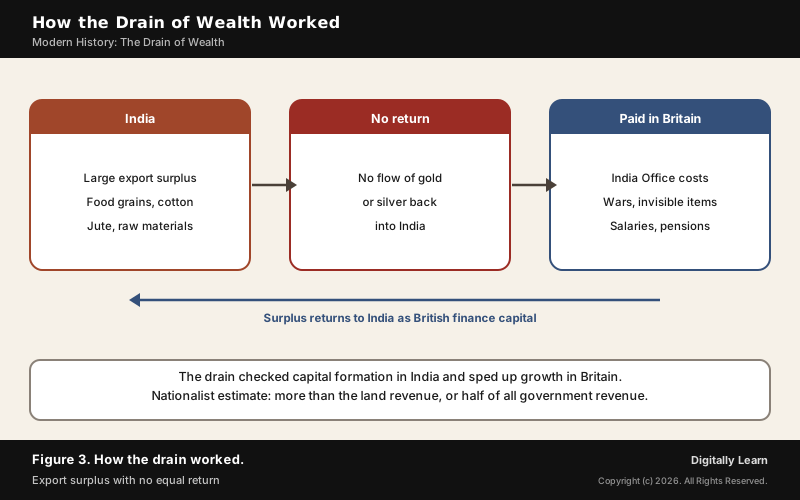
- Capital formation: The drain checked capital formation in India while the same wealth sped up the growth of the British economy.
- Finance capital: The surplus came back to India as British finance capital, draining it further.
- Size: Nationalist estimates put the drain at more than the total land revenue, half the total government revenue, or one-third of total savings, about 8 per cent of the national product in today’s terms.
Economic Critique by the Moderates: Dutt, Ranade and Gokhale
R. C. Dutt, Ranade, Gokhale and the Other Economic Critics
Naoroji was the foremost of a group of economic analysts, and the others widened his case.
- R. C. Dutt: An Indian Civil Service officer turned economic historian, and Congress president in 1899. His Economic History of India argued that the Company and Parliament discouraged Indian manufactures to encourage those of England, so millions of artisans lost their earnings.
- M. G. Ranade: A judge of the Bombay High Court and a founder of the Congress, among the leading economic analysts.
- G. K. Gokhale: Assisted Ranade, won praise for his evidence before the Welby Commission, and gave budget speeches in the Central Legislative Council built on statistical analysis.
- Dinshaw Wacha: Congress president in 1901, who deposed before the Welby Commission with Gokhale in 1897.
- Others: G. Subramaniya Ayer and Prithwishchandra Ray.
Historians treat Dutt's Economic History of India and Naoroji's Poverty and Un-British Rule in India as the classic nationalist accounts of the Indian economy in the late nineteenth century.
Nationalist Critique of Trade, Industry, Railways and Taxes
The early nationalists argued that India was poor and growing poorer because of British rule. Since the causes were man-made, poverty could be explained and removed, and it became a national issue. Development meant industrialisation, based on Indian, not foreign, capital.
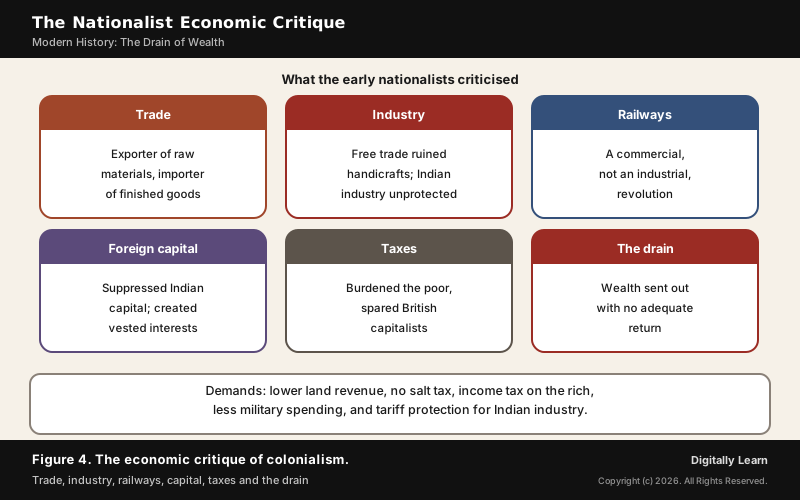
- Foreign capital: It suppressed Indian capital, caused the drain and created vested interests that wanted foreign rule to continue.
- Trade: It made India an importer of finished goods and an exporter of raw materials and foodstuffs.
- Railways: Not planned around India’s industrial needs, they brought a commercial rather than an industrial revolution. G. V. Joshi called railway spending an Indian subsidy to British industries.
- Industry: One-way free trade exposed handicrafts to unfair competition, while tariffs served British capitalists.
- Taxes: They burdened the poor and spared British capitalists and bureaucrats.
Significance and Legacy of the Drain Theory
Why the Drain Theory Mattered for the National Movement
The drain theory tied every strand of the nationalist critique together. The idea of one country taking away another's wealth was easy to grasp for a nation of peasants who met exploitation every day. It undermined the claim that foreign rule served Indians and showed that India was poor because it was ruled for British interests.
- National consciousness: The economic agitation was one of the stimulants of intellectual unrest and national feeling in the moderate phase (1875 to 1905).
- From reform to self-rule: Naoroji was the first to voice the demand for Swaraj from the Congress platform, in 1906.
- Influence on Gandhi: Poverty and Un-British Rule in India influenced Mahatma Gandhi.
The Drain Debate Today: Estimates and the Road to Planning
The size of the drain is still debated. The colonial government never seriously tried to estimate India's national or per capita income, and the private estimates that were made gave conflicting results. Recent estimates by Utsa Patnaik and Prabhat Patnaik put the present value of the tribute for 1765 to 1900 at 64.82 trillion dollars for the year 2020, far more than Britain's 2020 GDP of 3.25 trillion dollars.
The theory also shaped independent India's thinking on poverty. Addressing the Indian Economic Association, Prime Minister Manmohan Singh called Poverty and Un-British Rule in India the original classic work on poverty in India. He noted that Naoroji documented Indian poverty without proposing a solution, and that Jawaharlal Nehru's planning committee of 1938 later set out the growth approach to it.
Previous Year UPSC-CSE Questions
Previous Year UPSC-CSE Questions By the end you will be able to draft model answers for the following UPSC questions. Each question carries a collapsible framework showing how to approach it in the exam.
- UPSC Mains 2014 GS-IExamine critically the various facets of economic policies of the British in India from mid-eighteenth century till independence.
How to structure the answer in the exam
Introduction: British policy turned India into a colonial economy: a supplier of raw materials, a market and a field for British capital.
Body (sub-themes to develop):
- Trade and one-way free trade: raw materials out, manufactures in; handicrafts ruined.
- Finance: Home Charges, salaries, pensions, interest; the export surplus with no return.
- Railways and foreign capital: a commercial, not industrial, revolution.
- Taxation and land revenue: the burden on the poor; nationalist demands.
Conclusion: Conclude that the policies served British interests, and that the drain theory turned this into the economic case for self-rule.
- UPSC Prelims 2011 Prelims-GSWith reference to the period of colonial rule in India, "Home Charges" formed an important part of drain of wealth from India. Which of the following funds constituted "Home Charges"?
- Funds used to support the India Office in London.
- Funds used to pay salaries and pensions of British personnel engaged in India.
- Funds used for waging wars outside India by the British. Select the correct answer using the codes given below:
How to approach this Prelims question
Approach: Match each fund to what the Home Charges covered.
Trap to watch: Wars outside India are not part of the answer.
Key facts to recall:
- India Office in London
- Salaries and pensions of British personnel
Answer signal: 1 and 2 only: option (b).
- UPSC Prelims 2015 Prelims-GSWho of the following was/were economic critic/critics of colonialism in India?
- Dadabhai Naoroji
- G. Subramania Iyer
- R.C. Dutt
How to approach this Prelims question
Approach: Check each name against the list of early economic analysts.
Trap to watch: G. Subramania Iyer is less familiar but was one of them.
Key facts to recall:
- Naoroji, Dutt, Ranade, Gokhale, G. Subramaniya Ayer
Answer signal: 1, 2 and 3: option (d).
- UPSC Prelims 1996 Prelims-GSWho among the following leaders did not believe in the drain theory of Dadabhai Naoroji?
How to approach this Prelims question
Approach: Find the leader who stood with the Raj rather than the Congress.
Trap to watch: R. C. Dutt and M. G. Ranade were themselves economic critics.
Key facts to recall:
- Sir Syed urged loyal service to the Raj
- He became an active critic of the Congress
Answer signal: Sir Syed Ahmed Khan: option (d).
Sources and Further Reading
- PIB: Dadabhai Naoroji, the man who brought statistics into politics (2017)
- NCERT: Indian Economic Development (Class XI), Indian Economy on the Eve of Independence and Poverty
- Prime Minister's Office (archive): address to the 92nd annual conference of the Indian Economic Association
- Indian Culture Portal (Ministry of Culture): Poverty and Un-British Rule in India, digitised book
- Wikipedia: Drain of Wealth Theory
- Wikipedia: Dadabhai Naoroji
- Wikipedia: Romesh Chunder Dutt
- Wikipedia: Mahadev Govind Ranade
- Wikipedia: Gopal Krishna Gokhale
- Wikipedia: Dinshaw Edulji Wacha
- Wikipedia: Welby Commission
- Wikipedia: Syed Ahmad Khan
- UPSC: Previous year question papers
Editorial Disclaimer
This article explains the drain of wealth theory for UPSC preparation. Dates, figures and attributions reflect the cited sources.