


Overview
The Moderate leaders of India, known as the Moderates, led the early Indian National Congress and believed in liberalism and in gradual, lawful progress. They held that the British wished to be just to Indians but did not know the real conditions of the country. If public opinion were created at home and the demands were placed before the Government through resolutions, petitions and meetings, they reasoned, the authorities would concede them step by step. The label separates them from the younger nationalists of the early twentieth century, who were called Extremists by their opponents and by the British, though these leaders called themselves simply Nationalists.
Moderate Leaders of India and the Moderate Phase (1885‑1905)
Five Leading Moderates at a Glance
The period from 1885 to 1905 is known as the Moderate phase, because the Moderates dominated Congress policy throughout it. Five leaders stand out: Dadabhai Naoroji, Gopal Krishna Gokhale, Surendranath Banerjee, Pherozeshah Mehta and M.G. Ranade. Dinshaw Wacha, W.C. Bonnerjee, Badruddin Tyabji and R.C. Dutt worked beside them. In this phase the Congress hoped for a greater Indian share in governance, protection of civil rights and some social and economic reform, and it expressed faith in British rule.
| Leader | Base | Institution or office | Lasting contribution |
|---|---|---|---|
| Dadabhai Naoroji | Bombay and London | East India Association; Congress president three times | The drain theory; first Indian elected to the House of Commons |
| Gopal Krishna Gokhale | Pune | Servants of India Society (1905); Imperial Legislative Council | Reasoned budget criticism; political mentor of Gandhi |
| Surendranath Banerjee | Calcutta | Indian Association (1876); the newspaper The Bengalee | An all-India agitation on the civil service age limit; a leading voice against the partition of Bengal |
| Pherozeshah Mehta | Bombay | Bombay Presidency Association; Congress president in 1890 | Bombay municipal reform; fearless criticism in the Imperial Council |
| M.G. Ranade | Pune | Poona Sarvajanik Sabha; Indian National Social Conference | Economic analysis and social reform; teacher of Gokhale |
Moderate Leaders and the Associations They Founded
Regional Associations of Bengal, Bombay and Madras
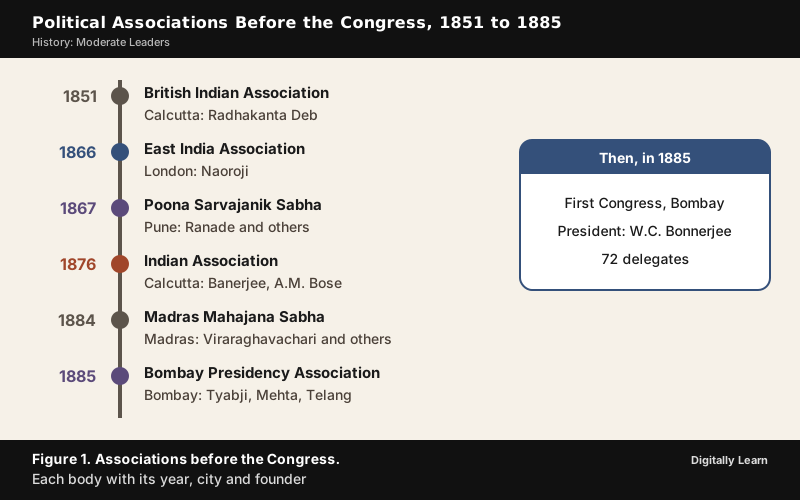
The Moderate leaders did not start from nothing. Political associations of the first half of the nineteenth century were dominated by wealthy and aristocratic men and were local in outlook. In Bengal, the Landholders' Society and the Bengal British India Society merged in 1851 to form the British Indian Association, with Radhakanta Deb as its first president. By the second half of the century the associations were led by the educated middle class of lawyers, journalists, doctors and teachers, who had a wider agenda.
Younger Bengal nationalists led by Surendranath Banerjee and Ananda Mohan Bose, discontented with the pro-landlord line of the British Indian Association, founded the Indian Association in 1876. In the Bombay Presidency, the Poona Sarvajanik Sabha was founded in 1867 by M.G. Ranade and others as a bridge between the government and the people, and Badruddin Tyabji, Pherozeshah Mehta and K.T. Telang started the Bombay Presidency Association in 1885. In Madras, the Madras Mahajana Sabha was founded in 1884 by M. Viraraghavachari, Subramania Aiyer and P. Anandacharlu. In London, Dadabhai Naoroji organised the East India Association in 1866 (some accounts give 1867) to discuss the Indian question and influence public men in England.
Founding of the Indian National Congress in 1885
The plan for an all-India body took final shape under Allan Octavian Hume, a retired English civil servant who had become critical of colonial policies and resigned in 1882. He worked with leading Indians to organise the first session of the Indian National Congress at Bombay in December 1885. Seventy-two delegates attended, mostly from the Anglicised upper classes, and W.C. Bonnerjee was elected the first president. Naoroji, then a prominent advocate, played a leading role beside Hume and Bonnerjee. Two sessions of the Indian National Conference, held in Calcutta in 1883 and 1885 under Surendranath Banerjee and Ananda Mohan Bose, had already drawn representatives from the major towns, and the Conference merged with the Congress in December 1886.
The Congress then met every December in a different part of the country. Its early aims included building a democratic nationalist movement, politicising and educating people, and creating a feeling of national unity irrespective of religion, caste or province. Among its early presidents were Naoroji three times, Tyabji, Mehta, Anandacharlu, Banerjee, R.C. Dutt, Ananda Mohan Bose and Gokhale.
Dadabhai Naoroji and the Drain Theory
Career from the East India Association to the House of Commons
Dadabhai Naoroji, known as the Grand Old Man of India, was born in 1825 and died in Bombay on 30 June 1917. A teacher of mathematics at Elphinstone Institute and then a merchant in London, he turned to politics as his true calling. Through the East India Association he argued India's case before a British audience, and he later carried it into Parliament. In 1892 he was elected as a Liberal for Finsbury Central, the first Indian elected to the House of Commons, by a margin of five votes. He took his oath on his copy of the Khordeh Avesta and lost the seat at the 1895 general election.
He served the Congress as president in 1886, 1893 and 1906, and he also published a newspaper, the Voice of India. He sat on the Welby Commission, the Royal Commission on the Administration of Expenditure of India, which was established in 1895 and reported in 1900. Gokhale and Dinshaw Wacha both gave evidence before it in 1897.
The Drain of Wealth in Poverty and Un-British Rule in India
Naoroji's most influential idea was the drain of wealth theory, which holds that India's wealth was being steadily transferred to Britain without a return. He stated it first in the paper "England's Duties to India", read before the East India Association on 2 May 1867, where he calculated that the Home Charges alone had moved about £100 million out of India since 1829. The Home Charges were the sums India paid in Britain every year for the cost of British civil administration and the Indian army, interest on India's external debt and the pensions of British officials. In 1876 he read "Poverty of India" before the Bombay branch of the Association, and in 1901 he published the book Poverty and Un-British Rule in India. The title carries his argument: A policy that impoverished India was against British principles themselves.

He set out six causes of the external drain.
- India was governed by a foreign government.
- India did not attract immigrants who brought labour and capital.
- India paid the Home Charges to Britain every year.
- India bore the burden of empire building inside and outside its borders.
- Free trade let foreigners take the highly paid jobs.
- Principal earners spent their money abroad or left with it, because most were foreign personnel.
British officials and traders also sent their private savings home, which added to the drain. Later work extends the argument. R.C. Dutt wrote the Economic History of India, and a modern estimate by Utsa Patnaik for 1765 to 1938 comes to US$45 trillion at today's value.
Naoroji at the Calcutta Session of 1906
The demand for self-government like that of the self-governing colonies of Canada and Australia was raised by Naoroji in 1904, Gokhale in 1905 and Tilak in 1906. At the Calcutta session of December 1906 the Extremists wanted Tilak or Lajpat Rai as president, while the Moderates proposed Naoroji, who was widely respected by all nationalists. He was elected president, and the session declared Swaraj, Swadeshi, Boycott and National Education to be the Congress objectives. Swaraj was not defined, so it was read as anything from self-rule within the Empire to full independence. Naoroji thus became the first to voice the demand for Swaraj from a Congress platform.
Gopal Krishna Gokhale: Council Work and Political Mentorship
Budget Speeches and Legislative Council Work
Gopal Krishna Gokhale lived from 1866 to 1915 and graduated from Elphinstone College in 1884. He was Ranade's protégé, and he joined the Congress in 1889. He was joint secretary of the Congress with Tilak in 1895, and in 1896 he founded the Deccan Sabha. He was elected to the Bombay Legislative Council in 1899 and to the Imperial Legislative Council on 20 December 1901.
In the Imperial Council he became known as a great authority on economics, and some called him the Leader of the Opposition. He argued that budget surpluses did not show a healthy economy, and he showed with facts and figures the deepening poverty, citing heavy military spending, heavy taxation and excise duties on indigenous industries such as textiles. On 25 February 1910 he moved the first non-official resolution under the new rules, recommending prohibition of indentured labour for Natal in South Africa.
The Servants of India Society (1905)
The Servants of India Society was formed in Pune on 12 June 1905, the year in which Gokhale presided over the Congress at Banaras. He left the Deccan Education Society to form it, with Natesh Appaji Dravid, Gopal Krishna Deodhar and Anant Patwardhan beside him. Its aim, in the preamble Gokhale wrote, was to train men prepared to devote their lives to the cause of the country in a religious spirit and to promote by all constitutional means the national interests of the Indian people.
Members took vows of renunciation and worked for education, sanitation and health care, and against untouchability and alcoholism. Mobile libraries, schools and night classes for factory workers were among its projects. The society chose to stay away from party organisations such as the Congress. After Gokhale's death in 1915, Srinivasa Sastri took over as president, and in 1930 the society set up the Gokhale Institute of Politics and Economics in Pune.
Gokhale, Gandhi and the Moderate-Extremist Divide
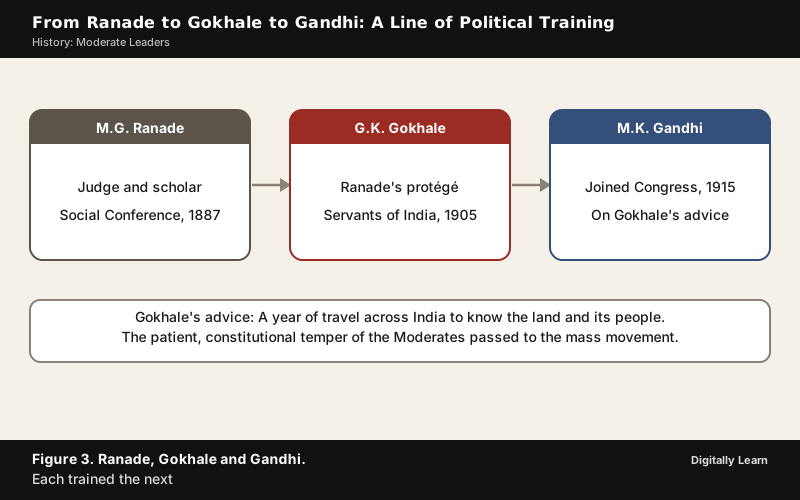
Gandhi acknowledged Gokhale as his political mentor. When Gandhi returned from South Africa in 1915, he joined the Congress on Gokhale's advice, and on that advice he spent a year travelling around British India to know the land and its people. His first major public appearance was the opening of Banaras Hindu University in February 1916. Through this link the patient, constitutional temper of the Moderates passed to the leader of the mass movement.
Gokhale led the Moderate faction of the Congress. He believed that self-government would come through constitutional means and cooperation with the British Government, whereas Tilak preached protest, boycott and agitation. They also differed over the Age of Consent Bill of 1891‑92, which raised the age of consent from 10 to 12. Gokhale supported it to curb child marriage, while Tilak objected to British interference in Hindu tradition.
At the Banaras session of 1905, presided over by Gokhale, the Moderate-Extremist differences came into the open. At Surat in 1907 his candidate for president was Rashbehari Ghosh, but when the pandal erupted he stood beside Tilak to protect him. He feared a permanent split and, as he lay dying in 1915, hoped to see the Congress united again.
Surendranath Banerjee and the Indian Association
From the Civil Service to Public Life
Surendranath Banerjee, often known as Rashtraguru, lived from 1848 to 1925. He passed the Indian Civil Service examination in 1869 but was barred on a claim that he had misrepresented his age. He cleared the matter in the courts and in 1871 was posted as assistant magistrate in Sylhet, but he was soon dismissed for a serious judicial error. He went to England to appeal against the dismissal, failed, and returned in 1875 convinced that racial discrimination had decided his case. He became a professor of English, and he later founded Ripon College, now Surendranath College, in 1882.
The Indian Association and the Civil Service Age-Limit Agitation
On 26 July 1876 Banerjee and Ananda Mohan Bose founded the Indian Association, which aimed to create a strong body of public opinion, to unite Indian peoples on a common political programme, to promote friendly feeling between Hindus and Muslims and to bring the masses into the public movement. Its membership fee was kept low to draw poorer sections. The Association gave Bengal's educated middle class a more democratic platform than the older landlord bodies.
In 1877 the government lowered the maximum age for the civil service examination from 21 to 19. The Association protested, and Banerjee toured India as its special delegate to gather support for a memorial to the British Parliament. The campaign built national feeling on a single political issue, and it asked for simultaneous examinations in England and India. The Indian National Conference, which the Association's leaders had organised, merged with the Congress when the Congress met at Calcutta in December 1886.
The Bengalee, the Congress Presidency and the Anti-Partition Agitation
Banerjee bought the newspaper The Bengalee in 1879 and edited it for 40 years. He was arrested in 1883 for publishing remarks held to be contempt of court, and protests and hartals followed in Bengal and in cities such as Agra, Faizabad, Amritsar, Lahore and Pune. He presided over the Congress at Poona in 1895 and at Ahmedabad in 1902.
When Curzon announced the partition of Bengal in 1905, Banerjee was one of the leaders who united people across communities to resist it. The Association under his leadership organised the boycott and Swadeshi movement, raised a National Fund and inaugurated the National Council of Education in 1906. The partition was annulled in December 1911.
After 1906 he remained a senior Moderate. He supported the Montagu-Chelmsford Reforms, left the Congress in 1919 to help found a Liberal organisation, served as a minister in Bengal from 1921 to 1924 and wrote A Nation in Making, published in 1925.
Other Moderate Leaders and Their Work
Pherozeshah Mehta and Bombay Public Life
Pherozeshah Mehta, born in 1845, was the first Parsi barrister called to the bar from Lincoln's Inn, in 1868. He drafted the Bombay Municipal Act of 1872 and is considered the father of the Bombay Municipality. He was among the founders of the Bombay Presidency Association, and he presided over the Congress at Calcutta in 1890.
He became a member of the Imperial Legislative Council in 1893, where his criticism of government policy was frank, bold and vigorous. He was known as the Lion of Bombay and also as Ferocious Mehta. He opposed Lord Lytton's censorship of the vernacular press. Later he started the newspaper The Bombay Chronicle, which became an important nationalist voice, and he was the first president of the Central Bank of India. He died in Bombay on 5 November 1915.
M.G. Ranade, Social Reform and Economic Thought
Mahadev Govind Ranade, a judge and scholar who lived from 1842 to 1901, shaped the intellectual side of the Moderate movement. He helped to establish the Poona Sarvajanik Sabha, and he joined the Prarthana Samaj in 1867. His promotion to the Bombay High Court was delayed because of his political activities, and he served there as a judge until his death. He published Essays on Indian Economics in 1899, and he is listed among the early economic analysts of colonial rule.
Ranade and Raghunath Rao founded the Indian National Social Conference, which met every year from its first session in Madras in 1887 at the same time and place as the Congress. It was the social reform cell of the Congress and advocated inter-caste marriages and opposed polygamy. Ranade summed up the mission of social reform as to humanise, equalise and spiritualise Indian society.
W.C. Bonnerjee, Badruddin Tyabji and Dinshaw Wacha

Womesh Chunder Bonnerjee presided over the first Congress at Bombay in 1885 and again in 1892 at Allahabad. In 1886 he argued that the Congress should confine itself to political matters and leave social reform to other organisations. He financed the British Committee of the Congress in London, and in 1893 he founded the Indian Parliamentary Committee in England with Naoroji and Tyabji.
Badruddin Tyabji was the first Indian to practise as a barrister of the Bombay High Court, and he helped found the Bombay Presidency Association in 1885. He presided over the Madras Congress of 1887 and became the first Muslim president of the Congress. At the Allahabad session of 1888 he moved a resolution that no subject objected to by Hindu or Muslim delegates as a body should be discussed. At a time when Syed Ahmad Khan was campaigning against the Congress, and had founded the All India Muhammadan Educational Conference in 1886 as an alternative platform, Tyabji's presidency showed the early Congress reaching across communities.
The first woman president, Annie Besant, presided in 1917, and Sarojini Naidu became the first Indian woman president in 1925.
Dinshaw Wacha, an associate of Naoroji in Bombay, presided over the Congress in 1901 and gave evidence before the Welby Commission in 1897.
R.C. Dutt and the Economic Critique of Colonial Rule
Romesh Chunder Dutt entered the Indian Civil Service in 1871 and retired in 1897. He presided over the Congress in 1899. His Economic History of India collected evidence that the colonisers had extracted huge wealth from India, supporting the drain argument.
The early nationalist economists argued that colonial rule turned India into a supplier of foodstuffs and raw materials, a market for British manufactures and a field for British capital. They said that the poverty of India was man-made and therefore explainable and removable. G.V. Joshi remarked that expenditure on railways should be seen as an Indian subsidy to British industries. The group demanded reduction of land revenue, abolition of the salt tax, protection of modern industry by tariffs and an independent economy built on Indian capital and enterprise.
Significance of the Moderate Leaders
Institutions, Economic Critique and Trained Successors
The Moderate leaders left three lasting gifts. The first was institutions: The Indian Association, the Poona Sarvajanik Sabha, the Bombay Presidency Association, the Social Conference and the Servants of India Society. The second was the economic critique of colonialism, from Naoroji's drain theory to Dutt's Economic History of India, which made poverty a national political issue and rallied all sections of society. The third was people. Ranade trained Gokhale, and Gokhale guided Gandhi into Indian public life.
Their limits were equally real, since they drew on a narrow, English-educated base and had little contact with the masses. They nonetheless built the foundations, in organisation, ideas and personnel, on which the later mass movement stood.
Previous Year UPSC‑CSE Questions
Each Prelims question is explained option by option, and each Mains question comes with an answer outline.
- UPSC Prelims 2017Consider the following pairs:
- Radhakanta Deb: First President of the British Indian Association
- Gazulu Lakshminarasu Chetty: Founder of the Madras Mahajana Sabha
- Surendranath Banerjee: Founder of the Indian Association
Which of the above pairs is/are correctly matched?
How to approach this Prelims question
Approach: Test each pair against the founder or first president of the body it names.
- Pair 1: Radhakanta Deb was the first president of the British Indian Association of 1851; correct.
- Pair 2: The Madras Mahajana Sabha of 1884 was founded by M. Viraraghavachari, Subramania Aiyer and P. Anandacharlu, while Chetty founded the Madras Native Association; wrong.
- Pair 3: Surendranath Banerjee founded the Indian Association in 1876 with Ananda Mohan Bose; correct.
Trap to watch: Gazulu Lakshminarasu Chetty belongs to Madras politics, but he founded the older Madras Native Association, not the Mahajana Sabha.
Why each option is right or wrong:
- (a) 1 only: Wrong. Pair 3 is also correct, so one pair is not enough.
- (b) 1 and 3 only: Correct. Radhakanta Deb was the first president of the British Indian Association, established in 1851, and Banerjee founded the Indian Association in 1876.
- (c) 2 and 3 only: Wrong. Pair 2 is incorrect because the Madras Mahajana Sabha (1884) was founded by Viraraghavachari, Subramania Aiyer and Anandacharlu; Gazulu Lakshminarasu Chetty founded the Madras Native Association.
- (d) 1, 2 and 3: Wrong. It includes the incorrect pair 2.
Answer: (b) 1 and 3 only. Radhakanta Deb and Banerjee are correctly placed, but the Madras Mahajana Sabha was founded by Viraraghavachari, Subramania Aiyer and Anandacharlu, not by Chetty.
- UPSC Prelims 2015Consider the following statements :
- The first woman President of the Indian National Congress was Sarojini Naidu.
- The first Muslim President of the Indian National Congress was Badruddin Tyabji.
Which of the statements given above is/are correct?
How to approach this Prelims question
Approach: Check each person's presidency against the list of Congress presidents.
- Statement 1: Annie Besant, president in 1917, was the first woman president, and Sarojini Naidu became the first Indian woman president in 1925; wrong.
- Statement 2: Badruddin Tyabji presided at Madras in 1887 as the first Muslim president; correct.
Trap to watch: Sarojini Naidu was the first Indian woman president; the first woman president was Annie Besant.
Why each option is right or wrong:
- (a) 1 only: Wrong. Annie Besant became the first woman president in 1917; Sarojini Naidu was the first Indian woman president.
- (b) 2 only: Correct. Tyabji presided over the Madras session of 1887 as the first Muslim president.
- (c) Both 1 and 2: Wrong. Statement 1 fails.
- (d) Neither 1 nor 2: Wrong. Statement 2 is correct.
Answer: (b) 2 only. Tyabji presided in 1887 as the first Muslim president, but the first woman president was Annie Besant in 1917, not Sarojini Naidu.
- UPSC Mains 2021 GS‑ITo what extent did the role of the Moderates prepare a base for the wider freedom movement? Comment.
Answer outline
The outline sets out what the question asks, the main arguments, relevant examples and the direction of the conclusion; it is not a full model answer.
Introduction: The Moderates led the Congress from 1885 to 1905 and worked through constitutional agitation.
Body (sub-themes to develop):
- Institutional base: The Indian Association, the Poona Sarvajanik Sabha, the Bombay Presidency Association, the Indian National Social Conference and the Servants of India Society.
- Intellectual base: Naoroji's drain theory and Dutt's economic critique, which made poverty a national issue.
- Political training: Gokhale's budget speeches and Mehta's criticism in the Imperial Council, and Banerjee's all-India age-limit agitation.
- Human base: Ranade trained Gokhale, and Gokhale guided Gandhi into public life.
- Limits: A narrow, English-educated base and little contact with the masses.
Conclusion: The Moderates prepared a substantial but socially narrow base, which the mass movement later widened.
Sources
- NCERT: Exploring Society, India and Beyond (Class VIII, Part II), India's Long Road to Independence
- NCERT: Exploring Society, India and Beyond (Class VIII, Part I), The Colonial Era in India
- Press Information Bureau: Dadabhai Naoroji, the man who brought statistics into politics
- Press Information Bureau: Address on the history of parliamentary democracy in India
- President of India: Speech on the history of parliamentary democracy
- Prime Minister's Office: Tribute to Gopal Krishna Gokhale
- Maharashtra State Gazetteers: Greater Bombay District, Public Life
- Wikipedia: Dadabhai Naoroji
- Wikipedia: Gopal Krishna Gokhale
- Wikipedia: Surendranath Banerjee
- Wikipedia: Indian Association
- Wikipedia: Pherozeshah Mehta
- Wikipedia: Mahadev Govind Ranade
- Wikipedia: Badruddin Tyabji
- Wikipedia: Womesh Chunder Bonnerjee
- Wikipedia: Servants of India Society
- Wikipedia: Indian National Congress
- Wikipedia: Welby Commission
- Wikipedia: Annie Besant
- Wikipedia: Sarojini Naidu
- UPSC: Civil Services Examination question papers
Editorial Disclaimer
This article draws on the NCERT history textbooks, releases of the Press Information Bureau, a speech of the President of India, the Maharashtra State Gazetteers and the other sources listed above.
See more of our UPSC articles in Google Search
Add to Preferred Sources