

Overview
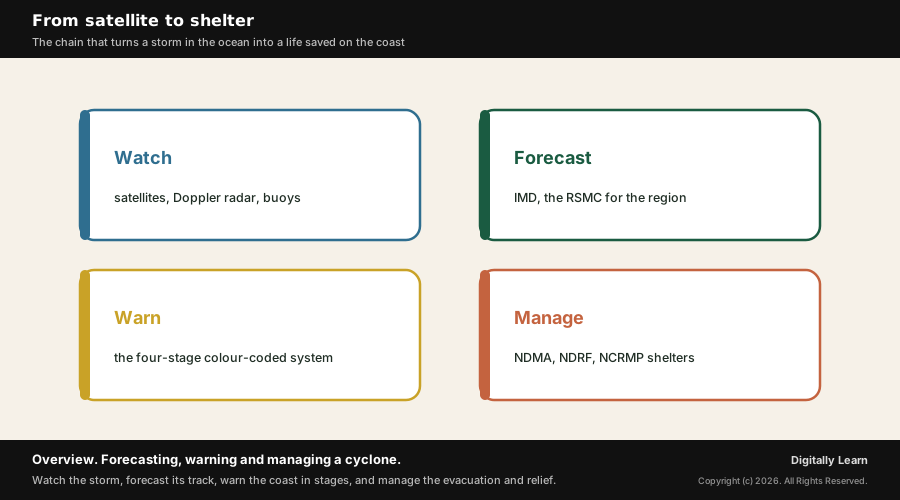
Cyclone forecasting and disaster management is the chain by which India watches a developing storm with satellites and radar, forecasts its track and surge at the India Meteorological Department, warns the coast through a four-stage colour-coded system, and manages the evacuation and relief through the NDMA, the NDRF and the National Cyclone Risk Mitigation Project.
The cyclone warning chain
Why early cyclone warning saves lives
A tropical cyclone cannot be stopped, but its toll can be cut almost to zero by warning people in time. India's cyclone defence is therefore a chain that runs from a satellite image to a villager reaching a shelter, and every link in that chain has to hold.
That chain has four parts: watching the storm, forecasting its track, warning the coast in stages, and managing the evacuation and relief. The sections below follow it in order and explain why India is now seen as a world model in cyclone preparedness.
How a cyclone is watched and monitored
Satellites, radar and ocean buoys
The watch begins far out at sea. Satellites such as the INSAT series, supported by the National Remote Sensing Centre, photograph the cloud mass day and night and reveal the storm's eye, size and movement long before it nears land.
Closer in, Doppler weather radars along the coast measure the rain and wind inside the storm in real time, while ocean buoys and tide gauges run by INCOIS track the sea state and the rising water, feeding a constant stream of data to the forecasters.
| Observing tool | What it watches |
|---|---|
| Satellites (INSAT, NRSC) | Cloud mass, eye, size and movement, day and night |
| Doppler weather radar | Rain and wind inside the storm, in real time |
| Ocean buoys and tide gauges (INCOIS) | Sea state, waves and the rising water level |
| Automatic weather stations | Surface wind, pressure and rainfall on the coast |
Predicting where and how hard a cyclone will strike
The IMD as the regional warning centre
All of this data converges on the India Meteorological Department. The IMD is one of six Regional Specialised Meteorological Centres of the World Meteorological Organization, and its New Delhi centre is the regional nodal agency for the whole Indian Ocean north of the equator.
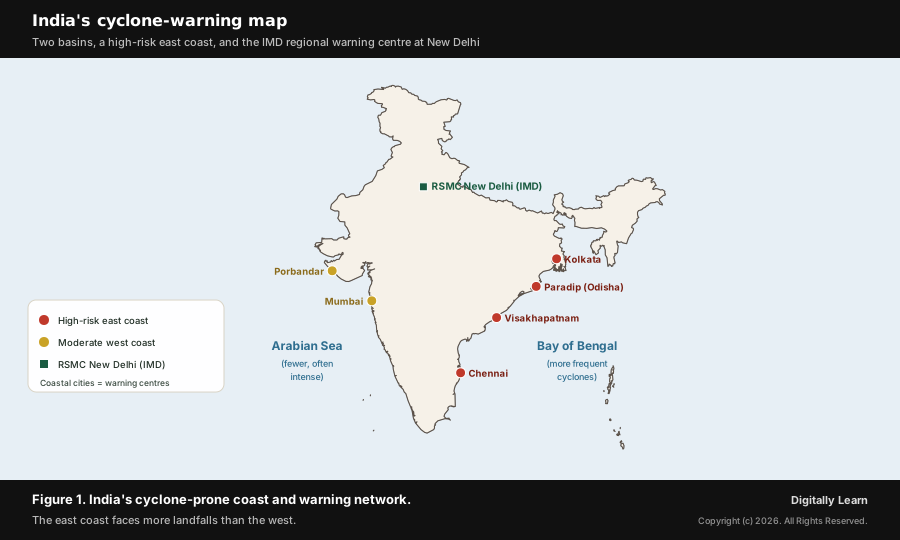
That role carries a regional duty. The IMD, as RSMC New Delhi, forecasts, names and issues warnings for tropical cyclones over the Bay of Bengal and the Arabian Sea, and shares them with the thirteen member countries that contribute the cyclone names used since 2020.
Track, intensity and storm-surge forecasts
From the data the forecasters predict two things: where the storm will go and how strong it will be. Numerical models project the track and the likely point of landfall, narrowing the warning as the cyclone approaches the coast.
The deadliest hazard is the storm surge, the wall of sea water a cyclone pushes ashore. INCOIS, under the Ministry of Earth Sciences, forecasts the surge and the high waves so that the right stretch of coast can be cleared in time.
The four-stage colour-coded cyclone warning
The four-stage warning system
The IMD turns its forecast into action through a four-stage warning. Each stage is issued earlier than the danger and carries a stronger colour, so that officials and the public always know how much time is left before landfall.
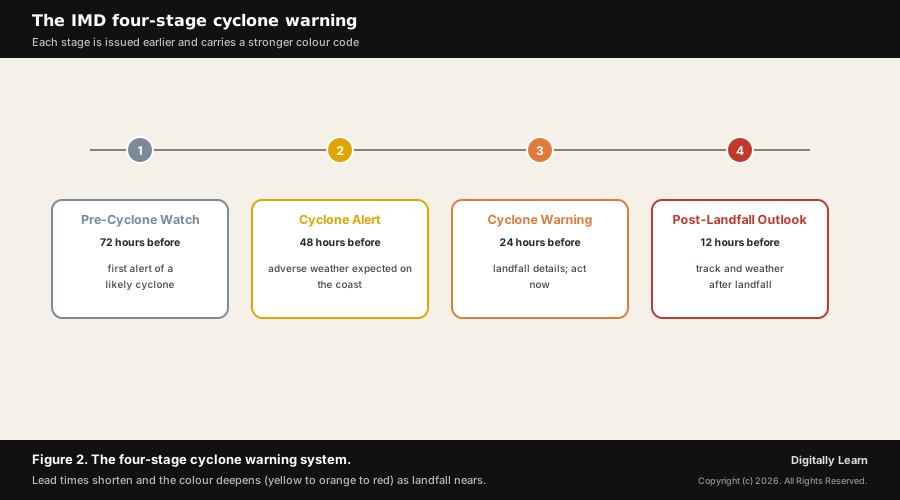
It opens with a Pre-Cyclone Watch about 72 hours ahead. Then come a Cyclone Alert at 48 hours in yellow, a Cyclone Warning near 24 hours in orange, and a Post-Landfall Outlook about 12 hours before landfall in red, each one sharpening the message.
Disaster management: NDMA, NDRF and the response agencies
The disaster-management institutional architecture
Forecasting is only half the system; the other half is response. At the apex sits the National Disaster Management Authority, the body set up under the Disaster Management Act of 2005 and chaired by the Prime Minister, which lays down the policy everyone else follows.
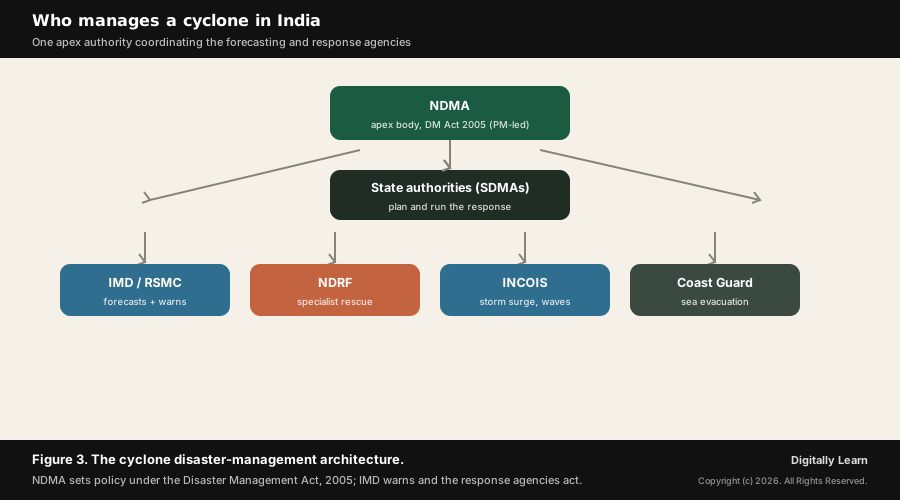
Below it the work is shared. The National Disaster Response Force carries out rescue, the state authorities run the evacuation, INCOIS warns of the surge and the Indian Coast Guard clears the sea, so that one storm meets a single, coordinated response.
Reducing coastal vulnerability before the storm
Cyclone shelters and the NCRMP
Warning saves lives only if there is somewhere to go. The National Cyclone Risk Mitigation Project, run by the NDMA with World Bank support, builds that safety into the coast itself, hardening the places where cyclones strike hardest.
- multi-purpose cyclone shelters, with the approach roads and bridges to reach them
- saline embankments to hold back the storm surge
- early-warning dissemination systems for the last mile
- underground cabling and other resilient coastal infrastructure
The project ran in two phases. Phase I began in 2011 in Andhra Pradesh and Odisha, and Phase II followed in 2015 across Gujarat, Maharashtra, West Bengal and other coastal states.
Falling cyclone deaths: from the 1999 Odisha super cyclone to Fani
How India cut cyclone deaths from 1999 to Fani
The proof of the system is in the death toll. The 1999 Odisha super cyclone, the most intense ever recorded in the North Indian Ocean, killed about 9,887 people because few could be warned or moved in time.
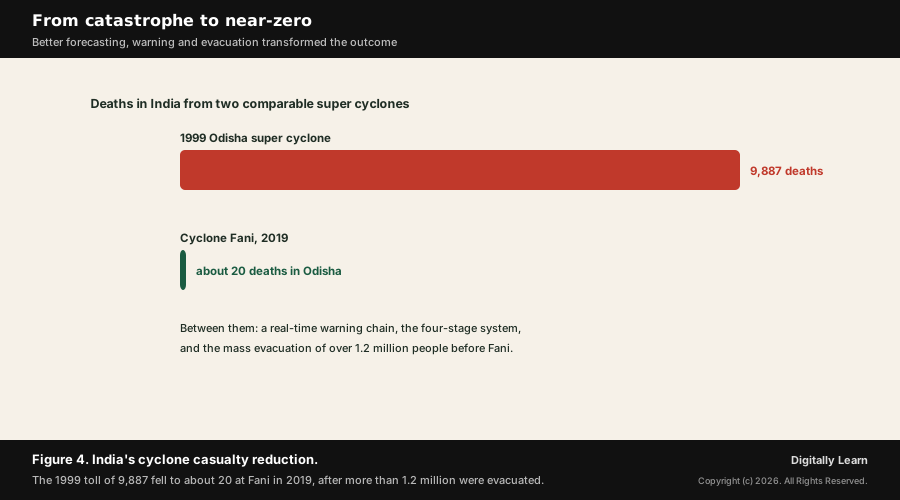
Twenty years later the contrast was stark. Before Cyclone Fani struck Odisha in 2019, more than 1.2 million people were evacuated on the strength of the warnings, and the death toll fell to about twenty, a transformation now studied around the world.
How this appears in the UPSC exam
What the UPSC exam asks on cyclone management
This topic sits in GS Paper I geography and GS Paper III disaster management. The 2022 question on the IMD's colour-coded warnings and the 2020 question on India's shift to a proactive approach both draw directly on this material.
A strong answer names the institutions and shows the chain. Link the IMD and its four-stage warning to the NDMA, the NCRMP and the evacuation record, and the 1999-to-Fani story gives a ready, evidence-based conclusion.
Previous Year UPSC-CSE Questions
Previous Year UPSC-CSE Questions By the end you will be able to draft model answers for the following UPSC questions. Each question carries a collapsible framework showing how to approach it in the exam.
- UPSC Mains 2022 GS-IDiscuss the meaning of colour-coded weather warnings for cyclone prone areas given by India Meteorological Department.
How to structure the answer in the exam
Introduction: Introduce the IMD as the RSMC that issues graded, colour-coded cyclone warnings.
Body (sub-themes to develop):
- The four stages: Pre-Cyclone Watch, Cyclone Alert, Cyclone Warning, Post-Landfall Outlook.
- The colour code: yellow (alert), orange (warning), red (post-landfall), each signalling greater urgency.
- Lead times that shorten from 72 hours to 12 hours as landfall nears.
- How the codes trigger evacuation and the response by NDMA, NDRF and the states.
Conclusion: Conclude that the colour code translates a forecast into simple, time-bound public action.
- UPSC Mains 2020 GS-IIIDiscuss the recent measures initiated in disaster management by the Government of India departing from the earlier reactive approach.
How to structure the answer in the exam
Introduction: State the shift from post-disaster relief to pre-disaster preparedness and mitigation.
Body (sub-themes to develop):
- The Disaster Management Act, 2005 and the NDMA as the institutional turn.
- Investment in early warning: the IMD's four-stage system and INCOIS.
- Mitigation infrastructure: the NCRMP, cyclone shelters and embankments.
- Result: the fall in cyclone deaths from 1999 to Fani in 2019.
Conclusion: Conclude that the proactive approach saves lives and assets, as the cyclone record shows.
Sources and Further Reading
- India Meteorological Department (RSMC New Delhi)
- RSMC New Delhi: four-stage cyclone warning
- Wikipedia: India Meteorological Department
- Wikipedia: Tropical cyclone naming (North Indian Ocean)
- National Disaster Management Authority (NCRMP)
- World Bank: National Cyclone Risk Mitigation Project
- INCOIS (Ministry of Earth Sciences)
- WMO Tropical Cyclone Programme
- Wikipedia: 1999 Odisha cyclone
- Wikipedia: Cyclone Fani
Editorial Disclaimer
This article explains cyclone forecasting and disaster management in India for UPSC preparation, drawing on the IMD, NDMA, INCOIS and World Bank sources. Institutions, stages and figures reflect the cited authorities.