


Overview
Part 5: From Disturbance to Dissipation
Five WMO stages, Dvorak T-numbers, IMD intensity tiers, and the three pathways of decay.
The tropical cyclone life cycle is the progression of a storm from a disorganised disturbance through intensification to a mature cyclone, then dissipation.
Life Cycle as the Operational Planning Unit
Definition: Five Operational Stages from Disturbance to Dissipation
The tropical cyclone life cycle is the chronological progression of a storm system from a disorganised tropical disturbance through intensification to a mature cyclone, and finally to dissipation.
The World Meteorological Organization operational scheme uses five distinct stages: tropical disturbance, tropical depression, cyclonic storm (the IMD name for what other basins call a tropical storm), mature tropical cyclone, and dissipation. The Indian Meteorological Department maps each stage to specific sustained wind speed bands covered in Part 2 of this series.
The lifecycle framing is the operational planning unit for forecasting and disaster management. Each stage triggers a specific RSMC New Delhi warning tier, a specific level of evacuation activation, and a specific Coast Guard alert posture. Part 4 of this series covered the mechanism that drives genesis; Part 5 takes the time-axis perspective, showing how the same physical forces unfold across a typical five-to-seven day lifespan and where the canonical failure modes between stages occur.
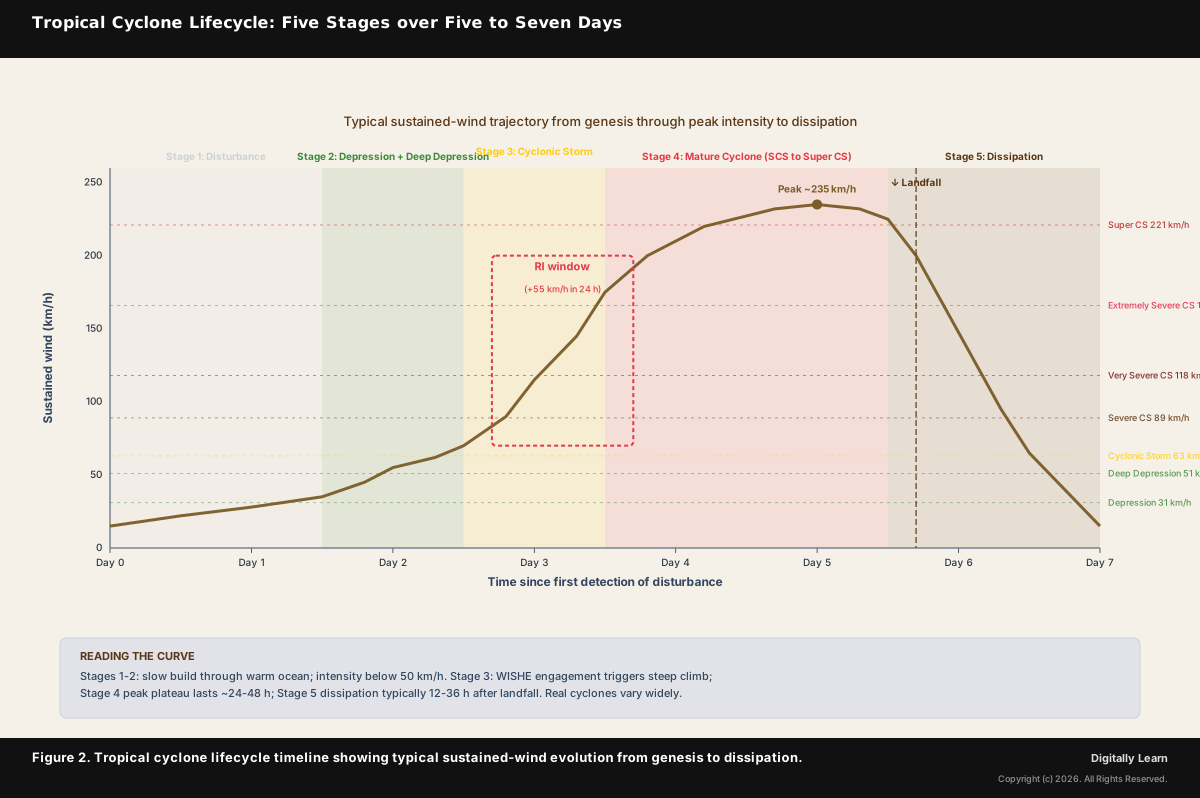
| Stage | What happens | IMD intensity tier |
|---|---|---|
| 1. Tropical disturbance | Disorganised thunderstorm cluster over warm ocean; weak rotation, no closed circulation | Low-pressure area / well-marked low |
| 2. Tropical depression | Closed surface circulation forms; eye not yet visible | Depression and Deep Depression (31 to 62 km/h) |
| 3. Cyclonic storm | System crosses the naming threshold; WISHE feedback fully engaged | Cyclonic Storm (63 km/h and above) |
| 4. Mature cyclone | Eye, eyewall and rainbands organised; peak-intensity plateau | Severe to Super Cyclonic Storm (89 km/h and above) |
| 5. Dissipation | Energy supply cut by landfall, cool water or extratropical transition | Weakening back through the lower tiers |
Stage 1: Tropical Disturbance
The Twenty-Four to Seventy-Two Hour Pre-Cyclone Window
What is the significance of the disturbance stage. A tropical disturbance is a disorganised cluster of thunderstorms over warm ocean water with weak low-level rotation but without a closed surface circulation. This is the pre-cyclone window during which only a small fraction of disturbances will graduate to depression status.
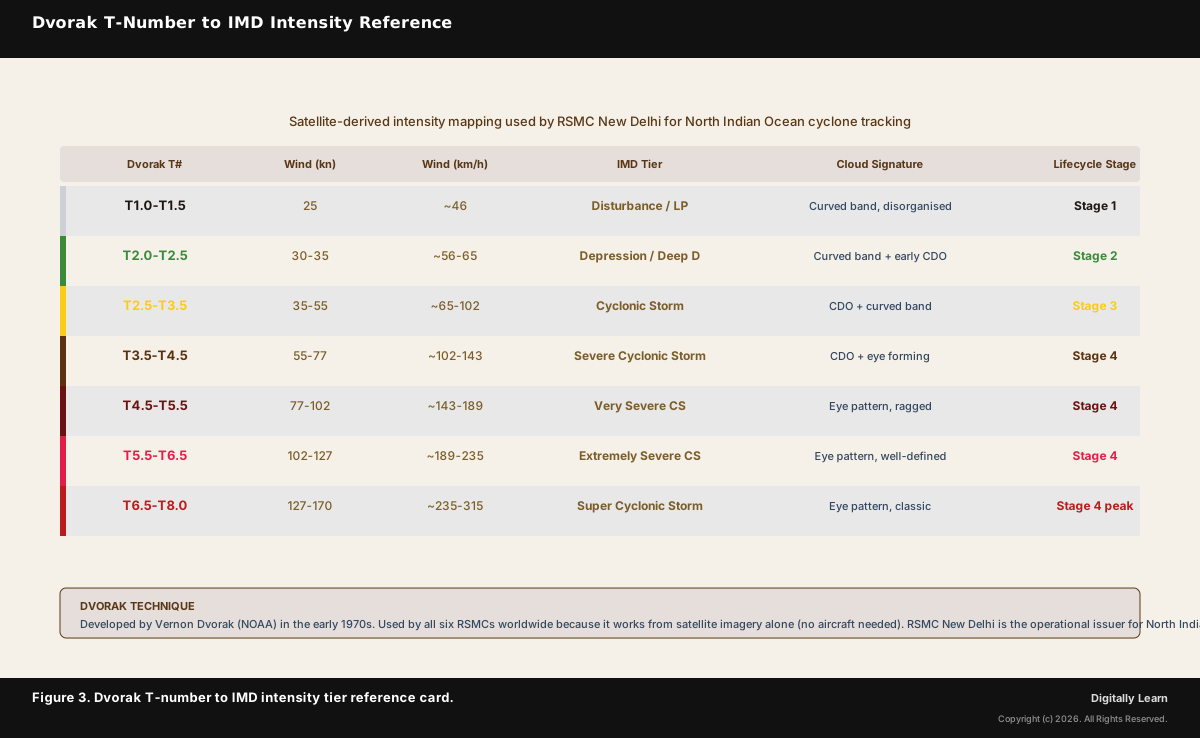
- Dvorak T-number range: T1.0 to T1.5 on the Dvorak satellite intensity scale, corresponding to a sustained surface wind estimate of approximately twenty-five knots (around forty-six kilometres per hour) on the Dvorak CI scale.
- Satellite signature: Curved band pattern with disorganised cloud bursts; no central dense overcast yet; no eye signature visible.
- Typical duration: Twenty-four to seventy-two hours before either graduating to tropical depression or dissipating without further intensification.
- Failure-mode rate: Most tropical disturbances do NOT graduate. Vertical wind shear above ten metres per second, dry-air entrainment at the mid-troposphere, or migration into cooler water all break the genesis pathway at this stage.
- Operational handling: RSMC New Delhi flags these as a low-pressure area or well-marked low-pressure area in bulletins; no formal cyclone warning is issued yet.
Stages 2 and 3: Tropical Depression and Cyclonic Storm
Closed Circulation Forms, the Storm Receives a Name
Stages 2 and 3 carry the system from a closed but weak low-level circulation through to a named cyclonic storm with a fully engaged WISHE feedback. Both stages take place over warm ocean (sea-surface temperatures above twenty-six point five degrees Celsius) and require the low vertical wind shear condition to hold.
- Stage 2 Tropical Depression: Sustained winds reach thirty-one to fifty kilometres per hour (the IMD Depression tier); the system has a closed surface circulation. The Deep Depression sub-tier (fifty-one to sixty-two kilometres per hour) follows. Dvorak T-number is approximately T2.0 to T2.5 (around thirty to thirty-five knots on the Dvorak CI scale). The eye is not yet visible.
- Stage 3 Cyclonic Storm: Sustained winds cross the sixty-three kilometre per hour threshold (IMD CS tier; Dvorak T2.5 to T3.5, approximately thirty-five to fifty-five knots on the CI scale). At this point the system receives a name from the regional naming list covered in Part 2. The Atlantic and Pacific equivalent is the Tropical Storm tier.
- WISHE engagement: This is where the wind-evaporation positive feedback covered in Part 4 begins to dominate the intensity trajectory. Each kilometre per hour of wind gain unlocks slightly more latent heat extraction from the warm ocean, which unlocks more convection, which closes the loop.
- Eyewall formation begins: A ring of intense thunderstorms around a developing low-pressure centre starts to organise; the central dense overcast becomes visible on satellite imagery.
- Operational handling: IMD issues a cyclone alert (forty-eight hours pre-landfall) followed by a cyclone warning (twenty-four hours pre-landfall) once the system intensifies to Cyclonic Storm or higher; colour-coded warnings (yellow watch, orange alert, red warning) escalate accordingly.
Stage 4: Mature Tropical Cyclone
Eye, Eyewall, and the Peak-Intensity Plateau
The mature stage begins when sustained winds cross eighty-nine kilometres per hour (the IMD Severe Cyclonic Storm threshold; Dvorak T3.5 to T4.0 and above) and the eye, eyewall, and outer rainbands are fully organised. The Maximum Potential Intensity ceiling defined by the Emanuel framework covered in Part 4 is approached during this stage, with peak winds typically reaching seventy to eighty percent of MPI in real-world events.
- Eye formation: A clear central column thirty to sixty-five kilometres in diameter develops as subsiding dry air dries the cloud cover; the eye is the canonical satellite signature of a mature cyclone.
- Eyewall: A ring of the most intense convection surrounding the eye; this is where peak surface winds and storm-surge potential are concentrated.
- Rapid intensification (RI): Defined by the US National Hurricane Center as an increase of at least thirty knots (fifty-five kilometres per hour) in the maximum sustained winds within twenty-four hours. Approximately twenty to thirty percent of all tropical cyclones undergo RI; the probability for hurricane-force tropical cyclones has increased from one percent in the 1980s to approximately five percent now, an increase IPCC AR6 attributes to anthropogenic climate change beyond natural variability.
- Peak-intensity plateau: Once the cyclone reaches its environment-constrained peak, the intensity holds at a plateau for hours to a few days while the cyclone is still over warm open water; the Dvorak T-number stays at its maximum during this window.
- Indian anchor cases: Cyclone Phailin (October 2013) underwent RI before Odisha landfall; Cyclone Fani (May 2019) reached Extremely Severe Cyclonic Storm before Puri landfall; Cyclone Amphan (May 2020) became Super Cyclonic Storm in the Bay of Bengal.
Stage 5: Dissipation
Three Pathways from Mature Cyclone to Decay
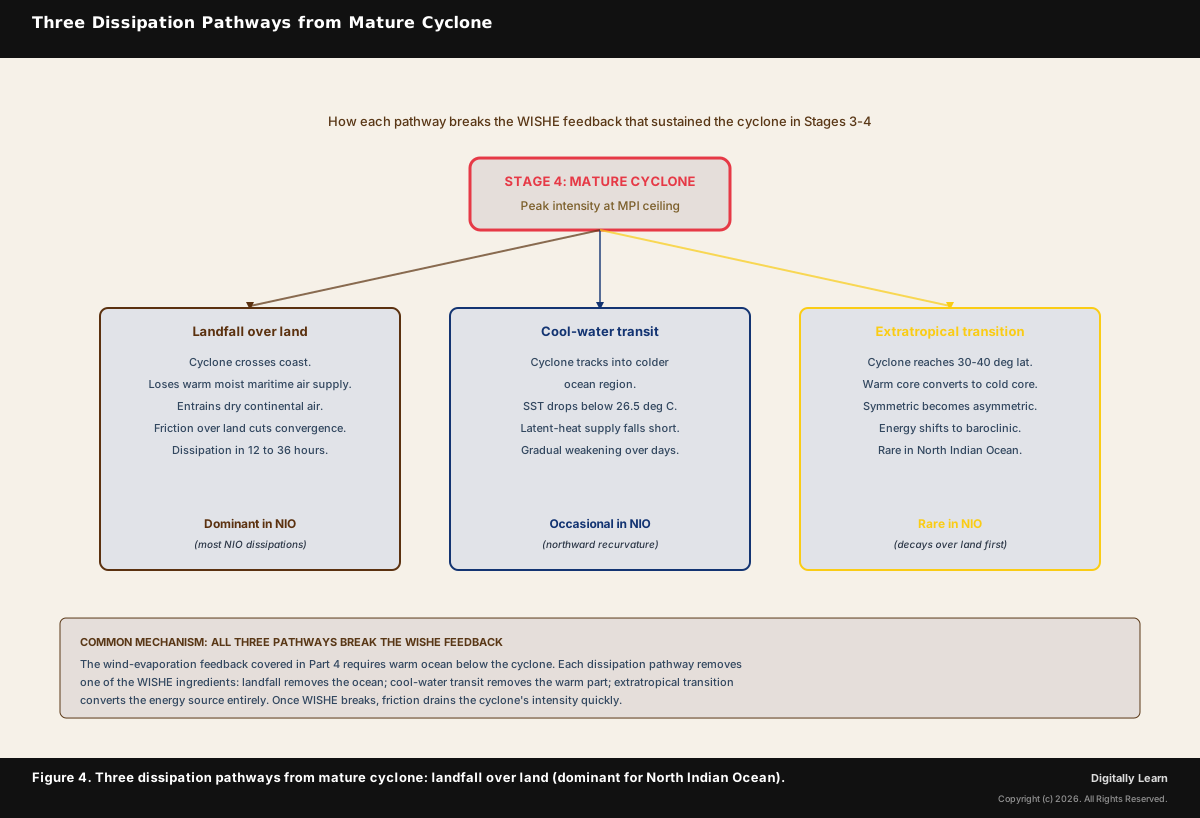
The dissipation stage ends the cyclone's life and operates through one of three distinct pathways, each of which breaks the WISHE feedback covered in Part 4 in a different physical way.
- Landfall over land: The dominant dissipation pathway for North Indian Ocean cyclones. Once the cyclone crosses the coast, it is cut off from its supply of warm moist maritime air and starts to entrain dry continental air. The increased surface friction over land also accelerates the loss of low-level convergence. Dissipation typically completes within twelve to thirty-six hours of landfall.
- Cool-water transit: When the cyclone tracks polewards into ocean regions where sea-surface temperatures fall below the twenty-six point five degree Celsius threshold, the latent-heat supply that fuels WISHE drops below sustaining levels and the cyclone weakens.
- Extratropical transition (ET): When the cyclone reaches mid-latitudes (typically between thirty and forty degrees latitude), its warm core converts to a cold core, the symmetric structure becomes asymmetric, and the primary energy source shifts from latent-heat release to baroclinic processes along temperature gradients. The system size increases while the core weakens; high-impact winds extend across a broader geographic area. Extratropical transition is rare in the North Indian Ocean because cyclones usually decay over land before reaching mid-latitudes.
Climate-Driven Lifecycle Shifts and Cluster Cross-References
How Warming Is Reshaping the Cyclone Life Cycle
Climate change is reshaping the cyclone life cycle through three measurable shifts that change forecast confidence and disaster-management timelines.
- Higher rapid-intensification frequency: The probability that a hurricane-force tropical cyclone undergoes rapid intensification has risen from approximately one percent in the 1980s to approximately five percent now. IPCC AR6 Working Group 1 Chapter 11 attributes this increase to anthropogenic warming beyond natural variability. The operational consequence is a compressed warning timeline: RI events that occur within twenty-four hours of landfall leave very little room for evacuation escalation.
- Extended mature-stage duration: Warmer sea-surface temperatures and deeper warm-water layers (higher ocean heat content) keep cyclones at peak intensity for longer before they hit dissipation triggers, increasing the time-integrated wind-and-rain impact.
- Slower post-landfall decay: Recent research suggests that warmer atmospheric moisture content allows cyclones to retain intensity for longer after landfall in some basins, especially over moist soils and inland water bodies. The implication is that inland districts historically considered low-risk may now face higher residual wind and rainfall.
Part 6 develops the temperate-cyclone polar-front theory and extends the dissipation pathway of extratropical transition. Part 8 covers the cyclone-monsoon interaction between cyclone lifecycle and the Indian monsoon (pre-monsoon and post-monsoon peaks). Part 9 covers the physical and socio-economic impacts that scale with lifecycle stage.
Part 10 covers the major Indian case studies including the lifecycle-specific characteristics of 1999 Odisha, 2013 Phailin, 2019 Fani, 2020 Amphan, 2021 Tauktae, 2023 Biparjoy, and 2024 Dana. Part 11 covers forecasting and disaster management, and Part 12 covers the climate-change synthesis.
Sources
- Fundamentals of Physical Geography, Class 11, Chapter 11: World Climate and Climate Change
- Tropical cyclone
- Dvorak technique
- Rapid intensification
- Extratropical transition
- RSMC New Delhi: North Indian Ocean Cyclone Bulletins and Lifecycle Tracking
- Best Track Archive for North Indian Ocean Tropical Cyclones
- Tropical Cyclone Programme and Lifecycle Definitions
- Best Track Archive and Intensity Methodology
- Rapid Intensification Research and Dvorak Technique Documentation
- Assessment Report 6 Working Group 1 Chapter 11: Weather and Climate Extreme Events
- Cyclone Disaster Management Guidelines and Lifecycle-Anchored Evacuation Protocols
Previous Year UPSC-CSE Questions
Previous Year UPSC-CSE Questions By the end you will be able to draft model answers for the following UPSC questions. Each question carries a collapsible framework showing how to approach it in the exam.
- UPSC Mains 2022 GS-IDiscuss the meaning of colour-coded weather warnings for cyclone prone areas given by India Meteorological Department.
How to structure the answer in the exam
Introduction: The India Meteorological Department issues a four-tier colour-coded weather warning system for cyclone-prone areas, anchored to the lifecycle-stage progression covered in Part 5 of this series and the IMD intensity scale covered in Part 2.
Body (sub-themes to develop):
- Colour-tier matrix: Green (no warning, the disturbance stage or below); Yellow (watch, Deep Depression or higher expected); Orange (alert, Cyclonic Storm or higher, evacuation preparation); Red (warning, Severe Cyclonic Storm landfall imminent, full evacuation).
- Lifecycle anchoring: each colour tier corresponds to a specific stage of the WMO five-stage scheme. Yellow fires at Stage 2 Deep Depression, Orange at Stage 3 Cyclonic Storm, Red at Stage 4 Mature Cyclone approaching the coast.
- Operational consequence: rapid intensification can compress the timeline between Yellow and Red, which is the principal forecast-uncertainty challenge of the modern climate-affected cyclone.
Conclusion: The colour-coded warning system links satellite-derived Dvorak T-numbers to lifecycle stage to evacuation decision in a single inter-agency framework. The increasing frequency of rapid-intensification events covered in this Part 5 article is the principal new pressure on the existing escalation timeline.
- UPSC Mains 2024 GS-IWhat is sea surface temperature rise? How does it affect the formation of tropical cyclones?
How to structure the answer in the exam
Introduction: Sea-surface temperature rise is the warming of the ocean's upper layer that fuels tropical cyclones. The Part 5 specific dimension is the lifecycle-stage perspective on how that warming reshapes the storm's trajectory.
Body (sub-themes to develop):
- Higher rapid-intensification frequency: the RI probability for hurricane-force tropical cyclones rose from about one percent in the 1980s to about five percent now, an increase IPCC AR6 attributes to anthropogenic warming.
- Extended mature-stage duration: warmer ocean heat content keeps cyclones at peak intensity longer before they hit dissipation triggers, increasing the time-integrated wind-and-rain impact.
- Compressed warning timeline: RI close to landfall leaves little room for evacuation escalation, the principal operational consequence of SST rise.
Conclusion: Cross-referenced with Parts 1, 3, and 4 for the full development. Part 5 underscores that SST rise compresses the warning-to-landfall timeline and lengthens the peak-intensity window.
- Prelims 2015In the South Atlantic and South-Eastern Pacific regions in tropical latitudes, cyclone does not originate. What is the reason?
How to approach this Prelims question
Approach: Cross-referenced from Part 1. In Part 5 the linkage is that the cyclone lifecycle cannot start in regions where the seed-disturbance condition (ITCZ presence) fails year-round; without Stage 1 there can be no Stages 2 through 5.
Trap to watch: Option (c) Coriolis force too weak is plausible at first glance but incorrect. Coriolis is sufficient at the relevant latitudes.
Key facts to recall:
- Six worldwide cyclone basins all align with ITCZ presence over warm ocean.
- South Atlantic and South-Eastern Pacific are NOT among the six basins.
- ITCZ is the primary seed-disturbance channel that triggers Stage 1 of the lifecycle.
- Without Stage 1 there can be no lifecycle progression to Stages 2 through 5.
Answer signal: ITCZ seldom occurs (option b).
Disclaimer
This article is an explainer for UPSC preparation and is not a substitute for primary documents. For operational warnings and live cyclone tracking, consult the IMD RSMC New Delhi portal. Intensity thresholds and wind-speed bands follow the official IMD classification.