


Overview
Why the Bay has more cyclones, and the global distribution of tropical cyclones

The Bay of Bengal and Arabian Sea are the two parts of the North Indian Ocean cyclone basin, the least active of the world's seven tropical cyclone basins. The Bay of Bengal produces about four times as many cyclonic storms as the Arabian Sea, and its storms are deadlier, because they strike a low, shallow, densely peopled coast.
Global Distribution of Tropical Cyclones: Basins and Belts
Where Tropical Cyclones Form: The Seven Basins
Tropical cyclones form only over warm tropical seas, and the areas where they form are divided into seven basins: the North Atlantic, the eastern and western North Pacific, the South-west Pacific, the South-west and South-east Indian Ocean, and the North Indian Ocean (the Arabian Sea and the Bay of Bengal). They are intense low-pressure areas confined to the belt between 30 degrees north and 30 degrees south.
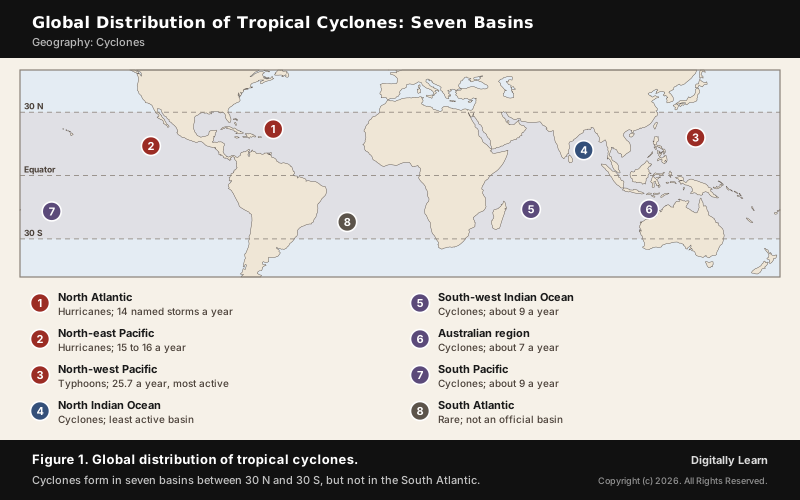
| Basin | Storms a year and local name |
|---|---|
| North-west Pacific | 25.7 tropical storms; typhoons; the most active |
| North-east Pacific | 15 to 16 tropical storms; hurricanes |
| North Atlantic | 14 named storms; hurricanes |
| South-west Indian Ocean | About 9; cyclones |
| South Pacific | About 9; cyclones |
| Australian region | About 7; cyclones |
| North Indian Ocean | 4 to 6; cyclones; the least active |
Across the world an average of 86 tropical cyclones of tropical-storm strength form each year; 47 reach hurricane or typhoon strength and 20 become intense storms. The North-west Pacific alone accounts for one-third of all activity, while the North Indian Ocean contributes only about seven per cent.
- Spin by hemisphere: Surface winds blow anticlockwise round the eye in the Northern Hemisphere and clockwise in the Southern Hemisphere, because of the Coriolis effect.
- Southern basins: The WMO splits the south into three: the South-west Indian Ocean between Africa and 90 degrees E, the Australian region between 90 and 160 degrees E, and the South Pacific between 160 degrees E and 120 degrees W.
- Medicanes: On rare occasions tropical-like storms of hurricane strength form over the Mediterranean Sea, but it is not a tropical cyclone basin.
Hurricane, Typhoon and Cyclone: One Storm, Regional Names
A hurricane, a typhoon and a cyclone are the same kind of storm; only the region changes the name. Tropical cyclones are called cyclones in the Indian Ocean, hurricanes in the Atlantic, typhoons in the Western Pacific and South China Sea, and willy-willies in Western Australia.
- Who names them: Each basin has a Regional Specialized Meteorological Centre; for the North Indian Ocean it is the India Meteorological Department (RSMC New Delhi), which names a storm once it becomes a cyclonic storm with winds of at least 63 km per hour.
- The list: Naming in the North Indian Ocean began in September 2004. The current list has 169 names, 13 from each of 13 member countries of the WMO/ESCAP Panel, and a name once used is never used again.
- Why name storms: Names are the fastest way to communicate warnings and avoid confusion when several storms are active at once.
Storms in every basin are graded and named on the IMD intensity scale and the regional naming lists.
Why No Tropical Cyclones Form in the South Atlantic or at the Equator
Two gaps on the world map need explaining. Cyclones rarely form within 5 degrees of the equator, because the Coriolis force there is too weak to set a low spinning; its absence between 0 and 5 degrees prohibits tropical cyclones.
The South Atlantic is the other gap. It is not an official basin, and the reason is not mainly cold water: vertical wind shear there is much too strong, and there is usually no Inter-Tropical Convergence Zone over the ocean to supply spin and thunderstorms. A rare hurricane, Catarina, did form there in March 2004 and struck Brazil.
Why Cyclones Hit the South China Sea, Bay of Bengal and Gulf of Mexico
Cyclones need a particular set of conditions, and some seas meet all of them season after season. The conditions for forming and strengthening a tropical storm are:
- A large sea surface warmer than 27 degrees C.
- The presence of the Coriolis force.
- Small variations in vertical wind speed, that is, little wind shear.
- A pre-existing weak low-pressure area or low-level cyclonic circulation.
- Upper-level divergence above the sea-level system.
The South China Sea belongs to the North-west Pacific, the most active basin, and the coast of China sees the most landfalling tropical cyclones in the world, while the Philippines receives six to seven landfalls a year. The Gulf of Mexico lies inside the North Atlantic basin, where hurricanes form from June to November. The Bay of Bengal dominates the North Indian Ocean. All three are warm, partly enclosed seas in the cyclone belt with coasts close by, so storms that form there often reach land.
Bay of Bengal and Arabian Sea Cyclones Compared
How Many More Cyclones Form in the Bay of Bengal?
India's peninsular shape puts it between two cyclone seas, the Bay of Bengal to the east and the Arabian Sea to the west. The Bay is far busier: in the NCERT record of cyclonic storms, the Bay of Bengal counts 314 against the Arabian Sea's 82, nearly four to one.
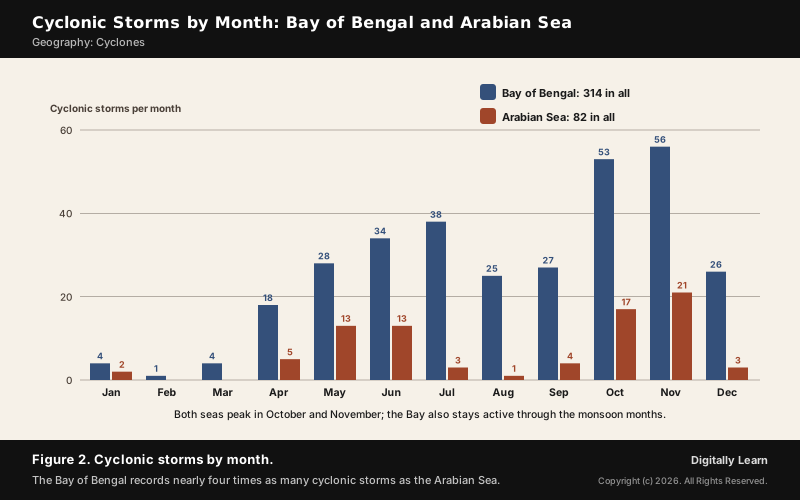
- Busiest months: November (56 in the Bay, 21 in the Arabian Sea) and October (53 and 17).
- Pre-monsoon: A smaller peak in May and June in both seas.
- Monsoon months: The Bay stays active in the record (38 in July), but its monsoon systems usually peak only as depressions or deep depressions before crossing Odisha or West Bengal, because high wind shear stops most from becoming full cyclones; the Arabian Sea almost falls silent (3 in July, 1 in August).
- Whole basin: Only about five to six tropical cyclones form in the North Indian Ocean in a year.
The two seas also differ in timing. November alone holds 25.6 per cent of the Arabian Sea's storms against 17.8 per cent of the Bay's, and May and June together hold 31.8 per cent of the Arabian Sea's against 19.7 per cent of the Bay's. The Arabian Sea's storms are packed into the two transition seasons, while the Bay's are spread through the year.
Why the Bay of Bengal Has More Cyclones Than the Arabian Sea
The Bay of Bengal is more prone to cyclones because it meets the formation conditions more often, and because it receives storms that were born elsewhere. The reasons are:
- Warmer, more humid water: High sea surface temperatures and humidity make the Bay more favourable to cyclone formation.
- Borrowed storms: Many Bay cyclones form in the south-east Bay or the Andaman Sea, or grow from the remnant of a typhoon that crossed from the South China Sea.
- A cooler, windier Arabian Sea: The Arabian Sea forms fewer cyclones because of its cooler sea surface and high wind shear.
- Monsoon depressions: Even in the monsoon months the Bay keeps producing depressions that cross the east coast.
The same shear explains the quiet monsoon months across the basin. Between the surface monsoon low and the upper-level high, strong vertical wind shear tears young cyclones apart, which also stops any cyclone forming in the Red Sea although it is deep and warm enough. A strong positive Indian Ocean Dipole can raise Arabian Sea activity, as in 2019.
Why Bay of Bengal Cyclones Are More Dangerous
The Bay of Bengal's storms are not only more frequent but deadlier, and the reason lies on the coast. Although the North Indian Ocean is the least active basin, the deadliest tropical cyclones in the world have formed here, because the Ganges and Ayeyarwady deltas are so densely peopled.
- A shallow, wide shelf: A wide shelf with shallow water produces a higher storm surge, because the surge has less room to spread down and away; the Bay of Bengal is one such shallow area.
- A low-lying coast: The low coast of the Bay is particularly vulnerable to surges.
- The worst record: The 1970 Bhola cyclone killed at least 300,000 people, possibly 500,000, mainly through the storm surge on the islands of the Ganges Delta.
- Recurving storms: Cyclones that cross about 20 degrees north generally recurve, and they are more destructive.
- Recent extremes: The 1999 Odisha cyclone was the most intense ever recorded in the Bay, and Amphan in May 2020 was the strongest cyclone to strike the Ganges Delta and the strongest to hit India since 1999.

Arabian Sea Cyclones: Fewer, Often Offshore, but Rising
Most Arabian Sea cyclones form over the south-east of the sea or grow from the remnant of a Bay of Bengal storm, and move north-west towards the Arabian Peninsula. Some turn north-east after crossing about 15 degrees north and strike the Gujarat coast.
- Offshore endings: Most Arabian Sea storms die out at sea; a significant number strike Gujarat and Maharashtra, and 11 per cent reach the Arabian Peninsula, the Horn of Africa or Pakistan.
- Gonu, 2007: The strongest cyclone on record in the Arabian Sea, with peak winds of 240 km per hour; it struck Oman and then Iran.
- Tauktae, 2021: The strongest cyclone to make landfall in Gujarat since the 1998 Gujarat cyclone.
- Biparjoy, 2023: An erratic, powerful storm that made landfall at Naliya in Gujarat on 16 June.
- A warming sea: Eight cyclonic storms formed in the Arabian Sea in 2019, a joint record, and the sea surface there has warmed by 1.2 to 1.4 degrees C in recent decades.
| Feature | Bay of Bengal | Arabian Sea |
|---|---|---|
| Cyclonic storms (NCERT record) | 314 | 82 |
| Where they form | South-east Bay, Andaman Sea | South-east Arabian Sea |
| Usual track | North-west, then recurve north-east | North-west to Arabia, some to Gujarat |
| Main landfall in India | Odisha, West Bengal, Andhra, Tamil Nadu | Gujarat, Maharashtra |
| Deadliest storm | Bhola, 1970 | Gonu, 2007 (strongest) |
Whether the Arabian Sea's rise is a lasting shift turns on warming seas and rapid intensification.
Cyclone Seasons, Landfall and Warnings in India
Cyclone Seasons in India: May and November Peaks
The North Indian Ocean has a double peak of activity: one in April and May, before the monsoon, and another in October and November, just after it. Cyclones form from March to June and October to December, and the severe ones occur almost only from April to June and from late September to early December.
- Post-monsoon, the main season: In the Bay of Bengal cyclones mostly develop in October and November, in the retreating monsoon season; storms from the Andaman Sea cross the coast of the southern Peninsula.
- Intensification: A depression is most likely to strengthen in April, May and November, when more than half of the depressions become storms.
- By July: The place of origin shifts to around 18 degrees north near the Sundarbans delta, and the easterly jet steers monsoon depressions into India.
The two cyclone seasons follow the monsoon, which switches cyclones on and off.
East Coast and West Coast: Where Cyclones Strike India
Bay of Bengal storms usually move north-west until they reach the east coast and then turn north-east. Most strike Odisha or West Bengal, and a significant number hit Andhra Pradesh and Tamil Nadu; 30 per cent strike Bangladesh, Sri Lanka or Myanmar, and 13 per cent die out at sea.
- Exposure of the east coast: Tropical cyclones from the Bay of Bengal hit the Tamil Nadu, Andhra Pradesh and Odisha coasts with very high wind velocity and heavy rainfall.
- Exposure of the west coast: Gujarat and Maharashtra take most Arabian Sea landfalls.
- Force falls inland: A cyclone draws its energy from the sea, so its force decreases with distance from the coast; coastal areas are often struck by severe cyclonic storms averaging 180 km per hour.
- Storm surge: An abnormal rise of the sea driven by the pressure gradient and strong winds, which floods coastal lowlands.
Cyclones strike coasts, crops and livelihoods, as the major Indian cyclones from the 1999 Odisha super cyclone to Biparjoy show.
Tracking North Indian Ocean Cyclones: IMD and the Early Record
Systematic study of Bay of Bengal and Arabian Sea storms began in the 19th century with Henry Piddington, who used ships' logs and published tracks of individual storms in the Journal of the Asiatic Society of Bengal between 1839 and 1858. Today the India Meteorological Department watches the basin for 13 countries.
- Advisories: IMD is one of six RSMCs worldwide, giving cyclone and storm-surge advisories to Bangladesh, India, Iran, Maldives, Myanmar, Oman, Pakistan, Qatar, Saudi Arabia, Sri Lanka, Thailand, the United Arab Emirates and Yemen.
- Scale: Since 2015 a storm with winds of 165 to 220 km per hour has been called an extremely severe cyclonic storm.
- Size: A storm over the Bay of Bengal, Arabian Sea and Indian Ocean is 600 to 1,200 km across and moves 300 to 500 km a day.
Warnings reach people through monitoring, shelters and evacuation, built on an understanding of how a cyclone forms.
Previous Year UPSC-CSE Questions
Previous Year UPSC-CSE Questions By the end you will be able to draft model answers for the following UPSC questions. Each question carries a collapsible framework showing how to approach it in the exam.
- UPSC Mains 2014 GS-ITropical cyclones are largely confined to South China Sea, Bay of Bengal and Gulf of Mexico. Why?
Answer outline: how to structure the answer
What the question asks, the main arguments, relevant examples and the direction of the conclusion. This is not a full model answer.
Introduction: Open with the cyclone belt between 30 N and 30 S and the conditions: sea above 27 degrees C, Coriolis force, low shear, a pre-existing low, upper divergence.
Body (sub-themes to develop):
- South China Sea: part of the North-west Pacific, the most active basin; China has the most landfalls.
- Bay of Bengal: warm, humid, fed by Andaman Sea and Pacific remnants; about four times the Arabian Sea.
- Gulf of Mexico: warm North Atlantic sea where hurricanes form June to November.
- Partly enclosed seas close to coasts, so storms reach land.
- Contrast: no cyclones within 5 degrees of the equator or in the South Atlantic (shear, no ITCZ).
Conclusion: Conclude that the word 'confined' overstates it, since the North-west Pacific and other basins are active too, but these three seas combine warm water and exposed coasts.
Sources
- NCERT: Fundamentals of Physical Geography (Class XI), Atmospheric Circulation and Weather Systems
- NCERT: India Physical Environment (Class XI), Climate; Natural Hazards and Disasters
- PIB (MoES): New list of names of tropical cyclones over the north Indian Ocean
- IMD RSMC New Delhi: Frequently Asked Questions on Tropical Cyclones
- NOAA AOML: Hurricane FAQ
- WMO: Tropical cyclone naming
- Wikipedia: Tropical cyclone basins
- Wikipedia: North Indian Ocean tropical cyclone
- Wikipedia: Tropical cyclone
- Wikipedia: Tropical cyclone naming
- Wikipedia: Storm surge
- Wikipedia: 1970 Bhola cyclone
- Wikipedia: Cyclone Gonu
- Wikipedia: Cyclone Tauktae
- Wikipedia: Cyclone Biparjoy
- Wikipedia: Cyclone Amphan
- UPSC: Civil Services Examination question papers
Disclaimer
This article draws on the NCERT geography textbooks, the India Meteorological Department, the Press Information Bureau, NOAA, the WMO and the other sources listed on this page. Tracks and genesis zones on the maps are generalised.