


Overview
Classification, Naming, and Tracking
How the IMD seven-tier scale, the Saffir-Simpson cross-reference, the thirteen-nation naming panel, and RSMC New Delhi work as one system.
Tropical cyclone classification, naming, and tracking form one institutional pipeline. This guide explains the IMD seven-tier intensity scale by three-minute sustained wind, the Saffir-Simpson cross-reference, the thirteen-nation North Indian Ocean naming panel that has named storms since Cyclone Onil in 2004, and the tracking architecture run by RSMC New Delhi.
Why Standardised Classification Underpins Every Cyclone Response
Definition: Classification, Naming, and Tracking as Three Linked Operations
Tropical cyclone classification is the assignment of a forming storm to one of seven IMD intensity tiers based on its three-minute maximum sustained wind speed. Naming is the assignment of a human-readable name drawn from a thirteen-nation rotational list once the storm reaches the cyclonic-storm threshold.
Tracking is the continuous observation of the storm's centre and forward motion through satellite, radar, ocean-buoy, and surface-observation feeds. The three operations together form the institutional pipeline that converts a raw atmospheric disturbance into a named, intensity-classified, geographically located object that the IMD Regional Specialised Meteorological Centre New Delhi issues warnings about.
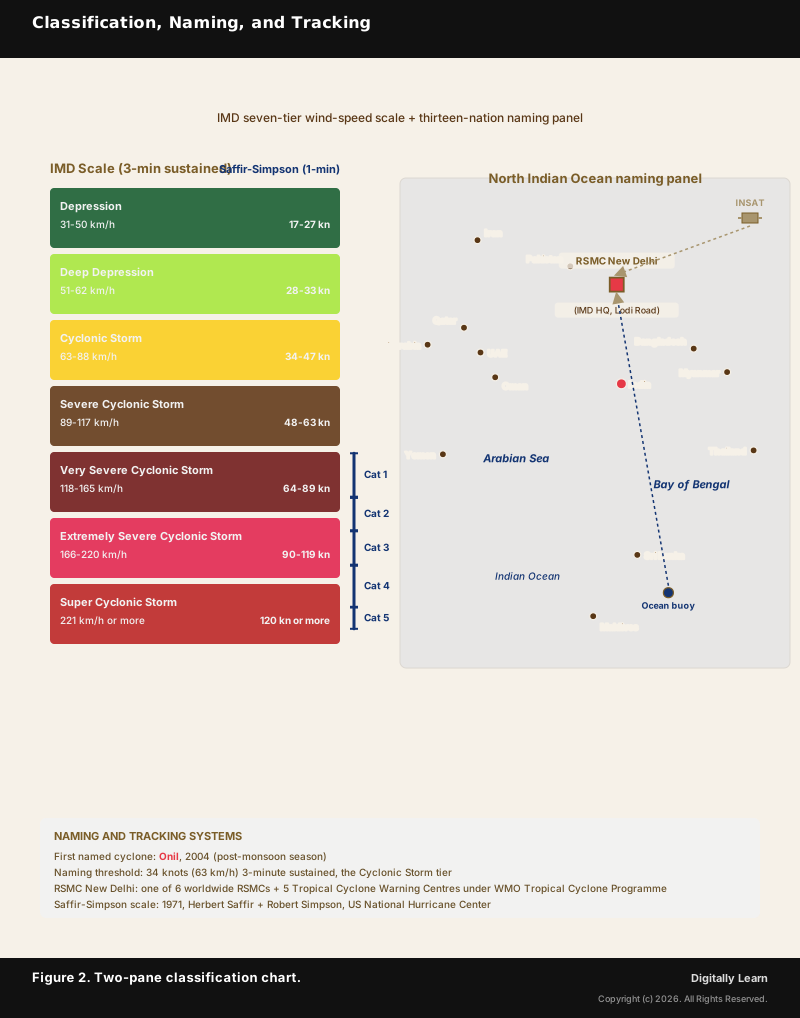
Standardisation is the precondition for cross-agency action. A severe cyclonic storm at 100 km/h sustained winds requires a different evacuation footprint than a super cyclonic storm at 250 km/h sustained winds.
Without a shared intensity vocabulary, the IMD warning to a state government, the Indian Coast Guard, the National Disaster Management Authority, and the fishing community would not converge on the same response level. The seven-tier IMD scale, the international Saffir-Simpson cross-reference, the thirteen-nation naming panel, and the RSMC New Delhi forecasting authority together define the operational framework covered in this article.
Why Classification, Naming, and Tracking Form One System
What is the significance of treating classification, naming, and tracking as a single institutional pipeline. The three operations are sequenced and interdependent. Classification feeds naming because a storm is named only when it crosses the cyclonic storm threshold at thirty-four knots of three-minute sustained wind.
Naming then feeds tracking because every IMD bulletin from that point onward identifies the storm by its assigned name. Tracking in turn feeds reclassification: as the storm intensifies or weakens, the IMD upgrades or downgrades its intensity tier in subsequent bulletins. The pipeline runs through the same authority at every stage, the IMD Regional Specialised Meteorological Centre at New Delhi, one of six such centres worldwide under the World Meteorological Organization Tropical Cyclone Programme.
| Pillar | Function | Authority |
|---|---|---|
| IMD seven-tier intensity scale | Defines wind-speed thresholds for each class | IMD India |
| Saffir-Simpson hurricane scale | International cross-reference (Cat 1 to 5) | US National Hurricane Center, 1971 |
| Thirteen-nation naming panel | Assigns names from rotational lists | WMO and ESCAP panel members |
| RSMC New Delhi forecasting | Issues bulletins for the entire North Indian Ocean basin | IMD as one of six worldwide RSMCs |
The IMD Seven-Tier Intensity Scale
Seven Classes from Depression to Super Cyclonic Storm
The IMD intensity scale is based on the three-minute maximum sustained wind speed measured at ten metres above the surface. Three-minute averaging is the World Meteorological Organization regional standard for the North Indian Ocean.
By contrast, the United States National Hurricane Center uses one-minute averaging for the Atlantic and Eastern Pacific basins, which produces a roughly twelve to fourteen per cent higher value for the same storm. Cross-basin intensity comparisons must therefore correct for the averaging-window difference before two storms are described as equally intense.
| IMD intensity category | Three-minute sustained wind (km/h) | Knots |
|---|---|---|
| Depression | 31 to 50 | 17 to 27 |
| Deep Depression | 51 to 62 | 28 to 33 |
| Cyclonic Storm | 63 to 88 | 34 to 47 |
| Severe Cyclonic Storm | 89 to 117 | 48 to 63 |
| Very Severe Cyclonic Storm | 118 to 165 | 64 to 89 |
| Extremely Severe Cyclonic Storm | 166 to 220 | 90 to 119 |
| Super Cyclonic Storm | 221 or more | 120 or more |
The seven tiers progress by wind-speed band, with each band roughly doubling the destructive energy of the preceding one. The lowest tier, the Depression, carries seventeen to twenty-seven knots (thirty-one to fifty kilometres per hour) of sustained wind. The Deep Depression raises this to twenty-eight to thirty-three knots (fifty-one to sixty-two km/h).
The Cyclonic Storm threshold at thirty-four knots (sixty-three km/h) is the operational naming threshold; once a storm crosses it, the IMD assigns a name from the panel-list rotation. Severe Cyclonic Storms reach forty-eight to sixty-three knots (eighty-nine to one hundred and seventeen km/h).
The upper tiers carry the operationally critical thresholds for evacuation and disaster declaration. Very Severe Cyclonic Storms at sixty-four to eighty-nine knots (one hundred and eighteen to one hundred and sixty-five km/h) trigger most coastal-state evacuation orders.
Extremely Severe Cyclonic Storms at ninety to one hundred and nineteen knots (one hundred and sixty-six to two hundred and twenty km/h) are the level at which storm surges become catastrophic on shallow shelves. Super Cyclonic Storms at one hundred and twenty knots and above (two hundred and twenty-one km/h and above) are rare; the 1999 Odisha Super Cyclone and Cyclone Amphan in 2020 are the canonical recent Indian examples.
Saffir-Simpson Hurricane Wind Scale and the International Cross-Reference
Five Categories Developed 1971 by Saffir and Simpson
The Saffir-Simpson hurricane wind scale was developed in 1971 by civil engineer Herbert Saffir and meteorologist Robert Simpson at the United States National Hurricane Center. It is the international cross-reference standard for tropical cyclone intensity.
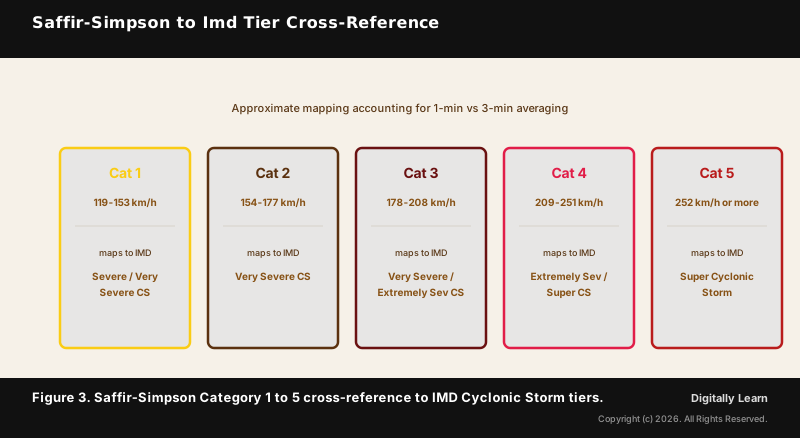
The scale uses one-minute sustained winds at ten metres above the surface, distinct from the IMD's three-minute standard. Five categories progress from Category 1 (119 to 153 km/h) through Category 5 (252 km/h and above), each band capturing a roughly doubling of destructive potential consistent with the IMD framework.
| Saffir-Simpson category | One-minute sustained wind (km/h) | Approximate IMD tier |
|---|---|---|
| Category 1 | 119 to 153 | Severe to Very Severe Cyclonic Storm |
| Category 2 | 154 to 177 | Very Severe Cyclonic Storm |
| Category 3 | 178 to 208 | Very Severe to Extremely Severe Cyclonic Storm |
| Category 4 | 209 to 251 | Extremely Severe to Super Cyclonic Storm |
| Category 5 | 252 or more | Super Cyclonic Storm |
The averaging-window difference matters for media reporting and cross-basin comparison. A Category 5 Atlantic hurricane at 252 km/h one-minute sustained is approximately equivalent to a 215 to 220 km/h three-minute sustained IMD reading, which would place the storm in the upper Extremely Severe Cyclonic Storm tier or just into Super Cyclonic Storm territory.
The IMD's three-minute standard is more conservative; the same physical storm reports lower numerical wind speeds in IMD bulletins than in National Hurricane Center bulletins. This explains why Cyclone Amphan in 2020, classified Super Cyclonic Storm by the IMD, was widely reported in international press as a Category 4 to 5 equivalent.
Naming Convention: The Thirteen-Nation Panel and Cyclone Onil
How North Indian Ocean Cyclones Got Names from 2004 Onward
Before 2004, North Indian Ocean cyclones carried no formal names; they were referenced by year and basin location alone. During the 2004 post-monsoon season, the IMD began naming cyclones in the basin, with the first name Cyclone Onil applied in 2004.
The naming protocol is administered jointly through the World Meteorological Organization (WMO) and the United Nations Economic and Social Commission for Asia and the Pacific (ESCAP). The naming threshold is the same as the operational cyclonic-storm threshold: a storm is named once its three-minute sustained wind reaches thirty-four knots.
The naming panel comprises thirteen contributing nations: Bangladesh, India, Iran, Maldives, Myanmar, Oman, Pakistan, Qatar, Saudi Arabia, Sri Lanka, Thailand, the United Arab Emirates, and Yemen. Each nation contributes a list of names. The IMD picks the next name from the next nation's list in alphabetical sequence, with the rotation advancing one nation per storm.
The 2019 Cyclone Fani was named by Bangladesh; the 2020 Cyclone Amphan by Thailand; the 2021 Cyclone Tauktae by Myanmar; the 2023 Cyclone Biparjoy by Bangladesh; the 2024 Cyclone Dana by Qatar. The naming convention serves three operational purposes (see list below) that together explain why named storms enter the public conversation faster and more durably than unnamed disturbances.
- Faster public communication: A named storm enters newsfeeds and warning bulletins more rapidly than a number-coded disturbance.
- Memorability for retrospective hazard assessment: Fani 2019, Amphan 2020, and Tauktae 2021 are recalled as discrete events.
- Inter-agency coordination: All basin states share a single name for each storm, simplifying cross-border response.
RSMC New Delhi and the Tracking Architecture
Six Worldwide RSMCs, Eleven Warning Centres, One Indian Ocean Authority
The IMD operates as one of six Regional Specialised Meteorological Centres (RSMCs) for tropical cyclones under the WMO Tropical Cyclone Programme. The six RSMCs are New Delhi for the North Indian Ocean, Miami for the North Atlantic, Honolulu for the Central Pacific, Tokyo for the North-West Pacific, La Reunion for the South-West Indian Ocean, and Nadi for the South Pacific.
Five additional Tropical Cyclone Warning Centres (TCWCs) cover specific sub-regions, taking the total worldwide cyclone-warning institutional count to eleven. The RSMC New Delhi forecasts cover the entire North Indian Ocean basin including Bangladesh, Pakistan, Sri Lanka, Maldives, Oman, and Myanmar coastal waters in addition to India's east and west coasts.
The tracking infrastructure rests on four complementary feeds. INSAT geostationary satellites provide continuous full-disc imagery of the basin, and Doppler weather radar stations (currently around thirty-three operational radars on the Indian coast) provide high-resolution near-coast tracking.
Ocean buoys operated by the Indian National Centre for Ocean Information Services and the National Institute of Ocean Technology provide sea-surface-temperature and wave-height data, and the Automatic Weather Station network provides surface-pressure and wind observations. The Joint Typhoon Warning Center of the United States Navy provides cross-reference forecasts for the same basin, with the two agencies' tracks usually agreeing to within fifty to one hundred kilometres on the projected landfall point.
Warning Communication, Colour-Code Alerts and Forecast Dissemination
From IMD Bulletin to NDMA Evacuation Order in Hours
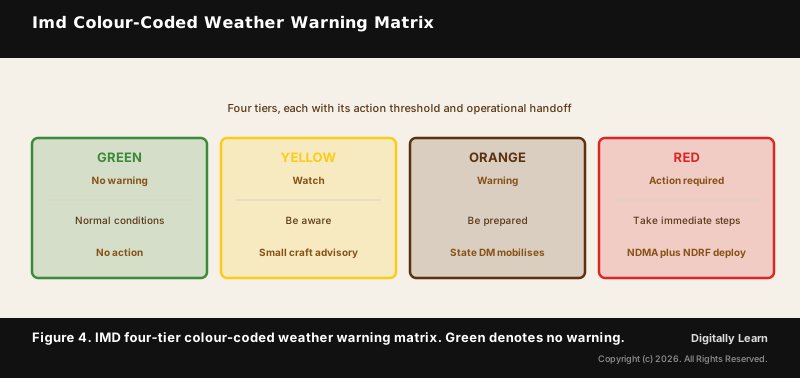
The IMD colour-coded weather warning system communicates cyclone risk in four escalating tiers. Green denotes no warning; normal conditions expected. Yellow denotes a watch: be aware of developing weather.
Orange denotes a warning: be prepared, with possible damage expected; this tier triggers state-level disaster-management mobilisation. Red denotes action required: take immediate evacuation steps; this tier is the operational handoff to the National Disaster Management Authority and its National Disaster Response Force. The lead time on cyclone forecasts has expanded from approximately twenty-four hours in the early 2000s to ninety-six hours of skill in recent cycles, with track-error margins reducing year on year.
Two contemporary themes connect this article to the wider series. First, the IMD colour-coded warning architecture is a measure of governance maturity in disaster response, with the warning lead-time progressively extending from twenty-four hours in the early 2000s to ninety-six hours in recent cycles.
Second, the rising frequency of rapid intensification events (Part 12 of this series develops the climate linkage) is pushing the classification system at the upper tiers: cyclones that historically only rarely crossed the Super Cyclonic Storm threshold now do so more often, raising the warning-and-evacuation challenge. Part 3 of this series develops the Bay of Bengal versus Arabian Sea basin contrast to which the IMD seven-tier scale is applied.
Previous Year UPSC-CSE Questions
Previous Year UPSC-CSE Questions By the end you will be able to draft model answers for the following UPSC questions. Each question carries a collapsible framework showing how to approach it in the exam.
- UPSC Mains 2022 GS-IDiscuss the meaning of colour-coded weather warnings for cyclone prone areas given by India Meteorological Department.
How to structure the answer in the exam
Introduction: The India Meteorological Department issues cyclone warnings for India's eastern and western coastlines through a four-tier colour-coded system that communicates risk severity and the corresponding action level required of state governments and citizens. The system flows from the IMD's role as the Regional Specialised Meteorological Centre New Delhi under the WMO Tropical Cyclone Programme.
Body (sub-themes to develop):
- Green and Yellow tiers: Green signals no warning with normal conditions and unaffected fishing fleets, while Yellow is a watch tier (be aware of developing weather, small-craft advisory, no large-scale mobilisation).
- Orange tier: a warning to be prepared, with possible damage expected, state-level disaster-management agencies mobilising, fishing fleets recalled, and vulnerable coastal populations advised to prepare for evacuation.
- Red tier: action required, severe damage expected, mandatory evacuation orders from state governments, the NDMA mobilising the NDRF for rescue, the Coast Guard suspending civilian sea operations, and the Indian Air Force readying airlift capability.
- Lead time and institutional handoff: forecast skill has improved from twenty-four hours in the early 2000s to ninety-six hours in recent cycles, with the chain running from IMD bulletins to state disaster-management authorities to the NDMA, the NDRF, the local administration, and finally the citizen.
Conclusion: The IMD colour-coded warning system institutionalises the conversion of meteorological intensity-classification (the IMD seven-tier scale) into operational action levels for the disaster-management chain. The 2024 Cyclone Dana and 2023 Cyclone Biparjoy operations demonstrated the system at scale: Red-coded warnings preceded mandatory evacuation of approximately one lakh people from Gujarat coastal districts and a comparable number from Odisha coastal districts, with low fatality counts that vindicate the warning-to-evacuation pipeline.
- UPSC Mains 2024 GS-IWhat is sea surface temperature rise? How does it affect the formation of tropical cyclones?
How to structure the answer in the exam
Introduction: Sea surface temperature rise is the long-term increase in the temperature of the uppermost layer of the ocean driven by anthropogenic greenhouse forcing. See Part 1 of this series for the three-pathway development of SST-to-cyclogenesis causation.
Body (sub-themes to develop):
- Lowered formation threshold: the Arabian Sea now crosses the 26 to 27 degrees Celsius SST minimum required for cyclogenesis more frequently than in past decades.
- Higher energy ceiling: the latent-heat reservoir feeding the cyclone column scales with SST, so a warmer ocean supports a higher peak-intensity ceiling and an extended cyclone season.
- Upward shift in the modal intensity tier: cyclones that historically peaked at Very Severe Cyclonic Storm now more frequently cross into Extremely Severe Cyclonic Storm on the IMD scale.
- More frequent rapid intensification: events where wind speed jumps about thirty knots in twenty-four hours push storms across IMD tier thresholds within a single forecast cycle.
Conclusion: Cross-referenced with Part 1 for the full causal development. Part 12 of this series synthesises the climate-change linkage, showing how a warming North Indian Ocean is reshaping the upper tiers of the IMD classification ladder.
- Prelims 2020Consider the following statements:
- Jet streams occur in the Northern Hemisphere only.
- Only some cyclones develop an eye.
- The temperature inside the eye of a cyclone is nearly 10°C lesser than that of the surroundings.
Which of the statements given above is/are correct?
How to approach this Prelims question
Approach: Already developed in Part 1 anatomy section. Linking to classification in Part 2: storms in the lower IMD tiers (Depression, Deep Depression, Cyclonic Storm) rarely develop a clearly defined eye; eye development becomes consistent from the Severe Cyclonic Storm tier upward and is unambiguous in the Very Severe, Extremely Severe, and Super Cyclonic Storm tiers.
Trap to watch: Statement 3 is the structural trap; the eye is warmer than surroundings due to adiabatic warming of descending air, not cooler.
Key facts to recall:
- Eye develops in mature tropical cyclones, not in weaker systems.
- Eye is warmer than surroundings (adiabatic warming).
- Eye development correlates with IMD intensity tier: Severe Cyclonic Storm and above.
- Jet streams: both NH and SH, polar plus sub-tropical.
Answer signal: Statement 2 only (option c).
Sources
- Fundamentals of Physical Geography, Class 11, Chapter 11: World Climate and Climate Change
- Tropical cyclone scales
- Saffir-Simpson scale
- North Indian Ocean tropical cyclone
- Tropical cyclone naming
- India Meteorological Department
- Tropical Cyclone Operational Procedures and the RSMC New Delhi Best Track Archive
- Cyclone Bulletins and Naming Lists
- Tropical Cyclone Programme and Regional Specialised Meteorological Centres
- Best Track Archive and Forecast Bulletins
- Cyclone Management Guidelines and Standard Operating Procedure
- Cyclone Warning Bulletins and NDMA Coordination Releases
Disclaimer
Cyclone categories and wind-speed thresholds here follow the India Meteorological Department scale and the Saffir-Simpson scale. Names for North Indian Ocean cyclones are assigned by the WMO and ESCAP panel through RSMC New Delhi. For live warnings and bulletins, consult the IMD and RSMC New Delhi portals.