


Overview
The Mechanism Deep Dive
From easterly wave to mature cyclone: how six conditions and the WISHE engine build the storm.
Tropical cyclogenesis is the staged process that turns a warm-ocean disturbance into a cyclone. This Part 4 deep dive covers the six conditions, the WISHE engine, and the Genesis Potential Index.
Tropical Cyclogenesis Defined: Five-Stage Pathway from Disturbance to Mature Cyclone
Definition: Cyclogenesis as a Multi-Stage Mechanism
Definition. Tropical cyclogenesis is the multi-stage atmospheric process by which a disorganised cluster of tropical thunderstorms organises into a coherent vortex, develops a closed low-level circulation, builds a warm-core column from surface to upper troposphere, and reaches sustained surface winds of at least sixty-three kilometres per hour (the cyclonic-storm threshold on the IMD scale covered in Part 2).
Part 1 of this series identified the six necessary conditions for genesis; Part 4 is the mechanism-level deep dive into how those conditions translate into a cyclone rather than an ordinary thunderstorm cluster.
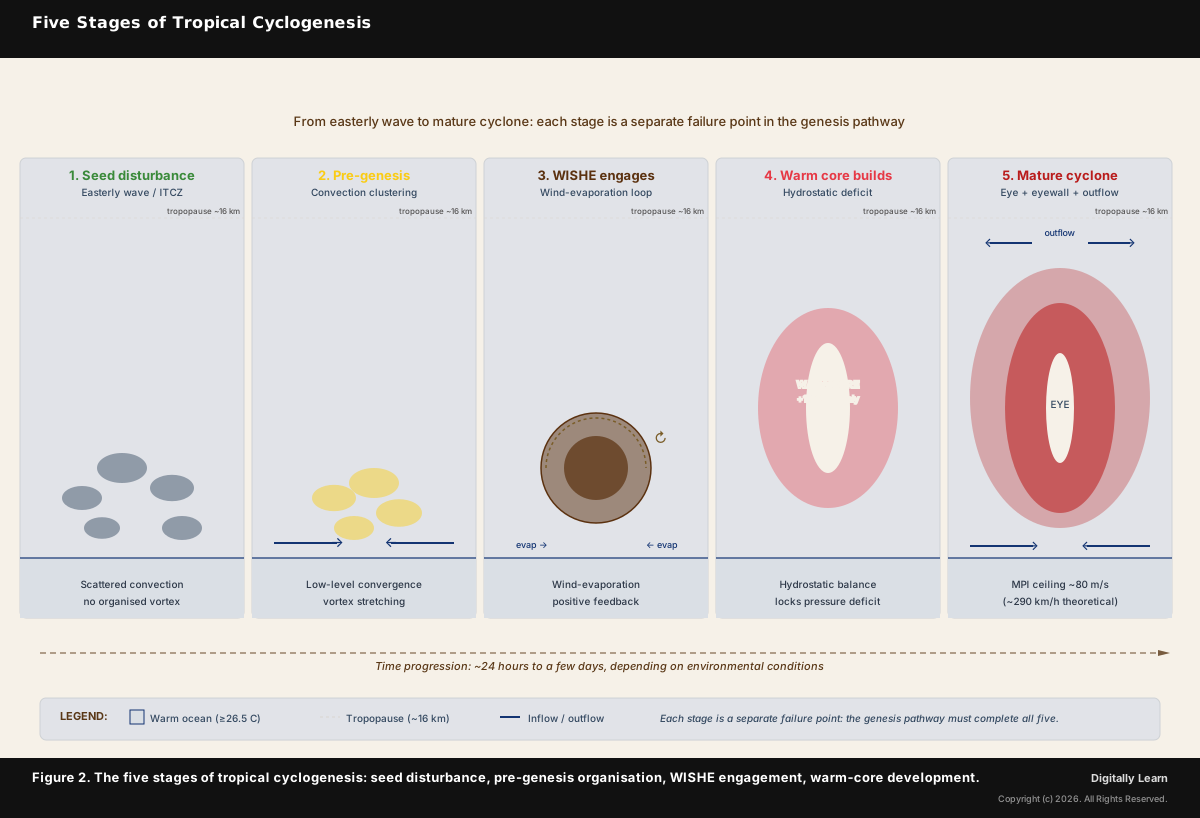
The six conditions are necessary but not sufficient. Hundreds of tropical disturbances form each year over warm ocean basins; only a small fraction become named cyclones. The selection mechanism is the cyclogenesis pathway: the disturbance must encounter a favourable seed disturbance, accumulate organised convection, engage the WISHE wind-evaporation feedback, build a coherent warm-core column, and survive long enough to lock in hydrostatic balance. Each stage has its own failure mode; this article walks through them in order.
| Condition | Canonical threshold | Mechanism it serves |
|---|---|---|
| Sea-surface temperature | At least 26.5 degrees Celsius through at least 50 m depth | Supplies the latent-heat energy that feeds the warm core |
| Coriolis force | Beyond about 5 degrees latitude (about 500 km) from the equator | Allows a low-pressure centre to spin up; genesis is suppressed on the equator |
| Vertical wind shear | Less than 10 m/s between the surface and the tropopause | Lets the warm core stack vertically instead of being torn apart |
| Pre-existing disturbance | A low-level vortex with cyclonic vorticity and convergence | Provides the seed circulation that organised convection can amplify |
| Mid-tropospheric humidity | Sufficient moisture at the 500 hPa (about 5 km) level | Sustains deep convective towers against dry-air entrainment |
| Upper-level divergence | Anticyclonic outflow aloft near the tropopause | Evacuates rising air so the surface pressure can keep falling |
Seed Disturbances: Where Cyclones Start
Easterly Waves, ITCZ, Monsoon Trough, and the MJO
Cyclogenesis never starts from a uniform calm tropical ocean. It begins with a pre-existing low-level disturbance that already has cyclonic vorticity and low-level convergence. Four sources supply these seeds across the world's six cyclone basins.
- Easterly waves (tropical waves): Westward-propagating troughs in the easterly trade winds, typically with a wavelength of around 2,000 to 4,000 kilometres. Tropical waves source approximately sixty percent of Atlantic tropical cyclones and approximately eighty-five percent of intense Atlantic hurricanes. African easterly waves originating over the Sahel are the canonical example; analogous waves form in the Pacific and Indian Ocean basins.
- Inter-Tropical Convergence Zone (ITCZ): The near-equatorial belt where Northeast and Southeast trade winds converge, producing semi-permanent low-level convergence and active convection. ITCZ-embedded depressions are the primary seed for Bay of Bengal pre-monsoon and Northwest Pacific cyclones.
- Monsoon trough: The seasonal extension of the ITCZ over the South Asian land mass during boreal summer. Mid-monsoon weak vortices that drift southwest from the monsoon trough into the Bay of Bengal occasionally intensify into cyclones, although the southwest monsoon high vertical wind shear suppresses most cases.
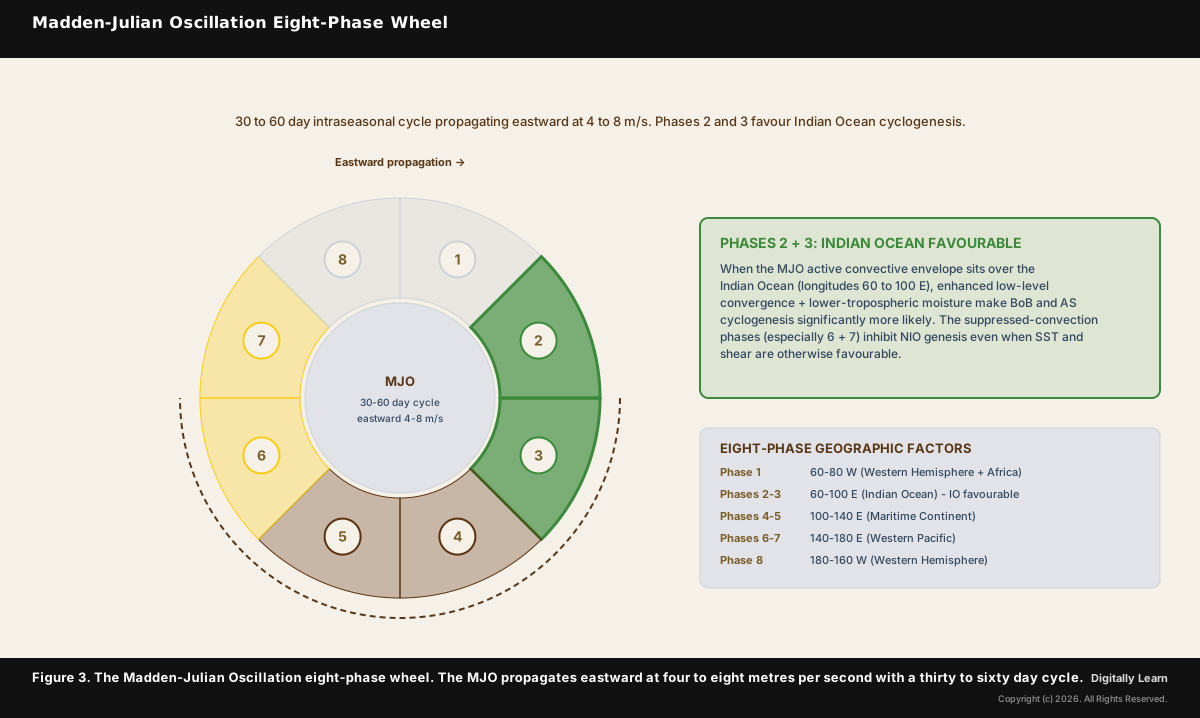
- Madden-Julian Oscillation (MJO): The dominant intraseasonal mode of tropical convection variability, propagating eastward at four to eight metres per second with a thirty to sixty day cycle. The MJO is classified into eight phases by the Real-time Multivariate MJO index; phases two and three correspond to enhanced convection over the Indian Ocean and are favourable for North Indian Ocean cyclogenesis.
Pre-Genesis Organisation: From Cluster to Vortex
Convection Clustering, Mid-Level Moistening, Vortex Stretching
The pre-genesis stage transforms a loose convective cluster into an organised low-level vortex through three concurrent processes that must overlap in space and time.
- Convection clustering: Individual thunderstorms within the disturbance begin to cluster around the low-pressure centre, drawing more moisture-laden air inward. The latent heat released by condensation warms the column and locally reduces surface pressure, which strengthens the convergence in a small positive feedback.
- Mid-level moistening: For sustained convection, the air at five kilometres altitude (around the five hundred hectopascal pressure level) must be moist enough to support deep convective towers. Dry mid-level air entrainment is a primary failure mode at this stage; the wet-bulb temperature at 500 hectopascal must reach negative thirteen point two degrees Celsius when sea surface temperatures are at the twenty-six point five threshold.
- Vortex stretching: As the low-level convergence intensifies, the vortex column is vertically stretched. By the conservation of angular momentum (the spinning-skater principle), the rotation rate increases as the column compresses horizontally and extends vertically. Coriolis-induced rotation is amplified into a closed cyclonic circulation at the surface.
WISHE Feedback: The Thermodynamic Engine
How the Cyclone Pumps Itself Up Through Wind-Evaporation Feedback
The defining transition from organised cluster to genuine tropical cyclone is the engagement of the WISHE (Wind-Induced Surface Heat Exchange) feedback, the thermodynamic engine that lets the system pump its own intensity from the warm ocean surface.
- Stronger surface winds extract more latent heat: Surface winds blow over the warm ocean and accelerate the evaporation of sea water. The faster the wind, the more latent heat is extracted per unit area of ocean surface (the same physical principle that makes wind feel colder on a wet day).
- More latent heat drives stronger convection: The extra evaporated moisture ascends with the inflow, condenses at altitude, and releases latent heat into the cyclone column. The warming further reduces central pressure and intensifies the inflow.
- Stronger convection generates stronger winds: The deeper pressure deficit accelerates the surface inflow, which intensifies the wind speeds and closes the feedback loop. The cyclone is now auto-amplifying: each stage strengthens the next.
- Friction caps the runaway: Surface friction grows as the cube of the wind speed and eventually offsets further intensification. The balance point between WISHE amplification and frictional loss defines the cyclone’s quasi-steady intensity.
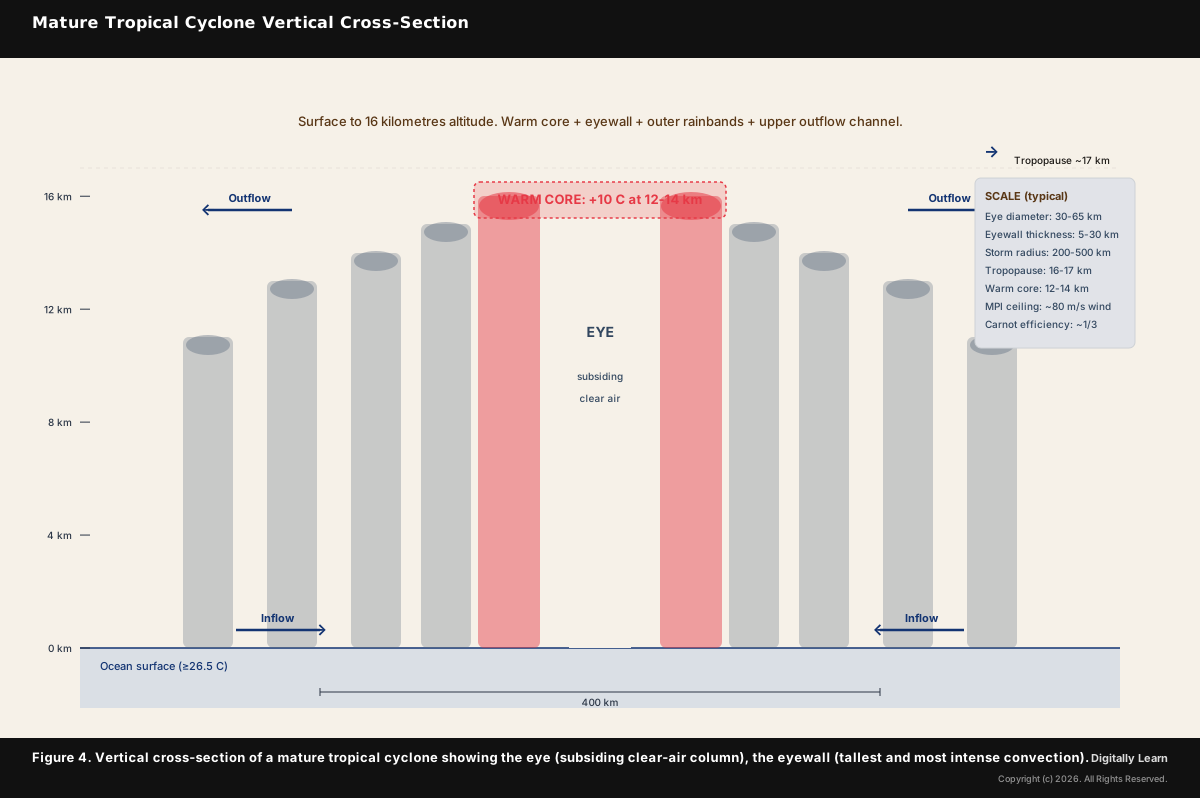
Kerry Emanuel's Maximum Potential Intensity (MPI) framework models the mature tropical cyclone as a Carnot heat engine running between a warm reservoir (the sea surface at around three hundred Kelvin) and a cold reservoir (the upper-tropospheric outflow at around two hundred Kelvin).
The Carnot efficiency is epsilon equals (T_s minus T_o) divided by T_s, approximately one-third for typical tropical conditions. The MPI formula yields a characteristic maximum wind speed on Earth of approximately eighty metres per second (around 290 kilometres per hour), the theoretical ceiling that real cyclones approach but rarely reach because of environmental constraints such as shear and dry-air entrainment.
Vertical Structure Development: Warm Core and Outflow
Building the Warm-Core Column from Surface to Sixteen Kilometres
The mature cyclone's signature is its warm-core anomaly: the centre of the cyclone is up to ten degrees Celsius warmer than the surrounding atmosphere at the same altitude in the upper troposphere. This warm core is built by the cumulative latent-heat release inside the eyewall convection during the WISHE-amplification phase.
The hydrostatic balance principle then locks the warm column to the surface pressure deficit: a warmer column over the same surface area must have lower surface pressure to maintain the same total atmospheric weight above.
The upper-tropospheric end of the column develops a complementary outflow channel: the rising air at the top of the eyewall (around fifteen to seventeen kilometres altitude) is expelled outward by upper-level anticyclonic divergence. Without this outflow, the column would back-pressure into stagnation and the cyclone would lose its energy-cycling capacity. The outflow channel organisation is one of the most reliable forecast indicators of whether a developing system will become a major cyclone or stall as a tropical storm.
Genesis Potential Index and the Climate-Change Reshaping of Basin Favourability
Forecast Indicators and the Climate-Change Shift
Operational cyclone forecast centres reduce the six necessary conditions into a single dimensionless Genesis Potential Index (GPI) that combines four physical components into one favourability score for cyclogenesis.
- Low-level absolute vorticity: A measure of the pre-existing rotational tendency at the eight-hundred-and-fifty hectopascal level. Higher absolute vorticity makes genesis more likely.
- Mid-tropospheric humidity: Relative humidity at the six-hundred hectopascal level captures the dry-air-entrainment failure mode; drier mid-levels suppress GPI.
- Maximum potential intensity: The Emanuel MPI itself (the ceiling derived from sea surface temperature and outflow temperature) sets the upper bound on what GPI can return.
- Vertical wind shear: Shear between the two-hundred and eight-hundred-and-fifty hectopascal levels enters as a suppressing factor; shear above ten metres per second drives GPI sharply downward.
Three climate-change signals are reshaping GPI distributions across the world's six basins. Warming sea-surface temperatures are pushing the twenty-six point five Celsius threshold further from the equator and into the historically marginal Arabian Sea, expanding the geographical envelope where genesis becomes thermodynamically possible. Atmospheric moisture content is rising at approximately seven percent per degree of warming (the Clausius-Clapeyron relation), boosting the mid-tropospheric humidity component of GPI in most basins.
Vertical wind shear patterns are projected to change differentially by basin, with some regions (parts of the Atlantic) seeing increased shear and others (North Indian Ocean) seeing reduced shear. Part 12 of this series develops the full climate-change linkage, including the rapid-intensification trend and the Arabian Sea track shift.
Previous Year UPSC-CSE Questions
Previous Year UPSC-CSE Questions By the end you will be able to draft model answers for the following UPSC questions. Each question carries a collapsible framework showing how to approach it in the exam.
- UPSC Mains 2024 GS-IWhat is sea surface temperature rise? How does it affect the formation of tropical cyclones?
How to structure the answer in the exam
Introduction: Sea surface temperature rise is the long-term warming of the ocean surface driven primarily by anthropogenic greenhouse-gas forcing, with regional amplification in semi-enclosed tropical basins. The effect on tropical cyclone formation operates through three distinct physical pathways that combine to expand both the geographical envelope and the intensity ceiling of cyclogenesis.
Body (sub-themes to develop):
- Formation threshold: tropical cyclones require sea surface temperatures of at least 26.5 degrees Celsius over at least 50 metres depth; rising SST extends the seasons and latitudes where this threshold is crossed, notably in the marginal Arabian Sea.
- Energy ceiling: the Emanuel Maximum Potential Intensity framework ties the theoretical wind-speed ceiling to the surface-to-outflow temperature gradient, so a warmer surface lifts the ceiling and supports more aggressive WISHE feedback before frictional balance.
- Basin expansion and rapid intensification: rising SST lengthens the cyclone-active season and speeds pre-genesis convection clustering, raising the frequency of rapid-intensification events nearer coastlines.
- Indian evidence: Cyclone Tauktae and Cyclone Biparjoy, both Arabian Sea storms with Gujarat landfall, are the canonical case studies of this warming-driven shift developed in Part 3 and Part 12.
Conclusion: Sea surface temperature rise expands the cyclone-favourable envelope, lifts the MPI ceiling, and shifts the basin-frequency balance toward historically marginal sub-basins. The implications for Indian coastal preparedness are direct: the East Coast remains the historical bulk-landfall zone, but the West Coast (especially Gujarat and Maharashtra) is now an emerging priority. Part 12 of this series develops the climate-change linkage in full.
- UPSC Mains 2014 GS-ITropical cyclones are largely confined to the South China Sea, Bay of Bengal and Gulf of Mexico. Why?
How to structure the answer in the exam
Introduction: See Part 3 of this series for the basin-distribution answer; the Part 4 mechanism-level perspective traces each named basin to the simultaneous satisfaction of all six cyclogenesis conditions.
Body (sub-themes to develop):
- Seed-channel supply: easterly waves source about 85 percent of intense North Atlantic hurricanes (the Gulf of Mexico inherits this channel), while the ITCZ supplies the Bay of Bengal and South China Sea seed disturbances through much of the year.
- Thermodynamic favourability: each named basin holds high SST, low peak-season shear, abundant mid-tropospheric moisture, and sufficient Coriolis over a long enough seasonal window.
- Warm-pool geometry: shallow shelves and accumulated cyclone energy give these basins the heat reservoir that the WISHE feedback amplifies, which Part 3 develops in full.
Conclusion: These three basins are the world's most reliable simultaneous satisfiers of the WISHE-favourable thermodynamic regime, which is why tropical cyclones cluster there. Part 3 of this series develops the basin distribution in full.
- UPSC Mains 2022 GS-IDiscuss the meaning of colour-coded weather warnings for cyclone prone areas given by India Meteorological Department.
How to structure the answer in the exam
Introduction: See Part 2 of this series for the colour-code matrix and warning escalation. Part 4 adds: the warning timeline tracks the cyclogenesis pathway from seed disturbance (yellow watch) through pre-genesis organisation (orange alert) to mature cyclone landfall (red warning).
Body (sub-themes to develop):
- Warning architecture: Part 2 sets out the IMD colour-code matrix and the escalation from green through yellow, orange, and red.
- Forecast inputs: IMD reads Genesis Potential Index evolution alongside observed Indian Ocean SST, vertical wind shear, and mid-tropospheric humidity across the genesis-to-landfall window.
- Tier mapping: each colour tier corresponds to a stage of cyclogenesis advancement, with the GPI and MPI estimates rising as the system organises.
Conclusion: The colour-coded warning system translates the cyclogenesis pathway into staged public guidance, which Part 2 of this series develops in full.
- Prelims 2015In the South Atlantic and South-Eastern Pacific regions in tropical latitudes, cyclone does not originate. What is the reason?
How to approach this Prelims question
Approach: In Part 4 the linkage is the mechanism level: the six worldwide cyclone basins coincide exactly with regions where the Inter-Tropical Convergence Zone provides reliable seed disturbances. The South Atlantic and South-Eastern Pacific lack consistent ITCZ activity (the ITCZ stays north of the equator most of the year in these longitudes), so condition five of the six necessary conditions fails year-round.
Trap to watch: Option (c) Coriolis force too weak is plausible at first glance but incorrect. The relevant tropical latitudes carry sufficient Coriolis. Option (a) Sea surface temperatures too low is partially true in the South-Eastern Pacific because of the cold Humboldt current, but the broader explanation across both basins is the missing ITCZ.
Key facts to recall:
- Six worldwide cyclone basins all align with ITCZ presence over warm ocean.
- South Atlantic and South-Eastern Pacific are NOT among the six basins.
- ITCZ is the primary seed-disturbance channel for tropical cyclogenesis.
- Coriolis is sufficient at the relevant latitudes; SST is partially sufficient; ITCZ is the missing piece.
Answer signal: ITCZ seldom occurs (option b).
Sources
- Fundamentals of Physical Geography, Class 11, Chapter 11: World Climate and Climate Change
- Tropical cyclogenesis
- Tropical wave
- Madden-Julian oscillation
- Maximum potential intensity (Emanuel framework)
- Frequently Asked Questions: A15. How does a tropical cyclone form?
- RSMC New Delhi: North Indian Ocean Cyclone Bulletins and Genesis Outlooks
- Tropical Cyclone Programme
- Assessment Report 6 Working Group 1 Chapter 11: Weather and Climate Extreme Events
- Best Track Archive and Tropical Cyclone Formation Alert Methodology
Disclaimer
This explainer is an aid for UPSC preparation and is not a substitute for primary sources. The six-conditions thresholds and the Emanuel maximum-potential-intensity value follow the cited NOAA, WMO, and Wikipedia references. Readers seeking real-time North Indian Ocean genesis outlooks should consult the IMD RSMC New Delhi portal.