


Overview
Pre-Monsoon and Post-Monsoon Seasons
How the four-phase Indian climate calendar governs when North Indian Ocean cyclones form, where they track, and when they compound into disasters.
The cyclone-monsoon interaction is the seasonal coupling that confines North Indian Ocean tropical cyclones to two annual peaks, May and November.
The Four-Phase Indian Climate Calendar
Definition: Pre-Monsoon, Monsoon, Post-Monsoon, Winter
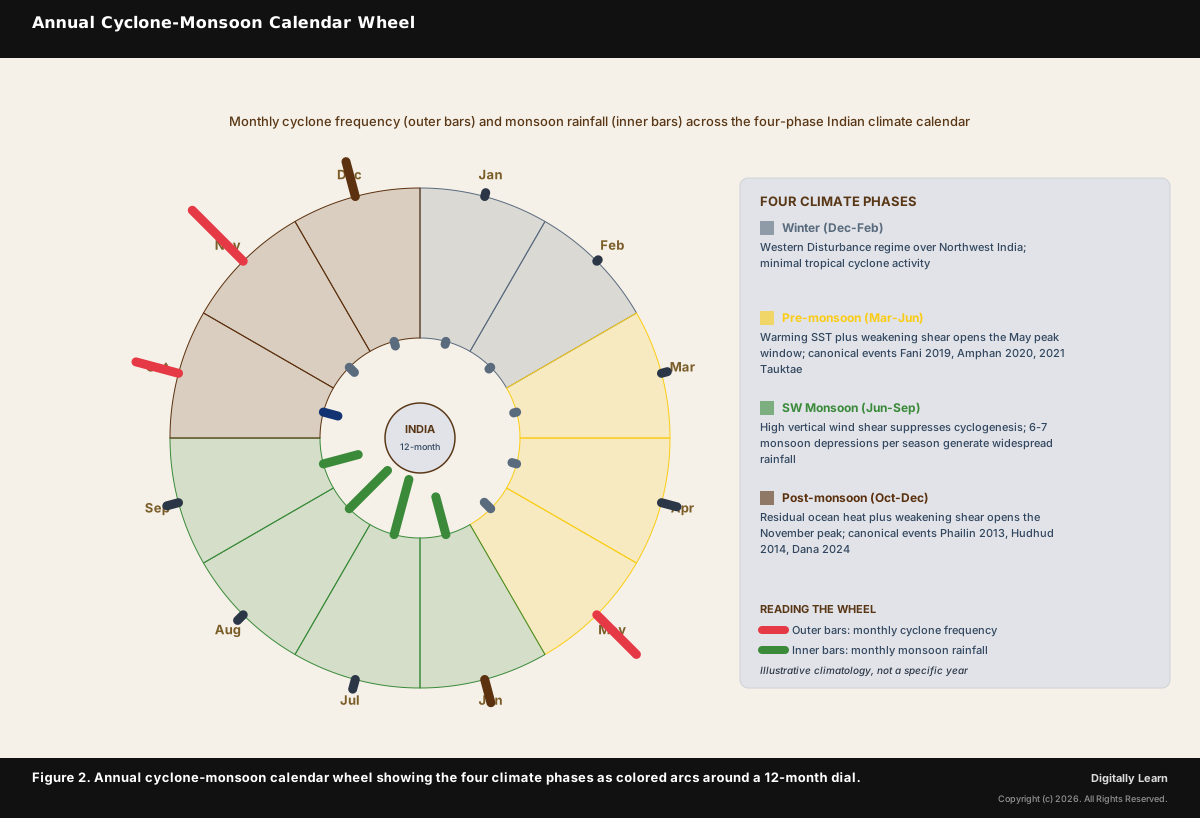
The Indian climate calendar divides the year into four operationally distinct phases. Pre-monsoon runs from March through June. The southwest monsoon runs from June through September, onsetting over Kerala around the first of June and reaching full subcontinental coverage by mid-July. The post-monsoon runs from October through December, with withdrawal beginning early September and completing early October. Winter runs from December through February with the Western Disturbance regime active over Northwest India (covered in Part 7 of this series).
Tropical cyclone activity over the North Indian Ocean is not uniform across the year; it concentrates in two narrow windows that fit precisely between the monsoon phases. The May pre-monsoon peak and the November post-monsoon peak covered in Part 3 of this series are direct consequences of the monsoon calendar.
The monsoon's own vertical wind shear suppresses cyclogenesis between June and September, while Western Disturbances dominate the winter quarter. Forecasting confidence at IMD therefore treats the cyclone-monsoon coupling as one integrated system rather than two separate processes.
Pre-Monsoon Cyclone Window: March to June, May Modal
Why the May Peak Sits Between Winter Shear and Monsoon Onset
What is the significance of the pre-monsoon window. Between the winter vertical wind shear regime that suppresses early-spring cyclogenesis and the southwest monsoon shear regime that suppresses June through September cyclogenesis, a brief late-spring window opens during which all six conditions of Part 1 can simultaneously be satisfied over the Bay of Bengal and the warming Arabian Sea.
- Warming sea-surface temperatures: Bay of Bengal and Arabian Sea SSTs climb past the twenty-six point five degree Celsius threshold for genesis (Part 1 of this series) during April through May. By May the warm pool is deep enough to support intensification through the WISHE feedback covered in Part 4.
- Weakening winter shear: The subtropical westerly jet that drove Western Disturbance traffic during winter (Part 7) retreats poleward through April. Vertical wind shear over the NIO falls below the ten metres per second threshold required for cyclonic column coherence.
- Residual mid-tropospheric moisture: Atmospheric moisture at five hundred hectopascal remains adequate from the recent winter; the dry-air entrainment failure mode that often suppresses spring genesis elsewhere is less acute in the Bay of Bengal warm pool.
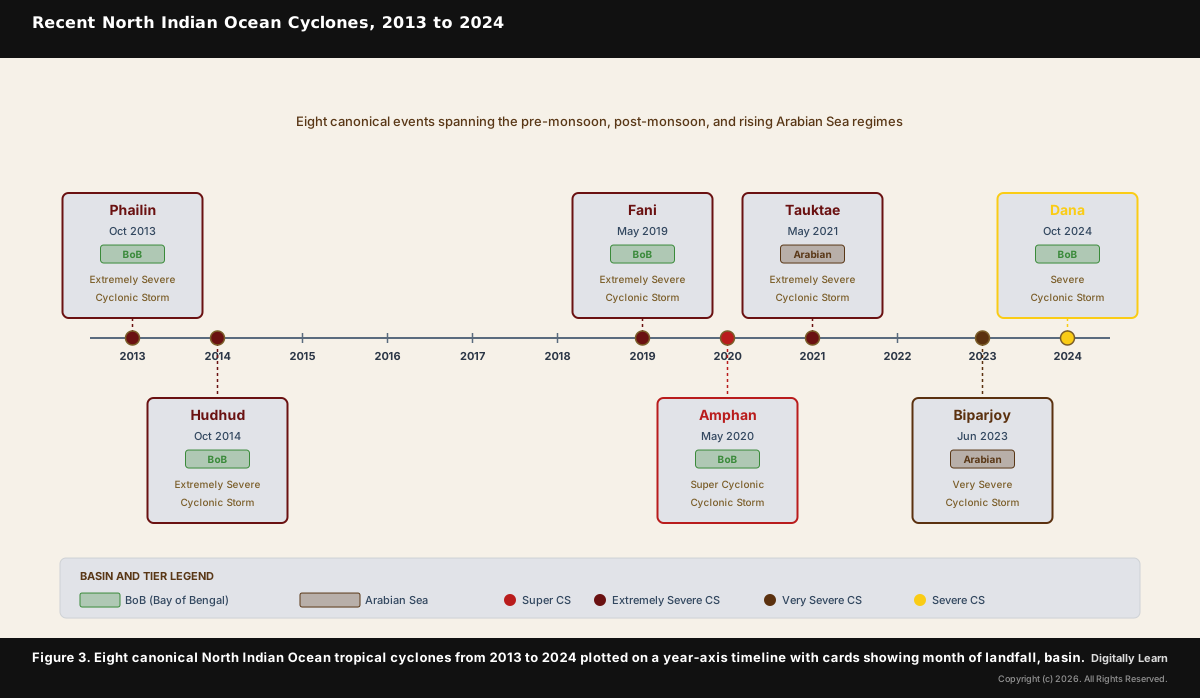
- Modal month is May: The May peak is the most reliable feature of NIO pre-monsoon climatology. Canonical examples include Cyclone Fani (May 2019, Extremely Severe Cyclonic Storm, Puri landfall), Cyclone Amphan (May 2020, Super Cyclonic Storm), and Cyclone Tauktae (May 2021, Extremely Severe Cyclonic Storm, Gujarat landfall).
Monsoon Suppression: Why June to September Is the Quiet Window
High Vertical Wind Shear, Monsoon Depressions, and the Suppression Mechanism
The southwest monsoon active phase produces a high vertical wind shear environment across the North Indian Ocean that suppresses tropical cyclogenesis even when sea-surface temperatures are at their annual peak. The monsoon trough hosts its own family of low-pressure systems that are not cyclones in the IMD sense.
- Vertical wind shear above ten metres per second: The southwest monsoon brings strong easterly winds in the upper troposphere over India coupled to strong westerly low-level monsoon winds at the surface. This vertical wind-direction reversal exceeds the ten metres per second threshold and tears apart any developing cyclonic column at the formation stage.
- Six to seven monsoon depressions per year: Within the monsoon trough, broad circulation systems called monsoon depressions form. India sees an average of six to seven such depressions per monsoon season. These are efficient rainfall producers that can generate a year of rainfall when they move through drier areas, but they rarely intensify to the IMD Cyclonic Storm threshold (sixty-three kilometres per hour sustained wind) because the same shear regime that suppresses tropical cyclones also caps their intensity.
- Monsoon depression characteristics: These systems are asymmetric with their strongest winds on the eastern periphery. They typically form over the head of the Bay of Bengal and track northwest across central India along the monsoon trough axis. The 2013 Kedarnath disaster covered in Part 7 of this series was triggered when one such system interacted with an out-of-season Western Disturbance.
- Why only 1 to 2 named cyclones form in the window: The exception cases occur when the monsoon trough briefly weakens or when a low-pressure system migrates south of the active shear band. Even in those cases, intensification is capped well below the post-monsoon ceiling.
Post-Monsoon Cyclone Window: October to December, November Modal
Why November Hosts the Most Frequent and Historically Deadliest Indian Cyclones
The post-monsoon window from October through December produces the most frequent and historically the deadliest Indian cyclones because of three converging factors that align uniquely in this two-month band.
- Residual ocean heat content: The Bay of Bengal warm pool retains the heat accumulated through the southwest monsoon. SSTs stay above the twenty-six point five threshold and the upper-ocean heat content remains the highest of the year.
- Rapidly weakening shear: The monsoon withdrawal that began in early September completes by early October. Vertical wind shear falls precipitously through October and November, opening a deep low-shear window over the Bay of Bengal.
- Southward jet retreat: The subtropical jet retreats southward across the Tibetan plateau toward its winter position. This brings upper-tropospheric divergence patterns favourable for cyclogenesis closer to the BoB latitudes.
- Canonical events: Cyclone Phailin (October 2013, Extremely Severe Cyclonic Storm, Odisha landfall); Cyclone Hudhud (October 2014, Extremely Severe Cyclonic Storm, Andhra landfall); Cyclone Biparjoy (June 2023 pre-monsoon edge, Very Severe Cyclonic Storm, Gujarat landfall); and most recently Cyclone Dana (October 2024, Severe Cyclonic Storm with peak winds one hundred ten kilometres per hour, Bhitarkanika Odisha landfall, six fatalities across Odisha, West Bengal, and Bangladesh).
| Feature | Pre-monsoon season | Post-monsoon season |
|---|---|---|
| Months | March to June | October to December |
| Modal peak month | May | November |
| Ocean heat source | Spring warming of the upper ocean | Residual heat stored through the monsoon |
| Wind-shear trend | Falling after winter retreat | Falling fast after monsoon withdrawal |
| Typical intensity | Severe to extremely severe | Most frequent and historically deadliest |
| Canonical events | Fani 2019, Amphan 2020, Tauktae 2021 | Phailin 2013, Hudhud 2014, Dana 2024 |
WD-Monsoon Compounding: The Lethal Interaction Class
When Two Cyclone Families Meet Over the Indian Subcontinent
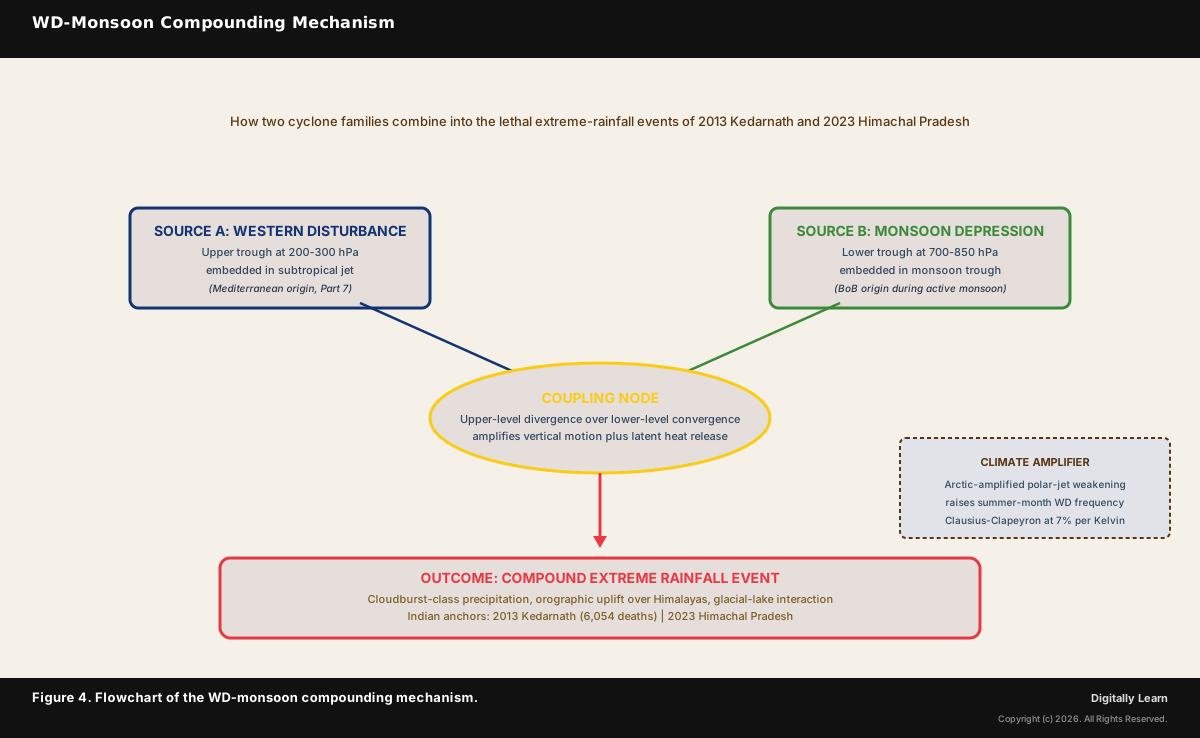
The most lethal cyclone-monsoon interaction class occurs when a Western Disturbance (Part 7 of this series) arrives during the active monsoon phase or during the post-monsoon transition. The moisture and dynamic-forcing fields of the two systems compound rather than cancel, producing extreme rainfall events that neither system would deliver alone.
- Compounding mechanism: The WD upper trough at two hundred to three hundred hectopascal provides upper-level divergence over a monsoon depression or BoB cyclonic circulation. The combined upper-divergence and lower-convergence amplifies vertical motion well beyond what either system produces alone, releasing very large amounts of latent heat in a small geographic footprint.
- 2013 Kedarnath as the canonical template: On 16 June 2013 a Bay of Bengal cyclonic circulation moved westward and combined with intense Western Disturbances from the north. Uttarakhand received three hundred seventy-five percent of normal monsoon rainfall that month. A mid-day cloudburst triggered Chorabari Glacier melt and Mandakini River flash flood; the final death toll was six thousand fifty-four. Full case-study coverage is in Part 7 (Western Disturbance article) and Part 10 (Indian case studies, queued) of this series.
- 2023 Himachal Pradesh as the recent recurrence: A similar WD-monsoon compounding event in July and August 2023 produced extreme rainfall and landslides across Himachal Pradesh; Part 10 of this series will cover the full toll.
- Why the climate-change signal amplifies this class: The Arctic-amplified polar-jet weakening covered in Part 7 increases the frequency of out-of-season Western Disturbances. Each summer-month WD that arrives during an active monsoon raises the probability of compounding. Clausius-Clapeyron moisture scaling at seven percent per Kelvin amplifies the resulting precipitation.
Climate-Change Shifts and Series Cross-References
Five Signals Reshaping the Cyclone-Monsoon System
Five measurable climate-change signals are reshaping the Indian cyclone-monsoon system together, each with its own forecasting and disaster-management consequence.
- Monsoon onset and withdrawal date drift: Recent decades show small but statistically meaningful shifts in both monsoon onset over Kerala (slightly later) and withdrawal completion (slightly later in some regions). The implication for the post-monsoon cyclone window is a compressed transition window with less buffer between monsoon withdrawal and the November cyclone peak.
- Pre-monsoon-cyclone-month extension: Cyclonic activity in April (historically rare) is now non-trivial. The May peak is extending toward both April and early June, lengthening the pre-monsoon hazardous window for the East Coast.
- Higher rapid-intensification frequency: The Part 5 climate-shift covered the rise from approximately one percent in the 1980s to approximately five percent now for hurricane-force tropical cyclones undergoing rapid intensification. This effect is amplified in the post-monsoon window when ocean heat content is at its annual maximum.
- WD-monsoon overlap rising: The Arctic-amplified jet weakening covered in Parts 6 and 7 increases summer-month WD incursion frequency. Each summer-WD-monsoon overlap raises the compounding-event probability.
- Arabian Sea cyclone activity rising: The Arabian Sea warming covered in Part 3 of this series shifts the historical Bay of Bengal versus Arabian Sea four-to-one frequency ratio toward parity. The West Coast (Gujarat, Maharashtra, Goa, Kerala) is now an emerging-risk zone for both pre-monsoon and post-monsoon cyclones.
Part 1 covers the six necessary conditions of cyclogenesis. Part 3 covers the basin distribution and the Bay of Bengal versus Arabian Sea split. Part 4 covers the WISHE mechanism. Part 5 covers the five-stage lifecycle. Part 6 covers the temperate cyclone framework. Part 7 covers the Western Disturbance regime.
Part 9 covers the impacts (queued). Part 10 covers the major Indian case studies including the full Kedarnath, Himachal, Phailin, Hudhud, Fani, Amphan, Tauktae, Biparjoy, and Dana coverage. Part 11 covers forecasting and disaster management. Part 12 covers the climate-change synthesis.
Previous Year UPSC-CSE Questions
Previous Year UPSC-CSE Questions By the end you will be able to draft model answers for the following UPSC questions. Each question carries a collapsible framework showing how to approach it in the exam.
- UPSC Mains 2017 GS-IWhat characteristics can be assigned to a monsoon climate that succeeds in feeding more than 50 percent of the world population residing in Monsoon Asia?
How to structure the answer in the exam
Introduction: Monsoon climate is a tropical and subtropical climate type characterised by a strong seasonal reversal of winds and rainfall, producing a four-phase annual calendar covered in Part 8 of this series. The combination of reliable seasonal rainfall, fertile alluvial floodplains, and adequate temperatures supports the most demographically dense agricultural civilisations in human history across South and Southeast Asia.
Body (sub-themes to develop):
- Defining characteristics: seasonal wind reversal driven by differential heating of land and ocean; a concentrated rainfall window (June to September) delivering seventy to ninety percent of annual rainfall in a four-month band; high year-round temperatures supporting multi-cropping.
- Physical base for agriculture: deep alluvial soils built by monsoon-fed river systems; cyclone-monsoon coupling delivering supplementary post-monsoon rainfall to peninsular India covered in Part 8 of this series.
- Agricultural support: paddy as the dominant monsoon crop in eastern and southern India; wheat as the dominant rabi crop in the Indo-Gangetic plains supported by Western Disturbance winter rainfall (Part 7); cropping intensity above one hundred fifty percent in the most productive regions.
- Demographic outcome: Monsoon Asia hosts more than fifty percent of the world's population on roughly twenty percent of the global land area; carrying-capacity dependence on monsoon reliability is therefore a primary food-security and water-security concern.
Conclusion: The monsoon climate is the demographic foundation of South and Southeast Asia. Its predictable seasonal calendar enables intensive agriculture and dense population settlement, while the cyclone-monsoon coupling provides supplementary moisture and significant disaster risk. Climate-change shifts in monsoon onset, withdrawal, intensity, and cyclone activity therefore have outsized humanitarian implications for the affected population centres.
- UPSC Mains 2015 GS-IHow far do you agree that the behaviour of the Indian monsoon has been changing due to humanizing landscape? Discuss.
How to structure the answer in the exam
Introduction: Humanizing landscape refers to the cumulative human modification of land surface through urbanisation, deforestation, irrigation, dam construction, and atmospheric pollutant emissions. The question of whether these anthropogenic landscape changes have measurably altered the behaviour of the Indian monsoon is one of the most active areas in monsoon-system research.
Body (sub-themes to develop):
- Evidence for change: monsoon onset and withdrawal date drift (Part 8 of this series); rising rapid-intensification frequency for monsoon-period cyclones; more frequent WD-monsoon compounding events such as the 2013 Kedarnath and 2023 Himachal Pradesh disasters; rising heavy-rainfall extremes at the cost of light and moderate rainfall days; Arabian Sea warming and the cyclone-track shift covered in Part 3.
- Anthropogenic drivers: aerosol cooling over the Indo-Gangetic plain reducing the meridional temperature gradient; greenhouse-gas warming amplifying atmospheric moisture content via Clausius-Clapeyron at seven percent per Kelvin; land-use change reducing surface evapotranspiration; irrigation increasing local-scale moisture supply.
- Natural-variability counter-arguments: monsoon variability is dominated by the El Nino-Southern Oscillation and the Indian Ocean Dipole at interannual timescales; decadal variability links to the Atlantic Multidecadal Oscillation; the detection-attribution challenge requires separating the anthropogenic signal from natural variability.
Conclusion: The behaviour of the Indian monsoon shows multiple measurable changes consistent with anthropogenic forcing. The aerosol-greenhouse-gas-irrigation triad provides a plausible mechanistic chain. Calibrated agreement: the monsoon is changing, the changes are partly attributable to humanizing landscape, and the cyclone-monsoon system covered in Part 8 of this series is responding accordingly. The implications for food security and disaster preparedness are substantial.
- Prelims 2015In the South Atlantic and South-Eastern Pacific regions in tropical latitudes, cyclone does not originate. What is the reason?
How to approach this Prelims question
Approach: Cross-referenced from Parts 1, 3, 4, and 5. In Part 8 the linkage is that the same ITCZ that provides cyclone seed disturbances also organises the southwest monsoon over India. The monsoon trough covered in Part 8 of this series IS the ITCZ in its summer position over the Indian subcontinent.
Trap to watch: Option (c) Coriolis force too weak is plausible at first glance but incorrect at the relevant latitudes.
Key facts to recall:
- Six worldwide cyclone basins align with ITCZ presence over warm ocean.
- South Atlantic and South-Eastern Pacific are NOT among the six basins.
- ITCZ is the primary seed-disturbance channel for cyclogenesis.
- The monsoon trough over India IS the summer position of the ITCZ.
Answer signal: ITCZ seldom occurs (option b).
Sources
- Fundamentals of Physical Geography, Class 11, Chapters 10 and 11: Atmospheric Circulation and World Climate
- Monsoon of India
- Monsoon trough
- North Indian Ocean tropical cyclone
- Cyclone Dana
- Integrated Cyclone-Monsoon Bulletins and Seasonal Climatology
- Operational Forecasting and Monsoon Depression Tracking
- Seasonal Climatology and Climate-Change Research on the Cyclone-Monsoon System
- Climate Prediction Center ENSO and Indian Ocean Dipole Indices
- Assessment Report 6 Working Group 1 Chapter 11 on Monsoon Variability and Cyclone Projections
Disclaimer
This article is prepared for UPSC aspirants and covers the cyclone-monsoon interaction across the Indian climate calendar. Content is based on NCERT Class 11 Geography Chapters 10 and 11, cross-verified against authoritative primary sources like IMD and Wikipedia. Readers seeking real-time cyclone bulletins should consult the IMD RSMC New Delhi portal.