


Overview
Cyclone Impacts and Coastal Vulnerability
How cyclones cascade from wind to storm surge to coastal erosion and lost livelihoods across India's east and emerging west coasts.
Cyclone impacts are the physical, coastal, socio-economic and ecological effects of a tropical cyclone, from storm surge and wind to lasting coastal harm.
The Four-Tier Impact Hierarchy
Definition: Physical, Coastal, Socio-Economic, Ecological
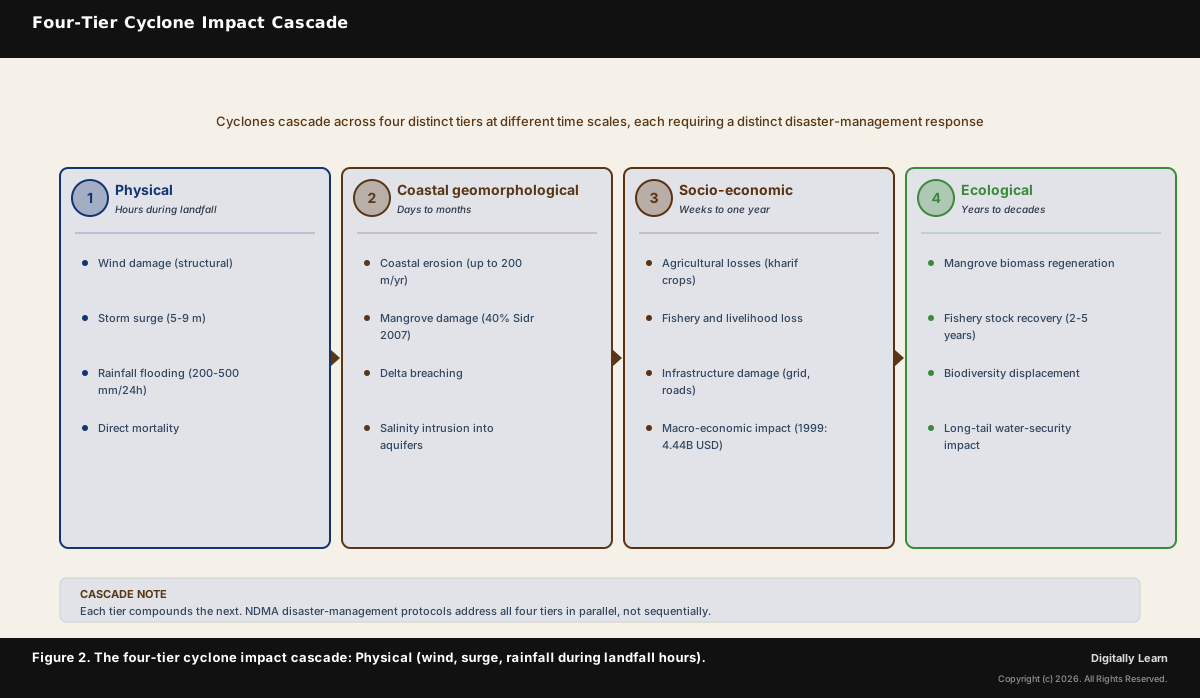
Cyclone impacts cascade across four distinct tiers that operate at different spatial scales and time horizons. Physical impacts (wind, storm surge, rainfall flooding) occur during the landfall window over hours. Coastal geomorphological impacts (erosion, mangrove damage, salinity intrusion, delta breaching) extend from landfall through months of post-event readjustment. Socio-economic impacts (agriculture, livelihoods, infrastructure) unfold from immediate damage through year-long economic recovery. Ecological impacts (mangrove biomass loss, fisheries collapse, biodiversity displacement) play out over years to decades.
Disaster-management protocols treat these four tiers as separate planning units even though one cyclone causes all four. The National Disaster Management Authority allocates resources by tier: physical response within twenty-four hours, coastal recovery within three months, socio-economic rebuilding within one year, ecological rehabilitation across one to two decades. The 1999 Odisha Super Cyclone reshaped Indian disaster management precisely because this cascade was so devastating and so badly handled.
Physical Impacts: Wind, Storm Surge, Rainfall Flooding
Storm Surge Mechanics and the Wind-Rain-Surge Triad
What is the significance of the physical-impact tier. The three physical drivers (wind, surge, rainfall) overlap in time but differ in spatial reach and damage signature. Storm surge is the deadliest of the three in head-of-bay landfalls; rainfall flooding extends inland the furthest; wind damages the broadest area.
- Wind damage: Structural damage scales with the IMD classification covered in Part 2 of this series. Super Cyclonic Storm winds of two hundred twenty-one kilometres per hour and above destroy unreinforced concrete construction, uproot mature trees, and bring down high-voltage transmission lines across radii of several hundred kilometres.
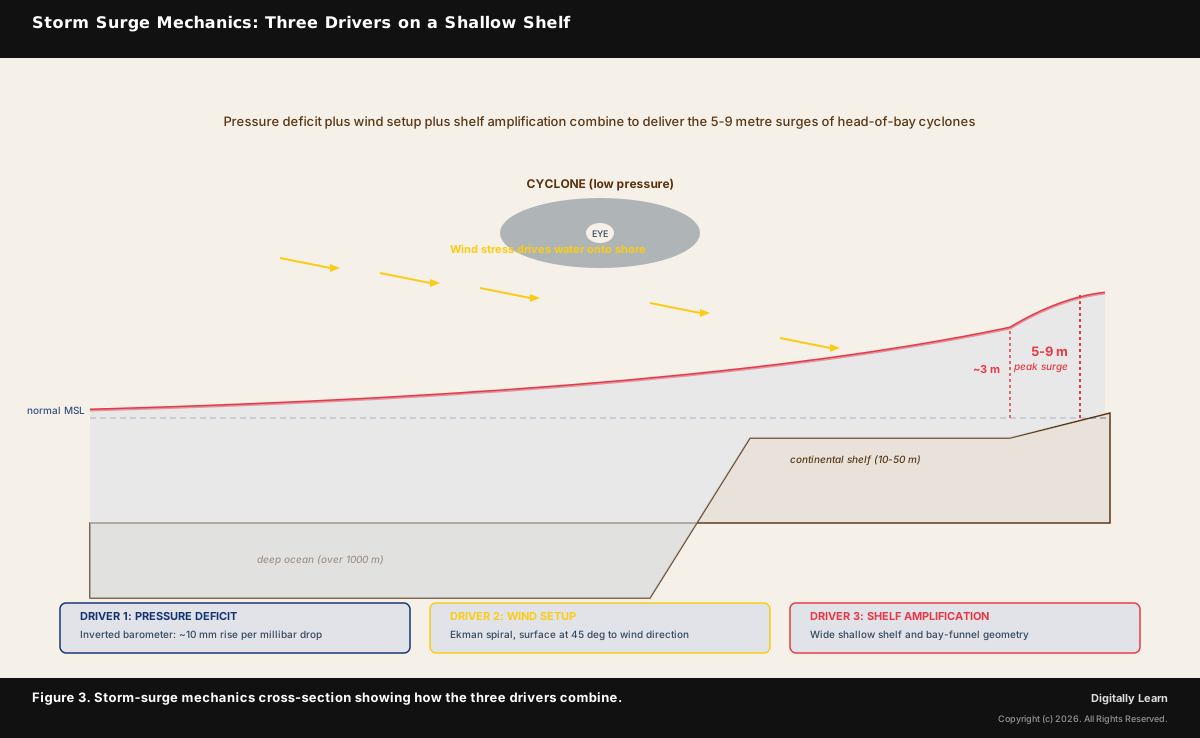
- Storm surge: The abnormal rise of seawater driven by three combined mechanisms. The atmospheric pressure deficit raises sea level by approximately ten millimetres per millibar of pressure drop (the inverted barometer effect; a one-hundred millibar pressure drop alone yields roughly one metre). Wind stress drives surface water onto shore through the Ekman spiral with surface currents at forty-five degrees to the wind. Shallow continental shelf geometry amplifies the surge; bay and funnel coastlines amplify it further.
- Surge example: 1999 Odisha Super Cyclone. At Paradip landfall on 29 October 1999, surge reached five to six metres at the coast with the Ministry of Urban Development estimating a peak of six point seven metres. Storm surge alone caused approximately seven thousand of the IMD-reported nine thousand eight hundred eighty-seven total deaths.
- Rainfall flooding: Landfalling Cyclonic Storms and above typically deliver two hundred to five hundred millimetres in twenty-four hours over the immediate landfall corridor. Inland flooding extends along river systems (cross-references to Indian Drainage Parts 9 through 12). Compound flooding events when a cyclone interacts with monsoon depressions or Western Disturbances are covered in Part 8 of this series.
- The 1970 Bhola anchor: The 1970 Bhola cyclone over the head of the Bay of Bengal remains the deadliest tropical-cyclone storm-surge event recorded, with up to five hundred thousand Bangladesh fatalities. The event is the historical reference point for cyclone preparedness across the entire NIO basin.
Coastal Geomorphology: Erosion, Mangroves, Delta Breaching
How Cyclones Reshape Indian Coastlines Over Months to Decades
The post-landfall coastal-geomorphological tier operates after the cyclone has dissipated and reshapes the Indian coastline over months to decades. The cascade includes erosion, mangrove loss, sand-bar reorganisation, delta breaching, and salinity intrusion into coastal aquifers.
- Coastal erosion: Major cyclones drive beach retreat over short windows that natural sediment supply cannot replace. The Sundarbans coast in West Bengal has retreated by up to two hundred metres per year in recent decades under the combined pressure of repeated cyclone events and sea-level rise. Decadal retreat-rate maps drive the Coastal Regulation Zone planning framework administered by the Ministry of Environment, Forest and Climate Change.
- Mangrove damage: Mangroves are the natural cyclone buffer for low-lying Indian coasts. The Sundarbans, spanning ten thousand two hundred seventy-seven square kilometres of the Ganges-Brahmaputra delta (six thousand seventeen in Bangladesh, four thousand two hundred sixty in India), protect Kolkata, Khulna, and the Port of Mongla from cyclone-induced flooding. Cyclone Sidr in 2007 damaged approximately forty percent of the Sundarbans; Cyclone Aila in 2009 affected at least one hundred thousand people and caused widespread mangrove mortality.
- Delta breaching: Major cyclones can breach coastal sand bars and barrier islands at the mouths of the Mahanadi (Indian Drainage Part 10), Krishna and Kaveri (Indian Drainage Part 11), and Brahmaputra (Indian Drainage Part 9). Salinity then propagates inland through breached channels into freshwater agricultural land.
- Salinity intrusion into coastal aquifers: Storm surge pushes saline water into low-lying coastal aquifers, contaminating drinking-water wells and irrigation. The intrusion can persist for years; the long-tail water-security impact is one of the most lasting non-mortality cyclone consequences for coastal Indian communities.
Socio-Economic Impacts: Agriculture, Livelihoods, Infrastructure
From Fishery Loss to Multi-Year Economic Recovery
The socio-economic tier emerges in the days, weeks, and years after the cyclone. The 1999 Odisha Super Cyclone produced four point four four billion US dollars of total damage in 2000 prices and reshaped twelve districts simultaneously. Smaller cyclones produce proportionally smaller but still substantial impacts that compound across already-vulnerable populations.
- Agricultural losses: East Coast cyclones strike at the height of the kharif harvest season (October-November) and damage standing paddy, groundnut, and cashew crops. The Andhra-Tamil Nadu coast can lose entire kharif harvests over millions of hectares to a single Severe Cyclonic Storm. Soil salinity from surge intrusion then degrades the next sowing window.
- Fisheries: Artisanal coastal fishing communities lose boats, nets, and shore infrastructure to wind and surge. Inshore fisheries can take six months to a year to recover; deep-sea fisheries recover faster but face fuel and supply-chain disruption.
- Infrastructure damage: Electrical grid (transmission and distribution poles), road network (especially national highways crossing the landfall corridor), telecom (cellular tower collapse), and ports (container handling, ship damage) all sustain damage scaled to landfall intensity. The 1999 Odisha event damaged twelve districts simultaneously, overwhelming the state’s reconstruction capacity.
- Livelihoods and displacement: Coastal artisanal communities (fishing, salt panning, coastal agriculture) face the largest livelihood disruption. Permanent displacement to inland areas is non-trivial: in the Sundarbans, approximately thirteen percent of residents relocated between 2000 and 2010 under cumulative cyclone-and-erosion pressure.
- Health-system burden: Waterborne disease surges (cholera, typhoid, hepatitis A, leptospirosis) emerge two to four weeks after landfall as contaminated water sources overwhelm sanitation. Vector-borne disease (dengue, malaria) surges over months as standing water provides mosquito breeding habitat.
State-Level Vulnerability and Exposure Profiles
Ranking Indian Coastal States by Cyclone Exposure
State-level exposure follows the Bay of Bengal versus Arabian Sea split covered in Part 3 of this series. The ranking reflects coastline length, population density, elevation, and historical landfall frequency.
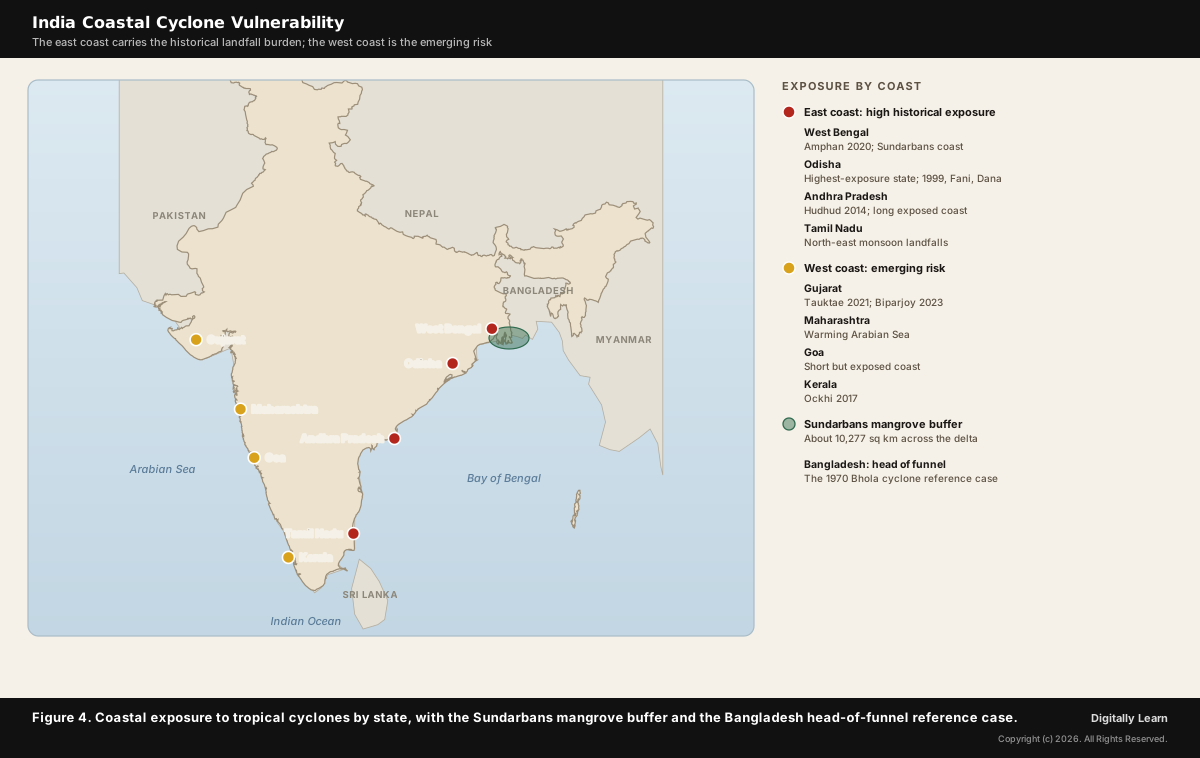
- East Coast (historical bulk): Odisha faces the head-of-bay funnel and historically absorbs the largest single-event landfalls including the 1999 Super Cyclone; Cyclone Dana made landfall here on 24 October 2024 covered in Part 8 of this series. West Bengal faces a similar exposure profile with the Sundarbans mangrove buffer offering partial protection. Andhra Pradesh faces frequent low-to-moderate-intensity storms with periodic Severe Cyclonic Storm exceptions (Phailin 2013, Hudhud 2014). Tamil Nadu faces southeast-trajectory storms during the November peak.
- West Coast (emerging risk): Gujarat now faces Arabian Sea storms with measurable landfall frequency (Tauktae May 2021, Biparjoy June 2023). Maharashtra and Goa face the Tauktae-class transit risk and storm-surge risk along the Konkan coast. Kerala sits at the southern edge of the cyclone-active zone but faces increasing extreme-rainfall events as the climate-amplified WD-monsoon compounding mechanism extends polewards (Part 7 cross-reference).
- Bangladesh as the head-of-funnel reference: Bangladesh shares the same head-of-Bay-of-Bengal exposure as West Bengal and Odisha. The historical 1970 Bhola fatality of up to five hundred thousand is the global mortality benchmark. The post-1991 Bangladesh cyclone-shelter network reduced fatality rates significantly, though the underlying physical exposure remains.
- Island territories: The Andaman and Nicobar Islands face periodic direct cyclone strikes but lower population density limits absolute mortality. Lakshadweep faces lower historical exposure (south of the cyclone-active zone) but is potentially exposed to the expanding Arabian Sea cyclone envelope.
- National-level exposure index: The National Disaster Management Authority maintains a coastal-state cyclone-exposure ranking that combines historical landfall frequency, coastline length, population within ten kilometres of the coast, elevation profile, and infrastructure density.
| Coastal state | Dominant basin | Exposure level | Representative recent landfall |
|---|---|---|---|
| Odisha | Bay of Bengal | Highest (head-of-bay funnel) | 1999 Super Cyclone; Dana 2024 |
| West Bengal | Bay of Bengal | High (Sundarbans buffer) | Amphan 2020 |
| Andhra Pradesh | Bay of Bengal | High (frequent storms) | Phailin 2013; Hudhud 2014 |
| Tamil Nadu | Bay of Bengal | Moderate to high | November-peak storms |
| Gujarat | Arabian Sea | Emerging risk | Tauktae 2021; Biparjoy 2023 |
| Maharashtra and Goa | Arabian Sea | Emerging risk (Konkan) | Tauktae 2021 |
| Kerala | Arabian Sea | Low, rising rainfall risk | Extreme-rainfall events |
Climate-Amplified Impacts and Series Cross-References
How Continued Warming Compounds Every Impact Tier
Each of the four impact tiers is being amplified by continued warming through a distinct physical channel, with the compound effect being substantially greater than any single channel.
- Sea-level rise compounding storm surge: Global mean sea level is rising at approximately three point seven millimetres per year per IPCC AR6. Each centimetre of background sea-level rise is added directly to every future storm surge, raising the inland reach of saline flooding. A forty-five centimetre sea-level rise could destroy seventy-five percent of the Sundarbans per UNESCO assessment, removing the natural cyclone buffer that protects Kolkata.
- Rapid-intensification frequency rise: The Part 5 climate-shift finding (rapid intensification probability rising from approximately one percent in the 1980s to approximately five percent now for hurricane-force tropical cyclones per IPCC AR6) compresses the warning-to-landfall timeline and shifts the impact profile toward shorter-notice high-intensity events.
- Moisture amplification raising rainfall totals: Atmospheric moisture content rises at approximately seven percent per degree Celsius of warming per the Clausius-Clapeyron relation. The two-hundred to five-hundred millimetre per twenty-four-hour landfall rainfall band is trending higher under continued warming, with cloudburst-class events now reaching well above the historical envelope (Parts 7 and 8 of this series).
- Arabian Sea track shift expanding impact zone: The Part 3 finding (historical Bay of Bengal to Arabian Sea cyclone ratio of approximately four to one is shifting toward parity) extends the impact-zone to the West Coast states that historically had low cyclone preparedness. Gujarat, Maharashtra, Goa, and Kerala now face emerging-risk exposure.
- Compound extreme events: The Part 8 WD-monsoon compounding mechanism (2013 Kedarnath template; 2023 Himachal Pradesh recurrence) produces impact-tier cascades that exceed any single-event historical envelope. Climate change amplifies the frequency of these compound events through the Arctic-amplified polar-jet weakening described in Parts 6 and 7.
Part 10 covers the full Indian case studies including 1999 Odisha Super Cyclone, Phailin 2013, Hudhud 2014, Fani 2019, Amphan 2020, Tauktae 2021, Biparjoy 2023, and Dana 2024 in chronological detail. Part 11 covers forecasting, monitoring, and disaster management response architecture including the National Cyclone Risk Mitigation Project (NCRMP) and the Coastal Regulation Zone framework. Part 12 covers the climate-change synthesis tying every signal across the series.
Previous Year UPSC-CSE Questions
Previous Year UPSC-CSE Questions By the end you will be able to draft model answers for the following UPSC questions. Each question carries a collapsible framework showing how to approach it in the exam.
- UPSC Mains 2022 GS-IIIExplain the mechanism and occurrence of cloudburst in the context of the Indian subcontinent. Discuss two recent examples.
How to structure the answer in the exam
Introduction: Cloudbursts are localised, very high-intensity rainfall events occurring predominantly in the Western Himalayas under combinations of southwest monsoon moisture and Western Disturbance incursions covered in Parts 7 and 8 of this series.
Conclusion: Both events demonstrate the four-tier impact cascade analysed in Part 9 of this series: physical impacts (extreme rainfall, debris flow, glacial-lake outburst) trigger coastal geomorphological impacts (river morphology changes), socio-economic impacts (livelihood and infrastructure loss), and ecological impacts (Himalayan ecosystem disruption). Climate change is amplifying the frequency and magnitude of these events.
- UPSC Mains 2016 GS-IIIWith reference to National Disaster Management Authority (NDMA) guidelines, discuss the measures to be adopted to mitigate the impact of the recent incidents of cloudbursts in many places of Uttarakhand.
How to structure the answer in the exam
Introduction: The National Disaster Management Authority (NDMA) coordinates Indian cyclone and cloudburst response through the National Cyclone Risk Mitigation Project (NCRMP) and the state-level Disaster Management Authorities. The 2013 Uttarakhand and Kedarnath disaster (Part 7 of this series) is the canonical anchor for the cloudburst-specific mitigation framework.
Conclusion: The NDMA framework now treats Himalayan cloudbursts as a four-tier compound hazard analysed in Part 9 of this series. The 2013 Uttarakhand response shortcomings drove substantial NDMA capacity expansion; the 2023 Himachal Pradesh response demonstrated measurable improvement in early-warning and evacuation effectiveness.
- Prelims 2010If there were no Himalayan ranges, what would have been the most likely geographical impact on India?
- Much of the country would experience the cold waves from Siberia.
- Indo-Gangetic plain would be devoid of such extensive alluvial soils.
- The pattern of monsoon would be different from what it is at present.
Which of the statements given above is/are correct?
How to approach this Prelims question
Approach: All three statements are correct. The Himalayas block cold polar continental air from reaching the Indian plains (Statement 1). The Himalayas supply the sediment that builds the Indo-Gangetic alluvial plain (Statement 2). The Himalayas force southwest monsoon orographic uplift and produce the Indian monsoon pattern (Statement 3). The cross-reference to Part 9 of this series is that the same Himalayan barrier governs the WD-monsoon compounding mechanism and the Indian cyclone-impact distribution.
Trap to watch: Aspirants who answer 1 and 3 only miss the alluvial-plain-supply connection (Statement 2 is correct).
Key facts to recall:
- Himalayas block cold-wave incursion from Central Asia and Siberia.
- Himalayan sediment built the Indo-Gangetic plain over geological time.
- Himalayan orographic uplift is essential to the Indian monsoon pattern.
- All three statements are correct; answer is option (d) 1, 2 and 3.
Answer signal: 1, 2 and 3; option (d).
Sources
- Fundamentals of Physical Geography Chapter 7: Natural Hazards and Disasters
- Storm surge
- 1999 Odisha cyclone
- Sundarbans
- Cyclone Bulletins and Impact Assessment Reports
- Cyclone Disaster Management Guidelines and National Cyclone Risk Mitigation Project (NCRMP)
- Storm Surge Forecasting and Coastal Vulnerability Atlas
- Coastal Regulation Zone Framework and Mangrove Conservation
- Assessment Report 6 Working Group 2 on Climate Impact, Adaptation, and Vulnerability
- Post-Cyclone Agricultural Recovery and Cyclone-Resilient Crop Variety Programme
Disclaimer
This article is prepared for UPSC aspirants and covers the four-tier cyclone impact hierarchy and Indian coastal vulnerability profile. Content is based on NCERT Class 11 Geography Chapter 7 cross-verified against authoritative primary sources like NDMA and Wikipedia. Readers seeking real-time storm-surge forecasts should consult the INCOIS portal.