


Overview
Winter Rain, Himalayan Snow and Rabi Agriculture
The Mediterranean-origin temperate cyclones that water the wheat fields of Punjab and trigger Himalayan cloudbursts in the same season.
Western Disturbances are extratropical storms from the Mediterranean, steered by the subtropical westerly jet, bringing winter rain and Himalayan snow to North India.
What a Western Disturbance Is
Definition: Mediterranean-Origin Temperate Cyclones Reaching India
A Western Disturbance is an extratropical (temperate) cyclonic system that originates over the Mediterranean region, draws additional moisture from the Caspian and Black Seas, and propagates eastward across Iran, Afghanistan, and Pakistan to reach the Western Himalayas.
The system is the India-specific subset of the temperate cyclone family covered in Part 6 of this series. It is steered by the subtropical westerly jet stream at around thirty degrees north, rather than the polar jet that drives the higher-latitude extratropical cyclones.
Western Disturbances are the dominant winter weather system over Northwest India during December through March. They deliver the winter rainfall that sustains the Rabi wheat crop across Punjab, Haryana, and the Gangetic plains, and they build the Western Himalayan snowpack that feeds the Indus and Ganga headwaters in melt season.
They account for nearly all the rainfall that Jammu and Kashmir, Ladakh, Himachal Pradesh, and Uttarakhand receive between December and March. They also produce the catastrophic cloudburst events that triggered the 2010 Leh flash floods and the 2013 Kedarnath disaster.
Origin and Trajectory: Mediterranean to Himalayas
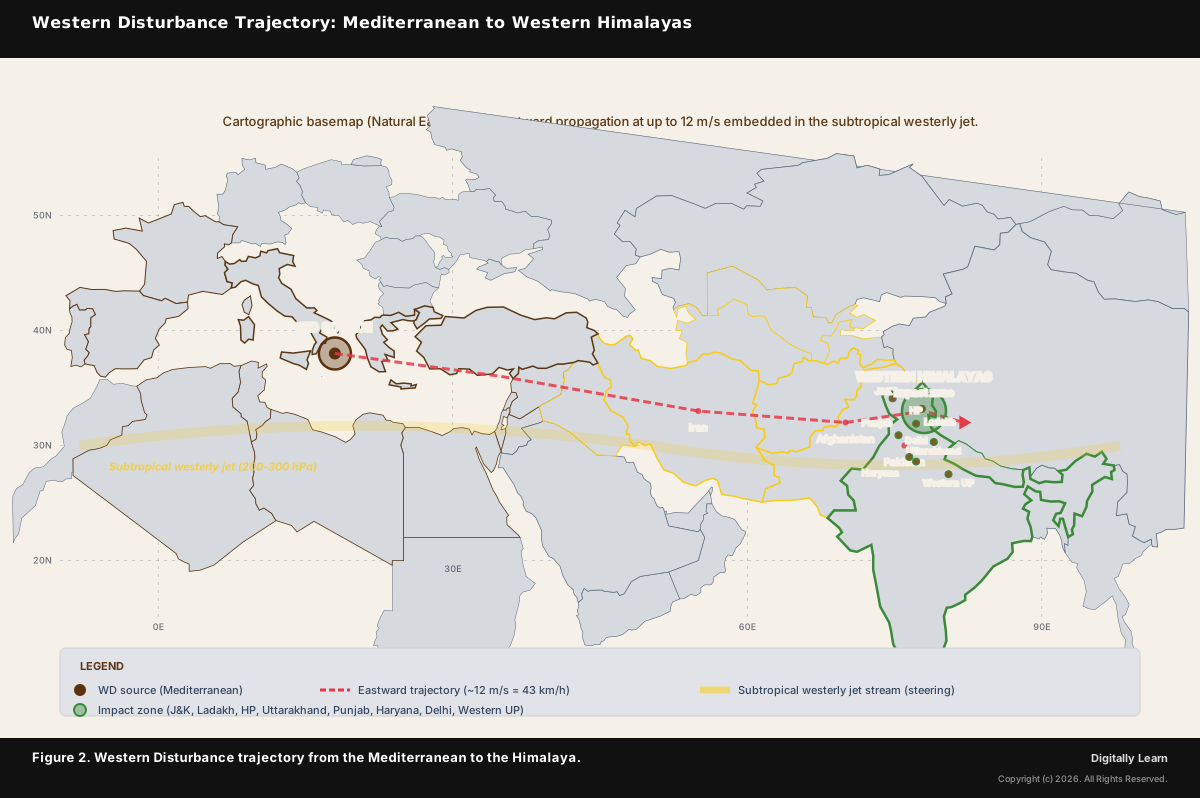
Eastward Propagation Embedded in the Subtropical Westerly Jet
What is the significance of treating Western Disturbances as Mediterranean exports? The genesis of these systems is far from India; the impact is entirely on India. Recognising the source region is the operational basis for monitoring upstream weather over the eastern Mediterranean and Iran days before a WD reaches the Indian subcontinent.
- Source region: The Mediterranean Sea is the primary genesis basin, with the Caspian Sea and Black Sea contributing additional moisture along the trajectory. Cyclogenesis follows the Bjerknes-Solberg framework covered in Part 6 of this series.
- Steering current: The subtropical westerly jet stream at approximately thirty degrees north and two hundred to three hundred hectopascal altitude (roughly ten to thirteen kilometres above sea level) is the upper-level transport channel. The jet shifts southward over India in winter (sharper temperature gradient) which is why WDs reach Indian latitudes in winter but not in summer.
- Eastward translation speed: WDs propagate eastward at speeds up to twelve metres per second (forty-three kilometres per hour) across the subcontinent until the Himalayan barrier inhibits further development and the system weakens rapidly.
- Active-season frequency: An average of four to five Western Disturbances form during the winter season. December through March is the peak window; activity tapers sharply in April and May.
- Latitude band: WDs operate at around twenty-eight to thirty-five degrees north, lower than the polar-front cyclones of higher latitudes covered in Part 6. This makes them the lowest-latitude temperate cyclone subset of operational importance worldwide.
Dual-Trough Vertical Structure
Upper Trough and Lower Trough Coupled by Orographic Forcing
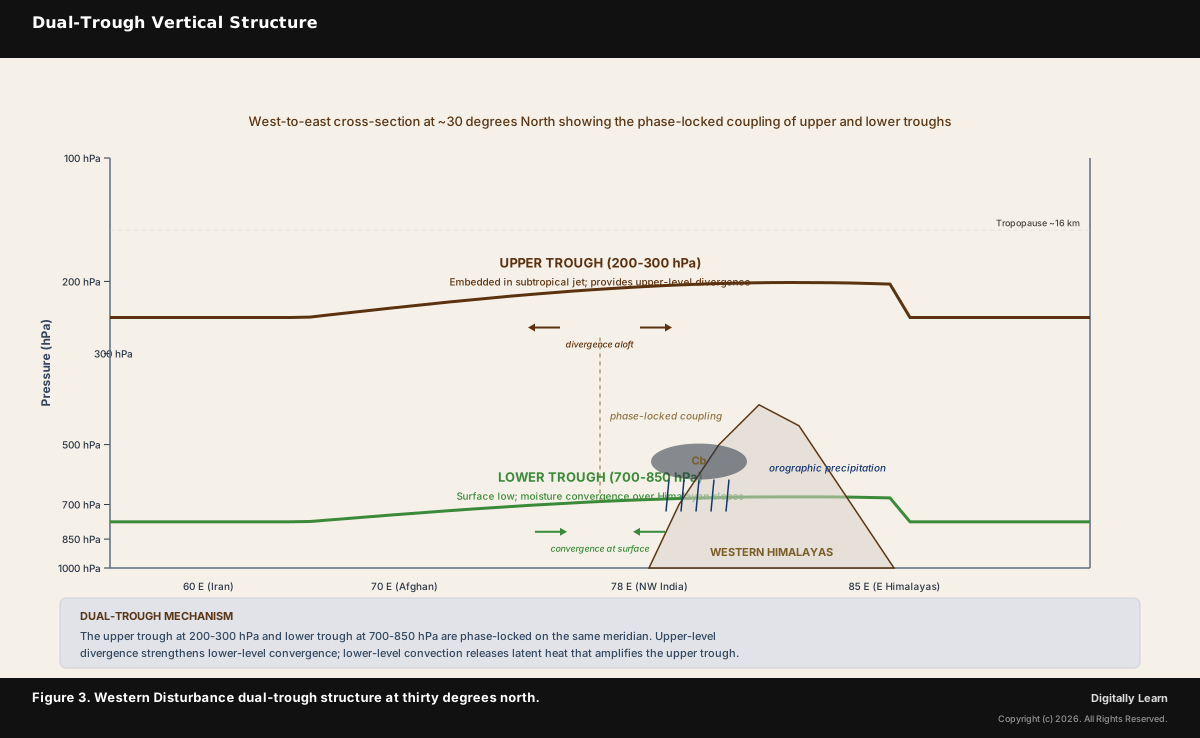
The diagnostic signature of a Western Disturbance on IMD synoptic charts is the dual-trough vertical structure, two coupled low-pressure troughs at different altitudes that lock together to produce the precipitation.
- Upper-tropospheric trough: A wave-shaped low-pressure perturbation in the subtropical westerly jet stream at two hundred to three hundred hectopascal altitude. This is the steering and energy-supplying component; it provides the upper-level divergence that organises convergence at the surface.
- Lower-tropospheric trough: A surface-to-mid-level low-pressure trough at seven hundred to eight hundred fifty hectopascal altitude (around one to three kilometres above sea level) over the Western Himalayas. This is the moisture-laden component; the low-level inflow draws Mediterranean and incidental Arabian Sea moisture into the system.
- Vertical coupling: The two troughs are phase-locked on the same north-south meridian. The upper trough’s divergence aloft creates a pressure deficit that strengthens the lower trough; the lower trough’s moisture convergence feeds convection that further amplifies the upper trough through latent-heat release.
- Orographic uplift over the Himalayas: The Western Himalayan mountain wall forces the low-level moist air to ascend, condensing into clouds and precipitation along the windward slope. This is what concentrates the WD rainfall on the Indian Himalayan states rather than dispersing it over the Pakistani plains.
Precipitation Mechanism and Indian Impact
Winter Rainfall, Snowfall, and the Rabi Crop Cycle
The Indian impact of Western Disturbances scales with geography, elevation, and crop calendar. The same Mediterranean-origin system delivers moderate-to-heavy rain to the plains and heavy snow to the high Himalayas in a single sweep.
- Indian states affected: Jammu and Kashmir, Ladakh, Himachal Pradesh, Uttarakhand receive the bulk of high-altitude snowfall; Punjab, Haryana, Delhi, and Western Uttar Pradesh receive moderate-to-heavy plains rainfall during a WD incursion.
- Winter rainfall climatology: WDs deliver an estimated five to ten percent of India’s annual rainfall, with this share rising to fifty to seventy percent of the December-to-March winter rainfall over Northwest India. The remainder comes from local-scale weather and residual monsoon moisture.
- Rabi wheat crop linkage: The Rabi crop sown in November and December depends on WD-delivered winter rainfall for soil moisture during the early growth stages. Punjab, Haryana, and Western UP wheat yields correlate directly with WD-frequency anomalies, which is a primary food-security signal monitored by the Ministry of Agriculture.
- Western Himalayan snowpack accumulation: WDs are the principal builder of the Western Himalayan snowpack that feeds the upper Indus (Indian Drainage Part 6 of this series) and upper Ganga (Indian Drainage Part 7) headwater catchments during the April-to-June melt season. Snowpack timing changes are therefore a downstream water-security signal for the entire Indo-Gangetic plain.
| Feature | Western Disturbance | Southwest Monsoon |
|---|---|---|
| Active season | December to March (winter) | June to September (summer) |
| Origin | Mediterranean, Caspian and Black Sea region | Indian Ocean and Bay of Bengal |
| Air-mass type | Extratropical (temperate) cyclonic | Tropical maritime |
| Steering current | Subtropical westerly jet stream | Cross-equatorial monsoon flow |
| Direction of arrival | West to east, from the northwest | South-west to north-east |
| Crop served | Rabi (wheat, mustard, gram) | Kharif (rice, maize, cotton) |
Cloudbursts and Extreme Events
When a Western Disturbance Amplifies into a Disaster
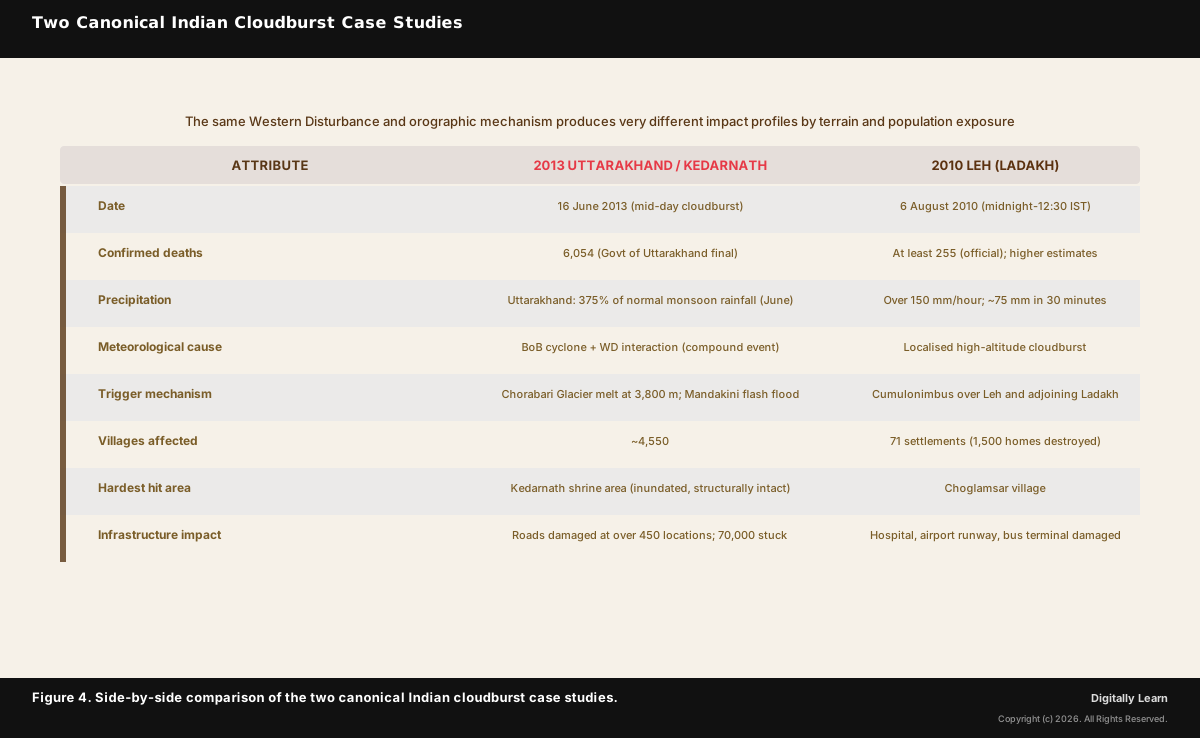
When the WD-driven moisture flux interacts with the Himalayan orography under favourable thermodynamic conditions, the result can be a cloudburst. The IMD defines a cloudburst as a localised, very high-intensity rainfall event delivering more than one hundred millimetres of rain within an hour over an area smaller than thirty square kilometres. Two canonical Indian cloudburst disasters drive policy attention on Western Disturbance risk.
- 2010 Leh cloudburst: On 6 August 2010, between midnight and 12:30 AM Indian Standard Time, a localised cloudburst struck Leh and the surrounding Ladakh region. Precipitation intensities exceeded one hundred fifty millimetres per hour, with an accumulation of approximately seventy-five millimetres in thirty minutes, equivalent to roughly a year of Leh’s average annual rainfall (about one hundred millimetres). At least two hundred fifty-five people lost their lives, one thousand five hundred homes were destroyed across seventy-one settlements, and the village of Choglamsar was particularly devastated.
- 2013 Uttarakhand and Kedarnath disaster: On 16 June 2013, a cyclonic circulation over the Bay of Bengal moved westward and rapidly intensified through moisture supplied from both the Bay of Bengal and the Arabian Sea, combining with intense Western Disturbances from the north. Uttarakhand received three hundred seventy-five percent of its benchmark normal monsoon rainfall that month. A mid-day cloudburst centred over Uttarakhand triggered melting of the Chorabari Glacier at three thousand eight hundred metres altitude, sending the Mandakini River into flash flood and inundating the Kedarnath shrine area. The final death toll was six thousand fifty-four; approximately four thousand five hundred fifty villages were affected; roads were seriously damaged at more than four hundred fifty locations.
Two further high-profile events, the 2014 Jammu and Kashmir floods (September 2014) and the 2023 Himachal Pradesh monsoon-WD interaction floods (July-August 2023), follow the same compounded WD-with-monsoon-or-orography mechanism. Part 10 of this series develops the full Indian case-study list including these events.
Climate-Change Signal and Series Cross-References
Why Western Disturbances Are Becoming More Frequent in Summer
Three climate-change signals are reshaping the Western Disturbance regime and the policy framework that responds to it.
- Arctic-amplified polar-jet weakening: The Arctic is warming approximately four times faster than the global average per IPCC AR6. The reduced equator-to-pole temperature gradient weakens the polar jet stream, which destabilises the subtropical jet meridional alignment and allows Western Disturbances to follow more meandering paths and to occur out of season.
- Summer-month WD incursions: Historically rare, WD incursions during June through September now occur with measurable frequency. When a summer WD encounters the active southwest monsoon, the moisture amplification produces compounded extreme rainfall events: 2013 Kedarnath is the canonical example; 2023 Himachal Pradesh is the more recent.
- Moisture amplification under warming: Atmospheric moisture content rises at approximately seven percent per degree Celsius of warming per the Clausius-Clapeyron relation. Each individual WD’s precipitation totals therefore trend higher under continued warming, raising the cloudburst frequency over Uttarakhand, Himachal Pradesh, and Jammu and Kashmir.
- Snowpack-to-rain conversion: At higher altitudes that historically received WD precipitation as snow, the warming trend is converting more of the precipitation to rain. The implication is earlier and faster melt-season runoff, reducing the natural reservoir function of the Western Himalayan snowpack that sustains dry-season river flows.
Part 6 covers the polar-front theory that underpins the WD framework. Part 8 covers the cyclone-monsoon interaction in detail, including the summer-WD-monsoon compounding mechanism. Part 9 covers the full impact spectrum including cloudburst-driven Himalayan flash floods. Part 10 covers the major Indian case studies. Part 11 covers forecasting, monitoring, and disaster management. Part 12 covers the climate-change synthesis including the storm-track shift and Arctic-amplification signals.
Previous Year UPSC-CSE Questions
Previous Year UPSC-CSE Questions By the end you will be able to draft model answers for the following UPSC questions. Each question carries a collapsible framework showing how to approach it in the exam.
- UPSC Mains 2024 GS-IWhat is the phenomenon of 'cloudbursts'? Explain.
How to structure the answer in the exam
Introduction: A cloudburst is operationally defined by the India Meteorological Department as a localised, very high-intensity rainfall event delivering more than one hundred millimetres of rain within an hour over an area smaller than thirty square kilometres. The phenomenon is the meteorological convergence of intense convection, orographic uplift, and saturated moisture flux concentrated in a small geographic footprint.
Conclusion: Cloudbursts are the localised extreme-rainfall expression of the same mechanisms that drive Western Disturbance precipitation, amplified by orography. Their increasing frequency under continued warming is a primary disaster-management challenge for the Himalayan states, requiring real-time radar surveillance and rapid-response evacuation protocols developed by the NDMA (the 2016 UPSC Mains GS-III question on NDMA Uttarakhand cloudburst mitigation tracks the institutional response).
- UPSC Mains 2022 GS-IIIExplain the mechanism and occurrence of cloudburst in the context of the Indian subcontinent. Discuss two recent examples.
How to structure the answer in the exam
Introduction: Cloudbursts are localised, very high-intensity rainfall events delivering more than one hundred millimetres in an hour over an area smaller than thirty square kilometres, occurring predominantly in the Western Himalayan states under combinations of southwest monsoon moisture and Western Disturbance incursions.
Conclusion: Both events demonstrate the compound-hazard nature of Himalayan cloudbursts: high-intensity rainfall plus orographic amplification plus glacial-lake interactions plus rapid drainage through narrow river valleys. The combination produces death tolls and damage far in excess of what a comparable rainfall event over flat terrain would cause.
- Prelims 2001In the following question, consider the Assertion (A) and the Reason (R) about India's winter season.
- Assertion (A): Anti-cyclonic conditions are formed in winter season when atmospheric pressure is high and air temperatures are low.
- Reason (R): Winter rainfall in Northern India causes development of anticyclonic conditions with low temperatures.
Select the correct answer using the codes given below.
How to approach this Prelims question
Approach: Assertion (A) is TRUE: anticyclonic conditions over Northern India in winter follow from high atmospheric pressure plus low air temperatures (cold dense air settles, raising surface pressure). Reason (R) is FALSE: the causality is reversed. Winter rainfall over Northern India does NOT cause anticyclonic conditions. The correct causal chain is that Western Disturbances (Part 7 of this series) embedded in the subtropical westerly jet bring winter rainfall and snowfall to Northwest India and the Western Himalayas; the prevailing winter regime over the plains is anticyclonic in between WD incursions.
Trap to watch: Aspirants who recognise winter rainfall is associated with WDs may infer that rainfall causes anticyclones. The correct causal chain is WD arrival to rainfall; anticyclones reassert between WDs.
Key facts to recall:
- Anticyclonic conditions in winter follow from high pressure plus low temperatures.
- Western Disturbances are temperate cyclones, not local anticyclones.
- WDs cause winter rainfall; winter rainfall does not cause anticyclones.
- Active WD season is December to March with an average of four to five WDs per winter.
Answer signal: A is true, R is false; option (c).
Sources
- Fundamentals of Physical Geography, Class 11, Chapter 10: Atmospheric Circulation and Weather Systems
- Western disturbance
- Subtropical jet stream
- 2013 North India floods
- 2010 Leh floods
- Western Disturbance Synoptic Charts and Winter Weather Bulletins
- Operational Forecasting and Western Disturbance Trajectory Modeling
- Peer-Reviewed Research on Western Disturbance Climatology and Climate-Change Trajectory Shifts
- Cloudburst Disaster Management Guidelines and Himalayan-States Response Plans
- Assessment Report 6 Working Group 1 Chapter 11 and Arctic Amplification Documentation
- Rabi Wheat Yield and Winter Rainfall Correlation Studies
Disclaimer
This article is an explainer prepared for UPSC preparation by the Digitally Learn editorial team. Figures and definitions are drawn from the reference works listed in the Sources section. It is not a substitute for primary documents such as NCERT textbooks and IMD bulletins.