


Overview
Meaning, formation and structure
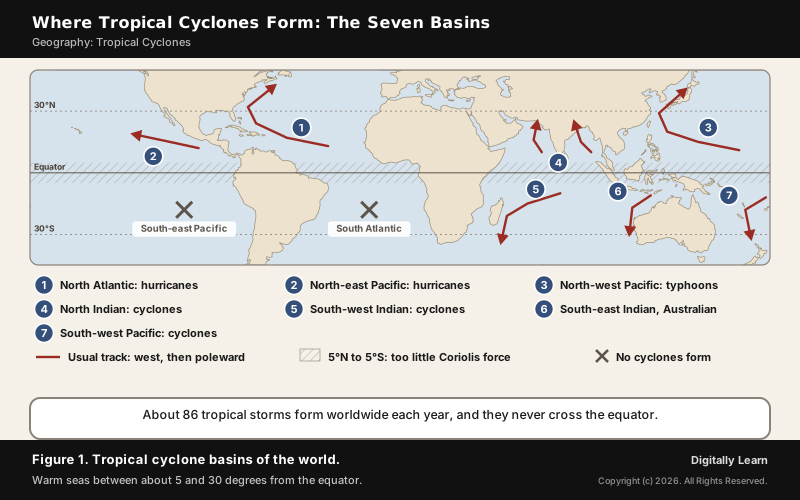
A tropical cyclone is a violent storm that forms over warm tropical seas: a low-pressure system whose winds spiral inward and upward around its centre, anticlockwise in the northern hemisphere and clockwise in the southern. It draws its energy from the heat released when water vapour condenses, which is why it forms only over warm water and dies over land. It is called a cyclone in the Indian Ocean, a hurricane in the Atlantic and a typhoon in the western Pacific.
What Is a Tropical Cyclone? Cyclone Definition and Regional Names
Cyclone Meaning: A Warm-Core, Non-Frontal Low over Tropical Seas
Tropical cyclones are violent storms that originate over oceans in tropical areas and move to the coasts, where they cause large-scale destruction through violent winds, very heavy rainfall and storm surges. They are intense low-pressure areas confined to the belt between 30 degrees N and 30 degrees S. The India Meteorological Department counts a low as a tropical cyclone once its central pressure falls 5 to 6 hPa below the surroundings and its maximum sustained wind reaches 34 knots, about 62 km per hour.
Two words sum up its nature. It is warm-cored: its centre is warmer than the air around it. It is non-frontal: it has no warm or cold fronts, unlike a temperate cyclone. The whole system is a vast whirl of 150 to 800 km spiralling around a centre and moving across the sea at 300 to 500 km a day.
The word cyclone comes from the Greek word for the coiling of a snake. It was coined by Henry Piddington, who worked in Kolkata during British rule, to describe the coiled winds of these storms.
Difference Between Cyclone and Hurricane: One Storm, Three Names
A cyclone, a hurricane and a typhoon are the same kind of storm. The scientific term for all of them is tropical cyclone; only the local name changes with the ocean.
| Region | Name used |
|---|---|
| Indian Ocean, including the Bay of Bengal and the Arabian Sea | Cyclone |
| Atlantic Ocean and north-east Pacific | Hurricane |
| Western Pacific and South China Sea | Typhoon |
| Western Australia | Willy-willy |
So the difference between a cyclone and a hurricane is one of place, not of physics. A hurricane is a strong tropical cyclone of the Atlantic or the north-east Pacific, and a typhoon is the same storm in the north-west Pacific; in the Indian Ocean and the South Pacific the storms keep the name tropical cyclone.
Why Cyclone Winds Turn Anticlockwise: The Coriolis Force
The spin comes from the Earth's rotation. It sets up an apparent force, the Coriolis force, that pulls moving air to the right in the northern hemisphere and to the left in the southern. When a low forms north of the equator, surface winds flow inward to fill it, are deflected to the right, and start an anticlockwise rotation. South of the equator the deflection is to the left and the rotation is clockwise.
- Cyclone: Low pressure at the centre; winds turn anticlockwise in the northern hemisphere and clockwise in the southern. Over a low, air converges and rises.
- Anticyclone: High pressure at the centre; winds turn clockwise in the northern hemisphere and anticlockwise in the southern.
- Where the force is zero: The Coriolis force is maximum at the poles and absent at the equator, which is why no cyclone can form right on the equator.
The force acts only on large, long-lived motions. It is far too tiny to decide which way water turns as it drains from a sink; the shape of the basin does that, so both directions occur in either hemisphere.
How Cyclones Are Formed: Conditions for Tropical Cyclone Formation
Six Conditions: Warm Sea, Moisture, Coriolis Force and Low Shear
Tropical cyclones originate and intensify over warm tropical oceans, but warm water alone is not enough. Six conditions have to be present together for a weak disturbance to grow into a storm.
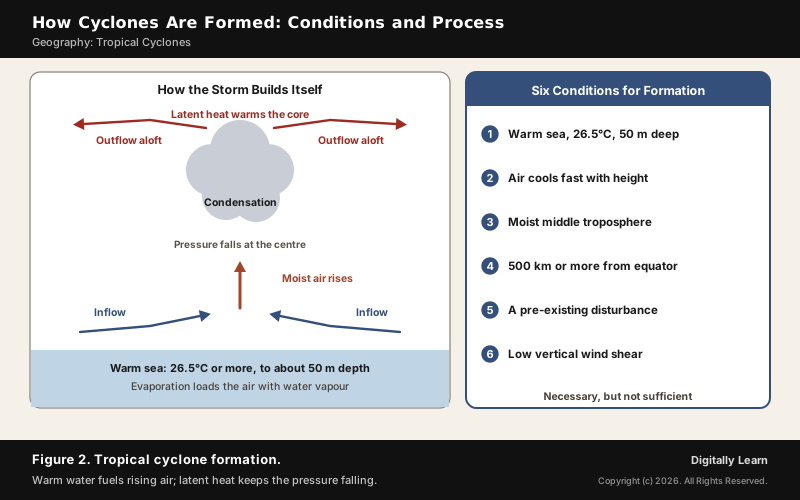
| Condition | Why it is needed |
|---|---|
| Warm sea, at least 26.5 degrees C to about 50 m depth | Warm water fuels the heat engine of the storm |
| Air that cools fast with height | An unstable atmosphere lets thunderstorms release the ocean's heat |
| Moist middle troposphere, near 5 km | Dry air in the middle levels stops thunderstorms from spreading |
| At least 500 km from the equator | Enough Coriolis force to keep the low from filling up |
| A pre-existing disturbance | A weak system with some spin and inflow to build on |
| Low vertical wind shear, under about 10 m per second | Strong shear tears the storm's convection apart |
The same conditions are often listed as five: a large sea surface warmer than 27 degrees C, the presence of the Coriolis force, small variations in vertical wind speed, a pre-existing weak low or low-level cyclonic circulation, and upper divergence above the sea-level system. The conditions are necessary but not sufficient: many disturbances meet them and still fail to develop.
How Cyclones Are Formed: From Easterly Wave to Cyclonic Storm
Cyclone formation begins with a small wave in the tropical easterlies. In the tropics, weak pressure waves called easterly waves move from east to west, and most tropical cyclones grow out of them. The steps that turn one into a storm follow in order:
- A low forms: Under favourable conditions a low-pressure area forms in the trough of an easterly wave, and air converges into it near the surface.
- Air rises: Over warm sea, with air blown off at upper levels, low-level convergence and upper divergence together drive moist air upwards.
- Vapour condenses: The moisture condenses in the middle troposphere and gives out the latent heat of condensation.
- Pressure falls further: The released heat warms the area, pressure at the centre falls more, and more air converges to replace the rising air.
- A cyclonic storm forms: The cycle feeds itself, and the low intensifies into a cyclonic storm.
This self-feeding loop is the core of cyclogenesis, the birth of a cyclone. The deeper physics is explained in the article on tropical cyclogenesis, and the stages from low to depression, storm, maturity and decay in the article on the tropical cyclone life cycle.
Sea Surface Temperature and Tropical Cyclones
Sea surface temperature, the temperature of the ocean's top layer, is the most important factor in a cyclone's development. The warm layer must also be deep, about 50 m, since the storm stirs up the water beneath it; a cyclone leaves a cool wake behind it that makes the same area less favourable for the next storm. A tropical cyclone weakens when it moves over water much cooler than 26.5 degrees C.
A rise in sea surface temperature therefore means more fuel. Warming seas can make cyclones last longer, occur more often and grow more intense, and warmer air holds about 7 per cent more water vapour for each 1 degree C of warming, so rainfall rises too. Between 1979 and 2017 the share of the most intense cyclones increased worldwide.
- Arabian Sea: Sea surface temperatures have risen by 1.2 to 1.4 degrees C in recent decades, and in 2019 a record eight cyclonic storms formed there, a number last matched in 1902.
- Rapid intensification: An increase in intensity of 30 knots in 24 hours; during Cyclone Amphan’s rapid intensification the Bay of Bengal was as warm as 33 degrees C.
- Very severe storms: Their frequency over the north Indian Ocean has risen by about one per decade in the last two decades, even as the total number of cyclones fell.
Why No Cyclones Form at the Equator or in the South Atlantic
Without the Coriolis force, the low pressure of a disturbance cannot be maintained; air rushes in and fills it. For this reason a corridor about 300 km wide on either side of the equator is free of cyclones, and tropical cyclones do not form between 0 and 5 degrees latitude except in the rarest cases. Typhoon Vamei, which formed near Singapore on 27 December 2001 with its centre at 1.5 degrees N, is the famous exception. For the same reason no cyclone migrates across the equator.
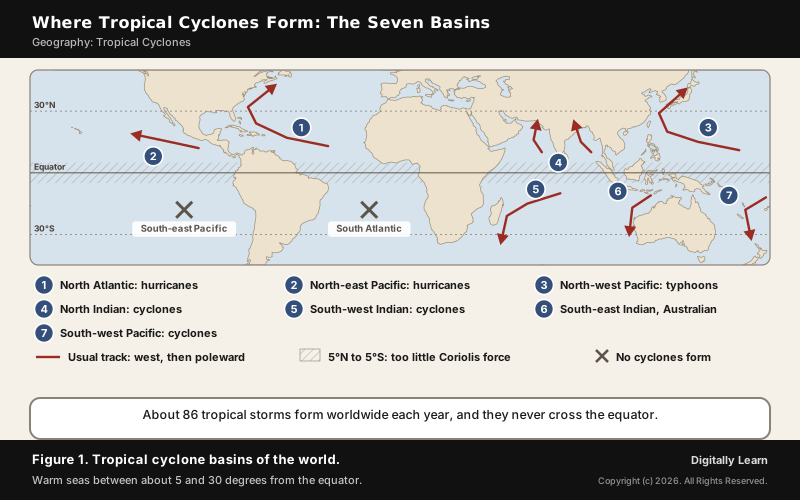
Tropical cyclones form in the lower latitudes of all oceans except the South Atlantic and the south-east Pacific. In the South Atlantic four things stand in the way: very strong vertical wind shear, a lack of disturbances to grow from, cooler water than in the tropical North Atlantic, and an Intertropical Convergence Zone that drops only one to two degrees south of the equator, too close to it for the Coriolis force to help. Hurricane Catarina, which struck Brazil in 2004, is the only recorded South Atlantic hurricane.
Structure of Tropical Cyclone: Eye, Eyewall and Rainbands
Tropical Cyclone Diagram: Size, Height and Pressure Gradient
A mature tropical cyclone is marked by strong winds spiralling around a centre called the eye. Around the eye rises the eyewall, and beyond it lie spiral rainbands. On radar a mature cyclone shows an eye, an eyewall, spiral bands, pre-cyclone squall lines and streamers.
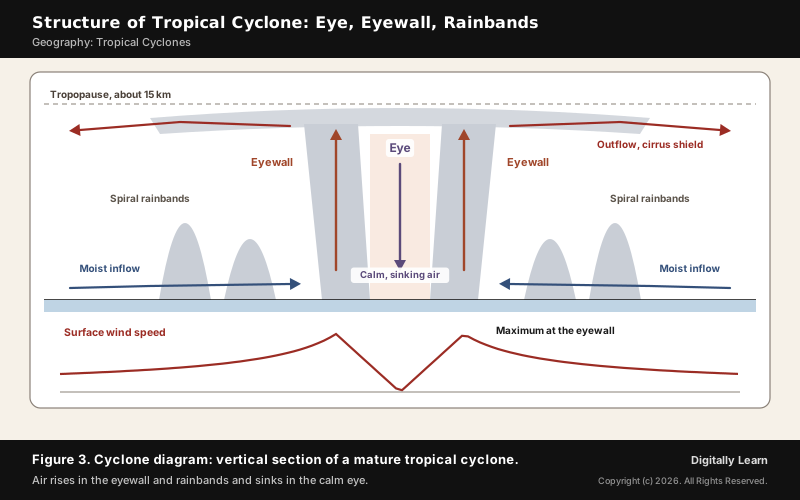
The pressure falls steeply towards the centre. Isobars lie close together, with a pressure gradient normally of 14 to 17 mb per 100 km and sometimes as high as 60 mb per 100 km.
- Width: The strong circulating system around the centre is 150 to 250 km across, while the whole storm over the Bay of Bengal, the Arabian Sea and the Indian Ocean measures 600 to 1,200 km.
- Height: The storm reaches 12 to 15 km, up to the tropopause.
- Range: Worldwide, cyclones measure 100 to 2,000 km; Typhoon Tip had tropical storm-force winds 2,170 km across, and Tropical Storm Marco of 2008 only 37 km.
- Indian seas: From 50 to 100 km radius up to 2,000 km, with an average radius of 300 to 600 km.
Eye of Cyclone: Diameter, Temperature and Pressure
The eye of a cyclone is a roughly circular area of light winds and fair weather at the centre of a severe tropical cyclone. The approximate range of the diameter of the eye of a cyclone is 10 to 50 km in a fully developed storm; worldwide, eyes range from 8 km to over 200 km across, but most are about 30 to 60 km. There is little or no rain, and sometimes blue sky or stars can be seen.
The eye has the lowest surface pressure in the storm and the warmest temperatures aloft. At 12 km it may be 10 degrees C or more warmer than the air outside, though only 0 to 2 degrees C warmer at the surface. The warmth comes from sinking air: the air in the eye descends slowly, is compressed and warms, and the sinking usually stops 1 to 3 km above the sea.
Only some cyclones develop an eye. Before a storm reaches very severe cyclonic storm strength of 64 knots, a uniform shield of cold cloud tops usually hides the centre; once it reaches that strength an eye can usually be seen on satellite images. In a weaker storm the eye may stay hidden under the cloud.
Eyewall, Spiral Rainbands and the Central Dense Overcast
The eyewall is the ring of deep cloud around the eye, where air spirals up to the tropopause. It has the highest surface winds of the storm, as high as 250 km per hour, and torrential rain. This wall cloud region is about 10 to 150 km wide. It slopes outward with height like the seats of a stadium, and the heaviest wind damage occurs where the eyewall crosses land.
Wind speed changes sharply across the storm. It rises to its maximum in the eyewall belt, falls rapidly towards the eye, and falls only slowly and irregularly outward from the eyewall.
- Spiral rainbands: Long, narrow bands of cloud lined up with the wind, which seem to spiral into the centre; trains of cumulus and cumulonimbus clouds drift outward from the eyewall along them.
- Central dense overcast: The cirrus cloud shield spread by the thunderstorms of the eyewall and rainbands; a nearly circular one shows low wind shear, a sign the storm can strengthen.
- Eyewall replacement: In intense storms an outer ring of thunderstorms can form and move in, weaken the old eyewall and replace it, after which the storm may return to its original strength.
Energy, Movement and Landfall of Tropical Cyclones
Tropical Cyclone as a Heat Engine: Latent Heat and Energy
A tropical cyclone is like a heat engine energised by latent heat: the winds gather moisture over warm seas, the moisture condenses in the towering cumulonimbus clouds around the centre, and the heat released drives the storm. With a continuous supply of moisture from the sea the storm grows stronger; on reaching land that supply is cut off and the storm dies.
- Efficiency: Only about 3 per cent of the heat released is turned into the kinetic energy of the winds.
- Scale: A mature cyclone releases energy equal to that of 100 hydrogen bombs.
- Heat transport: The storms take heat stored in the ocean to the upper atmosphere, where upper winds carry it towards the poles, keeping the tropics a little cooler and the poles less cold.
This energy source sets tropical cyclones apart from the storms of the middle latitudes, which are powered mainly by horizontal temperature contrasts between air masses.
Movement of Tropical Cyclones: Track, Recurvature and Landfall
Tropical cyclones move from east to west, the opposite of temperate cyclones. In the northern hemisphere they usually move west-north-west or north-west at an average of 15 to 20 km per hour, 360 to 480 km a day. Some then turn north and slow to 10 km per hour or less, and a large share later turn north-east and move fast, at 25 km per hour or more.
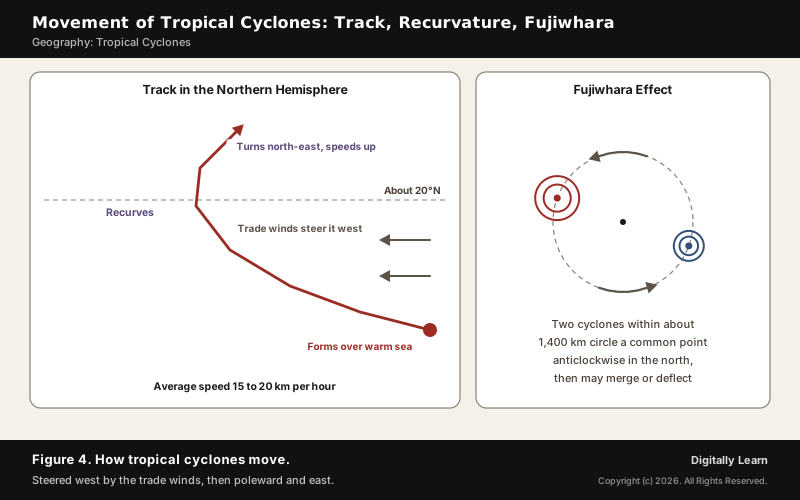
- Steering: The main control is the background wind, which carries a cyclone like leaves on a stream; the trade winds on the equator side of the subtropical high steer storms westward.
- Beta drift: A slow drift poleward and westward, at 1 to 3 m per second, set up by the storm itself because the Coriolis force changes with latitude; it acts even with no background wind.
- Recurvature: A turn poleward and then eastward when a storm meets the mid-latitude westerlies or the jet stream, which blows in both hemispheres, each with its own polar jet; cyclones that cross about 20 degrees N generally recurve and are more destructive.
- Landfall: The place where a cyclone crosses the coast. Over India, the easterly jet stream steers tropical depressions into the country in the monsoon season.
Fujiwhara Effect: When Two Cyclones Interact
The Fujiwhara effect occurs when two nearby cyclones move around each other and close the distance between them. It is named after the Japanese meteorologist Sakuhei Fujiwhara, who described it in a 1921 paper. Tropical cyclones usually interact when they are within about 1,400 km of each other.
The two centres circle a point between them, anticlockwise in the northern hemisphere and clockwise in the southern. If they are of equal size they orbit that point or push each other aside; if unequal, the larger dominates and the smaller circles around it. Close storms often spiral in and merge into one.
- Movement: Tracks bend, stall or swing aside; in 2009 Typhoon Parma stalled near the Philippines while circling Typhoon Melor, and in 2017 Hurricane Irwin turned north-west before it died.
- Intensity: One storm can strengthen at the other’s expense; in 2017 Hilary became stronger while Irwin became weaker, and a merger can build a larger cyclone.
- Indian Ocean cases: Cyclones Diamondra and Eunice in 2015, and Cyclones Seroja and Odette in 2021.
Why Tropical Cyclones Weaken over Land
A few hours after landfall, a tropical cyclone begins to weaken rapidly. The main reason is not friction but the loss of the heat and moisture the ocean supplied: without them the storm cannot keep up its thunderstorms near the centre, and without that convection it cannot survive.
Friction does act, in two directions. The rougher land surface of trees and houses lowers the sustained winds, while the extra turbulence brings faster air down in short bursts, so the gusts become stronger. There are exceptions: the Odisha super cyclone of October 1999 stayed almost stationary and kept cyclonic storm strength for 24 hours after landfall.
- Other ways to die: Moving over water cooler than 26.5 degrees C, meeting strong wind shear, or merging with the westerlies and turning into an extratropical cyclone over 1 to 3 days.
- Terrain: Over mountains a cyclone weakens quickly; over flat land it may last two to three days.
- Life span: A tropical cyclone over the north Indian Ocean lives 5 to 6 days and holds hurricane intensity for 2 to 4 days, against 6 days worldwide; the longest-lived in Indian seas lasted 14 days.
Tropical Cyclones in the Indian Ocean: Bay of Bengal and Arabian Sea
Tropical Cyclones in India: Seasons, Origin and Affected Coasts
India's peninsula lies between two seas that breed cyclones, the Bay of Bengal and the Arabian Sea, and the Bay produces far more storms. In the long record of cyclonic storms over Indian seas, the Bay of Bengal had 314 and the Arabian Sea 82. Storms come in two seasons: the north Indian basin has a double peak in May and November, and in the Bay most cyclones develop in October and November.
| Point | Bay of Bengal | Arabian Sea |
|---|---|---|
| Cyclonic storms in the record | 314 | 82 |
| In October and November | 109 | 38 |
| Why | Warmer; gets remnants of Pacific typhoons | Colder; few Bay storms survive the crossing |
- Why the Bay gets more: Besides storms that form in the south-east Bay and the Andaman Sea, it receives remnants of north-west Pacific typhoons, a basin with about 35 per cent of the world’s cyclones.
- Why the Arabian Sea gets fewer: Its storms form locally or come from the Bay across the peninsula, and most Bay storms weaken over land first; the Arabian Sea is also colder than the Bay.
- Why few form in the monsoon: Strong westerly winds below 5 km and strong easterly winds above 9 km give large vertical wind shear; in July the zone of origin shifts to about 18 degrees N near the Sundarban delta, and depressions cross the Odisha and West Bengal coast within a day or two.
The east coast bears the brunt. Cyclones strike Tamil Nadu, Andhra Pradesh and Odisha, and the thickly populated deltas of the Godavari, Krishna and Kaveri are their preferred targets. Severe cyclonic storms are most frequent for Andhra Pradesh and cyclones for Odisha; on the west coast, Gujarat is most vulnerable. The depressions and cyclones of this season also give the Coromandel coast the bulk of its rainfall.
Tropical Cyclones Compared with Tornadoes and Temperate Cyclones
Difference Between Cyclone and Tornado
A tornado is a rapidly rotating column of air that reaches from the ground to the base of a cumulonimbus or cumulus cloud, often seen as a funnel. It is a far smaller and shorter-lived vortex than a cyclone. Most tornadoes have winds under 180 km per hour, are about 80 m across and travel a few kilometres before they die, although the most extreme exceed 480 km per hour and 3 km in width.
| Point | Tropical cyclone | Tornado |
|---|---|---|
| Where it forms | Over warm tropical seas | Mostly over land, beneath a thunderstorm cloud |
| Size | Hundreds of kilometres | Usually about 80 m |
| Lifetime | Days; 5 to 6 in Indian seas | Minutes to over an hour |
| Structure | Eye, eyewall, rainbands | A single funnel |
The two can meet. A landfalling tropical cyclone often spawns tornadoes in its outer bands; Hurricane Ivan produced 120. The United States has by far the most tornadoes, but Bangladesh and adjacent eastern India also get them, and Bangladesh suffers the highest death toll, an average of 179 a year.
Tropical Cyclone and Temperate Cyclone: Key Differences
A temperate cyclone forms along the polar front in the middle latitudes, where cold and warm air masses meet. It shares the low centre and the cyclonic winds of a tropical cyclone, and little else.
| Point | Tropical cyclone | Temperate cyclone |
|---|---|---|
| Where it forms | Only over warm tropical seas | Over land and sea, 30 to 60 degrees latitude |
| Energy | Latent heat of condensation | Contrast of cold and warm air masses |
| Fronts and eye | An eye, no fronts | Clear fronts, no eye |
| Size and wind | Smaller, with higher winds | Larger area, weaker winds |
| Moves | East to west | West to east |
The tropical cyclone is more destructive because its wind is much higher and it strikes crowded coasts. The full account of the temperate cyclone, its fronts and polar front theory, is in the article on temperate cyclones.
Previous Year UPSC-CSE Questions
Previous Year UPSC-CSE Questions By the end you will be able to draft model answers for the following UPSC questions. Each question carries a collapsible framework showing how to approach it in the exam.
- UPSC Mains 2024 GS-IWhat is sea surface temperature rise? How does it affect the formation of tropical cyclones?
Answer outline: how to structure the answer
What the question asks, the main arguments, relevant examples and the direction of the conclusion. This is not a full model answer.
Introduction: Define sea surface temperature as the temperature of the ocean's top layer, and its rise as the warming of that layer with climate change.
Body (sub-themes to develop):
- Threshold: at least 26.5 degrees C to about 50 m depth; warm water fuels the heat engine.
- Latent heat of condensation powers the storm; more warmth means more fuel.
- Effects: longer, more frequent and more intense storms; about 7 per cent more vapour per degree.
- Rapid intensification, as in Cyclone Amphan over a 33 degrees C Bay of Bengal.
- Arabian Sea warming of 1.2 to 1.4 degrees C and a record eight storms in 2019.
Conclusion: Conclude that a warmer sea gives stronger, wetter and faster-growing cyclones, so coastal preparedness must keep pace.
- UPSC Prelims 2015 Prelims-GSIn the South Atlantic and South-Eastern Pacific regions in tropical latitudes, cyclone does not originate. What is the reason?
How to approach this Prelims question
Approach: Eliminate the options that are true elsewhere too, then pick the reason specific to these seas.
Trap to watch: The Coriolis force is not weaker in these seas than in the North Atlantic at the same latitude.
Key facts to recall:
- (a) Sea surface temperatures are low: wrong. The water is cooler than in the tropical North Atlantic, but the deciding reason is the missing Inter-Tropical Convergence Zone and the disturbances it brings.
- (b) Inter-Tropical Convergence Zone seldom occurs: right. There it drops only one to two degrees south of the equator, too close to it for the Coriolis force to help, so the disturbances cyclones grow from are missing.
- (c) Coriolis force is too weak: wrong. At these latitudes it is as strong as in the North Atlantic at the same latitude; it fails only close to the equator.
- (d) Absence of land: wrong. Cyclones form over open sea and need no land nearby.
Answer signal: The ITCZ seldom occurs there, option (b).
- UPSC Prelims 2020 Prelims-GSConsider the following statements:
- Jet streams occur in the Northern Hemisphere only.
- Only some cyclones develop an eye.
- The temperature inside the eye of a cyclone is nearly 10°C lesser than that of the surroundings.
Which of the statements given above is/are correct?
How to approach this Prelims question
Approach: Take each statement to the matching fact: jet streams, eyes, eye temperature.
Trap to watch: The eye is warm-cored: up to 10 degrees C warmer aloft, not colder.
Key facts to recall:
- (a) 1 only: wrong. Statement 1 is false, since jet streams blow in both hemispheres, each with its own polar jet.
- (b) 2 and 3 only: wrong. Statement 3 is false: the eye is warm, 10 degrees C or more warmer than the air outside at 12 km, not cooler.
- (c) 2 only: right. Only some cyclones develop an eye, usually once they reach about 64 knots.
- (d) 1 and 3 only: wrong. Both statements 1 and 3 are false.
Answer signal: Statement 2 only, option (c).
- UPSC Prelims 2002 Prelims-GSAssertion and Reason:
- Assertion (A): The surface winds spiral inwards upon the centre of the cyclone.
- Reason (R): Air descends in the centre of the cyclone.
How to approach this Prelims question
Approach: Judge each statement, then ask whether the reason causes the assertion.
Trap to watch: Both are true, but the inward spiral comes from low pressure and the Coriolis force, not from sinking air.
Key facts to recall:
- (a) Both true, R explains A: wrong. Air does sink in the eye, but that does not make the surface winds spiral inwards.
- (b) Both true, R does not explain A: right. The inward spiral comes from the low pressure and the Coriolis force; the sinking air only makes the eye calm and warm.
- (c) A true, R false: wrong. Air does descend slowly in the eye, so R is true.
- (d) A false, R true: wrong. Surface winds do spiral inwards towards the low at the centre.
Answer signal: Both true, R not the explanation, option (b).
Sources
- NCERT: Fundamentals of Physical Geography (Class XI), Atmospheric Circulation and Weather Systems
- NCERT: India Physical Environment (Class XI), Climate
- NCERT: India Physical Environment (Class XI), Natural Hazards and Disasters
- India Meteorological Department, RSMC New Delhi: Frequently Asked Questions on Tropical Cyclones
- NOAA JetStream: Tropical Cyclone Introduction
- NASA Space Place: How Do Hurricanes Form?
- Wikipedia: Tropical cyclone
- Wikipedia: Eye (cyclone)
- Wikipedia: North Indian Ocean tropical cyclone
- Wikipedia: Tropical cyclones in India
- Wikipedia: South Atlantic tropical cyclone
- Wikipedia: Fujiwhara effect
- Wikipedia: Tornado
- Wikipedia: Tropical cyclogenesis
- UPSC: Civil Services Examination question papers
Disclaimer
This article draws on the NCERT geography textbooks, the India Meteorological Department, NOAA, NASA and the other sources listed on this page. Storm numbers and tracks vary from year to year.