


Overview
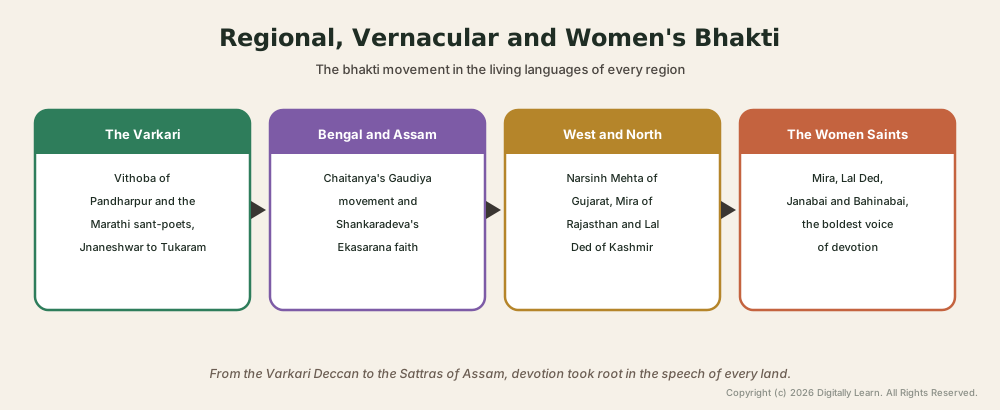
The medieval Bhakti movement took root as a cluster of regional, vernacular traditions, each singing of God in the living speech of its own land. In Maharashtra the Varkari sampradaya adored Vithoba of Pandharpur through the Marathi abhangs of Jnaneshwar, Namdev, Eknath and Tukaram. In Bengal Chaitanya founded the Gaudiya Vaishnava movement of congregational sankirtana, while in Assam Shankaradeva built the Ekasarana Dharma of the Sattra and the Namghar. Gujarat sang with Narsinh Mehta, Kashmir with the vakhs of Lal Ded, and Rajasthan with Mirabai, the Rajput woman who defied her age. Across every region the women saints, from Mira and Lal Ded to Janabai and Bahinabai, gave devotion its boldest and most personal voice.
Bhakti as a Regional and Vernacular Movement
From a Pan-Indian Devotion to Regional Vernacular Traditions
The bhakti of medieval India was never a single uniform movement, but a family of regional traditions, each rooted in its own land and language.
The earlier parts of this series followed the great streams of devotion: the Tamil bhakti of the Tamil Alvars and Nayanars, the Vedanta of the acharyas, the nirguna Sants of the north and the saguna poets of Rama and Krishna. This part turns to the same movement from a different angle, as a cluster of regional and vernacular phenomena. In Maharashtra, Bengal, Assam, Gujarat, Rajasthan and Kashmir, devotion took a local form, gathered local institutions, and above all sang in the mother tongue of the people rather than in Sanskrit.
What unites these traditions is the move from the learned tongue to the living speech. Each region produced saint-poets who carried the love of God into the language of the home and the field, and in doing so gave that language its first great literature. The Varkari of Maharashtra, the Gaudiya Vaishnavism of Bengal and the Ekasarana faith of Assam are not scattered curiosities but parallel chapters of one story, the rooting of devotion in the soil of every region. The figure below sets out the six traditions this part will follow.
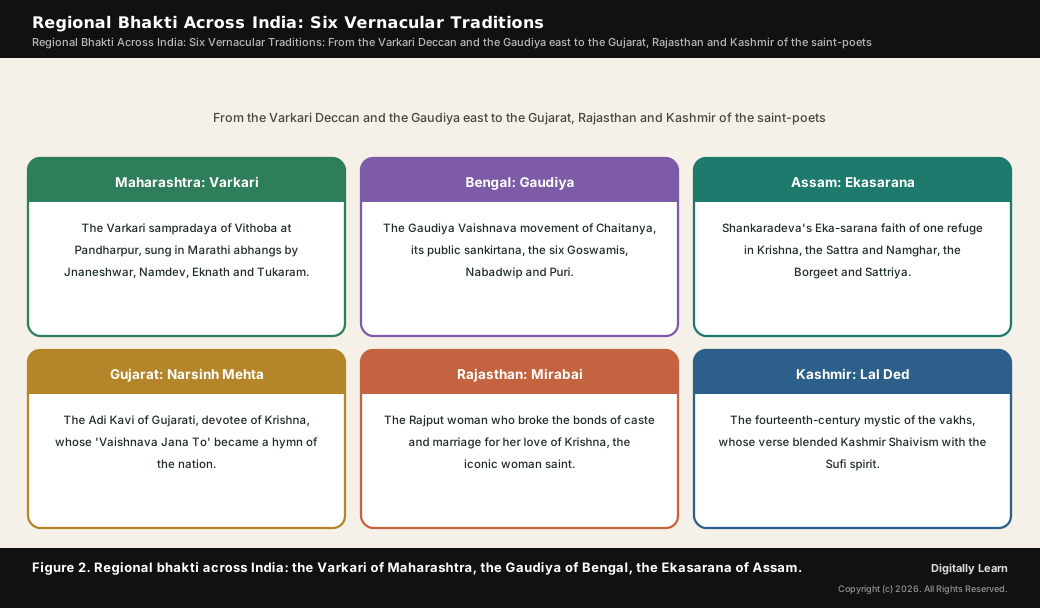
The Common Marks of the Regional Bhakti Movements
For all their local colour, the regional movements shared a common set of marks, which give them a family likeness across the breadth of India.
The first and deepest mark is the use of the vernacular, the chosen turning of devotion away from Sanskrit and toward the speech of the people. The second is a social openness, an offer of the path to all, regardless of caste, learning or sex, that drew in farmers, artisans, women and the low-born. The third is a body of institutions, the wari of the Varkari, the Sattra of Assam, the congregational sankirtana of Bengal, that carried the devotion beyond the single saint and made it endure.
A fourth mark is the towering place of the saint-poet, a figure who was at once a singer, a teacher and a reformer, around whose memory the whole tradition gathered. Where the official religion spoke in a tongue few understood, these saints spoke plainly of a God near at hand, and made their regional language the vehicle of the highest feeling. From this common ground each region built something distinct, and it is to those distinct traditions, beginning with the Varkari of Maharashtra, that this part now turns.
The Varkari Movement of Maharashtra: Jnaneshwar to Tukaram
The Varkari Sampradaya, Vithoba of Pandharpur and the Wari
The oldest and most enduring of the regional traditions is the Varkari sampradaya of Maharashtra, the devotion of Vithoba of Pandharpur.
The Varkari faith, whose name means the one who keeps the wari, the pilgrimage, is a sampradaya of the bhakti tradition rooted in the Marathi country. Its God is Vithoba, also called Vitthal, the dark deity who stands with hands on hips at the town of Pandharpur, regarded as a form of Vishnu and of Krishna, with his consort Rukmini at his side. Pandharpur lies on the western bank of the Bhima river, known here by its holy name the Chandrabhaga, and around the deity and the river the whole devotion turns.
The living heart of the tradition is the wari, the great pilgrimage on foot to Pandharpur, undertaken twice a year so that the pilgrims reach the town on the Ashadhi Ekadashi, the eleventh day of the bright fortnight of the month of Ashadha. The pilgrims walk in companies called dindis, singing abhangs, while the palkhi bears the sandals of the sants from their places of rest; this custom of carrying the paduka in a palanquin was begun by Tukaram's son Narayan in the year 1685. The figure below sets out the elements of the Varkari faith.
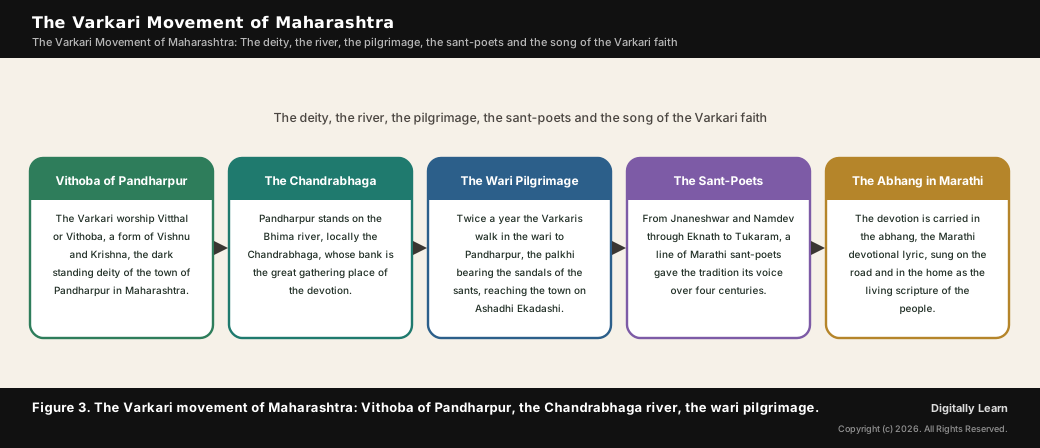
What makes the Varkari a true regional institution, and not merely a school of poets, is this fabric of place, river, pilgrimage and song. The devotion belongs to a particular land and a particular shrine, yet it crosses every line of caste, for the wari gathers Brahmin and farmer, weaver and untouchable, man and woman, on the one road to Pandharpur. Over four centuries a line of sant-poets, from Jnaneshwar to Tukaram, gave this devotion its voice in the Marathi abhang, and it is to them that the following sections turn.
Jnaneshwar and the Dnyaneshwari: The Fountainhead in Marathi
The fountainhead of the Varkari tradition is Jnaneshwar, also called Dnyaneshwar, the boy-saint whose Marathi commentary opened the scriptures to the people.
Jnaneshwar, by tradition a saint of the thirteenth century who lived only some twenty years, from about 1275 to 1296, belonged to the Nath and Varkari traditions and is counted among the founders of the Varkari devotion of Vithoba. His dates are those of pious tradition and should be held loosely, but his achievement is firm. While still very young he composed the Dnyaneshwari, a vast commentary in Marathi verse on the Bhagavad Gita, ranked among the oldest surviving works of Marathi literature and revered as a scripture in its own right.
The greatness of the Dnyaneshwari lay in its language. By expounding the Gita not in Sanskrit but in the Marathi of the people, Jnaneshwar placed the highest teaching within the reach of the unlettered, and gave his region a devotional classic in its own tongue. He also wrote the Amrutanubhav, a work of mystical philosophy, before, the tradition holds, entering a living samadhi at Alandi near Pune in 1296, where his shrine remains a great place of Varkari pilgrimage. With him the Marathi vernacular became, for the first time, the vehicle of a whole devotional culture.
Namdev and Eknath: The Varkari Tradition Carried Forward
After Jnaneshwar the tradition was carried forward by Namdev and Eknath, two saints who deepened the devotion and widened its reach.
Namdev, placed by tradition in the late thirteenth and early fourteenth century, though scholars date him very differently, was a Marathi sant-poet of the Varkari faith and a devotee of Vithoba, famed for his abhangs and his bhajan-kirtan. He is a figure of two regions, for he spent much of his life in the Punjab, and some of his hymns are gathered in the Sikh scripture, the Guru Granth Sahib; northern tradition remembers him as a nirguna saint of the formless Name, a dimension treated among the nirguna Sants Kabir, Nanak and Ravidas, while Maharashtra holds him a saguna devotee of Vithoba. Here he belongs to the Varkari line as one of its founding voices.
Eknath, who lived in the sixteenth century, from about 1533 to 1599, was a Varkari saint of Paithan on the Godavari and a devotee of Vitthal who renewed the tradition after a long gap. He composed the Eknathi Bhagavata, a Marathi rendering of part of the Bhagavata Purana, and the Bharud, a body of dramatic devotional songs, as well as the Bhavarth Ramayan; tradition also credits him with preparing a corrected text of Jnaneshwar's Dnyaneshwari, a service often noted though it is not recorded on the standard account of his works. Through him the Varkari devotion of Marathi passed, refreshed, toward its summit in Tukaram.
Tukaram and the Abhangas: The Summit of Varkari Devotion
The crown of the Varkari tradition is Tukaram, the seventeenth-century poet whose abhangs are the best loved devotional verse of Maharashtra.
Tukaram was a Marathi Varkari saint of the village of Dehu near Pune and a devotee of Vithoba; his dates are not certain, his birth given as either 1598 or 1608 and his death as 1649 or 1650, though historians widely accept that he died in 1650. He came of a humble trading family and lived through hardship and loss, and out of that life he made a poetry of plain, fierce and tender devotion. He is remembered above all for the abhang, the Marathi devotional lyric, of which his great collection, the Tukaram Gatha, is said by tradition to gather some four thousand five hundred.
The power of Tukaram's abhangs lies in their nearness to ordinary life and their refusal of all sham. He sang of the love of Vithoba and the longing for Pandharpur in the speech of the common people, scorning empty ritual, caste pride and hypocrisy, and his verse passed at once into the mouths of farmers and pilgrims. He was a contemporary of the Mughal age, and tradition links him to its rulers; his songs remain to this day the living scripture of the wari, sung on the long road to Pandharpur. With Tukaram the Marathi Varkari devotion reached a height of feeling and art that it has never surpassed.
Chaitanya and the Gaudiya Vaishnava Movement of Bengal
Chaitanya Mahaprabhu and the Founding of Gaudiya Vaishnavism
The bhakti of Bengal found its great founder in Chaitanya Mahaprabhu, whose movement reshaped the religious life of the east.
Chaitanya, who lived from 1486 to 1534, was born at Nabadwip, the Navadvipa of the Nadia country in Bengal, and became the founder of the Gaudiya Vaishnava tradition, the Vaishnavism of the Gauda region of Bengal. This part treats not the inward theology of his devotion, the doctrine of difference in non-difference that belongs to the saguna Krishna devotion of North Indian saguna Ram and Krishna devotion, but the movement he set in motion, the regional and social tradition with its own practices, places and institutions.
The mark of that movement was an ecstatic and public devotion to Krishna and to Radha-Krishna together, a love so overwhelming that Chaitanya himself was held by his followers to be devotion made flesh. He turned from learning to a life of love, gathering around him in Bengal a great company of devotees drawn from every level of society. What he founded was not a philosophy in a book but a living faith of the people, carried by song and procession, that swept across Bengal and Odisha in his own lifetime and has endured as one of the great Vaishnava movements of India.
Sankirtana, Nabadwip and Puri: The Social Impact in the East
The chief practice of the Gaudiya movement was the sankirtana, the congregational chanting that carried devotion into the open street.
In the sankirtana, Chaitanya made the public, congregational singing and chanting of the divine names, accompanied by music and dance in procession, the central act of devotion, one in which every person could share. This was a devotion of the crowd and the road, not of the closed temple, and it broke through the barriers of caste and learning, for the name of God on the lips needs no priest and no Sanskrit. From his birthplace at Nabadwip in the Nadia country the movement spread across Bengal, and Chaitanya later made his home at Jagannath Puri in Odisha, which became a second great centre of the faith.
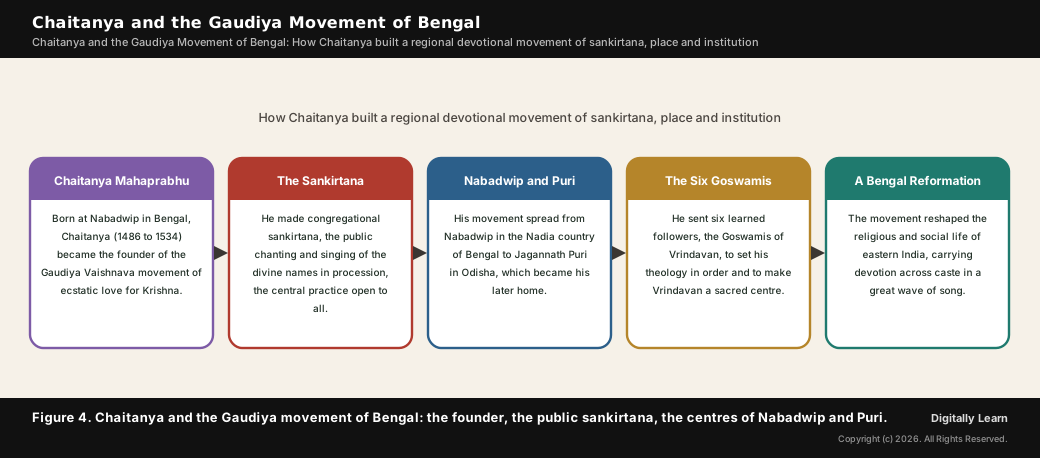
The social impact of the movement was profound. By making the path of pure devotion open to all, regardless of caste or condition, and by carrying it into the streets of Bengal and Odisha in a great wave of song, Chaitanya gave the region a popular religion of love that cut across the old hierarchies. The Bhakti movement, in the famous phrase of the examiners, received with his coming a remarkable re-orientation, a fresh turn toward ecstatic, congregational and socially open devotion. The figure above sets out the elements of this Bengal reformation.
The Six Goswamis of Vrindavan and the Bengali Padavali
Chaitanya gave his movement a learned spine and a poetic inheritance, in the six Goswamis of Vrindavan and the older Radha-Krishna songs of Bengal and Mithila.
To set his devotion on a firm foundation, Chaitanya sent a chosen few of his followers, who came to be known as the six Goswamis of Vrindavan, Rupa, Sanatana, Gopala Bhatta, Raghunatha Bhatta, Raghunatha dasa and Jiva, to present his theology in writing and to recover the holy places of Krishna. They made Vrindavan in the Braj country a great centre of Gaudiya learning and worship, linking the Bengal movement to the heartland of Krishna devotion, and gave the tradition the scholarly order that a living faith needs in order to last.
The Gaudiya devotion also drew on an older inheritance of vernacular song. The poets Chandidas, in Bengali, and Vidyapati, in Maithili, had already composed padavali, songs of the love of Radha and Krishna, that the Bengal Vaishnavas took up and sang as hymns of their faith. Vidyapati, the cuckoo-poet of Mithila who lived in the fourteenth and fifteenth centuries, first made Maithili a literary tongue, while the identity of Chandidas is wrapped in the famous puzzle of several poets bearing the one name. Together this earlier verse gave the Gaudiya movement a ready language of devotion in the speech of the eastern country.
Shankaradeva and the Ekasarana Dharma of Assam
The Eka-Sarana-Naam-Dharma: A Faith of One Refuge in Krishna
In the valley of the Brahmaputra the bhakti movement took the form of the Ekasarana faith of Shankaradeva, the saint who reshaped the religion of Assam.
Shankaradeva, whose long life is placed by tradition from 1449 to 1568, though his birth year is disputed and is sometimes given as 1483, was the saint, scholar and artist who founded the Vaishnava reformation of Assam. He taught the Eka-sarana-naam-dharma, the religion of one refuge in the Name, a devotion of single-minded surrender to Krishna alone, expressed above all through the hearing and the singing of his deeds. It was a strict monotheism of grace that set aside image-multiplicity and elaborate ritual in favour of the one God and his Name.
The Ekasarana faith carried a powerful message of social inclusion. Shankaradeva opened his devotion to all, drawing into it people of every caste and even those outside the caste order, including tribal communities of the Assam hills and plains, and he made the Assamese language the vehicle of the faith. In an age of many local cults and animal sacrifice, his teaching of a single God reached by simple devotion and song worked a quiet revolution in the religious and social life of the region. His disciple Madhavdev carried the movement forward and gave it much of its finest devotional song.
The Sattra and the Namghar: Institutions of Assamese Vaishnavism
The Ekasarana faith endured because Shankaradeva gave it lasting institutions, the Sattra and the Namghar that still order religious life in Assam.
The assembly of devotees that gathered around Shankaradeva grew over time into the Sattra, the monastery of the Assam Vaishnavas, a self-governing community of worship, learning and art that became the centre of religious life in the valley. The great Sattras of Majuli, the river island in the Brahmaputra, and of Barpeta remain living institutions to this day. Beside the monastery stood the Namghar, the house of the Name, the prayer hall of every village, which served as the social and religious heart of the community and a place of common assembly open to all.
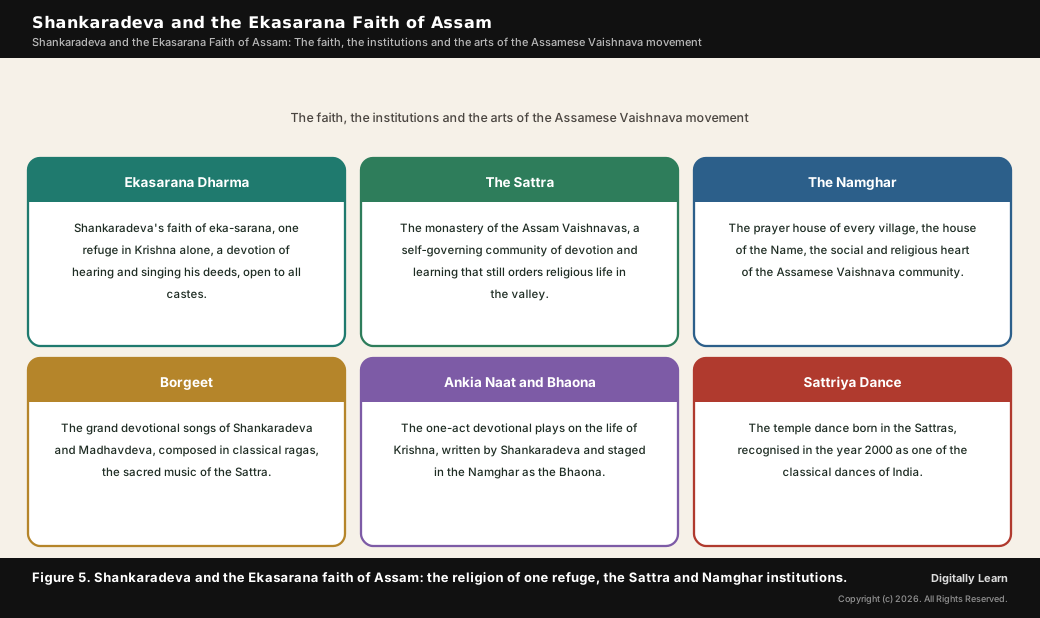
Through the Sattra and the Namghar the Ekasarana faith became far more than the teaching of a single saint; it became a durable social order that shaped the culture of Assam for five centuries. The Namghar in particular gave the village a common house, a forum where matters of the community as well as of devotion were settled, so that the religious institution carried a real civic life. This fabric of institutions, as much as the doctrine, is why the movement of Shankaradeva remains the living religion of the Assamese Vaishnava to the present day. The arts these institutions nurtured are the subject of the next section.
Borgeet, Ankia Naat and the Sattriya Dance
The Sattras of Assam became the cradle of a whole devotional culture of music, drama and dance, the lasting art of the Ekasarana faith.
Shankaradeva and his disciple Madhavdev composed the Borgeet, the grand devotional songs set to classical ragas that are the sacred music of the Sattra. Shankaradeva also created the Ankia Naat, the one-act devotional plays on the life of Krishna, written in a special stage language and performed as the Bhaona in the Namghar, a theatre that taught the faith through spectacle and song. From the same monastic culture grew the Sattriya, the temple dance of the Sattras, a tradition of devotional dancing that the Sangeet Natak Akademi recognised in the year 2000 as one of the classical dances of India.
These arts were not ornament but the very means of the Ekasarana devotion, the ways in which the love of Krishna was taught, shared and made beautiful within the Sattra. Through Borgeet, Ankia Naat and Sattriya, the faith of Shankaradeva entered the eye and the ear of the Assamese people and bound them into a shared devotional life. That a great classical dance and a whole body of song and drama should spring from one regional bhakti movement is a measure of how deeply the Ekasarana faith shaped the culture of Assam.
Regional Bhakti of Gujarat, Rajasthan and Kashmir
Narsinh Mehta of Gujarat and the Hymn Vaishnava Jana To
The bhakti of Gujarat found its first great voice in Narsinh Mehta, the saint honoured as the father of Gujarati poetry.
Narsinh Mehta, a poet-saint of the fifteenth century whose exact dates are uncertain, is honoured as the Adi Kavi, the first poet, of the Gujarati language. He lived a life of devotion at Junagadh and gave himself wholly to the worship of Krishna, composing bhajans of love for the Lord that became the foundation of Gujarati devotional literature. In him the speech of Gujarat first became the vehicle of high poetry and ardent bhakti.
His enduring fame rests above all on one hymn, Vaishnava Jana To, which paints the true devotee of Vishnu as the one who feels the pain of others and lives in humility, truth and compassion. Centuries later this song became the favourite of Mahatma Gandhi and a beloved hymn of the freedom struggle, carried across India far beyond its Gujarati home. That a fifteenth-century bhajan should become a moral anthem of the modern nation is a striking sign of the reach of regional bhakti into the later life of the country.
Mirabai of Rajasthan: The Rajput Woman Who Defied Her Age
The bhakti of Rajasthan is crowned by Mirabai, the Rajput princess who broke every bond of her age for her love of Krishna.
This part treats Mirabai not in the theology of her Krishna devotion, the bridal love of the saguna Lord that belongs to North Indian saguna Ram and Krishna devotion, but in her place as a woman saint and a figure of social defiance. She was a sixteenth-century Rajput of high birth, of the Rathore house, born at Kudki and raised at Merta, who married into the ruling family of Mewar and is forever linked with the fortress of Chittor. Her dates are very uncertain, placed about 1498 to 1547, and the record is unusually thin, for no manuscript of her verse survives from her own time and the earliest written records come more than a hundred and fifty years later.
What makes Mira the iconic woman saint of bhakti is her fearless rejection of the bonds of caste, rank and marriage. She held Krishna alone to be her true husband, and against the will of her royal in-laws she sang and danced her devotion in the open, in the company of saints of every caste; tradition tells of their attempts to silence and even to poison her. In defying the duties of a Rajput wife and the pride of her caste for the sake of God, she became, more than any other figure, the symbol of the woman's freedom that the bhakti path could offer, and her bhajans are sung across the north to this day.
Lal Ded of Kashmir and the Vakhs of the Valley
In the far north the devotion of Kashmir spoke through Lal Ded, the woman mystic of the vakhs, revered by Hindu and Muslim alike.
Lal Ded, also called Lalleshwari or Lalla, was a Kashmiri mystic of the fourteenth century, placed about 1320 to 1392, who belonged to the school of Kashmir Shaivism, the Trika philosophy of the valley. She was the creator of the vakh, the terse mystical verse that is among the very oldest surviving composition in the Kashmiri language, and through it she poured out a devotion that sought the divine within the self, beyond image and creed and the divisions of caste.
The deep significance of Lal Ded is that her voice stands at the meeting of two streams, the Shaiva mysticism of Kashmir and the Sufi spirit then spreading in the valley. Her verse is held to symbolise the harmonious blending of Shaivism and Sufism, and she is venerated to this day by Hindus as Lalla Yogini and by Muslims as Lal'arifa, a saint shared across the communities. As a woman, a mystic and a maker of the Kashmiri tongue, she shows how regional bhakti could carry, at one and the same time, a woman's voice and the promise of a devotion above sectarian division.
The Women Saint-Poets of the Bhakti Movement
The Distinctive Voice of Women in the Bhakti Movement
Across every region the bhakti movement gave women a voice it gave them nowhere else, and the women saints are one of its boldest features.
In a society that bound women to the home and the duties of caste and marriage, the path of devotion opened a door. Because bhakti held that God may be reached by love alone, without learning, priesthood or rank, it offered the woman a direct way to the divine that no other religious life allowed. The women who took it, from Mirabai of Rajasthan and Lal Ded of Kashmir to Janabai and Bahinabai of Maharashtra, often broke the bonds of custom to do so, and out of that struggle came a poetry of unusual force and feeling.
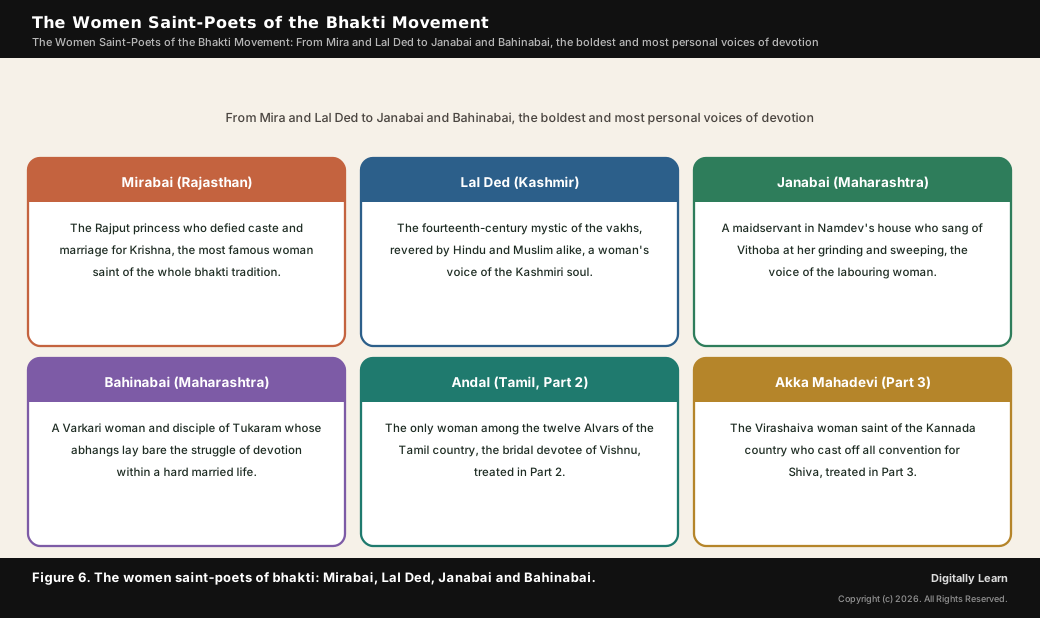
Their verse has a distinctive note of its own. The women saints sang of God as a husband or a lover, of the longing of the soul, and often of the hard cost of their devotion in a world that resented a woman's freedom; the abhangs of Bahinabai even lay bare the grief of being born a woman. In claiming God as their own and the open road of the saints as their right, the women of bhakti made a quiet but lasting assertion of the worth and freedom of women, and won a place in the religious memory of India that the centuries have not erased. The next section sets them out region by region.
The Women Saints Region by Region
The women saints rose in every region of the bhakti world, from the Tamil south to the Kashmir valley, each in her own tongue and tradition.
In Maharashtra the Varkari faith produced Janabai, a maidservant in the household of Namdev who sang of Vithoba at her grinding and sweeping, the voice of the labouring woman, and later Bahinabai, a disciple of Tukaram whose abhangs and life-story tell of the struggle to keep her devotion within a hard marriage. In Rajasthan stood Mirabai and in Kashmir Lal Ded, the two most famous of all. The earlier parts of this series add the southern women: Andal, the only woman among the twelve Alvars, and the Shaiva poet Karaikkal Ammaiyar of the Tamil Alvars and Nayanars, and Akka Mahadevi, the Virashaiva woman saint of the Vedanta acharyas and the Lingayat reform. The table below gathers them.
| Woman saint | Region or tradition | Dates (as given) | Remembered for |
|---|---|---|---|
| Mirabai | Rajasthan (Mewar) | About 1498 to 1547 (uncertain) | Rajput princess; bhajans of love for Krishna; defiance of caste and marriage |
| Lal Ded (Lalleshwari) | Kashmir (Shaiva-Sufi) | About 1320 to 1392 | The vakhs; a devotion blending Shaivism and the Sufi spirit |
| Janabai | Maharashtra (Varkari) | 13th to 14th century | A maidservant of Namdev; abhangs to Vithoba; the labouring woman's voice |
| Bahinabai | Maharashtra (Varkari) | 1628 to 1700 | Disciple of Tukaram; abhangs on devotion within a hard married life |
| Andal | Tamil country (Alvar) | Treated in Part 2 | The only woman among the twelve Alvars; bridal devotion to Vishnu |
| Akka Mahadevi | Karnataka (Virashaiva) | Treated in Part 3 | The Lingayat woman saint; vachanas of love for Shiva |
| Karaikkal Ammaiyar | Tamil country (Nayanar) | Early, about the 6th century | One of three women among the 63 Nayanars; Tamil hymns to Shiva |
Set side by side, these women show how widely the bhakti path opened itself to them, from the Tamil country in the sixth century to seventeenth-century Maharashtra. Each spoke in her own regional tongue, Tamil and Kannada in the south, Marathi, Rajasthani and Kashmiri in the north and west, and each turned the constraints of a woman's life into a poetry of devotion. Together they make the women saints not a footnote to the movement but one of its central and most original achievements.
The Sacred Geography of Regional Bhakti
The Regional Spread of Bhakti on the Map of India
The regional traditions of bhakti are bound to a sacred geography that spans the whole of India, from the Kashmir valley to the Deccan and the Brahmaputra.
Each tradition has its own holy ground. The Varkari devotion centres on Pandharpur on the Chandrabhaga in Maharashtra, with Jnaneshwar's Alandi and Eknath's Paithan close by. The Gaudiya movement runs from Nabadwip in Bengal to Puri in Odisha, with Vrindavan in the Braj country as the seat of its Goswamis. The Ekasarana faith fills the Brahmaputra valley, with its great Sattras on the island of Majuli and at Barpeta. The map below sets out these places across the country.
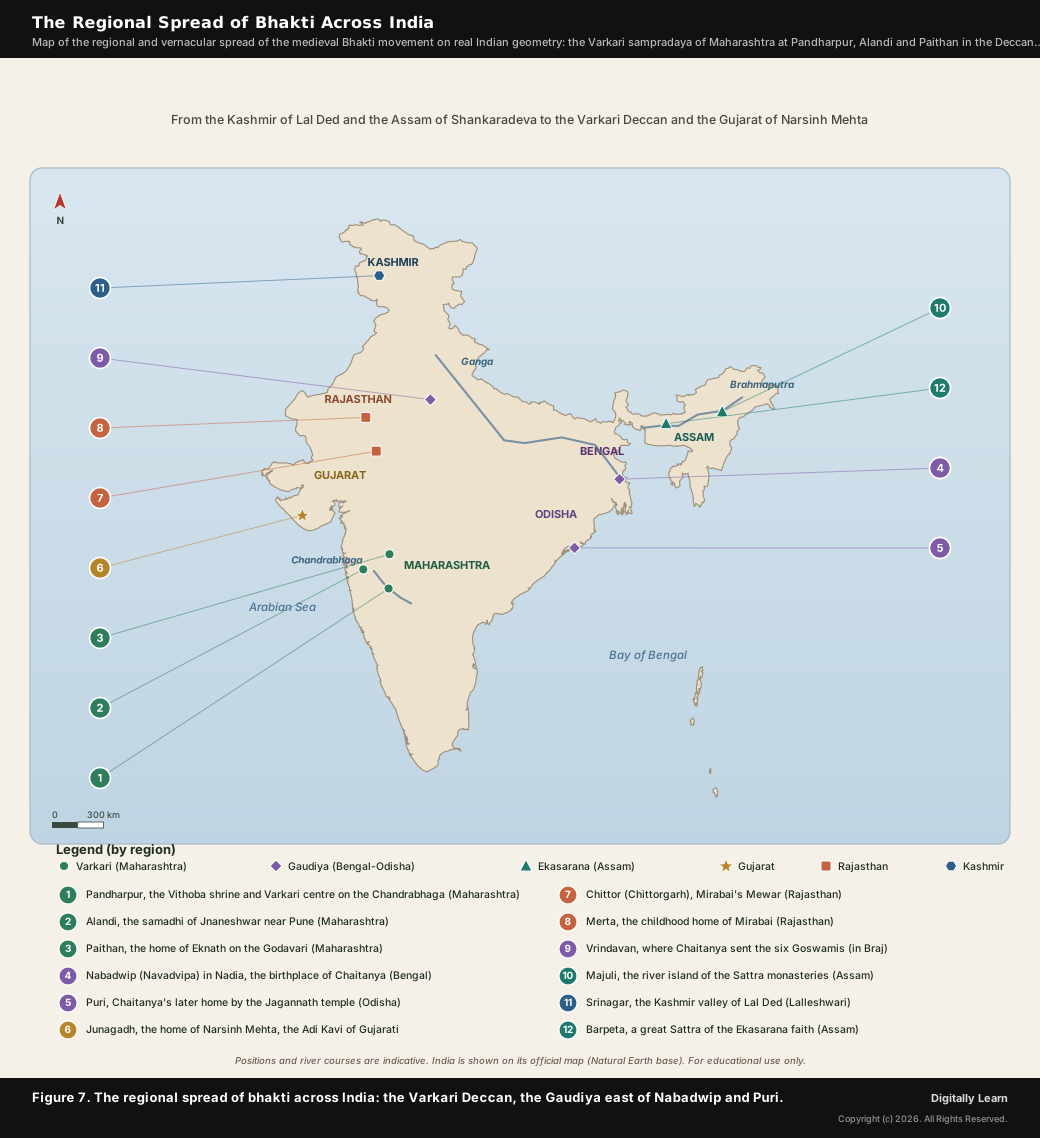
Read across the map, the geography tells the story of this part. To the west lie Junagadh of Narsinh Mehta in Gujarat and the Mewar of Mira at Merta and Chittor in Rajasthan; far to the north sits the Kashmir valley of Lal Ded; and the Deccan, Bengal, Odisha and Assam each hold their own tradition. That so many distinct movements should arise in so many regions, each in its own language and around its own shrines, is the central fact of regional bhakti, and the map makes plain how the devotion of India took root in every corner of the land.
Significance and Legacy of Regional, Vernacular and Women's Bhakti
Vernacular Literature and the Making of Regional Identity
The deepest legacy of regional bhakti is the founding of the vernacular literatures of India, the first great writing in the languages of the regions.
By choosing to sing in the mother tongue rather than in Sanskrit, the regional saints gave their languages a literature of the first rank. The Dnyaneshwari and the abhangs stand at the head of Marathi letters, the padavali of Chandidas and Vidyapati at the head of Bengali and Maithili, the Borgeet and Ankia Naat at the head of classical Assamese, and the bhajans of Narsinh Mehta at the head of Gujarati, while the vakhs of Lal Ded are among the oldest verse in Kashmiri. The table below gathers the regional traditions at a glance.
| Region or tradition | Chief saint or saints | Language | Key work or form |
|---|---|---|---|
| Maharashtra (Varkari) | Jnaneshwar, Namdev, Eknath, Tukaram | Marathi | The Dnyaneshwari and the abhang |
| Bengal (Gaudiya) | Chaitanya; Chandidas | Bengali | Sankirtana; the Radha-Krishna padavali |
| Mithila | Vidyapati | Maithili | The Padavali of Radha and Krishna |
| Assam (Ekasarana) | Shankaradeva, Madhavdev | Assamese | Borgeet, Ankia Naat and Sattriya |
| Gujarat | Narsinh Mehta | Gujarati | The bhajans, including 'Vaishnava Jana To' |
| Rajasthan | Mirabai | Rajasthani | The bhajans of love for Krishna |
| Kashmir | Lal Ded (Lalleshwari) | Kashmiri | The vakhs |
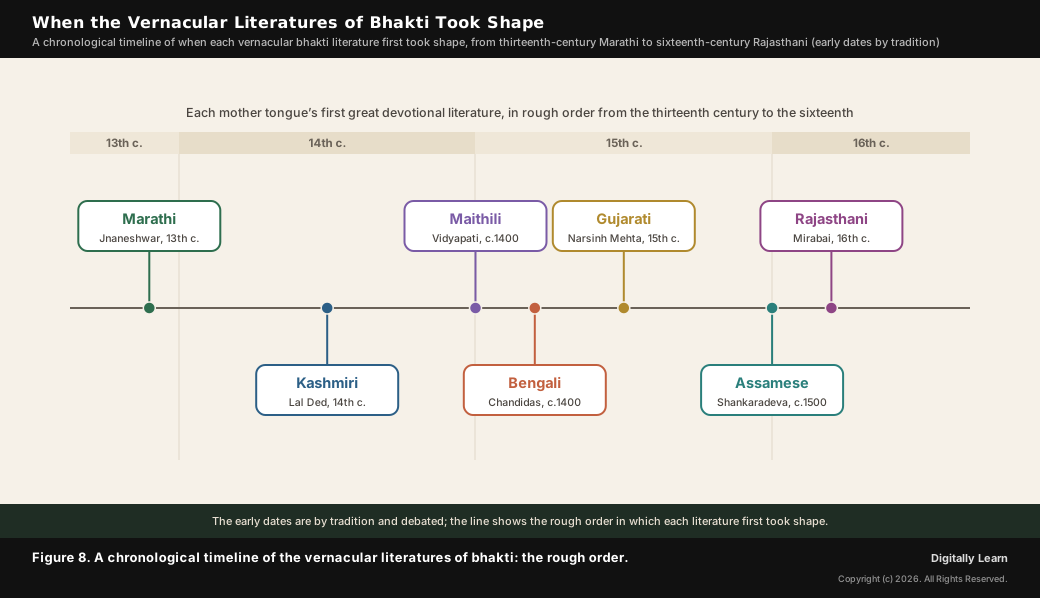
This service to the vernacular shaped far more than religion. By carrying the highest devotion into everyday speech, the regional saints helped to form the very identity of their regions, weaving a shared language and a shared devotional memory into the culture of Maharashtra, Bengal, Assam, Gujarat and the rest. The literatures they founded became, in time, the basis of the modern languages of India, so that the regional bhakti movement stands among the great formative forces in the cultural history of the country.
Social Reform, the Women's Voice and Composite Devotion
Beyond literature, regional bhakti worked a quiet social reform and reached across the lines of community, in ways that still mark Indian life.
Every regional tradition carried a message of social openness. The Varkari wari, the Gaudiya sankirtana and the Assamese Namghar gathered people across caste, and saints who were farmers, artisans, maidservants and the low-born stood beside Brahmins on the devotional road. The women saints, from Mira and Lal Ded to Janabai and Bahinabai, won for women a bold and lasting voice, and the example of Lal Ded, revered by Hindu and Muslim alike, shows how regional devotion could rise above the divisions of creed.
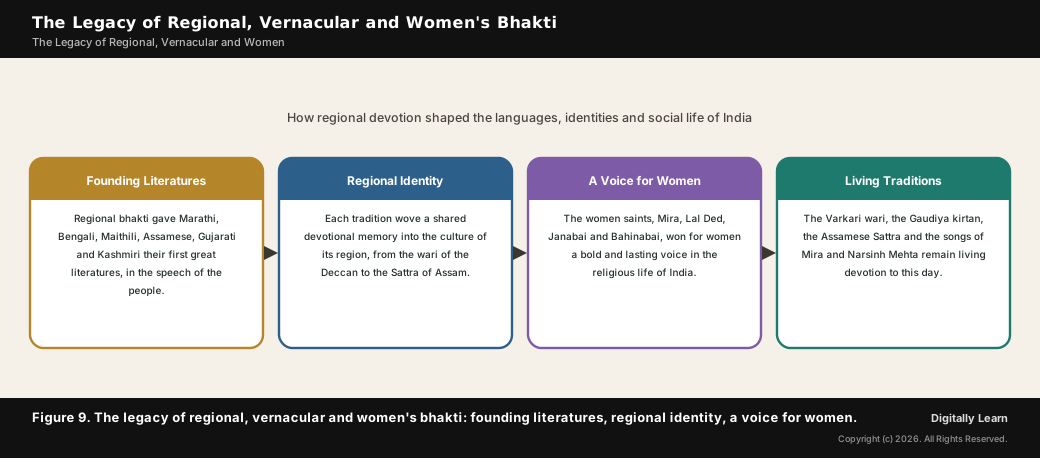
The fruits of this devotion remain living traditions to this day. The wari still walks each year to Pandharpur, the Gaudiya kirtan still sounds in Bengal, the Sattras of Assam still order the religious life of the valley, and the songs of Mira and Narsinh Mehta are sung across India. In carrying devotion into the regions and the vernaculars, in opening the path to all and giving women their voice, the regional bhakti movement left a legacy of language, identity and social feeling that runs through the whole later history of the country, and joins with the nirguna, saguna and southern streams of the earlier parts to complete the picture of medieval Indian devotion.
UPSC Relevance and Previous-Year Questions
Where Regional and Women's Bhakti Fits in the UPSC-CSE Syllabus
This topic belongs to General Studies Paper I: medieval Indian history and culture, where the regional saints, their works and their languages are a recurring theme, tested in Prelims as fine pairings and in Mains as a subject of religion, literature and society.
The questions most often test the saints region by region, their languages and institutions, and the place of the women saints. The following points are worth holding in working memory:
- The Varkari: the devotion of Vithoba of Pandharpur in Maharashtra, sung in Marathi abhangs by Jnaneshwar (the Dnyaneshwari), Namdev, Eknath and Tukaram, with the wari pilgrimage.
- Tukaram: the great Varkari poet of the abhang, of the seventeenth century, a contemporary of the Mughal age.
- Chaitanya: the founder of the Gaudiya Vaishnava movement of Bengal, of public sankirtana, born at Nabadwip and later at Puri, who gave the Bhakti movement a fresh re-orientation.
- Shankaradeva: the founder of the Ekasarana faith of Assam, of the Sattra and Namghar, and of Borgeet, Ankia Naat and the Sattriya dance.
- The regional saints and women: Narsinh Mehta of Gujarat (‘Vaishnava Jana To’), Mirabai of Rajasthan, Lal Ded of Kashmir (the vakhs), and the women saints Janabai and Bahinabai.
A 2006 Prelims question asked of which Mughal emperor the saint Tukaram was a contemporary. This part teaches that Tukaram was a Varkari poet of the seventeenth century, born around the turn of that century (about 1598 to 1608) and active until about 1650. His life therefore ran through the reign of Jahangir, who ruled from 1605 to 1627, and that is the answer the question seeks: Babar and Akbar are too early, while Aurangzeb belongs to the later seventeenth century. A reader who has fixed Tukaram's century from the section on the Varkari saints can place him at once against the Mughal line.
A 2018 Mains question asked candidates to discuss how the Bhakti movement received a remarkable re-orientation with the advent of Chaitanya Mahaprabhu. This part supplies the heart of the answer in the sections on the Gaudiya movement: Chaitanya's turn to an ecstatic, emotional devotion to Krishna; his making of public, congregational sankirtana the central practice; his opening of the path across caste; the spread of the movement through Bengal and Odisha; and the learned order given it by the six Goswamis of Vrindavan. From these the fresh turn Chaitanya gave to bhakti follows directly.
A 2004 Prelims question asked for the correct chronological order of Shankaracharya, Ramanuja and Chaitanya. This part fixes the last of the three, for it teaches that Chaitanya lived from 1486 to 1534, the latest by far, while the acharyas Shankara and Ramanuja belong to the earlier centuries treated in the Vedanta acharyas and the Lingayat reform; the order runs Shankaracharya, then Ramanuja, then Chaitanya. The fit is an honest partial one: this part anchors Chaitanya firmly in time, while the placing of the two older acharyas draws on the earlier part of the series.
Previous Year UPSC-CSE Questions
Previous Year UPSC-CSE Questions By the end you will be able to draft model answers for the following UPSC questions. Each question carries a collapsible framework showing how to approach it in the exam.
- UPSC Prelims 2006 GS-IBhakta Tukaram was a contemporary of which Mughal Emperor?
How to approach this Prelims question
Approach: Recall Tukaram's dates (born about the turn of the seventeenth century, active until about 1650) and pick the Mughal emperor whose reign falls within his lifetime.
Trap to watch: Akbar is the most famous Mughal and an easy wrong pick, but he died in 1605, before Tukaram's main life; Aurangzeb (from 1658) is too late. Jahangir (1605 to 1627) is the right fit.
Key facts to recall:
- Tukaram was a seventeenth-century Marathi Varkari saint who died about 1650.
- Jahangir reigned from 1605 to 1627, overlapping Tukaram's life.
- Babar and Akbar are too early; Aurangzeb is later.
Answer signal: Tukaram, the seventeenth-century Varkari saint, was a contemporary of the Mughal emperor Jahangir.
- UPSC Mains 2018 GS-IThe Bhakti Movement received a remarkable re-orientation with the advent of Sri Chaitanya Mahaprabhu. Discuss.
How to structure the answer in the exam
Introduction: Sri Chaitanya Mahaprabhu (1486 to 1534), the founder of the Gaudiya Vaishnava movement of Bengal, gave the Bhakti movement of the east a fresh and ecstatic turn that reshaped its devotion, its practice and its social reach.
Body (sub-themes to develop):
- An ecstatic, emotional devotion: Chaitanya made the love of Krishna and Radha-Krishna a path of pure feeling, a turn from doctrine to rapture.
- Sankirtana as the central practice: the public, congregational chanting and singing of the divine names in procession, open to all and needing no priest or Sanskrit.
- Social re-orientation: a popular religion of love that crossed caste and drew in every level of Bengali and Odia society.
- Place and institution: the spread from Nabadwip to Puri, and the learned order of the six Goswamis of Vrindavan, who systematised the theology and recovered the holy places.
Conclusion: By turning bhakti toward ecstatic, congregational and socially open devotion, and grounding it in lasting institutions, Chaitanya gave the movement in eastern India a re-orientation whose effects endure in the Gaudiya tradition to this day.
- UPSC Prelims 2004 GS-IWhich one of the following sequences indicates the correct chronological order?
How to approach this Prelims question
Approach: Date each figure and arrange them earliest to latest; fixing Chaitanya (1486 to 1534) as the latest already rules out the options that do not end with him.
Trap to watch: The options that place Chaitanya in the middle or first are wrong; he is the latest of the three. Distinguishing Shankara (8th century) from Ramanuja (11th to 12th century) settles the first two places.
Key facts to recall:
- Chaitanya lived 1486 to 1534, the latest of the three.
- Shankaracharya, the Advaita teacher, belongs to the eighth century.
- Ramanuja, the Vishishtadvaita teacher, belongs to the eleventh to twelfth century.
Answer signal: The correct chronological order is Shankaracharya, then Ramanuja, then Chaitanya.
Sources and Further Reading
- NCERT, Themes in Indian History and Medieval India (the regional saints and the Bhakti movement)
- Wikipedia: Varkari
- Wikipedia: Dnyaneshwar (the Dnyaneshwari)
- Wikipedia: Tukaram
- Wikipedia: Chaitanya Mahaprabhu
- Wikipedia: Gaudiya Vaishnavism (the six Goswamis)
- Wikipedia: Sankardev (the Ekasarana Dharma)
- Wikipedia: Sattriya (the Assam dance)
- Wikipedia: Narsinh Mehta (Vaishnava Jana To)
- Wikipedia: Mirabai
- Wikipedia: Lalleshwari (Lal Ded)
- Wikipedia: Vidyapati
- Sangeet Natak Akademi (Sattriya as a classical dance of India)
- Ministry of Culture, Indian Culture portal: the saints of the bhakti tradition
- Sahitya Akademi (the vernacular devotional literatures of medieval India)
- Indira Gandhi National Centre for the Arts (IGNCA): the bhakti and sant traditions
- National Portal of India (Know India: culture and heritage)
Editorial Disclaimer
This article is for UPSC preparation. The account of the regional and women saints follows the standard scholarship on medieval Indian religion. Many dates of these saints, those of Jnaneshwar, Tukaram, Shankaradeva, Mirabai, Lal Ded, Narsinh Mehta, Vidyapati and Chandidas above all, are traditional and contested, and these are flagged in the text.