


Overview
The economy of the Delhi Sultanate (1206 to 1526) rested on a peasant agriculture taxed at up to half the produce, and on a growing trade and town life. The Sultans measured land and took the land revenue in cash, Alauddin Khalji fixed prices in the markets of Delhi, and a sound currency of the silver tanka and the smaller jital served traders from Multan to Bengal. New crafts and techniques, from paper to the spinning wheel and the rahat, made the fourteenth century a time of growth.
Agriculture and Land Revenue in the Delhi Sultanate
Agriculture under the Sultanate: Crops, Peasants and Rural Gentry
Agriculture was rich. The traveller Ibn Battuta wrote that the soil was so fertile that it gave two crops a year, and rice was sown three times. Sesame, sugarcane and cotton were also grown, and they fed village industries such as oil pressing, the making of jaggery, weaving and dyeing.
Peasants were the great majority of the people, and most of them worked hard for a bare living. Famines and wars added to their hardship. Above them stood the muqaddams, the village headmen, and the khuts, the smaller landlords. Besides their own holdings, they held land on which they paid revenue at concessional rates, and they sometimes made ordinary peasants pay their share too.
These rural gentry were prosperous enough to ride costly Arab and Iraqi horses and wear fine clothes. Alauddin Khalji curtailed many of their privileges, but they recovered their old ways after his death. Many Hindu rais, or autonomous rajas, also kept their estates and their power under the Sultans.
Land Revenue and Taxes of the Delhi Sultanate: Kharaj and Jizya
The land revenue was the state's main income. Under the Khaljis and Tughlaqs the Sultan's officials measured the land and kept careful accounts, and the old chieftains lost their right to levy taxes of their own. Some of them now served the Sultanate as revenue collectors and assessors. Three taxes fell on the peasant.
- Kharaj: The tax on cultivation, about half of the peasant's produce.
- Tax on cattle: A grazing tax, called chara'i under Alauddin.
- Tax on houses: A tax on residences, called ghari under Alauddin.
Non-Muslims also paid the jizya. In the Sultanate it was a tax in lieu of military service, paid on a scale graded by means; women, children and the poor were exempt, and the brahmanas too at first. Because almost all cultivators were Hindus, it was at first collected along with the land revenue. Firuz Tughlaq, while abolishing many illegal cesses, made it a separate tax and levied it on the brahmanas as well.
Alauddin Khalji's Agrarian Reforms: Measurement and the Half Share
Alauddin Khalji made the land revenue far heavier and far better collected. He raised the state's demand in the doab to half of the produce, assessed it by measuring the land, and generally made the peasants pay in cash. To pay in cash, peasants had to sell their grain at low prices to the banjaras, the grain carriers who took it to the towns.
Direct collection by measurement could work only if the amils and other local officials were honest. Alauddin paid them salaries enough to live in comfort but audited their accounts strictly, and small defaults were punished with beatings and prison. He also created a new department, the Diwan-i-Mustakhraj, to investigate and recover arrears from the revenue collectors.
His measures fell hardest on the privileged people of the countryside, the khuts and muqaddams. The historian Barani wrote as if they were aimed at the Hindus alone, but they were directed mainly against these privileged sections, who had paid little and lived well.
Agriculture under the Tughlaqs: Muhammad's Doab and Firuz's Canals
Muhammad bin Tughlaq's agrarian measures failed disastrously in his own reign. Early in his rule there was a serious peasant rebellion in the Ganga-Yamuna doab. The state's share stayed at half, as under Alauddin, but it was fixed arbitrarily, not on the actual produce, and prices for turning the produce into money were also fixed artificially.
A severe famine then ravaged the area for about six years, and relief through advances for cattle, seed and wells came too late. The Sultan left Delhi and lived for two and a half years in a camp called Swargadwari near Kannauj. After his return he set up a separate department, the diwan-i-amir-i-kohi, to extend and improve cultivation in the doab.
- Development blocks: The area was divided into blocks, each under an official.
- Loans: Officials gave loans to cultivators to bring more land under the plough.
- Better crops: Peasants were urged to grow superior crops, wheat in place of barley and sugarcane in place of wheat.
- Failure: The scheme failed largely because the men chosen were inexperienced and dishonest.
Firuz Tughlaq turned to irrigation. He repaired and dug a number of canals; the longest, about 200 kilometres long, took off from the Sutlej towards Hansi, and another took off from the Yamuna. They watered fields and the new towns he built, Hissar-Firuzah (Hisar, founded in 1354) in Haryana and Firuzabad in Uttar Pradesh. Grain prices, which had risen sharply under Muhammad, fell almost to Alauddin's level under Firuz, perhaps because cultivation spread.
Alauddin Khilji Economic Reforms: Market Control and Fixed Prices
Alauddin's Market Reforms: Three Markets, the Shahna and Fixed Prices
Alauddin Khalji's control of the markets seemed to his contemporaries one of the wonders of the world. After his return from the Chittor campaign he fixed the price of everything, from grain, sugar and cooking oil to a needle, and from costly imported cloth to horses, cattle and slaves. He had a strong reason. The Mongol invasions of Delhi showed he needed a large army, and only low prices would let him pay it modest salaries.
He set up three markets at Delhi. One was for food grains, one for costly cloth, and one for horses, slaves and cattle. Each was under a high officer called the shahna, who kept a register of the merchants and controlled the shopkeepers and their prices.
- Cheap supply: Revenue from the doab came straight to the state, at half the produce, and peasants sold their grain cheaply to the banjaras.
- No hoarding: All banjaras were registered, and their agents and families were held collectively responsible for any breach.
- Reserves: The state stocked warehouses with grain and released it in famine or shortage.
- Punishment: Shopkeepers who overcharged or used false weights were punished very harshly.
| Grain | Price for one man (about 15 kg) |
|---|---|
| Wheat | 7.5 jitals |
| Rice | 5 jitals |
| Barley | 4 jitals |
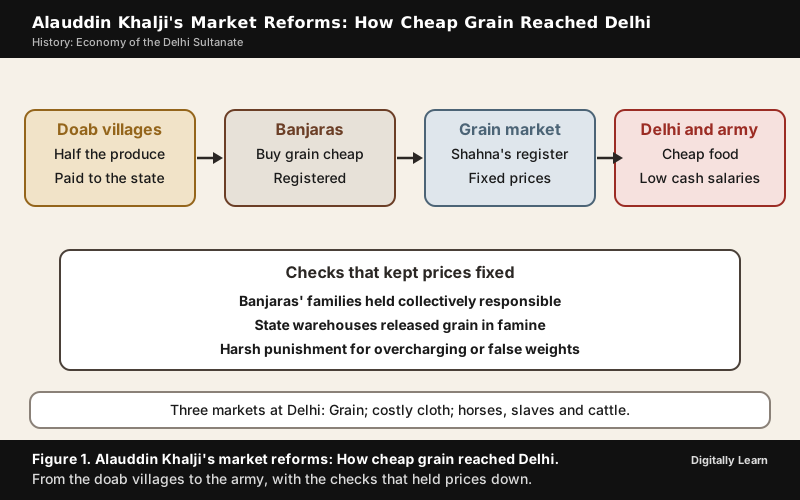
The prices held even in famine, Barani says, which contemporaries found a wonder. Alauddin also became the first Sultan to pay his soldiers fully in cash: 238 tankas a year to a trooper, and 78 more to one who kept two horses. Alauddin had built a new capital, Siri, in 1303, and dug the Hauz Khas reservoir to supply it. His conquests and market measures are taught in Alauddin Khalji's conquests and market control.
Trade, Towns and Crafts in the Delhi Sultanate
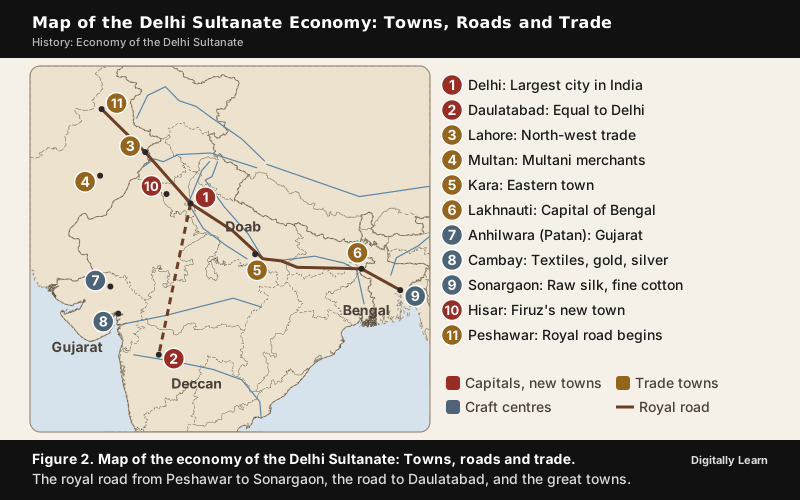
Growth of Towns and Trade: Delhi, Daulatabad, Cambay and Multan
With better communications and a sound currency based on the silver tanka, trade grew and so did towns. Ibn Battuta called Delhi the largest city in India, and Daulatabad was no smaller, a sign of the trade between north and south. A modern historian sums up the age as "the picture of a flourishing urban economy".
- North-west: Lahore and Multan, on the overland routes to Central and West Asia.
- East: Kara and Lakhnauti; Sonargaon in Bengal was famous for raw silk and fine cotton cloth.
- West: Anhilwara (Patan) and Cambay; Cambay was famous for textiles and for gold and silver work.
Indian textiles were already prized on the Red Sea and in the Persian Gulf, and fine Indian cloth now reached China, where it was valued more than silk. India imported high-grade textiles such as satin from West Asia, glassware and, above all, horses; from China it bought raw silk and porcelain.
Foodstuffs were generally cheap for townspeople. A modern historian estimates that under Firuz Tughlaq a family of a man, his wife, a servant and one or two children could live on five tankas a month. Living was easy for a lower official or a soldier, but artisans and workers found it hard, and town society was one of great inequalities.
Merchants, Roads and the Postal System of the Sultanate
Merchants of many communities carried this trade. The Arabs led the Indian Ocean trade but had not pushed out the Tamil and Gujarati traders, Hindu and Muslim. Coastal trade, and trade between the ports and north India, was in the hands of Marwaris and Gujaratis, many of them Jains, with Bohra merchants taking part.
The overland trade with Central and West Asia belonged to the Multanis, mostly Hindus, and the Khurasanis, who were Afghans, Iranians and others. Barani says the Multanis were so rich that the nobles had to go to their houses to borrow money for every feast.
Travel was risky, but the royal road from Peshawar to Sonargaon was kept in good repair with sarais on the way, and Muhammad bin Tughlaq built a road to Daulatabad. The state's post amazed Ibn Battuta. A horse-post, the uluq, changed royal horses every four miles, and a foot-post, the dawa, had three stations to a mile. News that took a traveller fifty days from Sind reached the Sultan in five. Muhammad bin Tughlaq received Ganga water at Daulatabad by these relays.
Technological Changes in the Sultanate Period: Paper, Charkha, Rahat
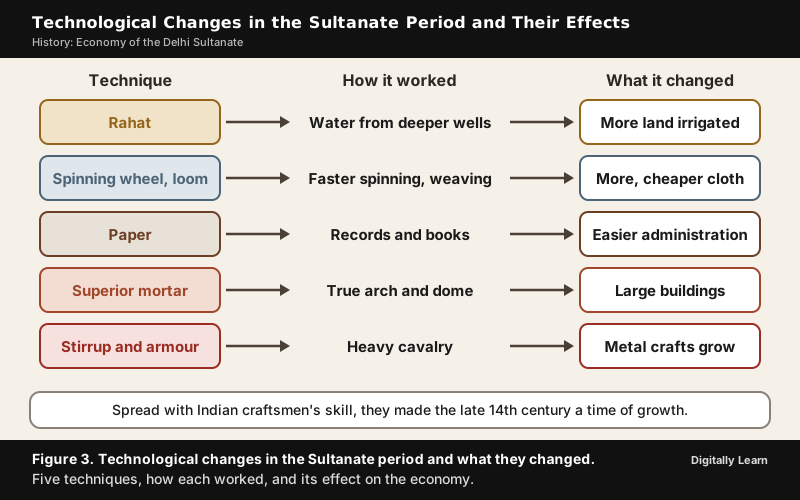
The Turks introduced or spread a number of crafts and techniques. Not all were new, but their spread, together with the skill of Indian craftsmen and the growth of agriculture, made the second half of the fourteenth century a period of growth and relative affluence.
| Technique | What it changed |
|---|---|
| Rahat (miscalled the Persian wheel) | Lifted water from a deeper level, so more land could be irrigated |
| Spinning wheel (charkha), improved loom | Faster spinning and weaving; more and cheaper cloth |
| Cotton carder's bow (dhunia) | Cleaned cotton faster and better |
| Paper | Easier record-keeping and copying of books |
| Superior mortar | Large buildings on the true arch and dome |
| Iron stirrup and armour | Heavy cavalry; growth of metal crafts |
| Glass-making | A new craft in the towns |
Royal Karkhanas and Firuz Tughlaq's Department of Slaves
The Sultan's household ran a large number of karkhanas, departments in which goods for the king and his household were stored and, sometimes, made under royal supervision. They produced costly articles of silk and gold and silver ware. An officer called the wakil-i-dar was in charge of these activities and of the decorum of the court.
Firuz Tughlaq had a separate department of slaves. He gathered about 1,80,000 slaves, trained many of them in handicrafts and posted them in the royal karkhanas across the empire, while others formed his personal bodyguard. He also set up a separate department of public works, which built canals and many of his public buildings.
Coinage of the Delhi Sultanate: Tanka, Jital and Token Currency
Tanka and Jital: The Silver and Billon Coins of the Sultanate
Iltutmish set up the currency of the Delhi Sultanate, drawing on both the coins brought by Muslim settlers and native Indian ones. Its basic coins were the silver tanka, weighing one tola of 96 rattis, about 11.2 grams, and the jital, a small coin of billon, silver mixed with copper. Forty-eight jitals made one tanka. Like the Ghaznavid coins before them, the Sultanate's jitals carried the name of the ruler who issued them.
This currency served the whole Sultanate. Grain prices in Alauddin's markets were reckoned in jitals, soldiers' pay in tankas, and the nobles' salaries in thousands of tankas. Under Muhammad bin Tughlaq leading ministers received 20,000 to 40,000 tankas a year. A worldwide shortage of silver in the fourteenth century slowly lowered the silver in the coins until the Mughals came.
Coins were struck in gold, silver and copper, with gold probably valued at ten times silver. Alauddin Khalji's coins called him Sikandar al‑Sani, the second Alexander. Muhammad bin Tughlaq struck gold coins in very large numbers, after which gold became scarce, and by the time of the Lodis coins were struck almost wholly in copper and billon.
| Coin | Metal | Value |
|---|---|---|
| Tanka | Silver, one tola (about 11.2 g) | The standard coin; 48 jitals |
| Jital | Billon, silver mixed with copper | One forty-eighth of a tanka |
Muhammad bin Tughlaq's Token Currency
Muhammad bin Tughlaq tried to make a cheap metal do the work of silver. There was a worldwide shortage of silver in the fourteenth century, and Qublai Khan in China and Ghazan Khan, a Mongol ruler of Iran, had already experimented with token money; in China, paper money had spurred trade. Between 1329 and 1332 Muhammad issued tokens of bronze, brass and copper to pass at the value of the silver tanka; some read "sealed as a tanka of fifty ganis". Specimens survive in museums across India.
- Hard to accept: Token money was a new idea in India, and traders and common people were slow to accept it.
- Forgery: The state could not stop people forging the new coins, and they lost value in the markets.
- Withdrawal: Muhammad withdrew the tokens and paid out silver for them. Accounts differ on the forged ones. One says those found by tests were refused and lay heaped outside the fort for years; another says all tokens, forged or genuine, were redeemed.
It was a genuine experiment, not one forced by an empty treasury. The failure hurt the Sultan's prestige and wasted money, but the government recovered quickly. Ibn Battuta, who reached Delhi in 1333, saw no lasting damage. The Sultan's other experiments are in the Tughlaq dynasty, Muhammad bin Tughlaq and Firoz Shah.
Previous Year UPSC‑CSE Questions
Each question comes with an explanation of how to approach it.
- UPSC Mains 2023 GS‑IWhat were the major technological changes introduced during the Sultanate period? How did those technological changes influence the Indian society?
Answer outline
The outline sets out what the question asks, the main arguments, relevant examples and the direction of the conclusion; it is not a full model answer.
Introduction: Introduce the Sultanate period as a time when the Turks brought in or spread new crafts and techniques, which combined with Indian skill to make the fourteenth century one of growth.
Body (sub-themes to develop):
- Irrigation: The improved rahat lifted water from a deeper level, extending cultivation.
- Textiles: The spinning wheel, an improved loom and the carder's bow raised cloth output; Indian cloth reached the Red Sea, the Persian Gulf and China.
- Paper: Easier record-keeping for the state and the copying of books.
- Building: A superior mortar made the true arch and dome possible.
- War and metal: The iron stirrup and armour for heavy cavalry fed the metal crafts.
- Society: Towns, crafts and merchant wealth grew, in a society of great inequalities.
Conclusion: Conclude that the new techniques, resting on the skill of Indian craftsmen, quickened the economy and town life of the age, though society remained deeply unequal.
- UPSC Prelims 1998The Sultan of Delhi who is reputed to have built the biggest network of canals in India was
How to approach this Prelims question
Approach:
- Step 1: Firuz Shah Tughlaq repaired and dug many canals, the longest about 200 kilometres from the Sutlej to Hansi and another from the Yamuna, to water fields and his new towns.
- Step 2: None of the other three is known for canals.
Trap to watch: Ghiyasuddin Tughlaq built Tughlaqabad; the canals were his successor Firuz's.
Why each option is right or wrong:
- (a) Iltutmish: Wrong. He is known for consolidating the Sultanate and setting up its currency.
- (b) Ghiyasuddin Tughlaq: Wrong. He founded the dynasty and built Tughlaqabad.
- (c) Feroz Shah Tughlaq: Correct. His canals, the longest about 200 kilometres, made the largest network.
- (d) Sikandar Lodi: Wrong. The great canal network was Firuz Shah's, not the Lodi Sultan's.
Answer: (c) Feroz Shah Tughlaq.
Sources
- NCERT: Themes in Indian History Part II (Class XII), Through the Eyes of Travellers
- NCERT: Our Pasts II (Class VII, earlier edition), The Delhi Sultans
- NCERT: Medieval India (Satish Chandra, Class XI, earlier edition), Government, and Economic and Social Life under the Delhi Sultanat
- Reserve Bank of India: Medieval India coinage
- District Hisar (Govt of Haryana): History
- Delhi Tourism (Govt of NCT of Delhi): Eight Cities of Delhi, Siri
- Wikipedia: Delhi Sultanate
- Wikipedia: Revenue reforms of Alauddin Khalji
- Wikipedia: Market reforms of Alauddin Khalji
- Wikipedia: Jital
- Wikipedia: History of the taka
- Wikipedia: Muhammad bin Tughluq
- Wikipedia: Firuz Shah Tughlaq
- Wikipedia: Western Yamuna Canal
- Wikipedia: Saqiyah
- Wikipedia: Spinning wheel
- Wikipedia: Ibn Battuta
- UPSC: Civil Services Examination question papers
Editorial Disclaimer
This article draws on the NCERT history textbooks and the other sources listed in the Sources section. Figures for prices and coin weights are those given in the sources for the period.