


Overview

The Tughlaq dynasty was the third dynasty to rule the Delhi Sultanate, from 1320 to 1414. It was founded by Ghazi Malik, who took the throne as Ghiyasuddin Tughlaq. Under his son Muhammad bin Tughlaq the Sultanate reached its widest extent and saw bold experiments, the move of the capital to Daulatabad and a token currency, that failed; under Firoz Shah Tughlaq it built canals and towns; after 1388 it declined, and Timur sacked Delhi in 1398.
Tughlaq Dynasty: Founder, Rulers and Time Period (1320 to 1414)
Tughlaq Dynasty Founder: Ghiyasuddin Tughlaq
The Khalji dynasty ended in confusion. After Alauddin Khalji died in 1316, palace murders followed, and in 1320 Khusro Khan killed Mubarak Khalji and took the throne. Ghazi Malik, the governor in the Punjab, marched on Delhi, killed Khusro Khan and became Sultan as Ghiyasuddin Tughlaq, starting the dynasty. The earlier Khalji rulers are covered in Alauddin Khalji.
- Frontier general: As governor of Multan and then Dipalpur under Alauddin Khalji, he guarded the north-west against the Mongols and led the vanguard against the invasion of 1306.
- Tughlaqabad: In 1321 he built a fortified city east of Delhi, the third historic city of Delhi, as a stronghold against the Mongols.
- Warangal: His son Jauna Khan, the future Muhammad bin Tughlaq, besieged the Kakatiya capital Warangal in 1323; the victory ended the Kakatiya dynasty.
- Bengal: He campaigned in Bengal in 1324-25.
- Death: In 1325 a wooden pavilion built in his honour collapsed on him. Ibn Battuta claimed it was a conspiracy by his son; other chroniclers blamed lightning or running elephants.
Tughlaq Dynasty Time Period and Rulers List
The Tughlaq dynasty ruled from 1320 to 1414, the third of the five dynasties of the Delhi Sultanate, after the early Turkish rulers and the Khaljis and before the Sayyids and the Lodis. Three strong reigns filled the first 68 years; weak successors and civil war filled the last 26.
| Ruler | Reign | Known for |
|---|---|---|
| Ghiyasuddin Tughlaq | 1320 to 1325 | Founder; Tughlaqabad; Warangal taken |
| Muhammad bin Tughlaq | 1325 to 1351 | Widest empire; Daulatabad; token currency |
| Firoz Shah Tughlaq | 1351 to 1388 | Canals, towns, hereditary posts |
| Weak successors | 1388 to 1414 | Civil wars; Timur sacks Delhi, 1398 |
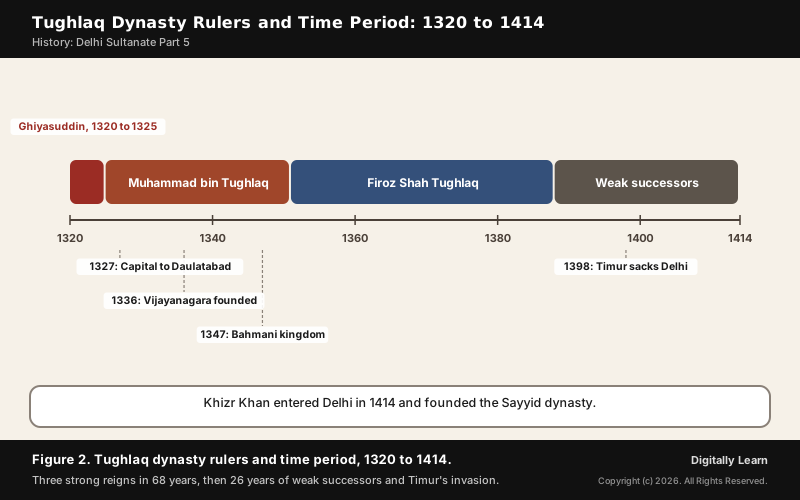
Dates differ slightly between books: some give Ghiyasuddin's reign as 1320 to 1324 and Muhammad's from 1324, because Ghiyasuddin died early in 1325. The last Tughlaq Sultan was Nasiruddin Mahmud, in whose reign Timur invaded; Khizr Khan entered Delhi in 1414 and founded the Sayyid dynasty.
Muhammad bin Tughlaq: The Sultan and His Experiments
Muhammad bin Tughlaq: Scholar, Conqueror and New Nobility
Muhammad bin Tughlaq ruled from 1325 to 1351. He was a learned ruler, skilled in Persian, Hindavi, Arabic, Sanskrit and Turkic, with an interest in medicine; his full name was Fakhruddin Muhammad Shah, and as a prince he was called Jauna Khan. Under him the Delhi Sultanate reached its widest extent, with campaigns between 1330 and 1335 that carried its armies across most of the subcontinent.
He also changed who ruled for him. The Khaljis and Tughlaqs raised people of humble birth, often their clients, to high office, and Muhammad appointed a wine distiller, a barber, a cook and two gardeners to high administrative posts. The chronicler Ziauddin Barani saw this as a sign of the Sultan's loss of judgement, a view that tells us as much about the old nobility as about the Sultan.

Governors ran territories called iqtas, and their holders, the muqtis, collected the revenue as salary and paid their soldiers from it. Under Alauddin Khalji and Muhammad Tughlaq these posts were not hereditary, holders were moved often, and accountants checked the revenue. The iqta system in full is in Delhi Sultanate administration.
Muhammad bin Tughlaq Shifted His Capital From Delhi to Daulatabad
In 1327 Muhammad bin Tughlaq ordered the capital moved from Delhi to Devagiri, which he renamed Daulatabad, in present-day Maharashtra. He had campaigned in the south as a prince, and Daulatabad lay at a central place from which both the north and the south could be administered. The residents of the oldest of Delhi's four cities were sent to the new capital, and the soldiers of his large standing army were garrisoned in the emptied city.
- The road: A broad road was built with shady trees on both sides and halting stations every two miles, with food and water, and a regular postal service linked Delhi and Daulatabad.
- The cost: Many died on the road of hunger and exhaustion, and the move was resented.
- The return: Revolts in the south and in Bengal, and fear for the northern frontier, led him to move the capital back to Delhi in 1335, costing more lives.
- The result: The Muslim elite settled at Daulatabad stayed on; it carried the Urdu language to the Deccan, and one of its members, Hasan Gangu, later founded the Bahmani kingdom.
Token Currency of Muhammad bin Tughlaq: Brass and Copper Coins
Muhammad bin Tughlaq paid his soldiers in cash. Instead of controlling prices, as Alauddin Khalji had done, he issued a token currency, coins of brass and copper that were to pass at the value of gold and silver, somewhat like present-day paper money. It was issued around 1330, after the costly campaigns had emptied the treasury.
- The coins carried inscriptions in Persian and Arabic rather than a royal seal, so people could not tell the official coin from a forgery.
- People saved their gold and silver coins and paid all their taxes in the new token coins.
- The cheap coins were easily counterfeited; Barani wrote that the houses of the Hindus became mints.
- The value of the coins collapsed, and trade and commerce were disrupted.
The token currency had to be recalled. The Sultan bought back both the real and the counterfeit coins at great expense, until heaps of coins lay within the walls of Tughlaqabad; use of the token coins had stopped by 1333. The Sultanate's coinage in general is in Delhi Sultanate economy.
Khurasan Plan, Qarachil Expedition and Taxes in the Doab
Muhammad bin Tughlaq was the first Sultan of Delhi to plan a campaign to capture Mongol territory. Confident after defeating a Mongol attack early in his reign, he raised a large standing army for an attack on Transoxiana and Khurasan. The soldiers were paid a year in advance and then kept idle; the treasury could not keep paying them, and the army was disbanded.
In 1333 he sent the Qarachil expedition into the Kumaon hills. Later chroniclers say he meant to cross the Himalayas towards China; the army could not fight in the hills, and nearly all of it perished. His campaign into Kashmir also ended in disaster, and he gave up his plans to invade Transoxiana.
To feed and pay the army he levied additional taxes in the Ganga-Yamuna doab. The rise coincided with famine, peasants fled their fields, and widespread rebellion followed. The Mongol threat itself is covered in Mongol invasions of the Delhi Sultanate.
Why Muhammad bin Tughlaq Is Called the Wisest Fool
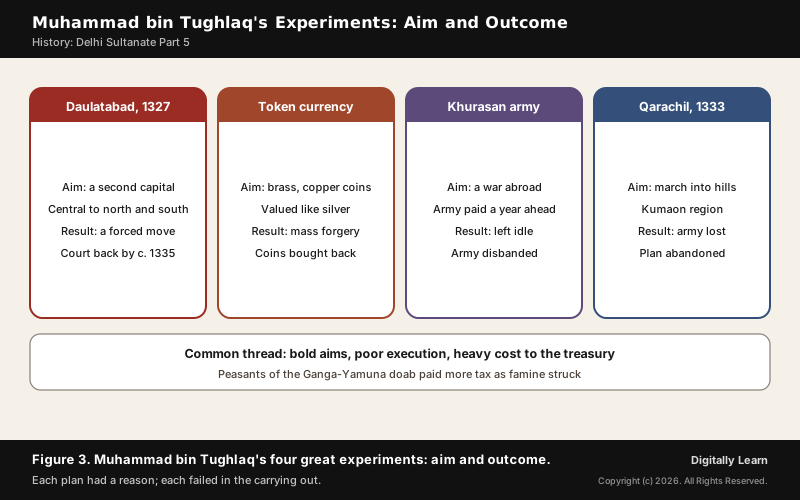
| Scheme | Reasoning | Why it failed |
|---|---|---|
| Daulatabad | A central second capital | Forced move, heavy loss of life |
| Token currency | Cash for a large army | No control of minting; forgery |
| Khurasan army | War against the Mongols | Could not be paid; disbanded |
| Doab taxes | Feed and pay the army | Came with famine; revolt |
A fair judgement weighs both sides. His measures were hasty and badly prepared, and he rarely took advice; Ibn Battuta criticised his excessive gifts and harsh punishments. Yet each plan had a reason, and unlike Alauddin's defensive measures, his were conceived as an offensive against the Mongols. Today a sudden, ill-considered order is still called a "Tughlaqi firman".
Revolts and the Breakup of the Tughlaq Empire (1334 to 1351)
Madurai, Vijayanagara and the Bahmani Kingdom Break Away
Revolts began in 1327 and grew after 1335, and the empire shrank from its edges. It was difficult to hold distant provinces like Bengal from Delhi, and soon after southern India was annexed, the whole region became independent. By the time Muhammad bin Tughlaq died, the Sultanate's control had shrunk to the north of the Narmada.
- Madurai Sultanate, 1334: Jalaluddin Ahsan Khan rebelled in Mabar and founded an independent sultanate at Madurai; on his way to crush it, the Sultan fell ill in an outbreak of plague at Bidar.
- Warangal, 1336: Kapaya Nayaka defeated the Tughlaq army and took Warangal back.
- Vijayanagara, 1336: Harihara and Bukka founded the Vijayanagara kingdom, which later ended the Madurai Sultanate.
- Bengal: The eastern provinces under their own governors broke away.
- Bahmani kingdom, 1347: The amirs of the Deccan rebelled; Zafar Khan, also known as Hasan Gangu, founded the Bahmani kingdom.
Muhammad bin Tughlaq spent his last years chasing rebellions. He died in March 1351 at Thatta in Sindh, while campaigning against rebels there. The Deccan kingdoms that rose against him, Vijayanagara and the Bahmanis, went on to contest the south between them.
Firoz Shah Tughlaq (1351 to 1388): Administration, Canals and Towns
Firoz Shah Tughlaq's Administration and Religious Policy
Firoz Shah Tughlaq, a cousin of Muhammad bin Tughlaq, took the throne in Sindh in March 1351 and ruled for 37 years. He took to heart the mistakes of his cousin's rule and recognised the Deccan's independence.
- Hereditary posts: A noble’s son could succeed to his father’s post and assignment, and an old soldier could send his son or even his slave in his place.
- Milder rule: He raised the salaries of nobles, stopped harsh punishments such as cutting off hands, and lowered the land taxes Muhammad had raised.
- Welfare: Hospitals for free treatment of the poor, and a department, the Diwan-i-Khairat, that gave money for the marriage of daughters of poor families.
- Religious policy: He followed the Sharia and the theologians closely, persecuted sects they considered heretical, and ended the old exemption of Brahmins from jizya.
- Learning: He kept a large library, had Sanskrit works translated into Persian and Arabic, and opened madrasas.
His reign has been described as the greatest age of corruption in medieval India, and after Firoz Shah's death the nobles fought over the throne. His own memoir claims he banned the tortures used by earlier Sultans; his court historian, Afif, also recorded harsh punishments, among them a Brahmin burnt alive for converting Muslim women.
Firoz Shah Tughlaq's Canals, Towns and Public Works
Firoz Shah Tughlaq is best remembered as a builder. He dug five major canals for irrigation, bringing more land under grain and fruit, including the renovation of the Western Yamuna Canal. His irrigation canals joined the Yamuna to the Ghaggar and the Sutlej, and they remained in use into the 19th century.
- Towns: Hisar, Fatehabad, Firozpur, Jaunpur and Firozabad, his new city of Delhi, founded in 1354.
- Ashokan pillars: He brought two Ashokan pillars to Delhi, from Topra and Meerut, carefully wrapped and carried by cart trains; the Topra pillar was re-erected at Firozabad in 1356.
- Repairs: When lightning struck the Qutb Minar in 1368, he replaced its top storey with the two floors that stand today.
- Public works: Sarais, gardens, bridges, mosques and madrasas, and a madrasa and tomb at Hauz Khas, built between 1352 and 1354.
Tughlaq Dynasty Architecture, Sources and Decline
Tughlaq Dynasty Architecture: Tughlaqabad to Firozabad
Tughlaq buildings are known for one feature above all, the sloping, rubble-filled wall, a mark of Tughlaq monuments: at Tughlaqabad the city walls rise 10 to 15 metres, topped by battlements and strengthened by round bastions, and Ghiyasuddin's own tomb, a single-domed square of red sandstone, has the same sloping walls.
| City of Delhi | Built by | What survives |
|---|---|---|
| Tughlaqabad, the third city | Ghiyasuddin, 1321 | Walls, bastions, his tomb |
| Jahanpanah, the fourth city | Muhammad bin Tughlaq, 1326-27 | Wall fragments, Begumpuri mosque |
| Firozabad, the fifth city | Firoz Shah, 1354 | Feroz Shah Kotla, Ashokan pillar |
Jahanpanah, the Refuge of the World, joined the earlier cities of Qila Rai Pithora and Siri to guard against the Mongols; its main mosque was the Begumpuri mosque. Firozabad's citadel, Feroz Shah Kotla, still holds a Jami Masjid, a stepwell and the Topra pillar. The wider Indo-Islamic style is in Indo-Islamic architecture of the Delhi Sultanate.
Persian Sources of the Tughlaq Age: Barani, Afif and Ibn Battuta
Much of what we know of the Tughlaqs comes from histories, tawarikh, written in Persian, the language of administration. Their authors were learned men, secretaries, administrators, poets and courtiers, who recounted events and advised rulers on just rule. Because they wrote for the court, they reflect the attitudes of the elite of their age.
- Ziauddin Barani (1285 to 1357): his Tarikh-i-Firuz Shahi covers Ghiyasuddin to the first six years of Firoz Shah; his Fatawa-i-Jahandari sets out the ideals a Muslim ruler should follow.
- Shams-i Siraj Afif: Firoz Shah’s court historian.
- Firoz Shah’s memoir: The Sultan’s own account of his reforms and his religious policy.
- Amir Khusrau: His Tughluq Nama describes Ghiyasuddin’s rise from humble beginnings.
- Ibn Battuta: A Moroccan traveller who reached Sind in 1333, served Muhammad bin Tughlaq as qazi of Delhi, and was sent as envoy to China in 1342; his Rihla, in Arabic, describes the court and the horse-post and foot-post.
These sources show the spirit of the age in two ways. They describe events, and they carry the values of the men who wrote them, the court elite: Barani's anger at low-born officials and his exaggeration of Delhi's emptying tell us how the old nobility saw the Sultan's changes. A student reads them as evidence to be weighed, not as neutral record.
Tughlaq Dynasty Last Ruler: Civil Wars, Timur and the Sayyids
After Firoz Shah died in 1388, no able ruler followed. A first civil war had broken out in 1384 among his heirs and nobles, and a second in 1394, when two rival Sultans held court a few kilometres apart in Delhi and Firozabad. Provinces stopped paying tax, and most of India became a patchwork of smaller kingdoms.
In 1398 the Turco-Mongol conqueror Timur invaded. He took Multan in October, defeated the Sultanate's armies and entered Delhi, and the city was plundered and its people massacred; Sultan Nasiruddin Mahmud fled. Before leaving, Timur is believed to have made Khizr Khan his viceroy, who entered Delhi on 6 June 1414 and founded the Sayyid dynasty. The Sayyids and Lodis are in the fall of the Delhi Sultanate.
Previous Year UPSC-CSE Questions
Previous Year UPSC-CSE Questions By the end you will be able to draft model answers for the following UPSC questions. Each question carries a collapsible framework showing how to approach it in the exam.
- UPSC Mains 2020 GS-IPersian literary sources of medieval India reflect the spirit of the age. Comment.
How to structure the answer in the exam
Introduction: Introduce the tawarikh, histories in Persian by courtiers and administrators, as the main written sources for the Sultanate.
Body (sub-themes to develop):
- Events: reigns, campaigns and experiments such as Daulatabad and the token currency.
- Values: Barani's scorn for low-born officials and his ideal ruler in the Fatawa-i-Jahandari.
- Self-image: Firoz Shah's memoir and the court history of Afif.
- Distortion: exaggerations such as the emptying of Delhi, checked against inscriptions.
- Limits: court-centred, silent on peasants and women; balance with travellers like Ibn Battuta.
Conclusion: Conclude that the sources mirror the outlook of the ruling class, which makes them evidence of the age as much as records of it.
- UPSC Prelims 2004 Prelims-GSWho was the last ruler of the Tughlaq dynasty of the Delhi Sultanate?
How to approach this Prelims question
Approach: Recall the end of the dynasty: Timur's invasion in 1398 and the Sayyids in 1414.
Trap to watch: Firoz Shah was the last strong ruler, not the last ruler.
Key facts to recall:
- Nasiruddin Mahmud fled before Timur in 1398
- Khizr Khan entered Delhi in 1414
Answer signal: Nasir-ud-din Mahmud, option (c).
- UPSC Prelims 1998 Prelims-GSThe Sultan of Delhi who is reputed to have built the biggest network of canals in India was
How to approach this Prelims question
Approach: Link canals to the builder-Sultan, Firoz Shah Tughlaq.
Trap to watch: Ghiyasuddin built Tughlaqabad, not canals.
Key facts to recall:
- Five major canals
- Western Yamuna Canal renovated
Answer signal: Feroz Shah Tughlaq, option (c).
- UPSC Prelims 2021 Prelims-GSConsider the following statements:
- It was during the reign of Iltutmish that Chengiz Khan reached the Indus in pursuit of the fugitive Khwarezm prince.
- It was during the reign of Muhammad bin Tughluq that Taimur occupied Multan and crossed the Indus.
- It was during the reign of Deva Raya II of Vijayanagara Empire that Vasco da Gama reached the coast of Kerala.
Which of the statements given above is/are correct?
How to approach this Prelims question
Approach: Date each event and match it to the ruler of the time.
Trap to watch: Timur came in 1398, almost fifty years after Muhammad bin Tughlaq died in 1351.
Key facts to recall:
- Chengiz Khan at the Indus, 1221, under Iltutmish
- Timur, 1398
- Vasco da Gama, 1498; Deva Raya II, 1423 to 1446
Answer signal: 1 only, option (a).
- UPSC Prelims 2000 Prelims-GSConsider the following events:
- Reign of Krishna Deva Raya of Vijayanagara.
- Construction of Qutab Minar.
- Arrival of Portuguese in India.
- Death of Firoz Tughlaq.
Which one of the following is the correct chronological sequence of the above events?
How to approach this Prelims question
Approach: Place each event by century, then by year.
Trap to watch: The Portuguese arrived (1498) before Krishnadevaraya's reign began (1509).
Key facts to recall:
- Firoz Shah died 1388
- Vasco da Gama 1498
- Krishnadevaraya from 1509
Answer signal: II, IV, III, I, option (a).
Sources
- NCERT: Our Pasts II (Class VII), The Delhi Sultans
- NCERT: Themes in Indian History II (Class XII), Through the Eyes of Travellers
- Delhi Tourism (Govt of NCT of Delhi): Eight Cities of Delhi, Tughlakabad
- Delhi Tourism (Govt of NCT of Delhi): Eight Cities of Delhi, Firozabad
- Maharashtra Tourism (Govt of Maharashtra): Devgiri / Daulatabad
- Haryana Tourism (Govt of Haryana): Lat of Feroz Shah
- Wikipedia: Tughlaq dynasty
- Wikipedia: Ghiyath al-Din Tughluq
- Wikipedia: Muhammad bin Tughluq
- Wikipedia: Firuz Shah Tughlaq
- Wikipedia: Tughlaqabad Fort
- Wikipedia: Jahanpanah
- Wikipedia: Firoz Shah Kotla
- Wikipedia: Hauz Khas Complex
- Wikipedia: Western Yamuna Canal
- Wikipedia: Ziauddin Barani
- Wikipedia: Bahmani Sultanate
- Wikipedia: Vijayanagara Empire
- Wikipedia: Sack of Delhi (1398)
- Wikipedia: Coinage of India
- UPSC: Civil Services Examination question papers
Editorial Disclaimer
This article draws on the NCERT history textbooks and the other sources listed on this page. Some dates differ by a year between sources.