


Overview
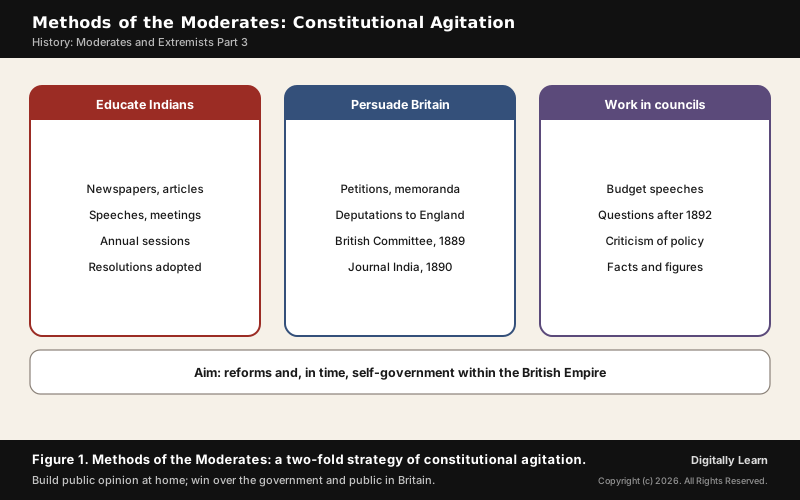
The Moderates, also called the Early Nationalists, were the leaders who guided the Indian National Congress from its founding in 1885 to about 1905. Educated professionals such as Dadabhai Naoroji, Pherozeshah Mehta, Surendranath Banerjee and Gopal Krishna Gokhale, they trusted the British sense of justice and sought reform through constitutional agitation: petitions, resolutions, speeches, the press and work in the legislative councils.
Who Were the Moderates: Early Nationalists of the Congress (1885 to 1905)
Moderates Meaning: The Early Nationalists and Their Leaders
The Congress in its first twenty years is often called "moderate" in its objectives and methods. Its leaders demanded a greater voice for Indians in government and administration, but asked for it gradually and within the framework of British rule. They are also called the Early Nationalists, because their work began the organised national movement in India.
- Dadabhai Naoroji: Businessman and publicist in London, member of the British Parliament from 1892, and author of Poverty and Un-British Rule in India.
- Pherozeshah Mehta: The Bombay leader, a fearless critic of government in the Legislative Council.
- Surendranath Banerjee: Founder of the Indian Association and editor of The Bengalee.
- Gopal Krishna Gokhale: Leader of the moderate faction, economist, and founder of the Servants of India Society in 1905.
- Others: W.C. Bonnerjee, Badruddin Tyabji, Romesh Chunder Dutt, S. Subramania Iyer and Dinshaw Wacha.
Most came from the educated middle class, lawyers, teachers, journalists and officials, many educated in England, and the early leadership was largely from Bombay and Calcutta. Their lives and work are covered in the Moderate leaders.
From Associations to the Congress: Where the Moderates Came From
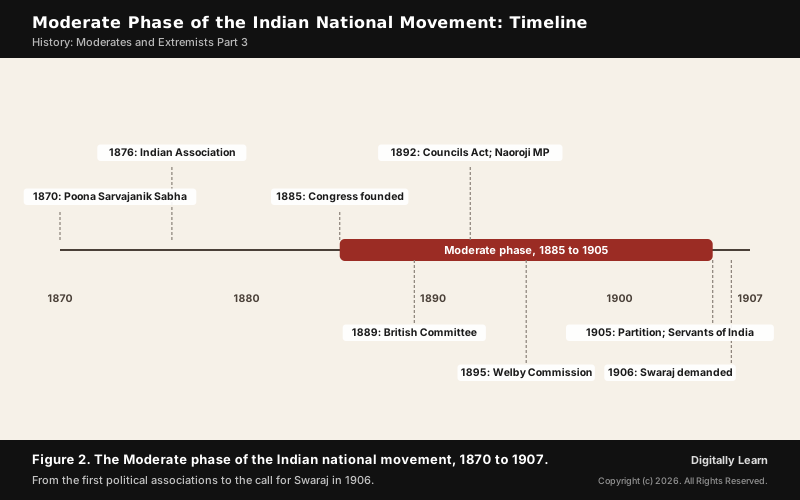
The Moderates did not begin with the Congress. From the 1870s educated Indians formed political associations in the presidency towns, and the anger over the Arms Act and the Vernacular Press Act of 1878 and the Ilbert Bill of 1883 deepened the wish for an all-India body.
- Poona Sarvajanik Sabha, 1870: In 1875 it petitioned the House of Commons for India’s direct representation in the British Parliament.
- Indian Association, 1876: Founded by Surendranath Banerjee and Ananda Mohan Bose; it demanded simultaneous civil service examinations in England and India.
- National Conference, 1883: Met in Calcutta under Banerjee and Bose and demanded representative assemblies; it merged with the Congress in 1886.
- Indian National Congress, 1885: 72 delegates met at Bombay in December 1885; A.O. Hume helped bring the regions together.
Ideology of the Moderates: Liberalism and Faith in British Justice
Liberalism, Faith in British Justice and Self-Government
The Moderates were liberals. Influenced by Western political ideas, they stressed individual dignity, the right to freedom and equality for all regardless of caste, creed or sex, and on that basis opposed British autocracy and demanded the rule of law, equality before the law and secular government. Gokhale admired John Stuart Mill and Edmund Burke, and Surendranath Banerjee, who studied Burke in England, was called the Indian Burke.
They had full faith in the British sense of justice and fair play, and many believed British rule had been a boon for India. They felt that the British respected the ideals of freedom and justice and would accept the just demands of Indians, so what was needed was to state those demands and make the government aware of Indian feeling. They also held that the British connection was in the interest of both countries.
- Gradual reform: They did not seek their goal at once, fearing the government would suppress them, and aimed to win freedom step by step, by patience and conciliation rather than confrontation.
- No taxation without representation: They demanded Indian control over the public purse.
- Swaraj within the Empire: By the beginning of the 20th century they demanded self-rule like the self-governing colonies of Canada and Australia; in 1906, as Congress President, Dadabhai Naoroji first gave voice to the demand for Swaraj from the Congress platform.
Economic Critique: Poverty, the Drain and the Budget
The Moderates' sharpest weapon was economic. The early Congress declared that British rule had led to poverty and famines: higher land revenue had impoverished peasants and zamindars, and grain exports to Europe had created food shortages. Naoroji's Poverty and Un-British Rule in India offered a scathing criticism of the economic impact of British rule.
- They demanded lower revenue, cuts in military spending and more funds for irrigation.
- They passed resolutions on the salt tax, the treatment of Indian labourers abroad, and the sufferings of forest dwellers under the forest administration.
- They hoped Indianisation of the services would also reduce the drain of wealth to England, since British officers sent much of their salaries home.
This shows that, though a body of the educated elite, the Congress did not speak only for professional groups, zamindars or industrialists. The drain theory in full is in the drain of wealth theory and moderate economic nationalism.
Methods of the Moderates: Constitutional Agitation and the 3 Ps
Constitutional Agitation Meaning: Prayer, Petition and Protest
The Moderates' method, constitutional agitation, meant orderly progress by constitutional means. The Moderates held annual sessions, processions and meetings, delivered speeches and debated economic, social and political questions; after these discussions they adopted resolutions, and they drafted petitions and memoranda for the government. The aim was to bring the authorities round to their view, step by step.
- Prayer: Appeals to the government’s sense of justice to grant reforms.
- Petition: Petitions, memoranda and resolutions placed before the authorities in India and Britain.
- Protest: Public meetings, speeches and the press, criticising policy within the law.
Two-Fold Strategy: Educating Indians and Persuading Britain
The Moderates followed a two-fold approach. First, they built public opinion in India, to create national consciousness and unity and to educate people on shared political issues. Second, they sought to influence both the British government and British public opinion in favour of reform.
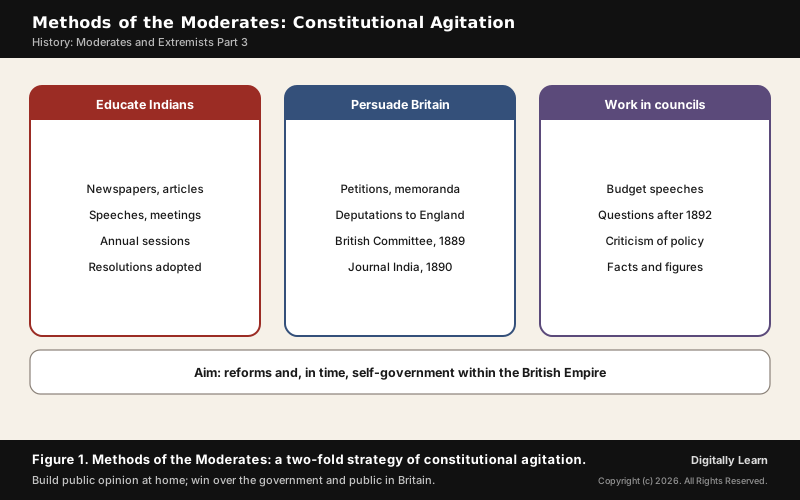
- In India: They published newspapers, wrote articles and showed how British rule was ruining the country; they criticised British rule in speeches and sent representatives to different parts of the country to mobilise opinion.
- In Britain: They sent deputations of leaders to England; a British Committee of the Congress was founded in 1889, with William Wedderburn in the chair from 1890, and it started a journal called India in 1890.
- In Parliament: Dadabhai Naoroji, the first Indian elected to the House of Commons in 1892, sat for Finsbury Central until 1895 and argued India’s case from within.
- British allies: A.O. Hume helped found the Congress; William Wedderburn presided over it in 1889 and 1910; and Gokhale arranged for the Irish nationalist Alfred Webb to preside in 1894.
Moderates in the Legislative Councils: The Indian Councils Act 1892
The Congress treated reform of the legislative councils as the root of all other reforms, and demanded it at every annual session. The Indian Councils Act 1892 was a partial answer: it enlarged the councils, let bodies such as universities, district boards, municipalities and chambers of commerce recommend members, and allowed members to discuss the annual budget and ask questions, though not to vote on it.
The Moderates used this narrow opening fully. Pherozeshah Mehta, known as the Lion of Bombay, was frank and vigorous in criticising government policy. Gokhale, whom some called the Leader of the Opposition, showed with facts and figures that budget surpluses hid deepening poverty caused by heavy army spending, heavy taxation and the neglect of irrigation.
Moderates and the British Government: Response and Civil Rights
Government Response: From Garden Parties to a Microscopic Minority
At first the government looked on the Moderates without hostility. A few officials attended the first session, and Lord Dufferin, the Viceroy, invited the delegates to a garden party in Calcutta in 1886; the Governor of Madras hosted another in 1887. Official attitudes soon changed.
- Dufferin suggested to Hume that the nationalists should turn to social rather than political affairs.
- In 1887 he ridiculed the Congress as representing only a microscopic minority of the Indian people.
- Officials called its leaders disloyal babus and violent villains.
- In 1890 government employees were forbidden to attend Congress meetings or take part in its deliberations.
The Moderates turned even official evidence to their use: the Dufferin Report of 1888 on the condition of the poor in Bengal became proof against the claim that British rule had helped the poorest. Hume's role gave rise to the 'safety valve' theory, that the Congress was founded to release unrest safely; that theory has since been refuted.
Defence of Civil Rights: Free Speech, the Press and Assembly
The Moderates defended civil rights whenever the government tried to curtail them, and this defence became part of the national movement from the start. Pherozeshah Mehta vehemently opposed Lord Lytton's move to censor the vernacular press, holding that the press should be as free as possible.
- 1883: Surendranath Banerjee was jailed for contempt of court over remarks in his paper, the first Indian journalist to be imprisoned; protests and hartals followed across Bengal and in cities from Lahore to Pune.
- 1897: When Tilak and other leaders were arrested and tried for their speeches, the Moderates demanded an end to preventive detention and the restoration of individual liberties.
- Always: They demanded freedom of speech and of the press, and the right to assemble and to form associations.
Moderates of the Indian National Congress: Main Demands
Constitutional, Administrative, Economic and Civil-Rights Demands
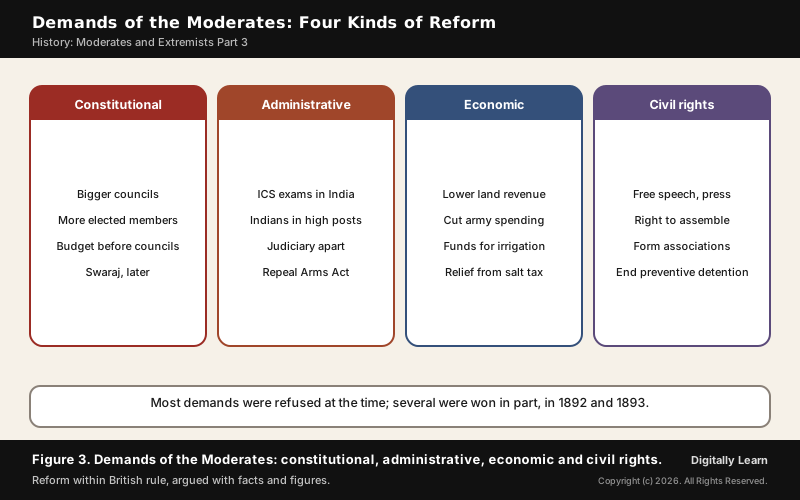
The Moderates' demands fall into four groups. Most were refused at the time, but together they set out the programme that later nationalists carried forward. How far they succeeded is weighed in the Moderates' demands, achievements and limitations.
| Kind | Main demands |
|---|---|
| Constitutional | Bigger councils with more elected members; the budget before the councils; later Swaraj |
| Administrative | ICS examinations in India too; Indians in high posts; judiciary separate from executive |
| Economic | Lower land revenue; less military spending; more irrigation; relief from the salt tax |
| Civil rights | Freedom of speech and press; right to assemble and form associations |
The call for Indianisation was also a stand against racism, since most important posts were held by white officials who assumed Indians could not hold responsibility. Some demands were met in part: the Councils Act of 1892, a House of Commons resolution of 1893 for simultaneous civil service examinations in London and India, and the Welby Commission on Indian expenditure in 1895.
Political Mendicancy: Criticism of the Moderates and Their Legacy
Political Mendicancy: Why Critics Called It the Politics of Prayers
By the 1890s many Indians questioned the Congress's political style. In Bengal, Maharashtra and Punjab, leaders such as Bepin Chandra Pal, Bal Gangadhar Tilak and Lala Lajpat Rai criticised the Moderates for their "politics of prayers" and stressed self-reliance and constructive work. People, they argued, must rely on their own strength, not on the good intentions of the government; Tilak's slogan was "Freedom is my birthright and I shall have it!"
- Narrow social base: Their influence stayed with urban educated Indians, lawyers, doctors, journalists and teachers; they did not draw the masses into the movement.
- Part-time politics: In 1887 Dinshaw Wacha complained to Naoroji that leaders were too busy with their own work and the pursuit of gold to advance the country.
- Misplaced faith: Some historians argue they misread the British government, believing its interests and the nationalists’ could be reconciled.
| Point | Moderates | Radical critics |
|---|---|---|
| Goal | Reform; later Swaraj within the Empire | Swaraj |
| Method | Petitions, resolutions, press, councils | Mass mobilisation, boycott |
| Relied on | British sense of justice | People's own strength |
| Support | Urban educated professionals | Wider mobilisation |
Why the Moderates Lost Ground and What They Built
The Moderates lost ground for three reasons. Their demands were mostly refused, and the government's attitude hardened from ridicule in 1887 to a ban on officials attending in 1890. Their methods seemed slow to a younger generation, and their goal of self-government within the Empire lacked conviction for many.
When Curzon partitioned Bengal in 1905, the Moderates and the radicals alike opposed it, but the Swadeshi movement that followed favoured mass action and boycott. The division came into the open at the Surat session of 1907, covered in the Surat Split; the rise of the new leaders is in the rise of extremism.
- National awakening: They made Indians conscious of shared political, economic and cultural interests.
- Political training: They popularised democracy, civil liberties, secularism and nationalism.
- Economic critique: They exposed the economic character of British rule and so weakened its foundations.
- A platform: Their programme established that India must be ruled in the interest of Indians, the base later nationalists built on.
Previous Year UPSC-CSE Questions
Previous Year UPSC-CSE Questions By the end you will be able to draft model answers for the following UPSC questions. Each question carries a collapsible framework showing how to approach it in the exam.
- UPSC Mains 2017 GS-IWhy did the ‘Moderates’ failed to carry conviction with the nation about their proclaimed ideology and political goals by the end of the nineteenth century?
How to structure the answer in the exam
Introduction: Introduce the Moderates as the Early Nationalists who led the Congress from 1885, seeking reform within British rule by constitutional means.
Body (sub-themes to develop):
- Narrow social base: urban educated professionals; the masses not drawn in.
- Methods: petitions and resolutions seen as the 'politics of prayers'.
- Faith in British justice while demands were refused.
- Hardening government: Dufferin's 'microscopic minority', ban on officials attending.
- Goal of self-government within the Empire lacked conviction for the young.
Conclusion: Conclude that the Moderates lost the initiative, though the awareness they built was used by those who came after.
- UPSC Mains 2021 GS-ITo what extent did the role of the moderates prepare a base for the wider freedom movement? Comment.
How to structure the answer in the exam
Introduction: Place the Moderate phase, 1885 to about 1905, as the start of the organised national movement.
Body (sub-themes to develop):
- National awakening and shared interests across regions.
- Political training: democracy, civil liberties, secularism, nationalism.
- Economic critique: poverty, the drain, the budget; the idea of rule in Indians' interest.
- An all-India platform: annual sessions, the press, the councils after 1892.
- Limits: narrow base and slow methods, which later movements overcame.
Conclusion: Conclude that the later mass movements stood on foundations the Moderates had laid.
- UPSC Prelims 1999 Prelims-GSThe Congress policy of pray and petition ultimately came to an end under the guidance of
How to approach this Prelims question
Approach: Link the end of pray-and-petition politics to the radical leaders of the 1890s and 1900s.
Trap to watch: Gandhi changed the movement later; the break with petition politics came with Tilak.
Key facts to recall:
- 'Politics of prayers' critique
- Tilak: Freedom is my birthright
Answer signal: Bal Gangadhar Tilak, option (b).
- UPSC Prelims 2000 Prelims-GSConsider the following statements:
- Assertion (A): The basic weakness of the early nationalist movement lay in its narrow social base.
- Reason (R): It fought for the narrow interests of the social groups which joined it.
Which one of the following is correct in respect of the above statements?
How to approach this Prelims question
Approach: Test each statement separately.
Trap to watch: A narrow base does not mean narrow interests: the Congress raised peasants', labourers' and forest dwellers' grievances.
Key facts to recall:
- Base: urban educated professionals
- Resolutions on revenue, salt tax, labourers
Answer signal: A true, R false, option (c).
- UPSC Prelims 2002 Prelims-GSWhich one of the following submitted in 1875 a petition to the House of Commons demanding India’s direct representation in the British Parliament?
How to approach this Prelims question
Approach: Recall the pre-Congress associations and their dates.
Trap to watch: The Indian Association (1876) came a year after the petition.
Key facts to recall:
- Poona Sarvajanik Sabha, 1870
- Petition to the House of Commons, 1875
Answer signal: The Poona Sarvajanik Sabha, option (d).
Sources
- NCERT: Our Pasts III (Class VIII), The Making of the National Movement: 1870s to 1947
- PIB: Dadabhai Naoroji, the man who brought statistics into politics (2017)
- PIB: The evolution of the Indian legislature (feature)
- PIB: Unsung Heroes of the Freedom Movement from Maharashtra
- Parliament of India Digital Library: The Indian Councils Act 1892
- Wikipedia: Early Nationalists
- Wikipedia: Indian National Congress
- Wikipedia: Dadabhai Naoroji
- Wikipedia: Gopal Krishna Gokhale
- Wikipedia: Pherozeshah Mehta
- Wikipedia: Surendranath Banerjee
- Wikipedia: Indian Association
- Wikipedia: Poona Sarvajanik Sabha
- Wikipedia: Indian Councils Act 1892
- Wikipedia: William Wedderburn
- Wikipedia: Bal Gangadhar Tilak
- UPSC: Civil Services Examination question papers
Editorial Disclaimer
This article draws on the NCERT history textbooks and the other sources listed on this page. The labels 'Moderates' and 'Extremists' are later conveniences, not names the leaders chose.