


Overview
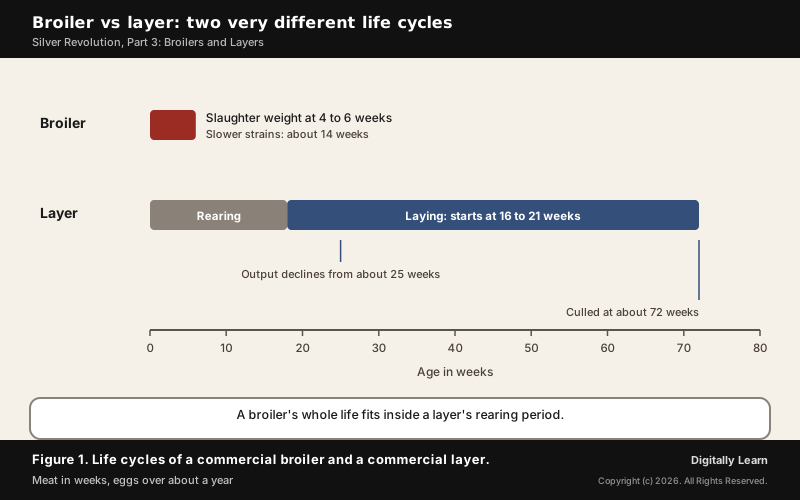
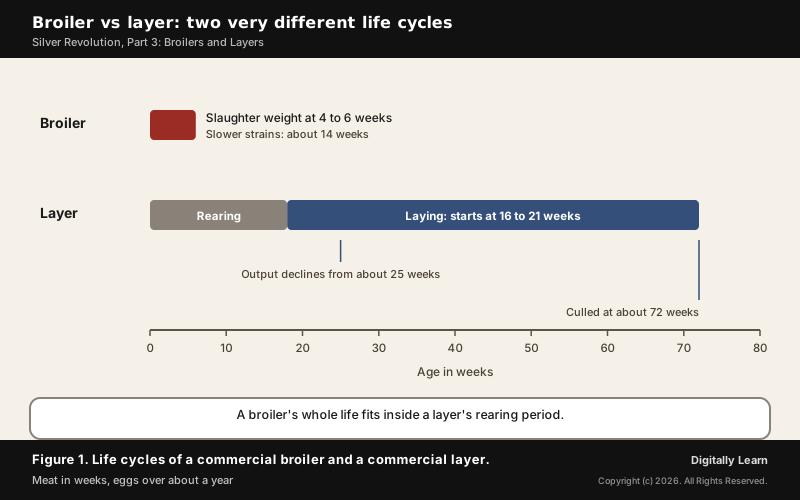
The difference between broiler and layer chickens is one of purpose: broilers are bred and raised for meat and reach slaughter weight in four to six weeks, while layers are bred for eggs, begin laying at 16 to 21 weeks and are kept for about a year of laying. The two birds need different feed, housing and management, and together they produce India's 149.11 billion eggs and 5.18 million tonnes of poultry meat.
Difference Between Broiler and Layer Chickens
Broiler vs Layer: Meaning, Purpose and Breeding
Poultry farming raises domestic fowl for two products, eggs and chicken meat. To get more of each, improved breeds are developed and farmed separately: layers for eggs and broilers for meat. A broiler is any chicken bred and raised specifically for meat; both male and female broilers are reared.
| Feature | Broiler | Layer |
|---|---|---|
| Purpose | Meat | Eggs |
| Age at output | Slaughter weight at 4 to 6 weeks; slower strains about 14 weeks | Begins laying at 16 to 21 weeks |
| Productive life | Sold for meat at a few weeks old | About 12 months of laying; flocks culled at about 72 weeks |
| Feed | Protein-rich ration with adequate fat, vitamin-rich supplements | Breeding aims at smaller layers that can use more fibrous, cheaper diets |
| Housing | Mixed-sex flocks in large sheds on litter | Often in cages; light controlled to keep hens laying |
| Efficiency | Feed conversion ratio about 1.6 in the US (2011) | About 2, with each hen laying about 330 eggs a year (US, 2011) |
Layer Farming: How Egg Production Works
Commercial hens usually begin laying at 16 to 21 weeks of age. Output declines gradually from about 25 weeks, and in many countries flocks are considered economically unviable by about 72 weeks and are slaughtered after roughly 12 months of laying, although chickens can naturally live six years or more.
- Light control: The light phase is lengthened to prompt laying at 16 to 20 weeks, then kept like summer day length so that hens lay all year rather than only in warm months.
- Yield: Some commercial breeds lay over 300 eggs a year.
- Battery cages: They make care easier, keep eggs cleaner, need less feed per dozen eggs and less labour, and remove broodiness and internal parasites; but manure handling, flies and investment are problems.
- India’s rule: In 2013 the Animal Welfare Board of India held battery cages to violate Section 11(1)(e) of the Prevention of Cruelty to Animals Act, 1960, and advised States to phase them out by 2017; the Punjab and Haryana High Court confirmed this in 2014.
Broiler Farming: How Chicken Meat Is Produced
Modern commercial broilers are bred to reach a slaughter weight of about 2 kg in five to seven weeks. They grow very fast, convert feed efficiently and are not very active, so their behaviour and physiology are those of immature birds rather than adults.
- Housing: Broilers are usually grown as mixed-sex flocks in large sheds under intensive conditions; a traditional growout house holds about 20,000 birds on bedding such as wood chips or rice hulls.
- Feed and care: The broiler ration is protein rich with adequate fat, and vitamins A and K are kept high in poultry feed; care is taken to avoid mortality and keep feathering and carcass quality.
- Welfare concerns: Rapid growth makes broilers prone to skeletal problems, skin and eye lesions and heart conditions.
- Breeding: Selection for large breast muscles interferes with natural mating, so artificial insemination is used; slower-growing free-range strains reach slaughter weight at 12 to 16 weeks.
Egg Production in India and Chicken Meat Production
Egg and Chicken Production in India: Output, Yields and the Meat Share
India produced 149.11 billion eggs in 2024-25, 4.44 per cent more than the year before, and ranks 2nd in the world. Commercial farms produced 125.98 billion (84.49 per cent) and backyard poultry 23.13 billion (15.51 per cent). The State pattern is covered in Part 2 on the highest egg producing states.
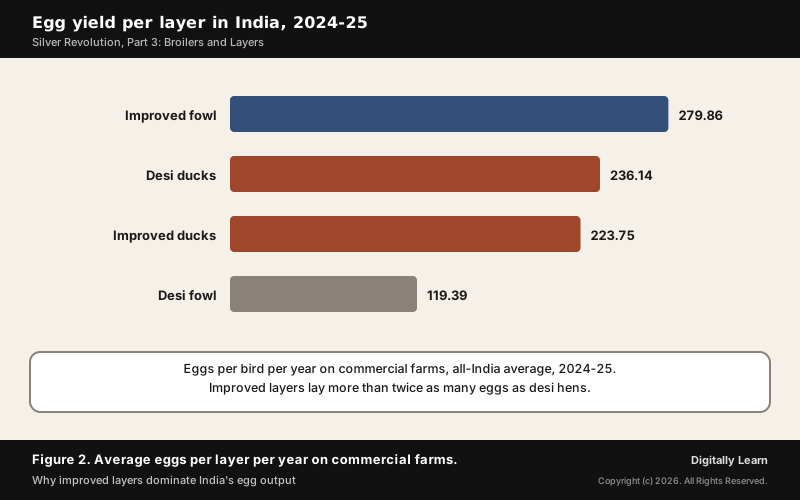
- Yield gap: On commercial farms an improved hen averaged 279.86 eggs a year in 2024-25, a desi hen 119.39.
- Species: Improved fowl produced 86.35 per cent of India’s eggs, desi fowl 12.59 per cent, desi ducks 0.85 per cent and improved ducks 0.22 per cent.
- Per person: Availability rose from 79 eggs a year in 2018-19 to 106 in 2024-25.
Poultry is now India's largest source of meat. Of the 10.50 million tonnes of meat produced in 2024-25, poultry contributed 5.18 million tonnes, or 49.27 per cent, and poultry meat grew 3.10 per cent over the previous year.
- Other meats: Buffalo contributed about 18.42 per cent, goat 15.06, sheep 11.29, pig 3.65 and cattle 2.30 per cent.
- Growth of meat: Total meat production rose from 8,114.45 thousand tonnes in 2018-19 to 10,504.54 thousand tonnes in 2024-25.
- Per person: Meat availability rose from 6.15 kg a year in 2018-19 to 7.50 kg in 2024-25.
- World rank: India is 4th in the world in meat production, according to the FAO.
- Birds: Poultry is the largest share of India’s livestock, 61 per cent in 2019.
Poultry Breeds and the Environment
Indigenous and Improved Poultry Breeds: Aseel, Kadaknath and Leghorn
India's commercial layers and broilers are improved breeds, but indigenous breeds remain important in rural poultry. Cross-breeding between Indian breeds such as Aseel and exotic breeds such as Leghorn aims at particular traits:
- Number and quality of chicks.
- A dwarf broiler parent for commercial chick production.
- Summer adaptation, that is, tolerance to high temperature.
- Low maintenance requirements.
- A smaller egg-laying bird that can use more fibrous, cheaper diets made from agricultural by-products.
- Aseel: An Indian game breed found particularly in Andhra Pradesh, Chhattisgarh and Odisha; the word means purebred.
- Kadaknath: A black-fleshed breed from Dhar and Jhabua in Madhya Pradesh, reared mostly by rural and tribal people; its meat received a GI tag on 30 July 2018.
- Rural varieties: Low input birds such as Vanaraja and Gramapriya are promoted for free-range rearing under the National Livestock Mission.
Worldwide, 74 per cent of poultry meat and 68 per cent of eggs are produced intensively. The main alternative is free-range farming at lower stocking densities, which is where the slower-growing strains and low input rural birds fit. Intensive producers routinely use approved medicines, such as antibiotics, in feed or drinking water to treat disease or to prevent outbreaks.
Poultry Litter, Ammonia and Reactive Nitrogen
Intensive poultry has an environmental cost. In the poultry house, uric acid and organic nitrogen in droppings and spilled feed are converted by microbes in the litter into ammonium, and wet litter produces more ammonia, along with odour and flies.
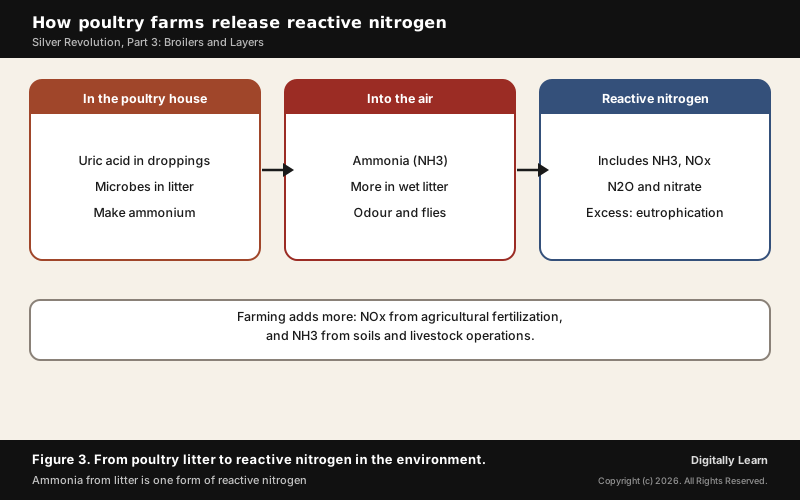
- Reactive nitrogen: All forms of nitrogen except molecular nitrogen (N2), including nitrogen oxides, ammonia, nitrous oxide and nitrate.
- Farm sources: NOx comes from agricultural fertilization, and ammonia is emitted from soils and from livestock operations, so poultry and cattle farms both release it.
- Why it matters: Just over half of the reactive nitrogen entering the biosphere comes from human activity, and an excess can cause problems such as eutrophication.
- Farm practice: Caked, wet litter is removed to cut ammonia, and manure conveyors address the manure and fly problems of cage houses.
Previous Year UPSC-CSE Questions
Previous Year UPSC-CSE Questions By the end you will be able to draft model answers for the following UPSC questions. Each question carries a collapsible framework showing how to approach it in the exam.
- UPSC Prelims 2019 Prelims-GSConsider the following statements :
- Agricultural soils release nitrogen oxides into environment.
- Cattle release ammonia into environment.
- Poultry industry releases reactive nitrogen compounds into environment.
Which of the statements given above is/are correct?
How to approach this Prelims question
Approach: Match each farm source with the form of reactive nitrogen it releases.
Trap to watch: All three are correct; reactive nitrogen includes both NOx and ammonia.
Key facts to recall:
- Reactive nitrogen: all nitrogen except N2
- Poultry litter: uric acid to ammonium to ammonia
- Livestock operations and soils emit NH3; fertilization gives NOx
Answer signal: 1, 2 and 3: option (d).
Sources and Further Reading
- Department of Animal Husbandry and Dairying: Basic Animal Husbandry Statistics 2025
- PIB: Release of Basic Animal Husbandry Statistics 2025 (26 November 2025)
- Department of Animal Husbandry and Dairying: National Livestock Mission operational guidelines (January 2025)
- NCERT: Indian Economic Development (Class XI), Chapter 5, Rural Development
- PIB: Livestock Census, empowering farmers and driving rural prosperity (28 October 2024)
- Wikipedia: Broiler
- Wikipedia: Poultry farming
- Wikipedia: Battery cage
- Wikipedia: Feed conversion ratio
- Wikipedia: Poultry litter
- Wikipedia: Reactive nitrogen
- Wikipedia: Human impact on the nitrogen cycle
- Wikipedia: Kadaknath
- Wikipedia: Aseel (chicken)
- UPSC: Previous year question papers
Editorial Disclaimer
This article explains broilers and layers from the NCERT Science textbook, the Department of Animal Husbandry and Dairying's statistics and the other sources listed below.