


Overview
Poultry farming in India is the raising of domestic fowl, mainly chickens and some ducks, for eggs and meat. It ranges from backyard flocks kept by village households to commercial farms of more than 1,000 birds, and it is supported by the National Livestock Mission, the Animal Husbandry Infrastructure Development Fund and farm credit.
What Is Poultry Farming? Meaning and Scale in India
What Is Poultry Farming: Layers, Broilers and Better Breeds
Poultry farming is undertaken to raise domestic fowl for egg production and chicken meat. Birds bred for eggs are called layers and birds bred for meat are called broilers, and the two are fed and housed differently: a broiler's ration is rich in protein with adequate fat, and the levels of vitamins A and K are kept high in poultry feed. Broilers reach slaughter weight at four to six weeks of age.
Better birds come from cross-breeding. Indian breeds such as the Aseel are crossed with foreign breeds such as the Leghorn to develop new varieties with the traits a farmer wants:
- More and better-quality chicks.
- A dwarf broiler parent for commercial chick production.
- Tolerance of high summer temperatures.
- Low maintenance needs.
- A smaller laying bird that can live on cheaper, more fibrous feed made from farm by-products.
How the industry grew is told in the meaning and history of India's poultry growth; the difference between the two kinds of bird is explained in broiler and layer farming.
Types of Poultry Farming in India
Types of Poultry Farming by Purpose, Breed and Species
The types of poultry farming can be sorted in three ways, and each one tells the farmer something different: what the birds are kept for, which breed is kept, and which species.
| Basis | Types | Example in India |
|---|---|---|
| Purpose | Layers for eggs; broilers for meat; dual-purpose birds for both | Commercial layer farms; broiler contract farms |
| Breed | Indigenous, exotic and improved crosses | Aseel and Kadaknath; the Leghorn; low-input birds such as Vanaraja |
| Species | Fowl (chickens) and ducks | Fowl lay 98.94 per cent of eggs; ducks 1.07 per cent |
A dual-purpose chicken is one used for both eggs and meat. Many older breeds were of this kind; the sharp split between laying and meat birds came with industrial breeding. Among Indian breeds, the Aseel is a game chicken found especially in Andhra Pradesh, Chhattisgarh and Odisha, and the Kadaknath, a black-fleshed bird of Dhar and Jhabua in Madhya Pradesh, is bred mostly by rural and tribal households and got a geographical indication tag in 2018. The White Leghorn is used as a layer in many countries.
By species, fowl dominate: improved fowl lay 86.35 per cent of India's eggs and desi fowl 12.59 per cent, while desi and improved ducks together lay just over 1 per cent. Duck rearing matters locally, especially where ponds and water bodies are at hand.
Backyard Poultry Farming and Commercial Poultry Farming
The most important distinction in India is scale. A farm with more than 1,000 birds is counted as commercial poultry; the small flock a rural household keeps around the house is backyard poultry. The two systems serve different ends: the first is a business, the second is extra income and food for families with little land.
- Birds: The 2019 census counted 534.74 million commercial birds, up from 511.72 million in 2012, and 317.07 million backyard birds, up from 217.49 million.
- Growth since 2012: Commercial poultry grew 4.50 per cent; backyard poultry grew 45.78 per cent.
- Eggs in 2024-25: Commercial farms laid 84.49 per cent and backyard flocks 15.51 per cent.
- Birds kept: Commercial farms keep improved layers and broilers; backyard flocks need hardy low-input birds that can live on free range.
Backyard poultry farming suits households that cannot enter commercial farming. Low-input birds, bred by public institutions such as the Central Avian Research Institute, the ICAR Directorate of Poultry Research and the Central Poultry Development Organisations, survive on free range with little bought feed. Their names are worth knowing: Vanaraja, Gramapriya, CARI Gold, Kalinga Brown, Kaveri, Chabro and Giriraja. Why backyard poultry matters for women and the landless is explained in the importance of poultry farming.
Poultry Farming Systems and Poultry House Types
Free-Range, Semi-Intensive and Intensive Poultry Farming Systems
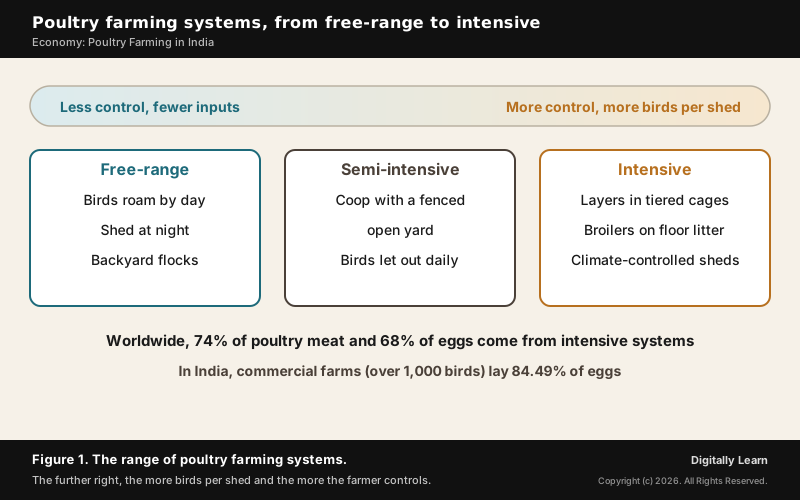
Poultry farming systems differ in how much freedom the birds have and how much the farmer controls. Worldwide, 74 per cent of poultry meat and 68 per cent of eggs are produced intensively, and the main alternative is free-range farming at lower stocking densities.
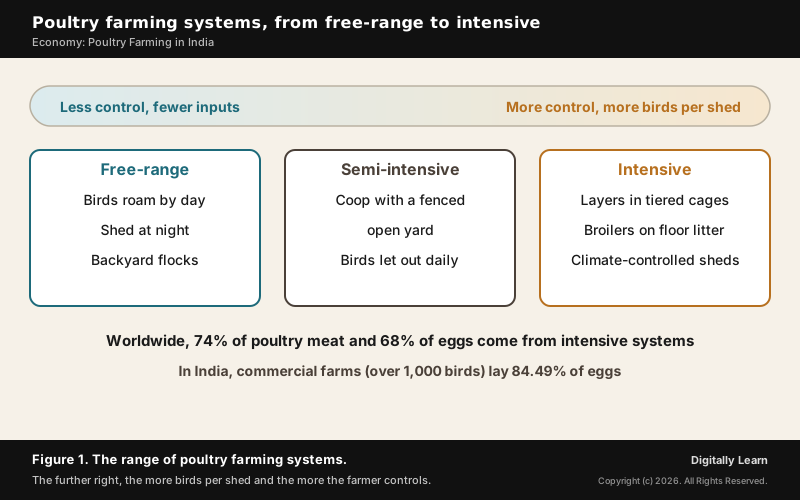
- Free-range: Birds roam freely for part of the day and are shut in a shed at night against predators. They can peck, scratch and forage, but the farmer has less control over what they eat, which makes output less reliable.
- Semi-intensive, or yarding: A hutch or coop is combined with a fenced yard, and the birds are released into it daily. Indian integrated farms keep poultry either backyard or semi-intensive.
- Intensive: Layers are kept in cages and broilers on floor litter, in sheds where more birds fit into each unit of space, which raises productivity and lowers food costs.
Each system trades one risk for another. Free-range birds can behave more naturally but are more exposed to predators and disease, and in South-East Asia poor disease control in free-range farming has been linked to bird flu outbreaks. Intensive sheds give the farmer more control over feed and output, but they concentrate manure and ammonia, a problem taken up in poultry manure and sustainable poultry farming.
Poultry House Types: Battery Cages, Furnished Cages and Litter Houses
- Battery cage: A small metal cage holding 3 to 8 hens, arranged in long rows of several tiers, often back to back. Eggs are cleaner, less feed is needed per egg and more hens fit into a house.
- Furnished cage: A larger ‘enriched’ cage with a nest, litter for scratching and perches, so the hens can behave more naturally while keeping most of the cage’s economic advantages.
- Litter house for broilers: Broilers are not raised in cages. They are floor-raised on litter such as wood shavings, peanut shells or rice hulls, in large climate-controlled grow-out houses with mechanical feeding and ventilation.
Battery cages are criticised because they give a hen too little space to stand, walk, flap her wings, perch or nest. The European Union banned the conventional battery cage from January 2012, which is why the furnished cage was developed. In broiler houses the main hazard is air: droppings release ammonia, and without enough fans it damages the birds' eyes and lungs.
Integrated Farming System: Poultry with Crops, Fish and Dairy
How Poultry Fits into an Integrated Farming System
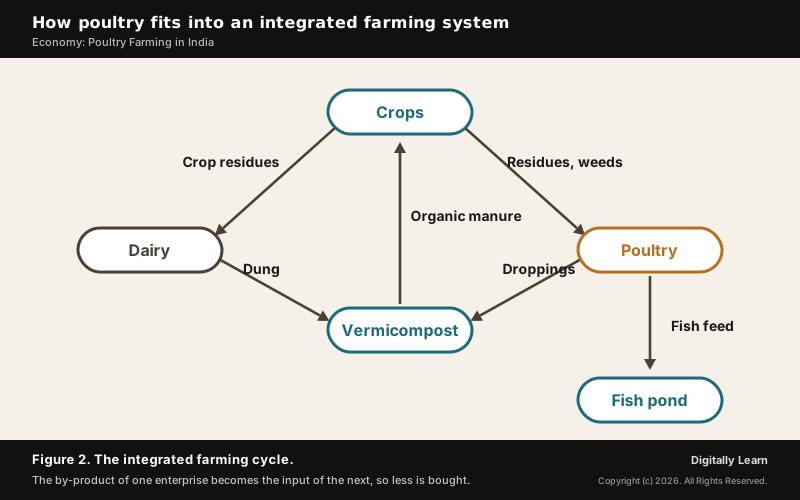
An integrated farming system (IFS) combines several enterprises, such as crops, dairy, poultry, fisheries and horticulture, on one farm, so that the by-product of one becomes an input for another. India has nearly one-fourth of the world's small and marginal holdings, and for such farms the land cannot grow; the answer is to get more from the same land by diversifying.
- Quick returns: Poultry, backyard or semi-intensive, gives eggs and meat for the household and the market and supplements earnings quickly.
- Recycling: Birds eat crop residues, weeds and kitchen waste, which cuts feed costs, and their droppings return nutrients as manure and vermicompost.
- Fish ponds: Fish in a farm pond can be fed with poultry droppings, a cheap addition to the system.
- Ducks: Duck rearing can be added where water bodies exist, alongside fish.
The gains are measurable. In one study of marginal farms, cropping alone gave 416 days of work a year, a crop-fish-poultry system 612 and a crop-fish-duck-goat system 752. A one-hectare model at Bihar Agricultural University with crops, orchard, dairy, goats, fish and ducks earned Rs 3,14,000 a year, five times the income of rice-wheat or rice-maize farming. Because income comes from several sources, IFS also cuts the risk from crop failure, price swings and bad weather.
Poultry Farming Government Schemes in India
National Livestock Mission: Rural Poultry Entrepreneurship
The main poultry farming government scheme is the National Livestock Mission (NLM), run by the Department of Animal Husbandry and Dairying since 2014-15 and revised from 2021-22. It has three sub-missions: breed development of livestock and poultry, feed and fodder development, and innovation and extension. For poultry, its aim is to bring unorganised rural poultry into the organised sector through entrepreneurs.
- Who can apply: Individuals, self-help groups, farmer producer organisations, farmers’ cooperatives, joint liability groups and Section 8 companies.
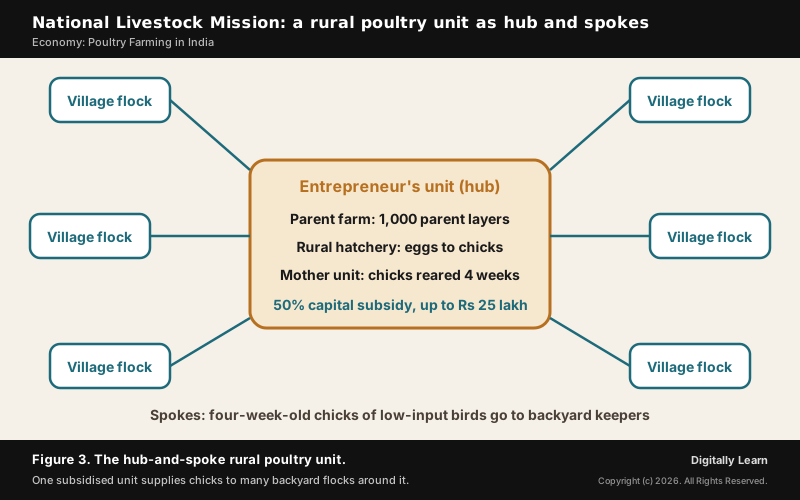
- What they build: A parent farm of at least 1,000 parent layers of low-input birds, a rural hatchery, and a brooder-cum-mother unit that rears chicks for four weeks before they go to village households.
- The subsidy: A one-time 50 per cent capital subsidy, up to Rs 25 lakh a unit, paid through SIDBI to the lending bank in two halves: after 25 per cent of the cost is spent, and after completion.
- What it excludes: No subsidy for working capital, a personal vehicle, or buying or renting land.
Preference goes to entrepreneurs who build forward and backward links, the hub-and-spoke model in which one unit supplies chicks to many backyard keepers. The guideline's model unit shows the scale: 1,100 parent birds to give 500 hatching eggs a day, a hatchery of 3,000 eggs a week giving 2,250 day-old chicks, and a mother unit brooding 2,000 chicks up to four weeks.
Animal Husbandry Infrastructure Development Fund and Farm Credit
Larger investments in the livestock value chain, such as feed plants and meat processing, are financed under the Animal Husbandry Infrastructure Development Fund (AHIDF), a Rs 15,000 crore fund approved by the Cabinet on 24 June 2020 under the AtmaNirbhar Bharat package. Scheduled banks lend up to 90 per cent of the project cost, the Department pays 3 per cent interest subvention, and a Rs 750 crore credit guarantee for small enterprises is managed by NABARD.
- Eligible activities: Dairy processing, meat processing and value addition, animal feed plants, and breed improvement and breed multiplication farms.
- For poultry: One of its aims is quality concentrated feed at affordable prices for cattle, buffalo, sheep, goat, pig and poultry.
- Eligible borrowers: Farmer producer organisations, private companies, individuals and entrepreneurs, Section 8 companies and micro, small and medium enterprises.
For a small farmer, the everyday source of working capital is the Kisan Credit Card (KCC), which since 2019 also covers animal husbandry. Under the Reserve Bank of India's directions of 2026, rearing poultry birds is named among the allied activities it finances. Its short-term limit covers post-harvest expenses, the household's consumption needs and the maintenance of farm assets, while equipment and the construction of a bird shed come under long-term investment credit. Why credit still reaches small and women farmers unevenly is explained in the problems of poultry farming in India.
Previous Year UPSC-CSE Questions
Previous Year UPSC-CSE Questions By the end you will be able to draft model answers for the following UPSC questions. Each question carries a collapsible framework showing how to approach it in the exam.
- UPSC Mains 2022 GS-IIIWhat is Integrated Farming System? How is it helpful to small and marginal farmers in India?
Answer outline: how to structure the answer
What the question asks, the main arguments, relevant examples and the direction of the conclusion. This is not a full model answer.
Introduction: An integrated farming system combines crops, dairy, poultry, fisheries and horticulture on one farm so that one enterprise's by-product is another's input.
Body (sub-themes to develop):
- Why small farmers: India has nearly one-fourth of the world's small and marginal holdings; land cannot grow, so output per unit must.
- Recycling: crop residues and weeds feed poultry and dairy; poultry droppings feed fish and vermicompost; manure returns to crops.
- Income and work: crop alone 416 days of work against 612 to 752 in integrated systems; a one-hectare model five times rice-wheat income.
- Risk: several income sources cushion crop failure, price swings and bad weather.
- Constraints: investment, management skill and market links.
Conclusion: Conclude that IFS turns a small holding into several small businesses, with poultry as the quick-return part, and needs credit and extension to spread.
- UPSC Prelims 2020 Prelims-GSUnder the Kisan Credit Card scheme, short-term credit support is given to farmers for which of the following purposes?
- 1. Working capital for maintenance of farm assets
- 2. Purchase of combine harvesters, tractors and mini trucks
- 3. Consumption requirements of farm households
- 4. Post-harvest expenses
- 5. Construction of family house and setting up of village cold storage facility
Select the correct answer using the code given below:
How to approach this Prelims question
Approach: Step 1: The KCC's short-term limit covers post-harvest expenses, household consumption and the maintenance of farm assets, so 1, 3 and 4 qualify. Step 2: machinery such as tractors and harvesters is long-term investment credit, so 2 does not. Step 3: a family house and village cold storage are not short-term KCC purposes, so 5 does not. Answer (b).
Trap to watch: Some of these items can be financed under a KCC as investment credit; the question asks only about short-term credit support.
Key facts to recall:
- (a) 1, 2 and 5 only: wrong. Machinery (2) is investment credit and a house and cold storage (5) are not short-term purposes.
- (b) 1, 3 and 4 only: right. Farm-asset maintenance, household consumption and post-harvest expenses are short-term purposes.
- (c) 2, 3, 4 and 5 only: wrong. It includes 2 and 5 and leaves out 1.
- (d) 1, 2, 3, 4 and 5: wrong. Statements 2 and 5 are not short-term purposes.
Answer signal: Option (b): the short-term KCC limit covers farm-asset maintenance, consumption and post-harvest expenses.
- UPSC Mains 2019 GS-IIIHow far is Integrated Farming System (IFS) helpful in sustaining agricultural production?
Answer outline: how to structure the answer
What the question asks, the main arguments, relevant examples and the direction of the conclusion. This is not a full model answer.
Introduction: IFS integrates several enterprises so that by-products are recycled within the farm.
Body (sub-themes to develop):
- Sustains production: internal nutrient recycling (manure, droppings, vermicompost), year-round output, less bought input.
- Resilience: diverse income cuts the risk of crop failure, price swings and weather.
- Limits: needs investment, management skill and market links; not every enterprise suits every farm.
Conclusion: Conclude that IFS sustains production best on small farms where recycling replaces purchased inputs, provided credit and extension support it.
Sources
- NCERT: Science, Class IX, Chapter 15, Improvement in Food Resources (poultry farming)
- Department of Animal Husbandry and Dairying: Basic Animal Husbandry Statistics 2025
- Department of Animal Husbandry and Dairying: 20th Livestock Census 2019, key results
- Department of Animal Husbandry and Dairying: National Livestock Mission guidelines
- Department of Animal Husbandry and Dairying: Administrative approval of AHIDF, 2021-22
- ICAR, Indian Farming (December 2025): Integrated farming systems for enhancing productivity and livelihood of small farmers
- ICAR, Indian Farming (February 2025): Integrated farming system for marginal landholders
- Wikipedia: Poultry farming
- Wikipedia: Broiler
- Wikipedia: Aseel
- Wikipedia: Kadaknath
- Wikipedia: Leghorn chicken
- Wikipedia: Kisan Credit Card
- Reserve Bank of India: Kisan Credit Card (KCC) Scheme Directions, 2026
- The Hindu (Delhi), 1 October 2026: Financing the agricultural value chain
- UPSC: Civil Services Examination question papers
Editorial Disclaimer
This article draws on official documents and the other sources listed on this page.